
5 of the Best Artworks to See at the ADAA Art Fair, From a Supernatural Alice Neel Painting to Zanele Muholi’s Latest Portrait Series
The opening night gala of the Art Dealers Association of
America’s (ADAA) art fair attracted the usual crowds of well-heeled
Manhattanite connoisseurs and international tastemakers alike.
Whereas the floors of the 67th Regiment Armory on Park Avenue
are typically covered in gray carpet for the crowds of art lovers,
this year’s edition featured the building’s newly renovated
hardwood floors, lending a sleeker and more modern vibe to the
storied show.
If the fair lacked some of the celebrities and typical boldface
names that characterized past editions, this time around, there was
no shortage of high-profile museum curators, collectors, and
artists whose own work graced the surrounding booths. We spotted
Nina Chanel Abney, KAWS, Kalup Linzy, Adam Pendleton, and Donald
Moffett, to name a few.
Could all of this have translated into a more serious audience
in our Instagram-obsessed society?
“Look around… no one is taking selfies,” P.P.O.W. co-founder
Wendy Olsoff told Artnet News, noting the engaged, interested crowd
of onlookers. Perhaps shockingly, her assessment was true, even
considering the crowds descending on the gallery’s booth for a solo
show of work by California artist Ramiro Gomez, who was in
attendance (and in demand) at the booth.
Early sales reports, delivered just hours into the opening,
indicated a strong response to the works on offer, including Pace
Gallery reporting a sellout of their solo booth of text paintings
by Adam Pendleton.
Here are a few more works you don’t want to miss.
Ziphi
Emhlabeni (2019)
Zanele Muholi

Zanele Muholi, Ziphi Emhlabeni
(2019). Photo by Eileen Kinsella
Booth: Yancey Richardson Gallery, New
York
What It Costs: $14,500 (each, in an
edition of eight)
Why It’s Special: For the past
several years, South African artist and photographer Zanele Muholi
has been creating self-portraits in various locations throughout
the world as a means of addressing issues of race, gender, personal
history, and African political history.
Recent portraits on show here, including works
made in formerly colonized countries such as Namibia, Botswana, and
Zimbabwe, continue her efforts in that series. While bearing
witness to the history of European imperialism in Africa, Muholi
marks their presence in these locations, reclaiming their
space.
—Eileen Kinsella
Installer
4 (2020)
Ramiro Gomez
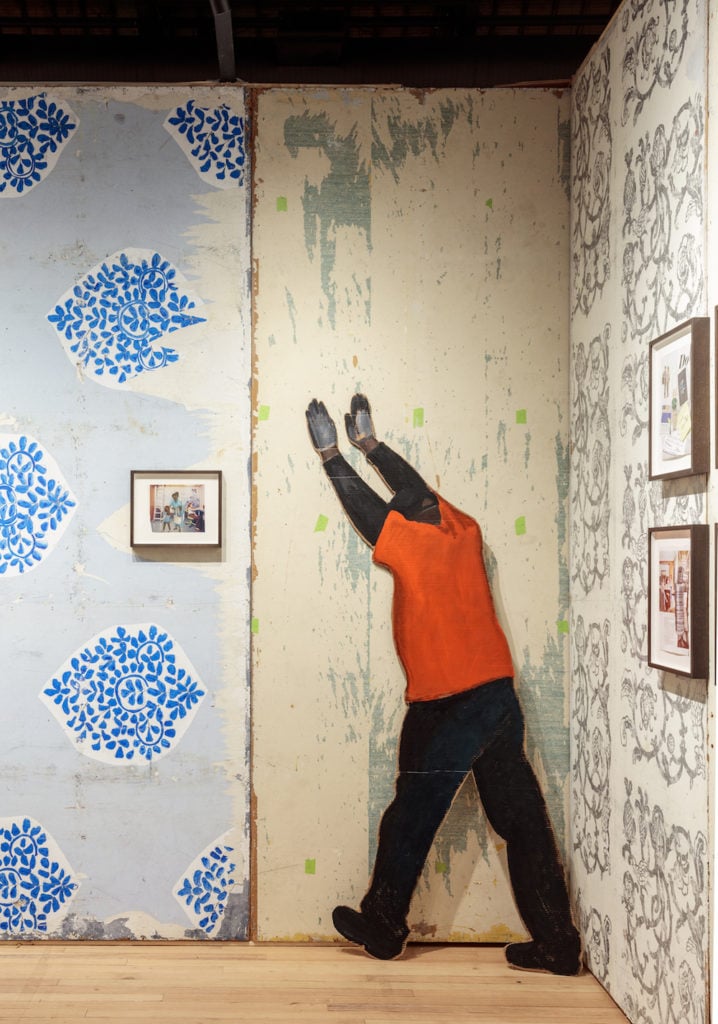
Installation view of Ramiro Gomez
Installer 4(2020) at P.P.O.W. at the ADAA Art Show. Image
courtesy of the artist and P.P.O.W Gallery.
Booth: P.P.O.W. Gallery, New York
What It Costs: $6,500 to $25,000
Why It’s Special: Gomez,
who was born in San Bernardino to undocumented Mexican
immigrants, focuses on the invisible labor forces
devoted to maintaining those distinctive looking pools, gardens,
and mansions in Southern California. Artnet News has been following
his signature works for the past few years at fairs and gallery
shows (including at P.P.O.W. and the gallery of Los Angeles dealer
Charlie James) in which he’s been showing serene Hockney-esque
images where workers who maintain lavish properties are
not-so-subtly acknowledged. A bonus? Gomez himself was on hand in
the booth last night to greet eager viewers and fans (including
us). We asked what’s different about tonight’s presentation, which
included more immersive pieces, as well imagery imposed on high-end
architectural and home decor magazines.
“I love to keep expanding and not give the
expected,” the artist said. The same magazines that were prevalent
in the homes where he was employed (Town and Country and
Architectural Digest, to name two) are the
ones that have now featured him—an irony not lost on him. After
briefly attending the California Institute for the Arts, he worked
as a live-in nanny in West Hollywood. These works take on
additional layers of “representations of internal fantasies,
dreams, and expressions of the self,” according to the
gallery.
—Eileen Kinsella
Lot 0210007/20 (OO,
night loop) (2007/2020)
Donald Moffett
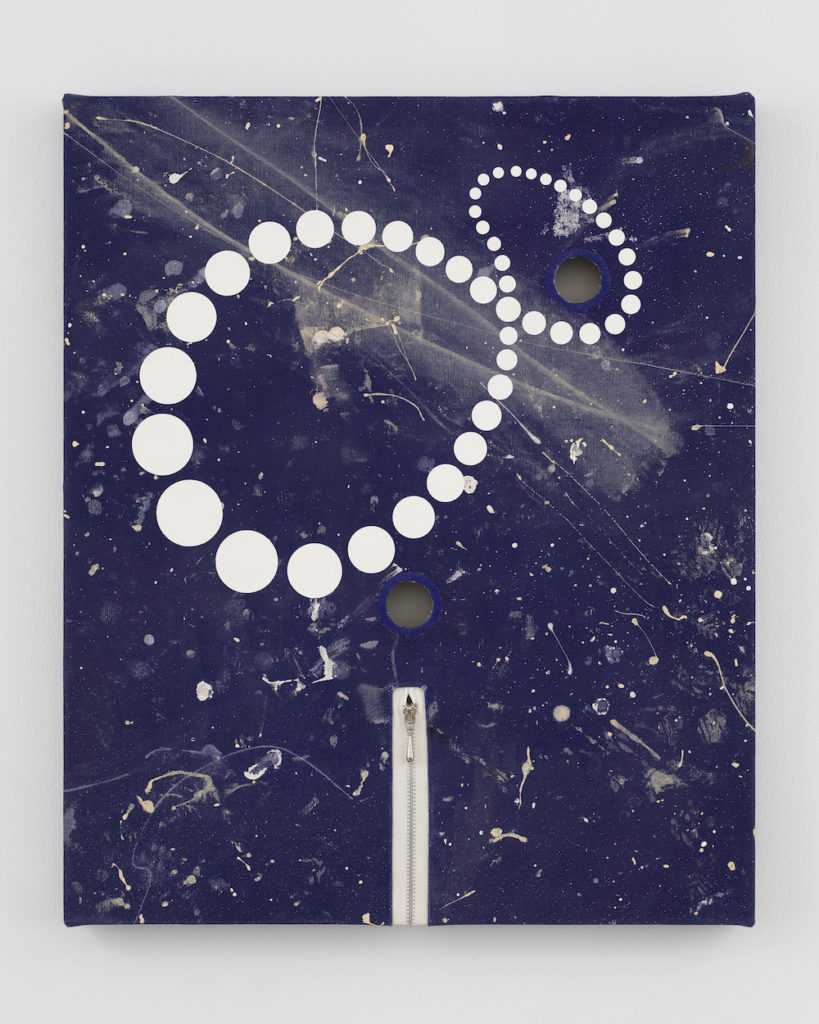
Donald Moffett, Lot 021007/20 (OO,
night loop) (2007/2020). Image courtesy the artist and Marianne
Boesky Gallery.
Booth: Marianne Boesky Gallery, New York
and Aspen
What It Costs: $110,000
Why It’s Special: Marianne Boesky devoted her
booth to a series of mixed-media works, titled Fleisch,
that Donald Moffett first started working on in 2007 and returned
to recently. The resulting display is both quiet and dazzling.
“Fleisch is the German word for our English half-rhyme flesh,
which designates the meat and fat between skin and bones, as well
as, figuratively speaking, carnal needs or appetites,” art
historian Kate Nesin writes in a catalogue essay accompanying the
show.
Moffett’s works “can at first appear all skin and bones… barely
painted, though their stretched linen expanses have been sized,”
according to Nesin’s essay. Marianne Boesky pointed out the
multiple additional symbols and marks—like tear shapes—and metal
zippers that emphasize the connection between painting and the
body. The compositions are “provocative and poetic, serving as
an implicit form of social critique of the body politic,” she
said.
On Sunday, March 1, the artist will be participating in the
fair’s “Meet the Artists”
event, where he will be registering voters at the booth from 12
p.m. to 3 p.m. Keep an eye out for Moffett’s limited-edition
sticker encouraging people to vote.
—Eileen Kinsella
The Sea
(1947)
Alice Neel
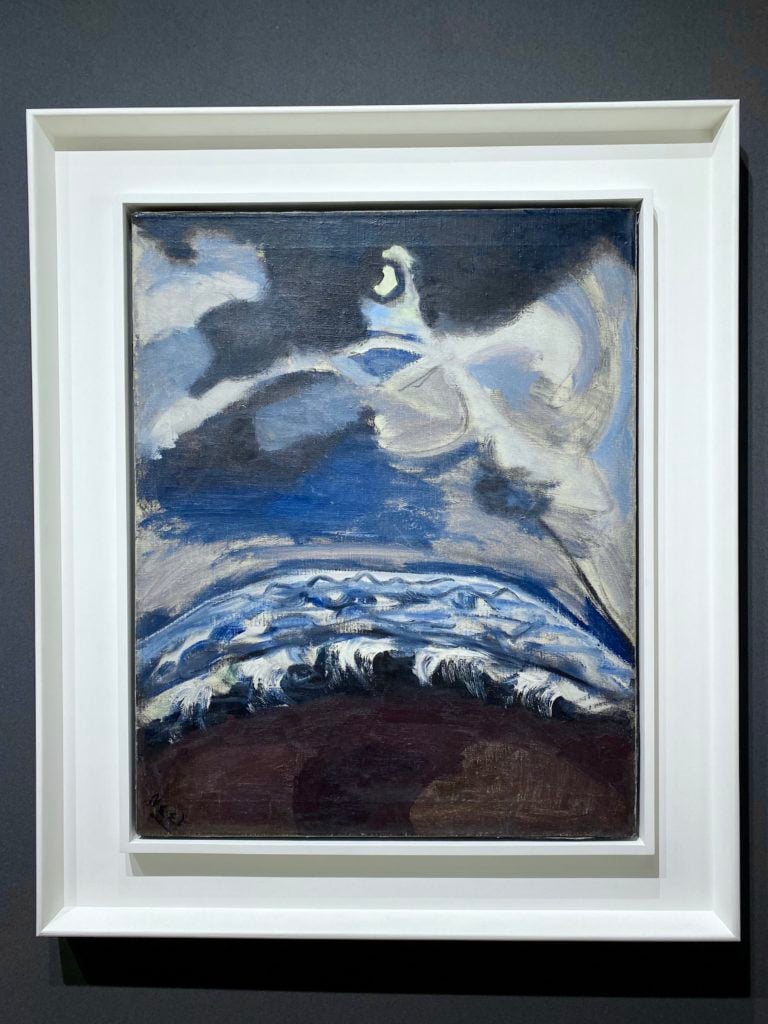
Alice Neel, The Sea (1947). Photo
by Tim Schneider.
Booth: Cheim & Read, New
York
What It Costs: $450,000
Why It’s Special: Although Alice Neel is rightfully renowned for
her evocative portraits, her practice had a wider scope than most
realize. Cheim & Read’s solo presentation of the artist’s work
includes multiple renditions of urban environments and this
roiling, figure-free marvel of the coast.
Gallery cofounder John Cheim
defines The
Sea as a “pantheistic
nature painting”: look closely, and you can see eyes in the surf
and faces in the sky above. Neel claimed she painted the work from
memory after taking a solo walk along the Atlantic Ocean to clear
her head upon learning of her father’s death. Channeled through her
usual virtuoso brushwork, the complex emotions stoked by her loss
infuse the turbulent seascape with an elemental power—one that Neel
enhances further by bending the horizon into a crescent, as if
grief had torqued the natural world into some alien
planet.
—Tim Schneider
Homo Rodans
(1959)
Remedios Varo
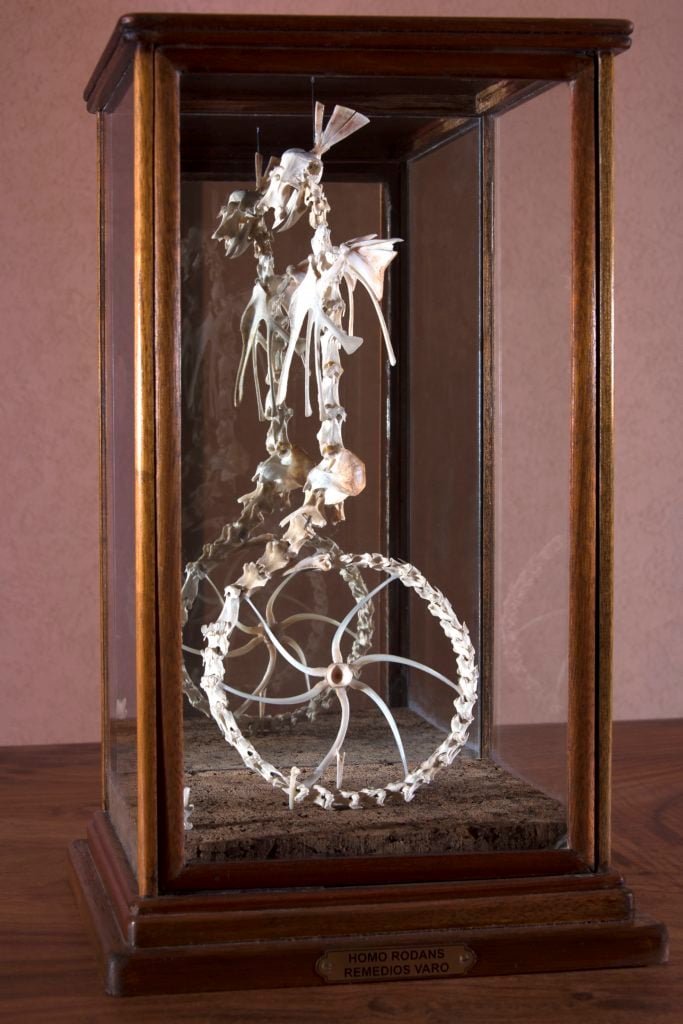
Remedios Varo, Homo Rodans
(1959). © 2020 Artists Rights Society (ARS), New York / VEGAP,
Madrid. Photo by Rafael Doniz, courtesy Gallery Wendi Norris, San
Francisco.
Booth: Gallery Wendi
Norris, San Francisco
What It Costs: $2.5
million (available only to institutions)
Why It’s Special: Homo
Rodans carries the
distinction of being the only surviving three-dimensional work by
the gone-too-soon Spanish Surrealist Remedios Varo, who died in
1963 at just 54 years old.
Wired together from chicken,
turkey, and fish bones saved from meals with friends, the sculpture
purports to be the extant skeleton of a species called
Homo
rodans, an overlooked
predecessor to Homo
sapiens that sported
bat-like wings and a large wheel in place of legs.
Accompanying the sculpture is a
stunning illustrated manuscript in which Varo adopts the character
of a fictional German anthropologist named Hälikcio von
Fuhrängschmidt, who argues for a rewriting of evolutionary history
to account for this preposterous creature.
“She wanted to imbue her love of
myth into science,” says dealer Melanie Cameron. The result is a
tongue-in-cheek masterpiece that stretches across genres, from
assemblage to illustration to meta-fiction.
—Tim Schneider
The post 5 of the Best Artworks to See at the ADAA Art Fair,
From a Supernatural Alice Neel Painting to Zanele Muholi’s Latest
Portrait Series appeared first on artnet News.
Read more https://news.artnet.com/market/adaa-art-show-best-works-2020-1787415
Further reading


Leave a comment