
Are Art Institutions Becoming Too ‘Ideological’? A Debate Breaks Out at the International Council of Museums Over Politics in the Galleries
Should museums’ core mission be preserving the world’s cultural
heritage, or should they use their collections to promote human
dignity, social justice, global equality, and planetary well-being?
That is the question facing the international museum community as
its wrestles with bringing its definition of what a museum should
be into the 21st century.
Next month, thousands of members of the International Council of
Museums (ICOM), which represents 20,000 institutions worldwide, are
due to meet in Japan to formally ratify a new definition of what
makes a museum a museum. The radical new definition, which was
accepted by ICOM’s board in July, has divided its national members,
some of whom are lobbying to get the vote postponed to avoid a
possible rift. Critics fear it is too “ideological,” while others
are concerned that traditional values of research and education are
being downgraded.
For the past half century, ICOM’s definition has remained the
same while the world in which they operate has changed. The current
definition states that a museum is: “A nonprofit institution” that
“acquires, conserves, researches, communicates, and exhibits the
tangible and intangible heritage of humanity and its environment
for the purposes of education, study, and enjoyment.”
The new definition finalized in July declares: “Museums are
democratizing, inclusive, and polyphonic spaces for critical
dialogue about the pasts and the futures.” The new wording stresses
the importance of championing human justice, equality, and the
wellbeing of the planet. It also suggests that museums
acknowledge and address the conflicts and challenges of the
present, while “[guaranteeing] equal rights and equal access to
heritage for all people.”
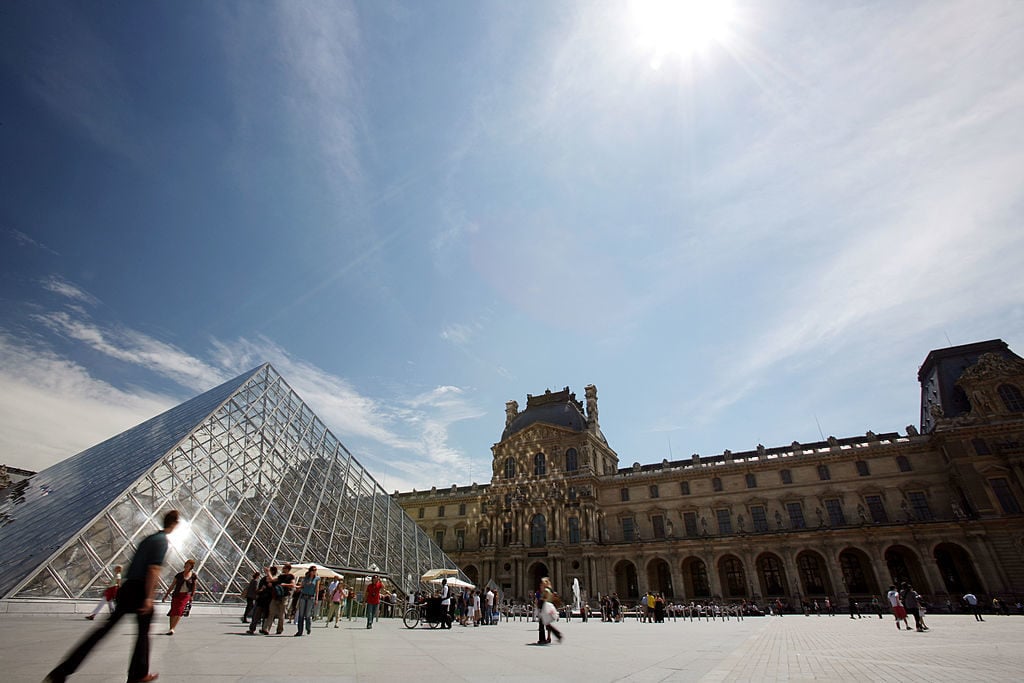
The new definition could present
challenges to museums such as the Louvre. Photo: Loic Venance
AFP/Getty Images.
A Problem for Museums Like the Louvre?
Last week, some 24 national branches of ICOM issued a petition
to postpone the vote. Countries that have voiced “concerns” include
France, Italy, Spain, Germany, Canada, and Russia.
Juliette Raoul-Duval, the chair of ICOM France, told
The Art Newspaper
the new definition on the table is an “ideological”
manifesto. François Mairesse, a professor at the Université
Sorbonne Nouvelle who resigned from the ICOM committee that drew up
the new definition, fears it will cause a rift in the organization.
He called the new definition “a statement of fashionable
values, much too complicated, and partly aberrant.” He added that
it would be a problem for most French museums, including the
Louvre, to embrace the new definition.
Meanwhile, Klaus Staubermann, the CEO of ICOM Germany, which
also wants the vote postponed, tells artnet News that he had
specific concerns about words that have been omitted. “The
previous definition had keywords like ‘institution’ and
‘education,’ which the new version does not carry. Both these words
are very important, because their presence has a crucial effect on
legislation in the German states,” he explained. Still, Staubermann
says that postponing the decision is less about those specific
concerns “and more about giving time to the discussion worldwide to
address and accommodate everyone’s concerns.”
What is at stake at the Kyoto meeting on September 7 is more
than a battle over terminology. It reflects a debate that has been
taking place for the past four decades around whether museums can
ever be ideologically neutral spaces. It also reflects a desire
since at least the 1980s for museums to be meeting places where
ideas can be discussed, turning the museum from a traditional
“temple” to a more democratic “forum.” The debate has been given
added urgency as institutions in the West face increasing pressure
over their colonial-era collections, sources of funding, and
historic under-representation of women’s history in particular.
Jette Sandhal, the Danish curator who has led the committee
drawing up the new ICOM definition, comes from the radical end of
the profession. The founding director the Women’s Museum of
Denmark, she turned the ethnological collections of Gothenburg in
Sweden into the Museum of World Cultures. Its inaugural exhibitions
included an installation by the US artist Fred Wilson and a show
about responses to the AIDS/HIV epidemic around the globe.
Sandhal posted a video in March in which she compared
the new definition to a “backbone” that would give institution’s
strength while maintain room for flexibility. The result of
three-years work, said that if a new definition is not agreed, the
conversation will continue as it has for the past “20 years.”
The post Are Art Institutions Becoming Too ‘Ideological’? A
Debate Breaks Out at the International Council of Museums Over
Politics in the Galleries appeared first on artnet
News.
Read more https://news.artnet.com/art-world/icom-museum-definition-debate-1630312
Further reading


Leave a comment