
Art Joburg, Overhauled With a New Owner and Business Model, Makes the Case for Johannesburg as the Capital of Africa’s Art Scene
As the market for contemporary
art from Africa gathers heat, many collectors are eagerly waiting
for tastemakers on the continent to pinpoint a region on which to
concentrate.
Unlike in Asia, where Hong Kong
has emerged as a clear market nexus for the broader region, an
obvious market hub has not been established in Africa in the same
way. This is despite a groundswell of activity in a few different
cities, including Marrakech, Lagos, and Accra. Fairs like 1-54
Marrakech, ART X Lagos, and the Cape Town Art Fair are all
competing for the attention of international and local collectors
interested in the continent, but it might be wise to look also to
the site of Africa’s oldest fair, Art Joburg, for some
answers.
As far as infrastructure goes,
South Africa has a head start on the rest of the continent. A
number of leading galleries, including Stevenson and Goodman
Gallery, are based there, and there are a growing number of
world-class institutions there, including the Zeitz MOCAA museum,
A4 Foundation, and the Norval Foundation in Cape Town. Johannesburg
is also home to the new Javett Art Centre at the University of
Pretoria.
Amid all the institutional
activity, Johannesburg, the country’s largest city, is also
making a case for itself as an international market center. There
is the promise of a new private institution, the brainchild of
local collector Gordon Schachat, on the horizon, plus more and more
galleries, which might have opened flagships in the more
tourist-friendly Cape Town, are seeing a need for a presence in the
capital city. And Art Joburg (formerly the Joburg Art Fair), now
entering its eleventh edition, makes a strong case for the city’s
draw.
The New Art Joburg
Under new management, this
year’s edition of Art Joburg, which ran September 13 through 15,
upped the game on previous editions. Now owned by the Johannesburg entrepreneur
Mandla Sibeko, who was a minority shareholder in and a director of
the previous iteration of the fair, Art Joburg has undergone a few
notable changes. Now 60 percent smaller than it was last year, it
welcomed 17 galleries on an invitation-only model in response
to growing
dissatisfaction from participating galleries who were unhappy with
the structure and model of the old fair, to the point that the main
exhibitors departed en masse, only returning in the past three
months since Sibeko took over the helm.
The new focused version of the
fair offers an elevated experience, and the smaller number of
participants made room for a new section, titled “Max,” where
larger scale works by African artists that are usually only
presented in places like Art Basel or the Venice Biennale, such as
a large-scale photographic installation by Zanele Muholi, could be
shared with a local audience.
“Our aim is to make sure that we
become the platform people would come to if they are looking for
the best of the best of African artists,” Sibeko tells artnet
News.
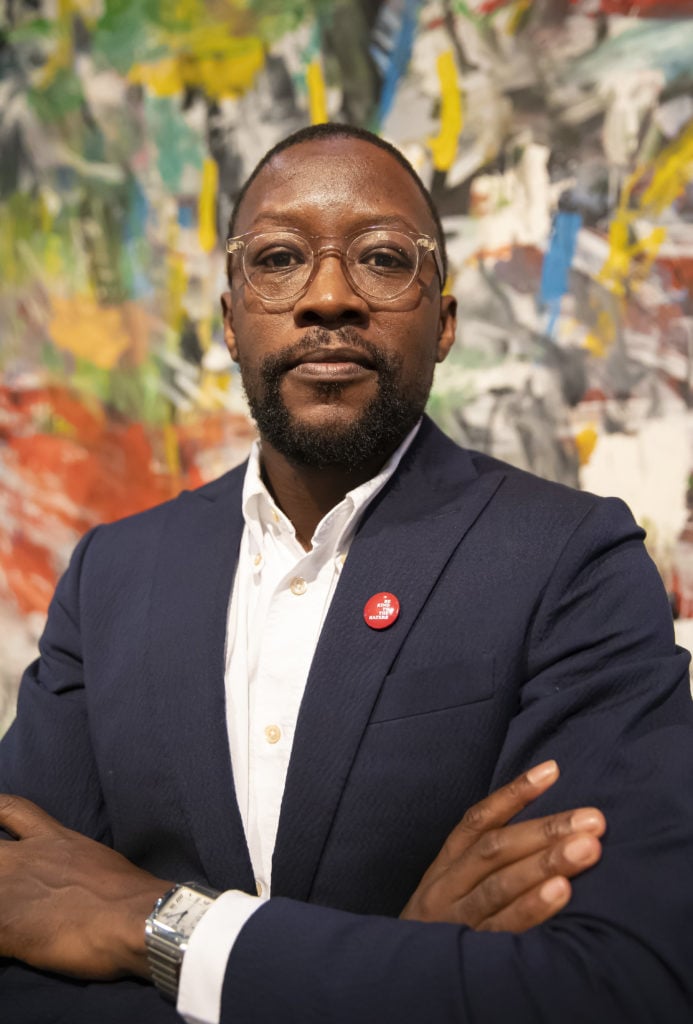
Mandla Sibeko.
Sibeko, who is a supermarket and
e-commerce entrepreneur, pointed out that
the fair is now 100
percent black owned, which Sibeko says marks an important change
for him, as well as for the city in historic terms. “You must
remember that South Africa 27 years ago was very segregated, we
came out of apartheid, so many spaces like in the art world the
business world, you could not find black people as leaders,” Sibeko
says. Cape Town art fair, for example, is owned by Fiera Milano, an
Italian company (which also owns Milan’s Miart
fair).
“It’s really part of changing
the narrative that we need to make sure that we become reflective
of the dream of people like Nelson Mandela, that one day South
Africa would be diversified, and would have leadership of black,
white across all our institutions and platforms.”
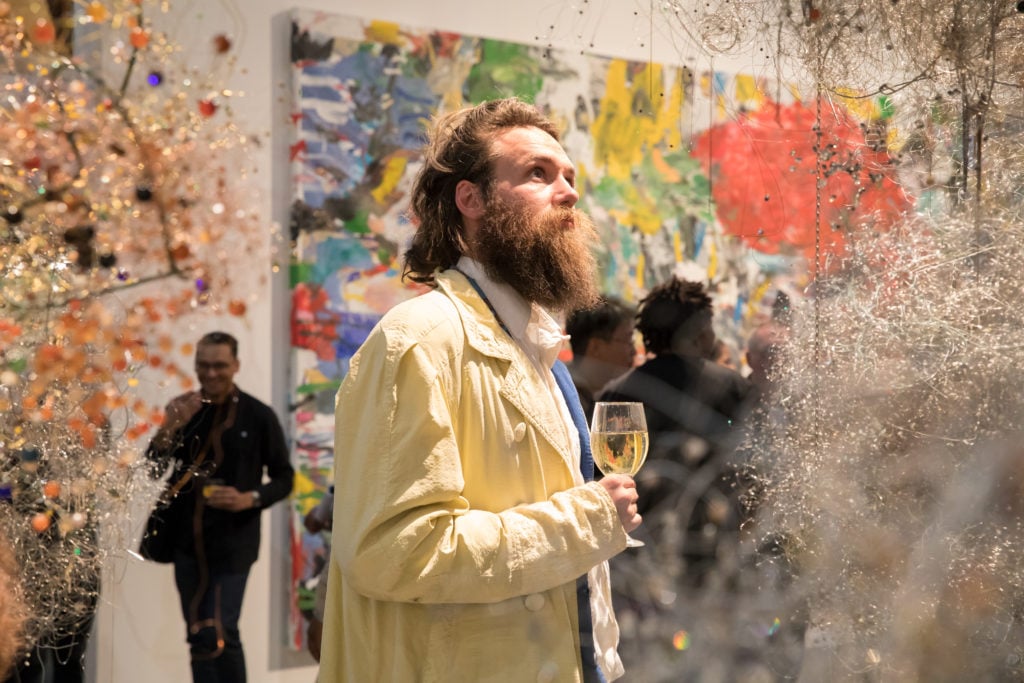
FNB Art Joburg 2019. Photo by Jacob
Sewela/FNB Art Joburg.
Joburg or Cape Town?
When speaking about South Africa
internationally, especially when it comes to the art scene, Cape
Town is cited more frequently as a hub, being home to institutions
such as Zeitz MOCAA, Norval Foundation, and A4 Foundation. Art
collector Louis Norval, founder and chair of the board at the
Norval Foundation was among the collectors roaming the fair in
Joburg.
When it comes to which South
African cities are attracting the most attention, Norval says that
Cape Town is an obvious choice for many because already has a place
in the global tourism calendar. “Cape Town as a city sells itself.
We just get the benefit of that,” he says. “The Beyeler Foundation
[in Switzerland] has a great big picture window. We have a great
window too, but our view is nicer.”
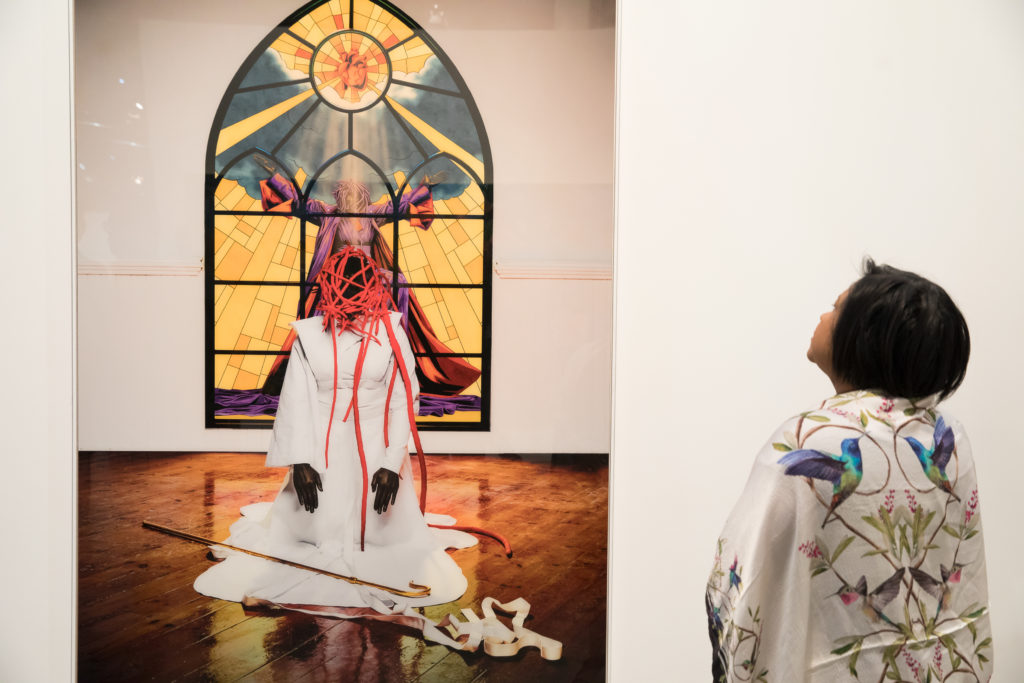
FNB Art Joburg 2019. Photo by Jacob
Sewela/FNB Art Joburg.
Liza Essers, the owner and
director of Goodman Gallery, which has spaces in both Cape Town and
Johannesburg, takes a different view. “South Africa is definitely the center of the
art market of the continent,” she says, “and Joburg is the cultural
center of the continent, where the heartbeat lies.”
Essers makes the case for Joburg
from a production perspective, with artists like Mikhael Subotzsky,
Nicholas Hlobo, and William Kentridge all basing their studios in
the city. Kentridge has also set up (and funds) an exciting
nonprofit, the Centre for the Less Good
Idea,
an interdisciplinary
incubator that supports experimental, and collaborative arts
projects.
The city is also home to
important collectors such Brian Joffe, Pulane Kingston, and Gordon
Schachats, whose upcoming Southern African Foundation for
Contemporary Art was a talking point at the fair. Johannesburg’s
art week is also rounded out by another coinciding art fair,
Latitudes,
and the UNDERLINE show, a
curator-led exhibition platform that offers no-cost exhibition
space to innovators at the Museum of African Design.
But when it comes to naming
a leading art destination on the continent, Sibeko says he doesn’t
think Africans should be “competing” to become the hub. “They
should be looking at where the scene is most established, or what’s
attractive about one city over another, and where the tourism
levels are heading,” he says.
Creating a Sustainable Art Ecosystem
In terms of sales, the new
version of the fair seems to have had a successful pilot edition.
On the first day of the fair, Goodman Gallery was able to “more
than cover costs,” and all the major South African collectors were
there, though sales were down from the previous year, in part due
to an economic recession. “South Africans don’t feel like spending
at the moment,” Essers says.
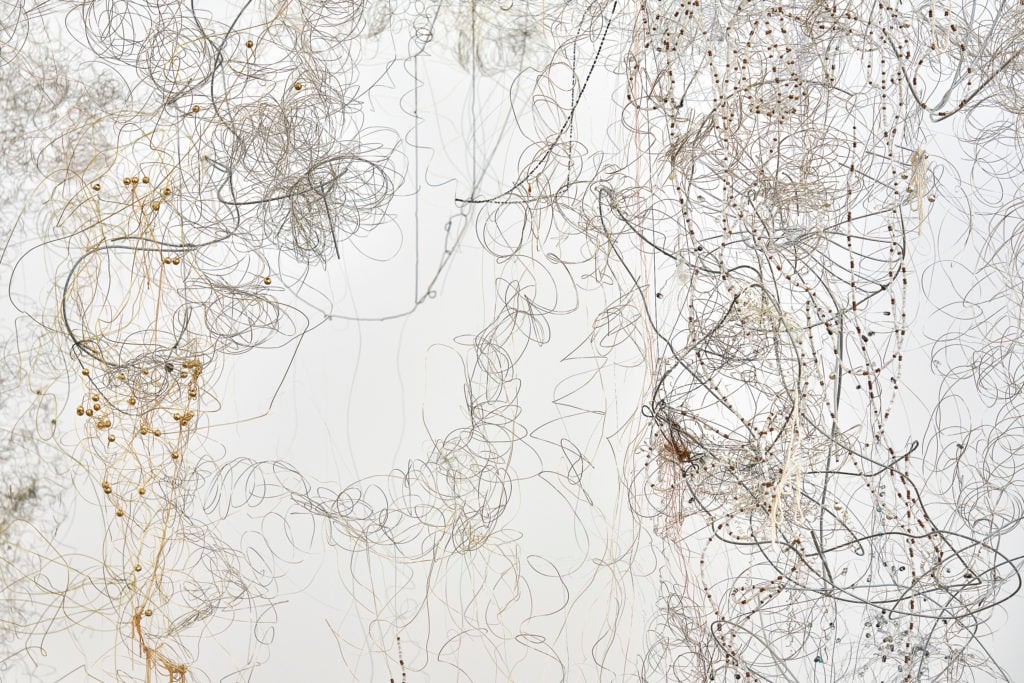
Igshaan Adams, detail of Ontdoen
(2018). Courtesy of black projects.
That said, by the end of the
fair, SMAC gallery had sold 16 works by 11 artists at prices
ranging from R50,000 (around $3,000) to R1 million (around
$68,000). Blank Projects parted with a work by Bronwyn Katz for
€7,000 ($7,750), four works by Igshaan Adams ranging from €13,000
to €22,000 ($14,400 to $24,400). Everard Read sold 17 works by a
variety of artists for prices ranging from R70,000 (around $5,000)
to around R1 million (around $68,000). Kalashnikovv sold works by
four artists, including two large-scale pieces Ayanda Mbuli and
Jake Singer.
But the galleries were not just
focused on sales. One particularly interesting aspect of the new
fair was the introduction of a new section of invited emerging
galleries, which accounted for nearly half the exhibitors, who were
mentored by the established galleries including Stevenson, Blank
Projects, and Goodman Gallery. “Here we have quite an interesting economy; you
have a first world country but you also have a third world country.
So I think that it is so important that as much as we build our
businesses we need to be conscious of how can we contribute to keep
growing the ecosystem,” Sibeko says.
So alongside schmoozing with
collectors and top-dollar sales, the established galleries were
also running crash courses in the best practices across, from
applying for art fairs to writing press releases to working with
artists, and placing works in the right collections.
Sibeko is already looking ahead
to next year, and is about to embark on a roadshow to attract more
attention from international collectors, starting in London at
Frieze. Next year he hopes to partner with galleries from Brazil,
the US, and UK that can compete at the level of the fair’s existing
galleries. “In a short timeframe, we have done well,” Sibeko says.
“But we have a long way to go.”
The post Art Joburg, Overhauled With a New Owner and
Business Model, Makes the Case for Johannesburg as the Capital of
Africa’s Art Scene appeared first on artnet News.
Read more https://news.artnet.com/art-world/art-joburg-african-art-market-1653268
Further reading


Leave a comment