
Contemporary Art Stars Have Ruled the Photography Market at Auction—But Now Their Works Are Available at Steep Discounts
Photography’s relationship to
the larger art market has been tense from the start. Even today,
it’s not terribly difficult to find collectors who regard certain
signal names in camerawork, such as Helmut Newton and Irving Penn,
as “fashion photographers” rather than fine artists (whatever that
latter term means in 2019). Extremism aside, photography also
attracts a fair share of buyers and sellers fixated solely on the
lens, to the exclusion of other media and the broader art-market
ecosystem around them.
And yet, in other ways,
photography has never held a more prominent position in the upper
echelons of the art business. Nearly every major commercial gallery
has added at least one living photographer or photographer’s estate
to their program over the past 20 years. As a result, photographs
and photo-based art are constant presences in exhibitions and
art-fair booths ranging from Art Basel Hong Kong to Frieze London.
The medium also supports its own slate of targeted fairs, such as
Paris Photo in November and Photofairs Shanghai, which open this
week.
These competing elements clarify
how difficult it is to talk about a monolithic “photography
market,” especially at auction. Photographic works by artists who
use a camera only part-time can hammer down in contemporary sales
for millions of dollars, while the same houses hold parallel slates
of photography-only sales containing works made as far back as the
1840s by artists completely unknown to the mainstream evening-sale
crowd.
A look at auction data exposes
some of these key tensions. But it also helps identify trends and
reveal opportunities for collectors looking to either start or
thoughtfully augment a photography collection. The upshot: As the
market for the genre has taken a tumble in recent years, now is a
good time to pick up photographs by major contemporary stars at a
discount. Just don’t wait—the tide is bound to turn
soon.
Read on for three takeaways from
the past five and a half years of photos at auction, from January
2014 through June 2019.
1. Photography Prices Are the Most Affordable in Recent
Memory
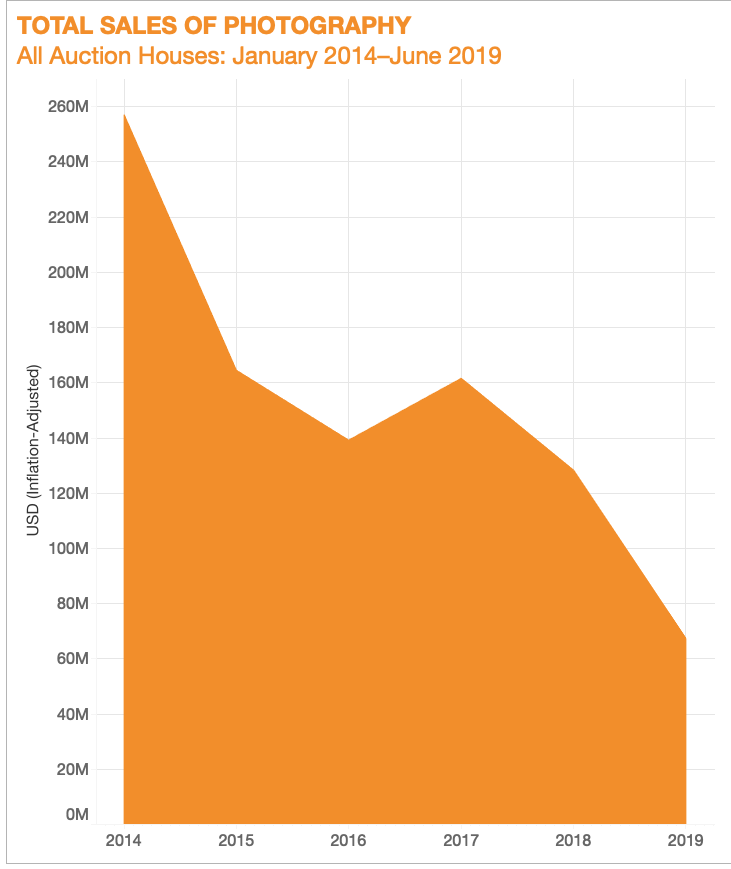
Total sales of photographic works at
auctions worldwide, January 2014–June 2019. © artnet Price Database
2019.
Over the past five years, the
photo market peaked (by both total sales and number of lots sold)
in 2014, when the medium brought in just over $257 million at
auction worldwide through the sale of around 13,000 works. Those
figures translate to an average sale price of about $19,500 per
work. (All dollar values have been adjusted for inflation
unless otherwise noted.)
After that, the genre’s
performance began to dip. By 2018, the market had effectively been
cut in half by value, achieving just over $128 million at auction
worldwide via roughly 10,400 works sold. Those figures dropped the
average sale price to about $14,200.
However, results in the first
half of 2019 suggest last year may have been the bottom of the
photography market at auction. Sales in the medium totaled about
$67.3 million from January through June thanks to 5,685 sold lots.
Both of those figures are on pace to slightly surpass their 2018
equivalents. And yet the average price of a photo at auction in the
first half of 2019 was just over $11,800—the most affordable in our
sample. But it’s reasonable to expect prices to climb if the medium
indeed experiences a broader recovery at auction.
That outcome is more plausible
than numbers alone might suggest. The major decline in photography
sales beginning in 2015 coincided with a major reshuffling of
personnel in the photography departments of multiple auction
houses. Denise Bethel, Sotheby’s chairman of photography in New
York and a 25-year mainstay at the house, departed at the end of
2014. Philippe Garner, the man responsible for holding the first
dedicated photography auction in the UK, retired as Christie’s
international head of photography in 2016.
It would be a mistake to
underestimate the trust vacuum facing potential consignors and
bidders in the small world of photography due to those two changes
alone. With the unavoidable growing pains of more junior figures
stepping into larger roles, or adjusting to new managers, sales
were bound to suffer.
But roughly four years beyond
that inflection point, it’s reasonable to expect that the new-look
photography departments are now rounding into form. That should
mean better prints mounting the block, more excitement in the buyer
pool, and fatter sales figures are on the horizon.
2. Contemporary Works Have Been Dominating the
Market
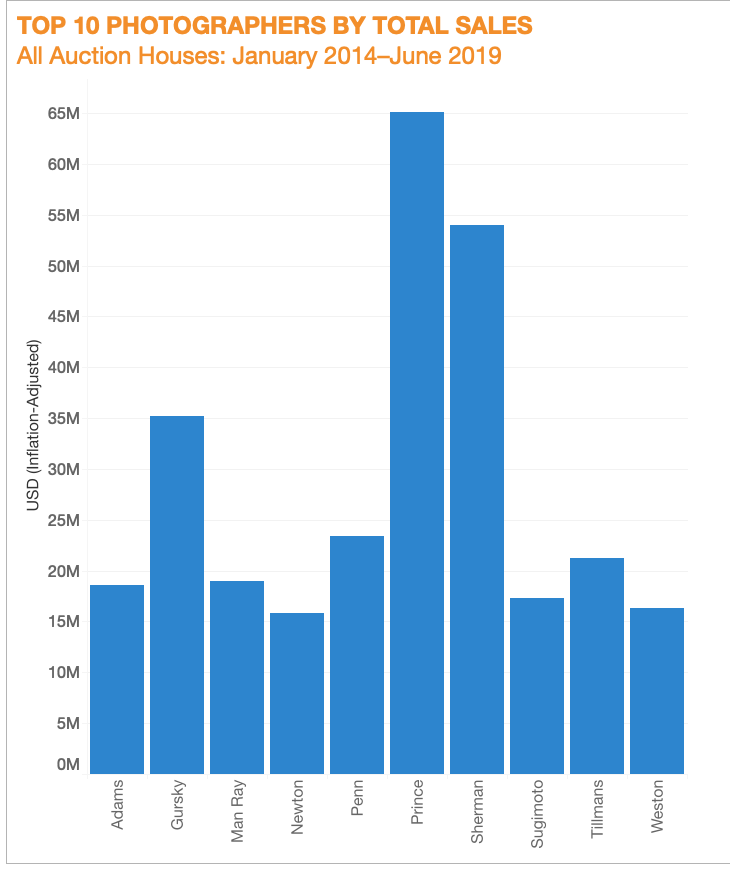
Top 10 artists by photography sales at
auction, January 2014–June 2019. © artnet Price Database 2019.
The list of best-selling artists
in photography from 2014 through June 2019 reveals how important
contemporary talents have become to this sector in recent years.
Half of the top 10 by total sales were born in 1945 or later,
qualifying them as contemporary in artnet’s
system.
These results crystallize the
aforementioned complications between contemporary art and a more
purist definition of photography. First-ranked Richard Prince, who
brought over $65 million at auction for his photos during this
period, also works in painting and sculpture. And a collector is
much more likely to find photos by second-ranked Cindy Sherman ($54
million in sales) or fifth-ranked Wolfgang Tillmans ($21.2 million)
in a contemporary evening or day sale than a narrowly defined
photography sale. Many, if not most, private dealers specializing
in photographs do not interact with these artists’ output on the
secondary market, and may not even consider them photographers per
se.
In fact, contemporary artists
make up the largest portion of the top 20 best-selling
photographers in the past five-and-a-half years, with the expanded
list including names like Gilbert & George (#12), Thomas Struth
(#13), and Vik Muniz (#14). Together, the nine artists accumulated
roughly $250.5 million in sales from January 2014 through June
2019. For perspective, that haul accounted for over 27 percent of
all photography sales at auction over the same
period. It also eclipsed the annual sales achieved in the medium
every year after 2014.
If we were to narrow the dataset
to photography sales only (as I did in a post
this April), we would
come away with a starkly different impression of who has been up
and who has been down since 2014. But even without making such a
fundamental change, other metrics can provide a valuable view of
soft spots in the auction market for camerawork.
3. …But Photos by Contemporary Stars Are Also Available at a
Deep Discount at Auction
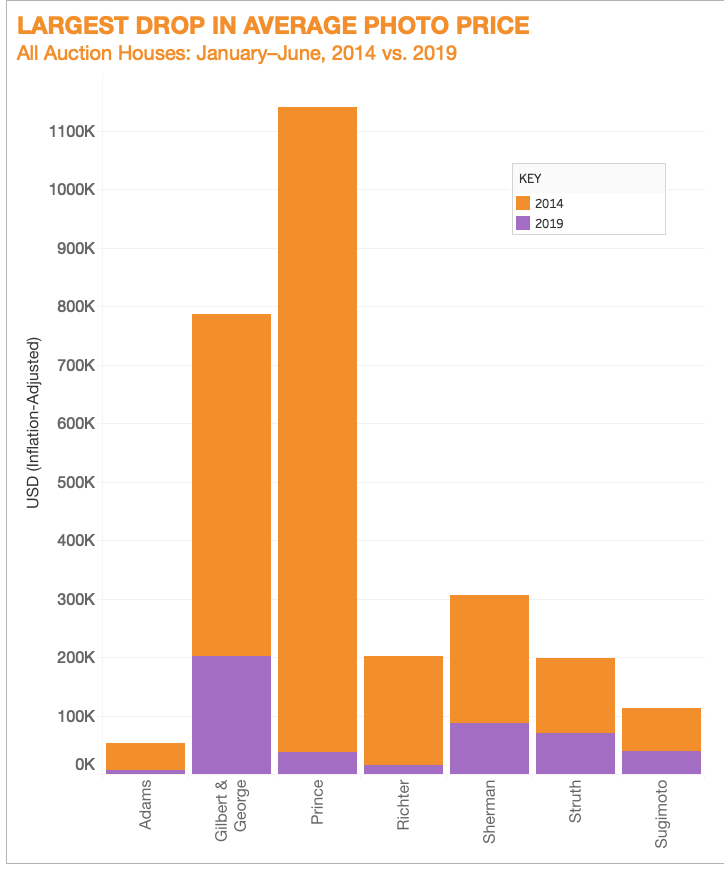
Largest drop in average photo price at
auction among top-selling photographers between the first halves of
2014 and 2019. © artnet Price Database 2019.
Given how robust sales have been
for contemporary artists wielding cameras since 2014, it likely
comes as a shock to learn that most of the top sellers fitting this
description have performed worse on average at auction in the first
six months of 2019 than the equivalent period five years ago. But
that is the case—and even more shocking is just
how much worse they’ve performed.
Seven of the top 20 best-selling
photographers saw their average price plummet by more than 45
percent this year, and five of those seven are contemporary
artists. This cohort is led by Richard Prince (down 97 percent),
Gilbert & George (down 66 percent), and Cindy Sherman (down 60
percent). The average
sales price for Gerhard Richter’s photography, meanwhile, dove by
91 percent.
In fact, only seven of the top
20 artists by photo sales saw their work change hands at a higher
average sales price in the first half of 2019 than in the first
half of 2014. With the lone exception of contemporary star Wolfgang
Tillmans, the risers consist entirely of “pure” photographers from
the postwar era: Helmut Newton, Richard Avedon, Diane Arbus, Peter
Beard, Irving Penn, and Robert Frank. (Modernist hero Edward Weston
comes close thanks to an average sales price that dropped a mere 10
percent between the two periods.)
The discrepancy in results
between these two groups shows two very different markets behaving
in opposite ways, even while both do so under the banner of
photography. The hard fall in the average price for photos by
capital-C contemporary artists does not mean those artists are not
selling well in 2019. It may simply mean more of their high-value
transactions have moved onto the private market in the past five
years, which tracks with major galleries’ increasing interest in
camerawork. It does mean, however, that those looking for a bargain
in this area might do well to look to the auction
market.
Meanwhile, the rise in value for
artists closer to the Arbus-Penn axis may reflect the renewed level
of trust among die-hard photography collectors and the major
auction houses after the aforementioned post-2014 staff exodus.
With it, higher quality lots may be mounting the block again,
in venues where collectors who favor these artists are predisposed
to buy.
In short, the photography market
contains multitudes. Prices have never been friendlier overall to
buyers at auction recently, and it’s a particularly opportune time
to buy photos by contemporary stars under the hammer. That is not
necessarily the case for purist-approved postwar photographers,
whose auction results move independently of the Princes and
Shermans of the world. The question for collectors is: Which side
of the photo market are you on?
Methodology:
The data covers all works in
the medium of photography offered in all sales around the world
from January 1, 2014 through June 30, 2019. This methodology
ensures that we captured traditionally higher-dollar and more
recently made photographic works sold in, for example, major day
and evening sales of contemporary art, not just the works sold in
auctions narrowly defined as photography-only. All dollar values
include buyers’ premiums and are adjusted for inflation unless
otherwise noted.
The post Contemporary Art Stars Have Ruled the Photography
Market at Auction—But Now Their Works Are Available at Steep
Discounts appeared first on artnet News.
Read more https://news.artnet.com/market/photo-market-contemporary-artists-1646302
Further reading


Leave a comment