
Museums Claim They’re Paying More Attention to Female Artists. That’s an Illusion.

Just 11 percent of all
acquisitions and 14 percent of exhibitions at 26 prominent American
museums over the past decade were of work by female artists.
According to a joint investigation by artnet News and In Other
Words, a total of 260,470
works of art have entered the museums’ permanent collections since
2008. Only 29,247 were by women.
More troubling, there have been
few advances made—even as museums signal publicly that they are
embracing alternative histories and working to expand the canon.
The number of works by women acquired did not increase over time.
In fact, it peaked a decade ago.
These findings challenge one of
the most compelling narratives to have emerged within the art world
in recent years: that of progressive change, with once-marginalized
artists being granted more equitable representation within art
institutions. Our research shows that, at least when it comes to
gender parity, this story is a myth.
“These numbers are a little
heart-wrenching,” artist Mickalene Thomas says. “But they are also
awakening. This is not about who you are as an artist—there is a
system that you aren’t a part of. It’s still a boys’
game.”
No Growth
Considering that women comprise
more than half of Americans, these numbers are disturbingly low.
Interestingly, the proportional representation of women in this
data study correlates with last year’s research into
African American artists: based on this country’s demographics,
the findings were each a fifth of what they should
be.
The minimal overlap between our
two studies reveals the extent to which African American women are
badly served by museums: their works made up just 3.3 percent (190
of 5,832) of the total number by women collected by US
institutions.

Amy Sherald, Planes, rockets, and
the spaces in between (2018). Courtesy of the artist and
Hauser & Wirth, ©Amy Sherald.
Unlike last year’s study, which
showed museums had made clear (though limited) progress over time,
there appears to have been an overwhelming lack of concentration on
work by women. Only a handful of institutions we surveyed
demonstrated the kind of consistency in their acquisitions and
programs that suggest they are paying more than lip service to the
issue.
“There is a perception that
change has been so substantial when the reality is not that case,”
says Jessica Morgan, the director of the Dia Art Foundation, one of
only two institutions to have acquired more than 50 percent
work by women over the past decade.
“There is such a huge imbalance that some kind of radical gesture
is required.”
The Business Case for Change
Striving for equity is not just
a matter of doing the right thing. Nor is it only about telling a
more accurate history. It is also an important way for museums to
ensure their own enduring relevance, and safeguard their financial
viability.
“The public that you are selling
to is not monolithic—it is not all white males,” says Susan
McPherson, founder of McPherson Strategies consultancy and an
expert on corporate social responsibility. “So if your viewpoint is
narrow, you won’t be able to grow membership and your customer
base.”
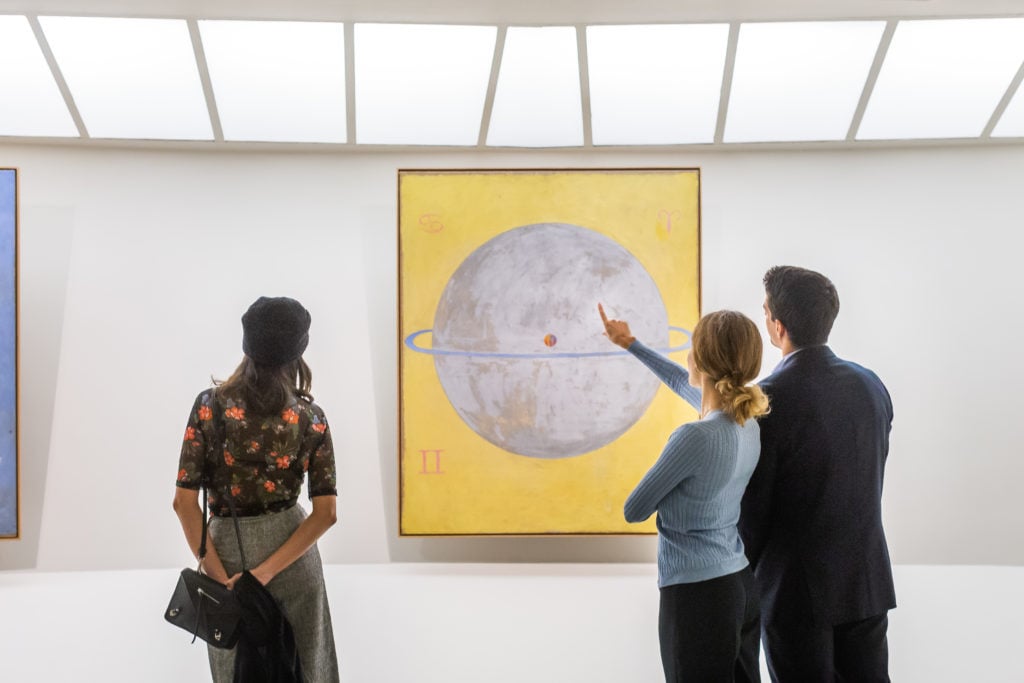
Opening for “Hilma af Klint: Paintings
for the Future.” Photo: Paul Rudd © Solomon R. Guggenheim
Foundation.
Indeed, fortune often favors the
bold. An exhibition last year of work by a relatively unknown
female painter—who had been largely ignored for decades by
historians and the art market—ended up being the most-attended
museum show in the Guggenheim’s history. The show of work by
Swedish mystic artist Hilma af Klint also drew the youngest
audience of any exhibition since the museum started to measure
visitor demographics and drove a 34% increase in membership.
The public is often out ahead of
the art world. “If you do a Gerhard Richter show, people think it will be a
blockbuster,” says Helen Molesworth, the former chief curator at
the Museum of Contemporary Art, Los Angeles. “It won’t be. Whereas
Hilma will. Museums at the level of program and board are suffering
from being behind the times.”
Slow-Moving Museums
There are a number of reasons
why museums have failed to increase their representation of female
artists. For one thing, their work is often seen as a specialist
pursuit running parallel to the canonical story of art history. And
many institutions share an unspoken belief that “they will only be
recognized as an important institution if they acknowledge the
greatest hits,” notes Maxwell Anderson, the president of the Souls
Grown Deep Foundation.
This bias may be built into the
very structure of museums, whose identities are shaped by the
objects they have collected in the past, suggests David Getsy, an
art historian at the School of the Art Institute of Chicago.
“Institutions have all these narratives about what makes them
special, so for many of them this is about a reformist
movement—which is slow and incremental—rather than revolutionary
movement,” he says.
Another limiting factor is a
lack of research about female artists, whose work was often not
collected by major institutions during their lifetimes, tracked by
historians, or conserved by art dealers. A recent study of Yale
School of Art students found that even after graduation rates
reached parity in the early 1980s, female alumni were written about
in books and scholarly publications two to three times less
frequently than their male peers.
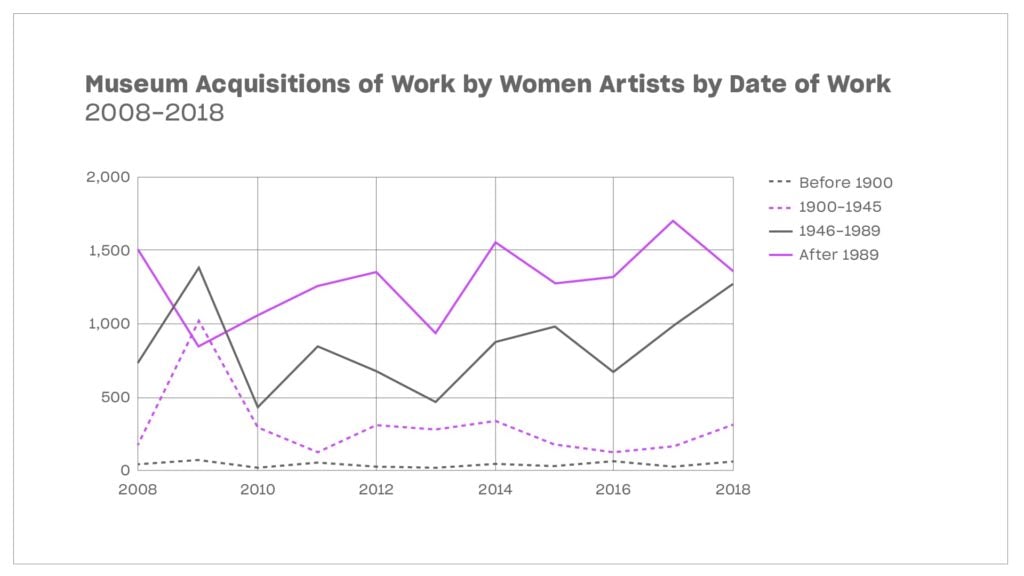
Courtesy of artnet News and In Other
Words at Art Agency, Partners.
This problem is more extreme for
encyclopedic museums, which confront a dwindling amount of
information the further back in time they look. Indeed, our data
shows that, on average, these larger historical museums are
collecting fewer works by women than their Modern and contemporary
counterparts.
Yet our research also reveals
that, when it comes to creating change, the type of institution is
less important than its level of commitment to the cause. For
example, the Los Angeles County Museum of Art—which collects art
from antiquity to the present—has been increasingly
focused on bringing more gender parity to its permanent
collection. Works by women represent 16 percent of its acquisitions over the past decade—4
percent more than the San
Francisco Museum of Modern Art and 7 percent less than the Museum of Modern Art in New York,
two prominent Modern and contemporary museums on either coast with
similar or larger operating budgets. (LACMA also comes out ahead
compared with many other historical museums; the MFA Boston, for
example, collected just 4 percent work by women between 2008 and
2018.)
Real Change Requires Checkbooks
What museums bring into their
permanent collections matters because their acquisitions ultimately
form the canon. Their collections are how history gets recorded for
posterity—and also the place where bias is most deeply entrenched.
“The great testament to the commitment an institution makes to an
artist is through acquisitions, not exhibitions, which are sweeping
and frankly cheaper,” says Christopher Bedford, the director of the
Baltimore Museum of Art.

Barbara Kruger, Belief+Doubt, 2012, at
the Hirshhorn Museum & Sculpture Garden. ©
Barbara Kruger. Photo: Cathy Carver.
Curators say they struggle to
convince their acquisition committees to pay up for work,
particularly by older, overlooked female artists, who frequently
lack an auction history that might be used to validate the asking
price. “It can be difficult to defend the value of the work,” says
Connie Butler, the Hammer Museum’s chief curator. “There is this
weird disconnect that even while people are happy to support a
show, the lack of auction records for female artists is a problem
when you’re trying to support acquisitions.”
One curator described a meeting
in which she pitched the work of an elderly female artist whose
exhibition the museum had recently staged to great success. The
committee decided against it, feeling that there were not enough
market comparables. Instead, they bought a work by a “hot” young
male artist.
Part of the reason that the
balance of acquisitions is so difficult to shift is because they
not only reflect purchases directed by curators, but also gifts
from donors. In fact, gifts comprise more than twice the number of
purchases we recorded. “A lot of institutions like ours don’t have
significant acquisition budgets,” says Anne Pasternak, the director
of the Brooklyn Museum. “Most of what you receive are gifts, and
the trend is that people bought male artists.”
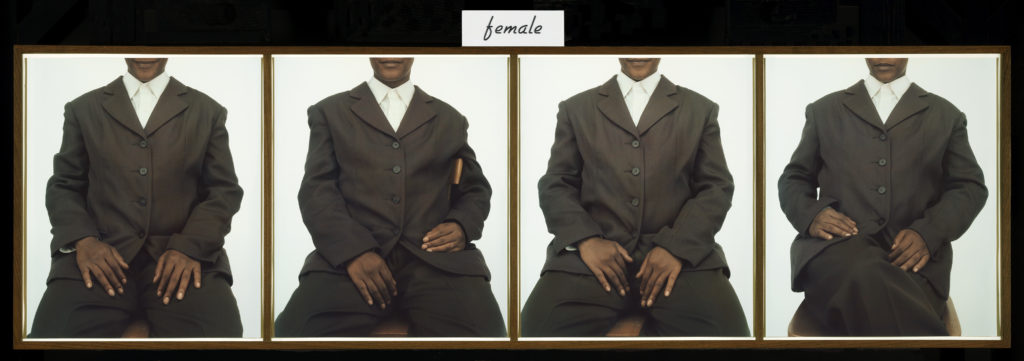
Lorna Simpson, She (1992).
Photograph © Museum of Fine Arts, Boston.
This trend is particularly
evident in larger museums, which may be more likely to attract
wealthy donors with the means and inclination to buy art that
reflects the established canon, reinforcing the status quo.
“A museum is a reflection of its
collecting community,” says Nonie Gadsden, the MFA Boston’s senior
curator of American decorative arts and sculpture, who organized
“Women Take the Floor,” an ongoing exhibition dedicated
to art by women (through May 3, 2021). “Artists with ‘known names’
are a lot easier for collectors, which means we have to try harder
to acquire an artist who may not be as familiar.”
Smaller museums, meanwhile, are
punching above their weight with regard to the representation of
women: 14 of the 15 museums that had acquired fewer than 5,000
objects over the past decade collected more works by female artists than the
11 percent average.
Playing the Waiting Game
Those with the most power to
create change seem to be the least interested in doing so. Several
influential figures we spoke to, including museum leaders, were
reluctant to acknowledge the gravity of the situation. They pointed
to a growth in representation that is not evident in our data. They
said change takes time. They wondered whether the numbers simply
reflect that there are a disproportionate number of male artists,
suggesting that women are more likely to put their careers on hold
to raise families or quit in the face of a lack of
opportunity.
“The excuses people give really
tells us a lot about the power of art and the difficulty people
have with change,” says Susan Fisher Sterling, director of the
National Museum of Women in the Arts in Washington, DC. “We are
lulled into a sense that parity is being achieved faster than we
think, but those myths reflect the status quo.”
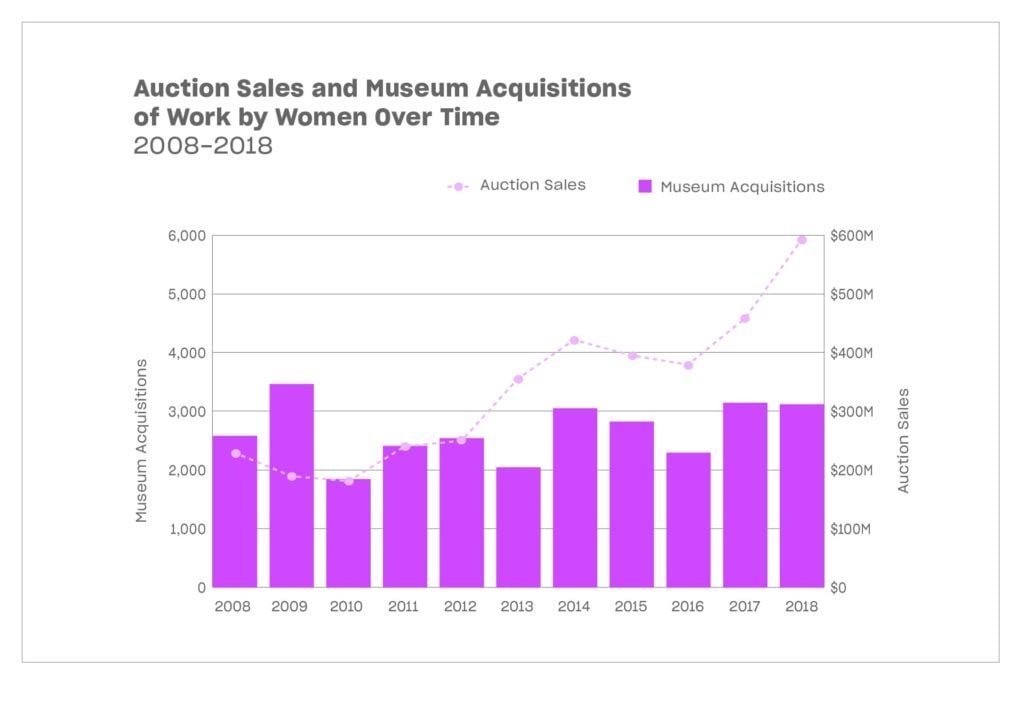
Courtesy of artnet News and In Other
Words at Art Agency, Partners.
Least surprised by the data were
the artists themselves, who expressed frustration with a system
that often asks them to meet a higher bar than their male peers to
garner recognition or earn a museum show. “I have never had a
museum come to me after a studio visit and say they like what I am
doing and we should make a show of new work,” says photographer
Catherine Opie. “I know Thomas Demand can make a new body of work
and be shown at museums all over. Same with [Thomas] Struth and
[Andreas] Gursky. But how many women get solo museum shows because
they are making an interesting body of work versus a survey or
retrospective?”
Artist Andrea Fraser says the
statistics reflect a broader shift away from the civic mission of
museums, some of which have become more interested in
“mass-marketing of the taste of the wealthiest and most influential
collectors” than “the idea that we need to educate the public and
not cater to established tastes and the spectacle of fame or of
genius.”
Who Is Calling the Shots?
Part of the reason that the
perception of progress is so much greater than the reality has to
do with who is leading the charge: of the chief curators at the
institutions we surveyed, the majority were female (23 women
compared to 13 men). Overall, US museums employ more women than
men—but, on the whole, those women earn less than their male
colleagues. According to the 2017 National Museum Salary Survey,
male chief curators make $71,050 on average, while women make
$55,550.
And the corner offices remain
male-dominated. Sixteen of the museums in our data set have male
directors, compared to nine that employ female directors. The
largest institutions are almost always run by men: of the country’s
top 10 institutions by budget, only one has a female director
(Kaywin Feldman of the National Gallery of Art in Washington,
DC).
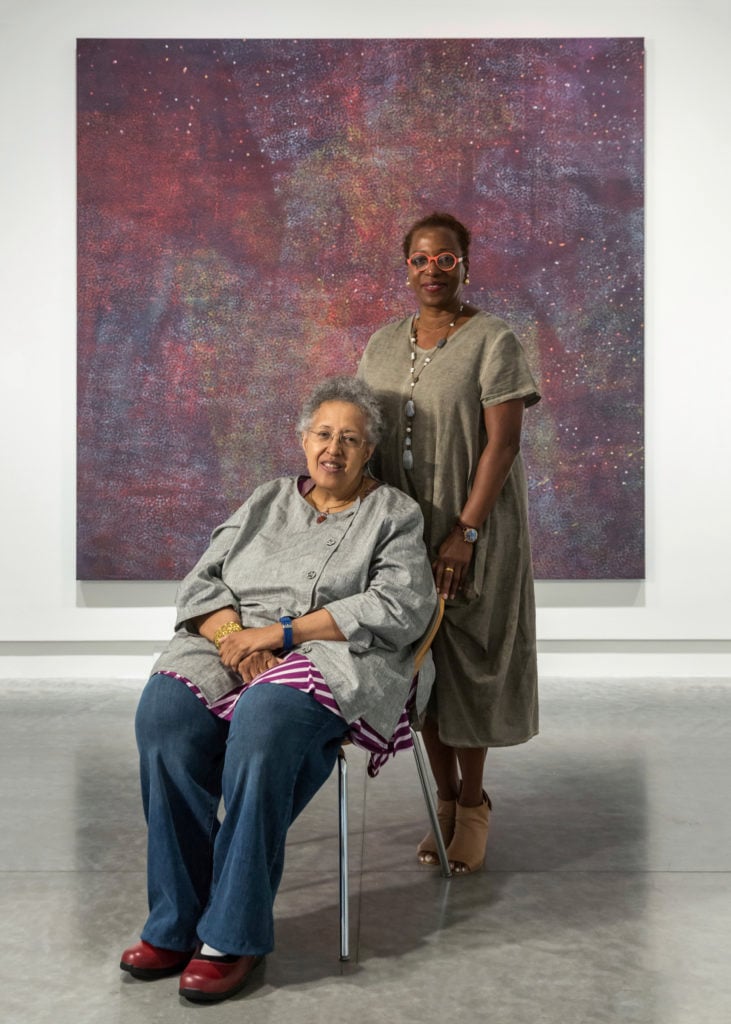
Artist Howardena Pindell with exhibition
co-curator Valerie Cassel Oliver, at the Virginia Museum of Fine
Arts retrospective “What Remains to be Seen.” Courtesy of VMFA.
Notably, the museums with the
highest proportion of exhibitions by women over the past decade—the
Dia Art Foundation in New York (39 percent), the Hammer Museum in Los Angeles (32
percent), and the Brooklyn
Museum in New York (29 percent)—all have female directors.
However, our findings suggest
that having women in leadership positions is not a cure-all.
Surprisingly, perhaps, an analysis of the boards of trustees at the
26 museums we surveyed revealed that almost half of their
members—47 percent—are female.
“The art world is simply not the
liberal, progressive bastion that it imagines itself to be,”
Molesworth says, “and you can’t solve a problem you can’t own.”
There is much well-meaning conversation taking place, but “really
wanting change means doing it. It means righting the ship. It means
you don’t get to do some other things—and it turns out that the
not-doing-other-things is not really on the table for a lot of
places.”
Making Way for Something New
Some museums have recognized the
scope of the problem—and started to take decisive
action.
The Pennsylvania Academy of the
Fine Arts took a radical step in 2013 when it sold Edward
Hopper’s East Wind Over
Weehawken (1934) for
$40.5 million. The museum did not it make public at the time, but
it planned to use the proceeds to strategically diversify its
collection. Since then, it has acquired works by women at a rate of
five times the national
average.
Within the past two years, other
museums, including the Baltimore Museum of
Art and the San Francisco Museum of
Modern Art, have followed suit. “The only way to catch up with
decades of negligence is to be overly aggressive in the present,”
Bedford says. In addition to selling work by canonized white men to
diversify the museum’s collection, the institution recently
announced that it will dedicate its entire 2020 program to female
artists, from exhibitions of work by Joan Mitchell, Candice Breitz,
and Katharina Grosse to acquisitions and public
programs.
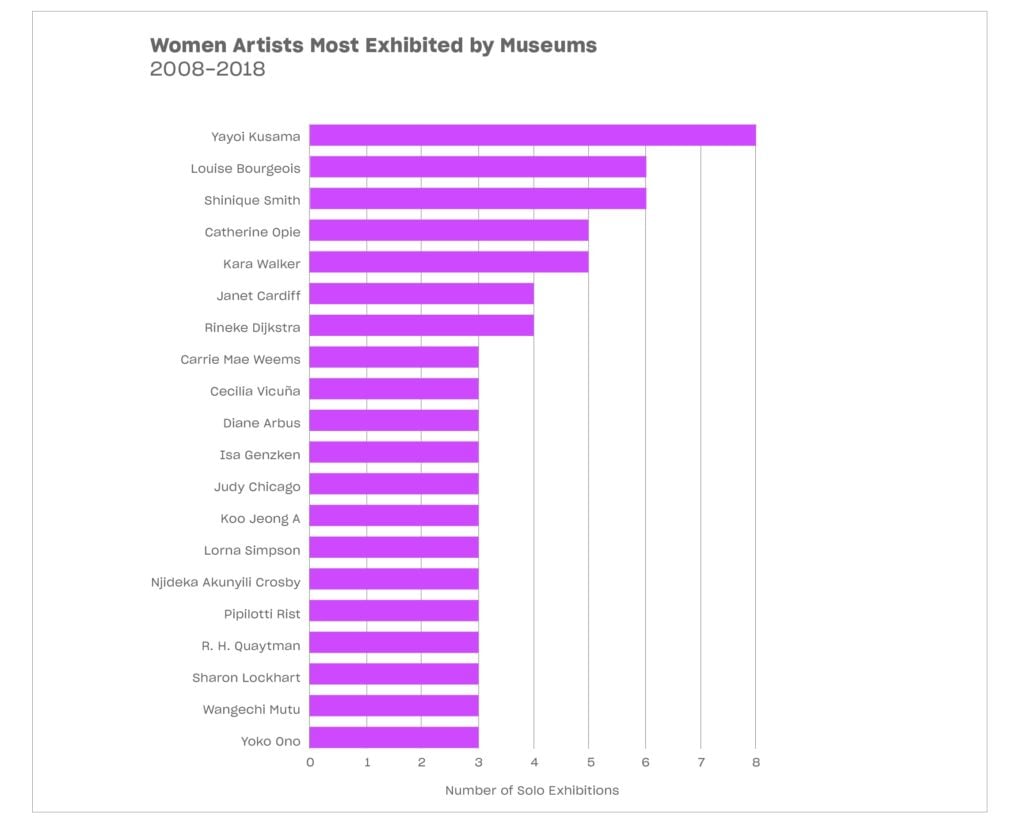
Courtesy of artnet News and In Other
Words at Art Agency, Partners.
There is a similar recognition
of the need for change at SFMOMA, where 12 percent of acquisitions
and 10 percent of exhibitions have been of work by women artists.
“We know that we have real work to do to achieve a more balanced
collection and program,” says Janet Bishop, chief curator and
curator of painting and sculpture. “That work is an explicit goal
within our new strategic plan.”
The recent $50.1 million sale of
a 1960 painting by Mark Rothko has allowed the museum to “make some
real strides within the acquisitions arena”, specifically
addressing historic gaps by buying work by artists including
Leonora Carrington, Lygia Clark, Alma Thomas, Mickalene Thomas and
Rebecca Belmore, Bishop says.
These purchases are already
reshaping the way the museum tells the stories of major art
movements. “Up until a few years ago, our Surrealist gallery
included most of the major male figures associated with the
movement but no paintings by women—we didn’t have any,” Bishop
says. Today, the gallery features two works by Dorothea Tanning and
one by Kay Sage.
The Quota Question
Such moves have been
controversial among those who believe that privileging one group
over another might lower the quality of the program or hamstring
curators. “I’m worried the focus is skewing things to the point
where we end up looking at artists in a gendered way rather than in
terms of quality,” says the gallerist Dominique
Lévy.
But others say that part of the
reason the art world lags behind other sectors in dealing with
issues of gender representation is because there is little external
pressure and “no formal
commitment, or metric by which
to measure success,” says Mia Locks, senior curator at the Museum
of Contemporary Art, Los Angeles.

Guerrilla Girls’ Do Women Have to be
Naked to Get into the Met. Museum? (ca. 1989). Courtesy of
Cooper Hewitt.
By contrast, public scrutiny and
the #MeToo movement have helped drive change more quickly in film
and other creative industries. The Academy of Motion Picture Arts
and Sciences has committed to reaching gender parity by next year;
just seven years ago, its membership was 77 percent
male.
“I think we are going to have
conversations that are uncomfortable for a lot of people about
quotas,” says artist Micol Hebron. “There has been a quota of more
men than women for centuries.”
Some museum leaders are on
board. “I do believe in quotas,” says Morgan. “If change is not
happening, then set yourself some goals.”
Real Change vs Illusions
A younger generation is not only
more open to, but is also actively pushing for, this kind of
radical change. The #MeToo movement “was a real wake-up call for a
younger generation who want to see equity in very specific ways,”
says Butler—who was at the forefront of an earlier push for
recognition of women artists when she curated the landmark
exhibition “WACK! Art and the Feminist Revolution” at MOCA, Los
Angeles, in 2007. “They will demand something even more strongly
than we did.”
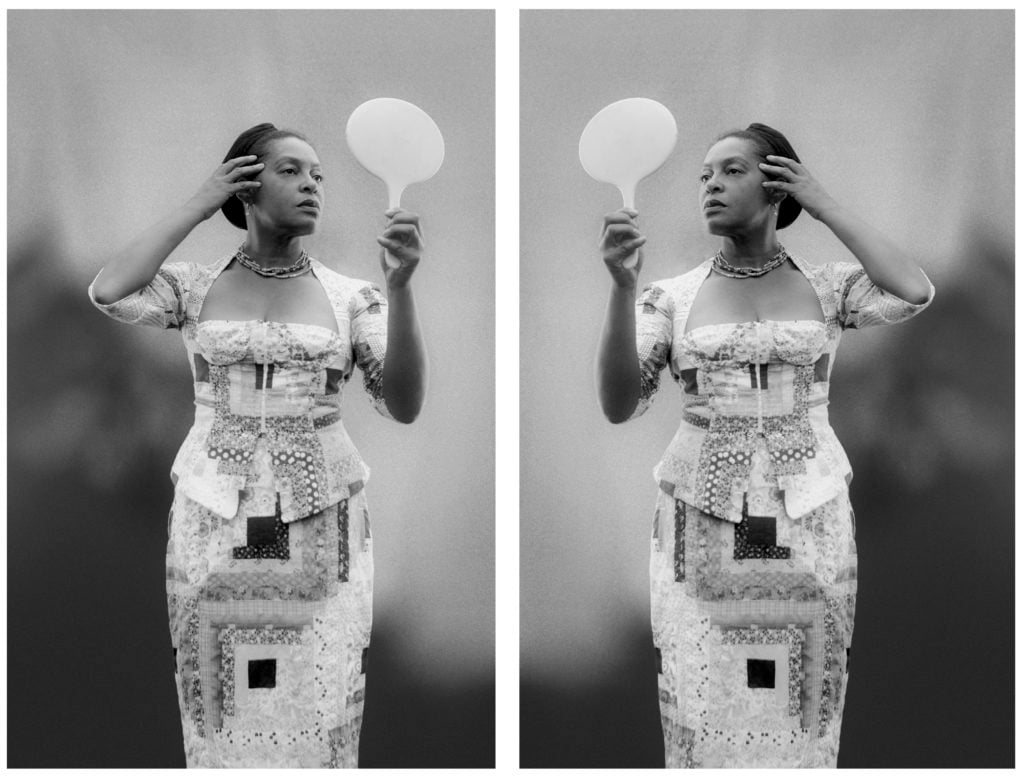
Carrie Mae Weems, I Looked and Looked
to See What so Terrified You from the Louisiana Project (2003).
Courtesy of the artist and the Nasher Museum at Duke
University.
But given the current perception
gap between people’s sense of progress and the reality about the
discernible lack of it, perhaps one of the key takeaways is that
the stories we tell ourselves—about our museums and our
societies—are not to be trusted. Institutions that are creating
change say it is important to dig deeper and question more. “Don’t
accept the first story. Or even the second or the third,” Morgan
says. “It is only through repeated research that you get to
understand what it is that you are looking at.”
The first step towards
“addressing the problem is acknowledging where we actually are
rather than where we perceive ourselves to be,” Locks says. “Then
we can begin the real work of change.”
This story is part of a research project on the presence of
work by female artists in museums and the market over the past
decade. For more, see our examination of the
market; four case studies on
museums making change; visualizations of our
findings; our investigation into
maternity leave in the art world; art-world reactions to
the data; and our
methodology.
Research by Julia Vennitti.
The post Museums Claim They’re Paying More Attention to
Female Artists. That’s an Illusion. appeared first on artnet
News.
Read more https://news.artnet.com/womens-place-in-the-art-world/womens-place-art-world-museums-1654714
Further reading


Leave a comment