
The Art World Is Considered a Progressive Place, But It Has a Big Blind Spot: Supporting Working Mothers

Curator Nikki Columbus made headlines last year
when she sued MoMA PS1 for discrimination after the
museum’s leadership allegedly rescinded a job offer upon learning
that she had recently had a baby. Although the case was ultimately
settled out of
court this March, the publicity surrounding it brought
widespread attention to an often overlooked bias in the art
industry—against pregnant women and new mothers.
Some say the discrimination they experience is outright; others
say it is more insidious, woven into the fabric of workplaces built
under patriarchal conditions that often fail to value men as
fathers and mothers as workers.
Despite study after study showing that substantial maternity
leave is good for both businesses and women alike, many
companies—both within and outside the art world—continue to operate
as if less is more. In America today, only 18 percent of working
mothers receive paid maternity leave, according to a National Compensation
Survey last year. And while mothers lose 4 percent of
their hourly wages for every child they have, fathers of the same
age and job status see their wages rise by 6 percent, according to
a 2014 study from the University of Massachusetts, Amherst.
These problems are amplified in the art industry, which is
largely composed of non-profits and small, private businesses that
lack human resources departments, and of artists and freelancers
(curators, writers, studio assistants) who may receive no benefits
at all. While the Family and Medical Leave Act of 1993 gave all
employees the right to take up to 12 weeks unpaid, it is not
enforceable for employers with fewer than 50 staff members—which
accounts for most art businesses and organizations.
And yet, despite its lack of security, the art industry
remains competitive, with no shortage of workers who are highly
educated, able to travel, and willing to keep up with a demanding
calendar of evening events. Quietly, though, many parents are
starting to ask themselves the true cost.
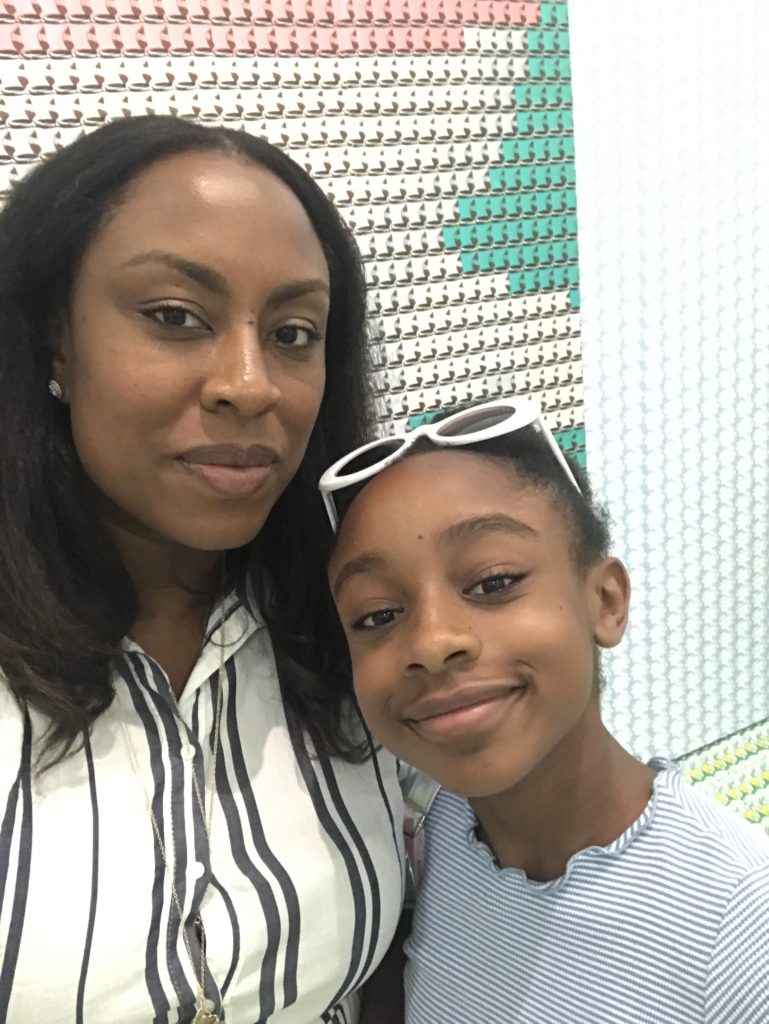
Art publicist Tiana Webb Evans and her
daughter Maya at the New Museum.
HR or No HR?
Researchers note that there are business incentives to offer
paid leave and other accommodations to new parents. Studies show
that women who receive maternity leave are 93 percent more likely
to return to work within a year than those who do not. Turnover
rates also plummet when companies offer more generous leave
packages.
When Google increased its parental leave from 12 weeks to
18 weeks, for example, it cut by half the rate at which new mothers
quit. “When we eventually did the math, it turned out this program
cost nothing,” wrote Laszlo Bock, Google’s former senior vice
president of people operations, in his 2015 book Work
Rules! Insights from Inside Google That Will Transform How You
Live. “The cost of having a mom out of the office for an
extra couple of months was more than offset by the value of
retaining her expertise and avoiding the cost of finding and
training a new hire.”
But there are few Googles in the art world. Many larger
organizations, such as museums, do have clear parental leave
guidelines in place, but the policies vary widely. Benefits also
depend on where the business is located, since the rules in London
are very different from those in New York or Los Angeles.
The Museum of Contemporary Art in Los Angeles, for example, has
the most robust policy of the museums we surveyed, with up to 28
weeks of unpaid leave for mothers and up to 12 weeks for fathers,
who can both apply for reimbursement of their full wages from the
state.
New Yorkers now have added benefits provided by the New York
State Paid Family Leave Act, which took effect in 2018 and applies
to private employers of any size. The law requires employers to
give new parents 10 weeks of paid family leave at 55 percent of
their average weekly wage (a rate that increases to 60 percent in
2020).
At the Whitney, new parents receive four weeks of paid
parental leave at 100 percent of their salaries, plus an additional
six weeks of paid medical leave. “The Whitney is dedicated to
providing opportunities for staff to spend time with their families
and loved ones, particularly during critical periods such as the
arrival of a new child,” the museum said in a statement.
Nonetheless, these policies are meager compared to those
mandated in almost every other developed nation: the time off
tallies less than the first three months of a child’s life.
The situation is even worse for the many art workers employed by
small and mid-size galleries, which often make up policies as they
go, usually not considering it until there is a need. “Maternity
leave policy in galleries seems to be uncharted territory for the
most part—it’s almost like you have to cross your fingers and hope
the gallery is sympathetic,” said Elisabeth Sann, a director at
Jack Shainman Gallery. Her employer did not need to create a
maternity policy until she got pregnant. In the end, the gallery
gave her 12 weeks of paid leave and she used an additional three
weeks of sick days and vacation time.
For gallery owners, the situation is tricky. New York gallery
owner Rachel Uffner resumed working almost immediately after her
child’s birth: “I make all the decisions and content for the
gallery so something like taking a strict maternity leave would
never be possible,” she said. Nonetheless, as business owner, she
has more freedom now: “My working hours are flexible.”
Sean Kelly, too, gave one employee who recently gave birth—his
daughter, Lauren—three months fully paid leave, which she
considered generous. “Sean is British so he strongly believes in a
more European approach to maternity leave (as well a healthcare
coverage and retirement plans),” she said. Still, the time off lags
behind that offered by European counterparts (in the UK, new
mothers are entitled by law to return to their job after a full
year off work if they choose; not all of this time is paid).
In other countries, new parents also do not have to negotiate
with their employers, a considerably less stressful arrangement.
Many in the US art world feel beholden to their bosses. Holly
Shen received 12 weeks of unpaid leave at the Brooklyn Academy of
Music, where she served as director of visual arts from 2013 to
2018. She recalled feeling “more or less pressured into being
available on-call by phone during my maternity leave—a request that
in some roles or positions is appropriate but that in hindsight
felt a bit exploitative.” By the time she had her second child, in
2017, she had more seniority, and BAM, which had undergone a change
in leadership, gave her fully paid leave.
Nevertheless, she said, “the onus is still on women to figure it
out for themselves.” Shen notes that her current employer, the San
Jose Museum of Art, offers no paid leave for new parents. “It’s
painful to be in a leadership position and not see any clear path
to achieving this,” she said.
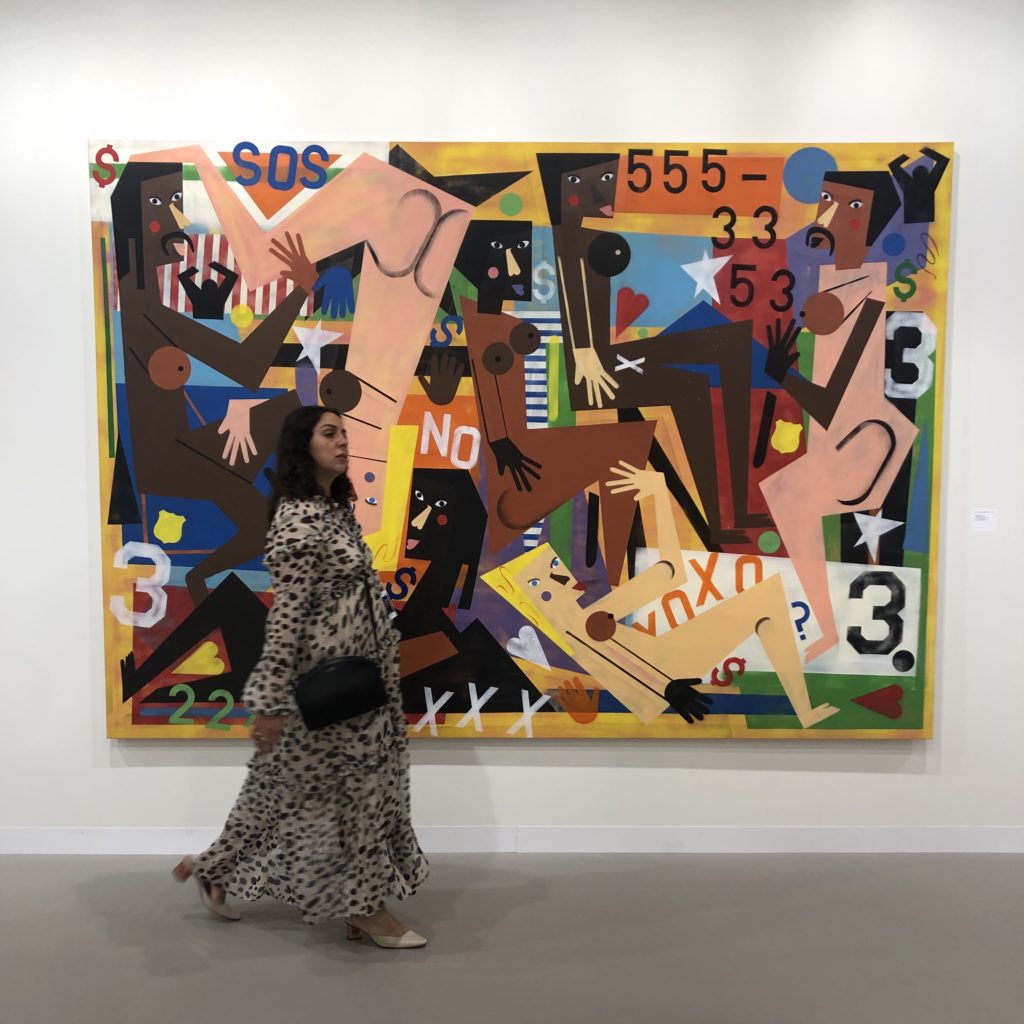
Elisabeth Sann, pregnant with her second
child, in front of a Nina Chanel Abney painting at Art Basel
2019.
An ‘Industry of Vampires’
Many women note that the art industry—which prizes both seeing
and being seen—often feels inhospitable to people with families.
“We are an industry of vampires because so much of the ‘real’
business happens at night or when you are out of the city on
business trips,” said art publicist Tiana Webb Evans, a mother of
three.
This can put all parents at a professional disadvantage, with
women often disproportionately bearing the burden. “I get
incredibly jealous of my male counterpart artists who seem like
they can roam forever out into the world because they have a wife
at home to take care of the child,” said artist Catherine Opie. She
has a son and stepdaughter with her wife, artist Julie Burleigh,
and says they share parenting responsibilities 50-50. “It’s not
about money, it’s about parenting, and what it is to be a parent is
to be present.”
Women who do strive to maintain a public presence often find
that the system does’t support them. Elisabeth Sann attended last
year’s Art Basel Miami Beach the week after she returned from
maternity leave. “Looking back on it, it sounds nuts that I went
down there, but I think it forced me to get back into the right
frame of mind,” she said. “I may miss out on opportunities because
I’m not out there as much as I used to be.”
It was during that fair that she realized she would have to stop
breast-feeding—the process was too difficult on the road. “I had
tried to call the convention center to see if they had dedicated
pumping rooms and couldn’t get an answer, so I would have had to
lug the pump and a cooler with ice packs to the fair, probably
leave it at the coat check because we don’t build our booths with
closets, hope that the bathrooms had an electrical outlet, and then
somehow carve out three 20-minute breaks during a fair at which I
normally don’t even have the time to eat or go to the bathroom,”
she recalled. “Plus, the day extends far beyond fair opening hours.
You have breakfast meetings, dinners, parties—you’re out of your
hotel room for 18-hour stretches.”
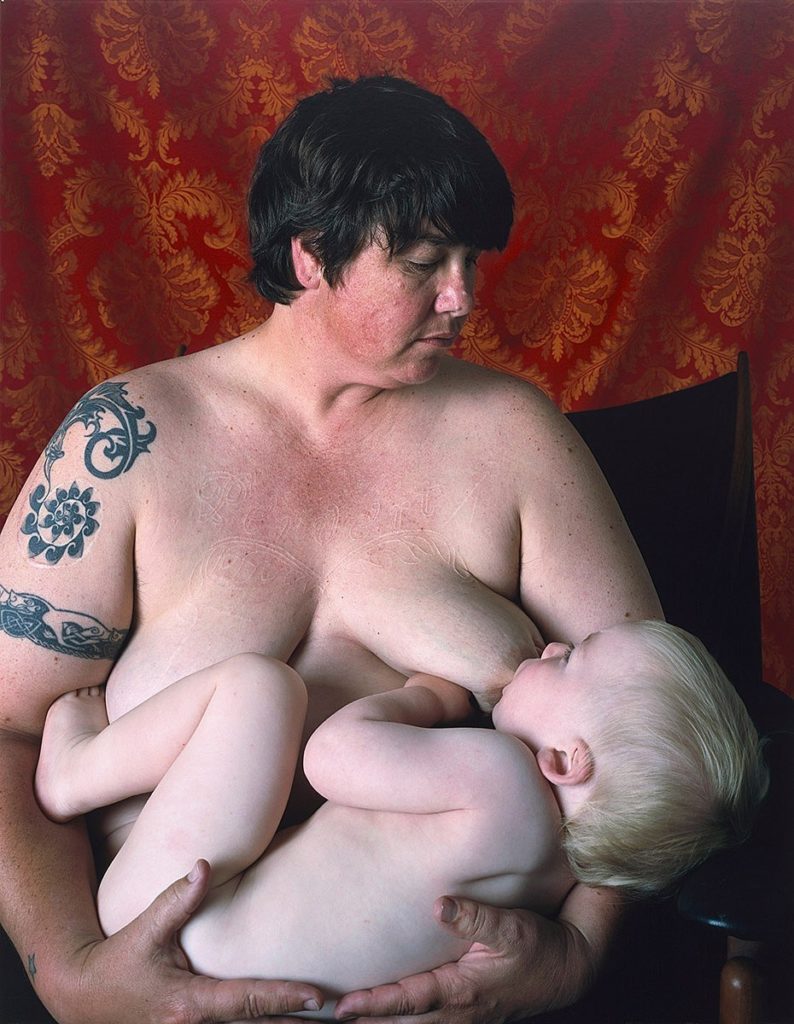
Catherine Opie,
Self-Portrait/Nursing (2004). Courtesy of Solomon R.
Guggenheim Museum, © Catherine Opie.
An Invisible Problem
Pumping—when to do it and where—was among the most common
grievances women interviewed for this story expressed. Those who
have not personally breast-fed may have no idea, for example, that
it can take hours each day, that it must be done at set intervals,
that it can be noisy and messy, and that bathrooms are never
acceptable places for a woman to pump or breastfeed.
“I wish I had more information or resources about nursing
or support for pumping while working,” said Shen, who felt
“resentment and annoyance” from colleagues when she needed to take
time to pump.
“I don’t think everybody realizes that when people come back
form maternity leave, yes they’re back, but they’re also pumping,”
noted Whitney Museum curator Rujeko Hockley, who gave birth to her
son in February, in the midst of curating the 2019 Whitney
Biennial. “That has to be part of the ways companies look at family
policies. The times you pump are set. It’s your internal body
schedule, based on when you fed your baby last. There’s actually
not as much flexibility as people might think. I actually can’t go
any time.”
That’s why Hockley and other new mothers working at the Whitney
have created an Outlook calendar to coordinate meetings around
their pumping schedules. The museum also has a dedicated lactation
room with a sink and a refrigerator. “I know people in the art
world who’ve said, ‘I pumped in the broom closet, or the bathroom,’
which is not hygienic,” Hockley said.
That would be illegal nowadays in New York City, which passed a
law in 2018 requiring all
businesses with four or more employees to provide a room devoted
solely to breastfeeding and pumping, and to allow employees the
time to do so. But most states and cities do not mandate a
lactation-only room in workplaces. Federal US law only requires
employers to provide a private space that is not a bathroom, which
could mean a manager’s office, an area behind a screen, a supply
room, or even a tent.
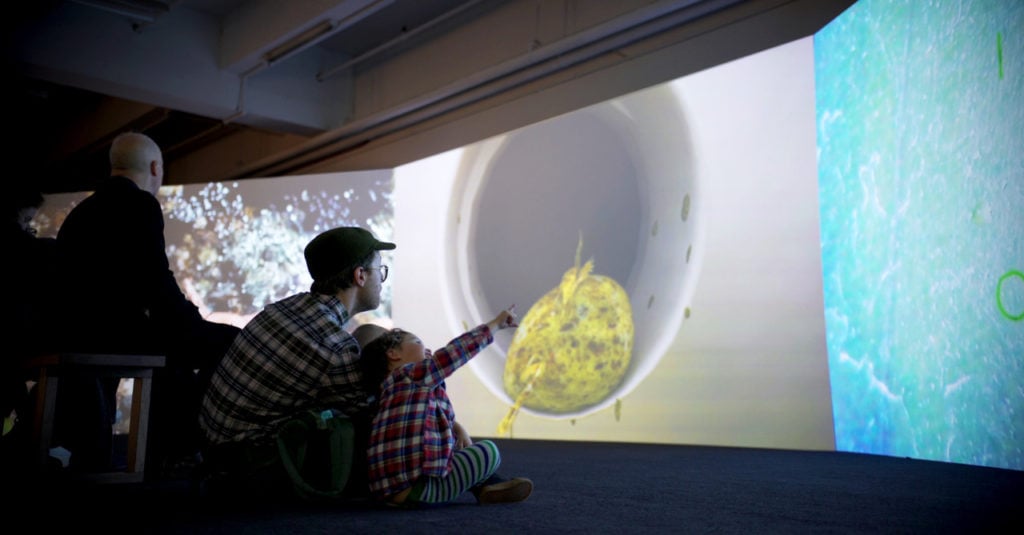
Holly Shen’s partner, artist Jeff
DeGolier, and their son, Hewitson Shen-DeGolier, looking at Eva
Papamargariti’s Precarious Inhabitants at NADA New
York. Courtesy of TRANSFER and Hellions Studio.
The Most Precarious Position of All?
Artists, who often receive few or no parenting or
healthcare benefits, are among the most vulnerable workers in the
industry. In the wake of having children, many report grueling
schedules, taking on side jobs that provide a more stable
income, and losing time to make art.
“I found it isolating, and the conflict between my son’s needs
and my need to work was intense, especially in the early years,”
said artist Moyra Davey, who edited the 2001 collection of essays,
Mother Reader: Essential Writings on Motherhood. Davey
started reading the essays that would later appear in the book
after giving birth to her first baby in an effort “to break the
isolation, for inspiration to keep going and to do better, for the
gratification of seeing my own experience so vividly mirrored,” she
wrote in the book’s introduction.
Because artists often do not work a traditional nine-to-five,
they also tend to be the ones who compromise when parenting needs
arise. “When my children were very young, I would stay home and
watch them in the day, working late into the evenings,” said artist
Nicholas Galanin, who has six children. “It was a challenge and I
ended up often working through dinner until 2 a.m., waking at 7
a.m. to watch them.”
Even the most successful artists describe making career
sacrifices to mitigate fears of financial insecurity. “I didn’t
want to rely on the art market to make sure I could provide for my
family,” Opie said. That’s why she has been teaching for three
decades, first as an adjunct and now as a tenured professor at
UCLA. “Teaching was always my way to being a parent because if it
didn’t work out through the art world then I always had a job with
health insurance,” she said.
Now, to help ease the burden on other working mothers, Opie has
instituted a kind of bring-your-baby-to-studio policy for her own
assistants who have young children. “I knew from being a mom how
hard it is just to completely go back to work and turn your baby
over to daycare,” she said. That’s why she built a diaper changing
area and a baby-friendly zone in her studio for assistants to bring
babies that are up to six months old. “It’s worked out great,” she
added.
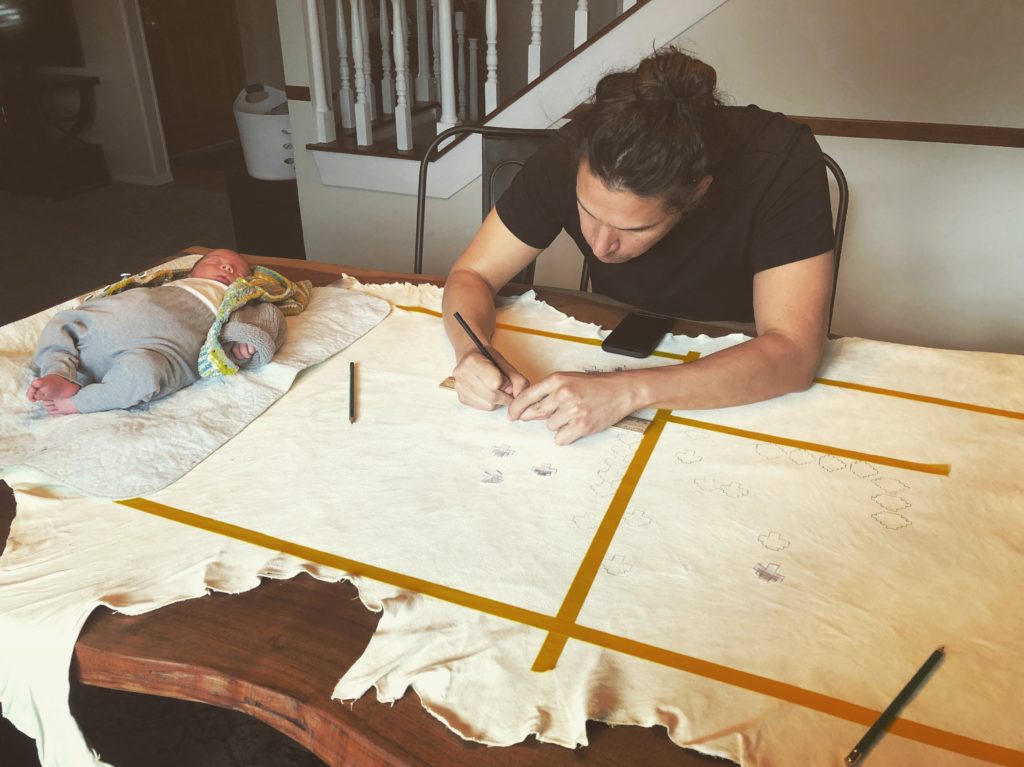
Artist Nicholas Galanin with his baby at
his home studio in Alaska. Courtesy of Nicholas Galanin.
An Ongoing Battle
No matter how workers in the art industry might creatively
balance their families and careers, sometimes the barriers are
beyond their control, and pregnancy discrimination remains a
serious problem.
Sann recounts seeing first-hand at previous gallery jobs “how
pregnant women or mothers were pushed aside or looked over for
opportunities. I once heard a gallery owner make a remark to a
pregnant woman about how much she was eating, implying she was
starting to look a little fat.”
Both federal and state laws in the United States forbid
discrimination against pregnant people, and the New York City Human
Rights Law singles out caregivers as a protected group as well.
(This is not the norm for caregivers in most states, however,
including California.) Job-seekers in the US are also not obligated
to disclose their pregnancy to would-be employers, which could lead
to discriminatory hiring decisions.
That’s a lesson Shen learned the hard way. “I was
interviewing for a gallery job and when I disclosed I had a small
infant at home I could instantaneously see that the gallerist did
not want to hire someone who had to worry about childcare,” she
said. “I think the statement was something to the effect of ‘well,
this job requires a lot of flexibility in the evenings, which could
be difficult for you.’ After that, for a long time, I stopped
telling anyone professionally that I was a mother.”
Shen’s account is strikingly similar to Columbus’s allegations
against MoMA PS1 last year. In her lawsuit, Columbus said the
museum offered her a job as associate curator of performance and
that, during the final negotiations over pay and start date, she
revealed that she had recently had a baby. The museum’s chief
curator Peter Eleey told her, according to her complaint, “Why
didn’t you tell me this two months ago?”
A few days later, the museum’s chief operating officer wrote to
her: “We are sorry that we are unable to tailor the position on the
terms you have proposed.”
Columbus says she is still experiencing fallout from the
incident. “When MoMA PS1 discriminated against me, I wasn’t just
left without a job, but an entire career path,” she said. “There
aren’t a lot of performance curator positions in New York, and
they’re generally either too entry-level or require more
experience.”
As part of the terms of her settlement earlier this year, she
says that the museum “had to commit to critical anti-discrimination
guidelines and trainings as well as other policy changes.”
In a statement, a spokesperson for MoMA PS1 said the museum
always complied with the law and has not made any changes as a
result of the settlement: “MoMA PS1 is committed to a work
environment in which all applicants and employees are treated with
respect and dignity. We have not, and will not, discriminate in
hiring or promotion based on pregnancy, caregiver status, or
gender—or any other characteristic protected under the law. Our
practices and policies have been at all times compliant with the
law. No changes were made to our practices as a result of the
settlement.”
The spokesperson did not respond when asked to clarify the
discrepancy between the museum’s and Columbus’s versions of the
settlement terms. Columbus maintains that she settled “precisely
because MoMA PS1 agreed to finally put in place policies that
would protect their employees. Whatever MoMA PS1 might claim their
practices were, they did not, in fact, have anything written down
that would inform employees of their legal rights.”
Today, Columbus is still looking for a job. “I’m not exactly an
unknown quantity—I’ve worked as an editor for 20 years, and I think
news has spread that I need a job,” she said. “But only one person
in the New York art world has approached me about a position.”
This story is part of a research project on the presence of
work by female artists in museums and the market over the past
decade. For more, see our examination of museums;
our examination of the
market; four case studies on
museums making change; visualizations of our
findings; art-world reactions to
the data; and our
methodology.
The post The Art World Is Considered a Progressive Place,
But It Has a Big Blind Spot: Supporting Working Mothers
appeared first on artnet News.
Read more https://news.artnet.com/womens-place-in-the-art-world/maternity-leave-parenthood-art-world-1613179
Further reading


Leave a comment