
Female Artists Represent Just 2 Percent of the Market. Here’s Why—and How That Can Change

When a female artist made
auction history last October, a man nonetheless managed to steal the
limelight. Five bidders had vigorously pursued British artist
Jenny Saville’s 1992 painting of a fleshy female nude, at
Sotheby’s, pushing the price to £9.5 million with fees ($12.5
million) and setting a world record for a living female artist. Yet
attention was swiftly diverted when onlookers noticed that the
final lot of the evening, Banksy’s Girl With Balloon (2006), had suddenly begun to shred
itself. By the following morning, the self-destructing Banksy
was international news, while Saville was a historical
footnote.
With or without fanfare, the sum
paid for Propped was still less than 14 percent of the record for a living
male artist at auction: $91.1 million for Jeff Koons’s
Rabbit (1986), set last May at
Christie’s.
Such disparity is the rule, not
the exception. According to a joint investigation by
In Other Words and artnet News—which together gathered and analyzed data from
international auctions, leading galleries and the Art Basel fair—it
is clear that the art market overwhelmingly finds greater value in
work produced by men than that made by women.
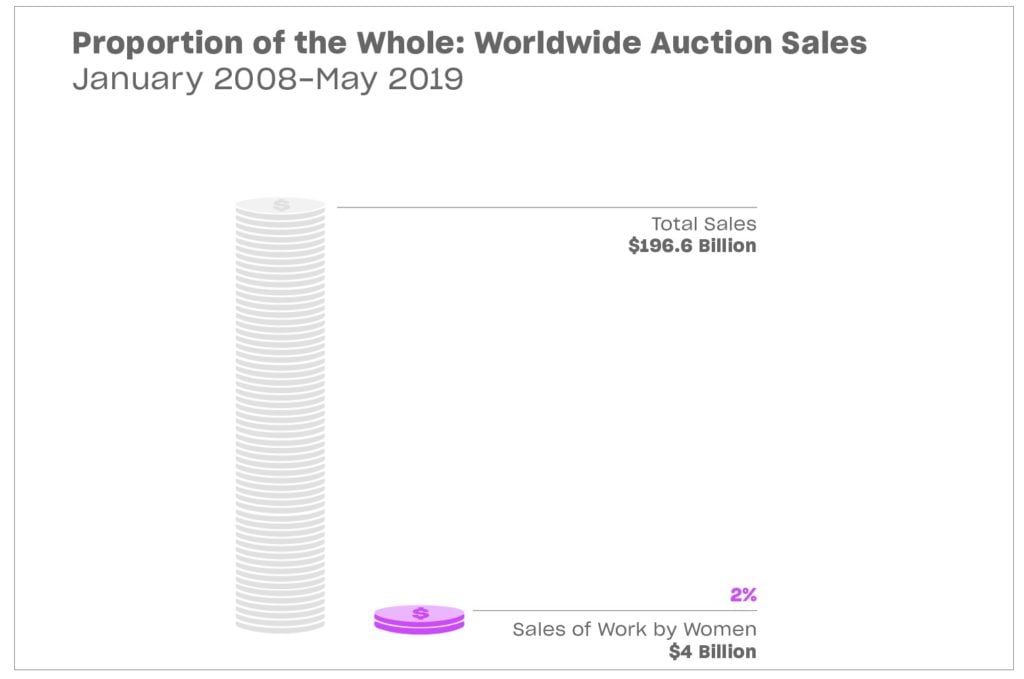
More than $196.6 billion has
been spent on art at auction between 2008 and the first five months
of 2019. Of this, work made by women accounts for just $4
billion—around 2 percent. For context, works by Pablo Picasso
generated $4.8 billion at auction during the same period, more than
the total spent on every
single female artist in
our data set combined—almost 6,000 women.
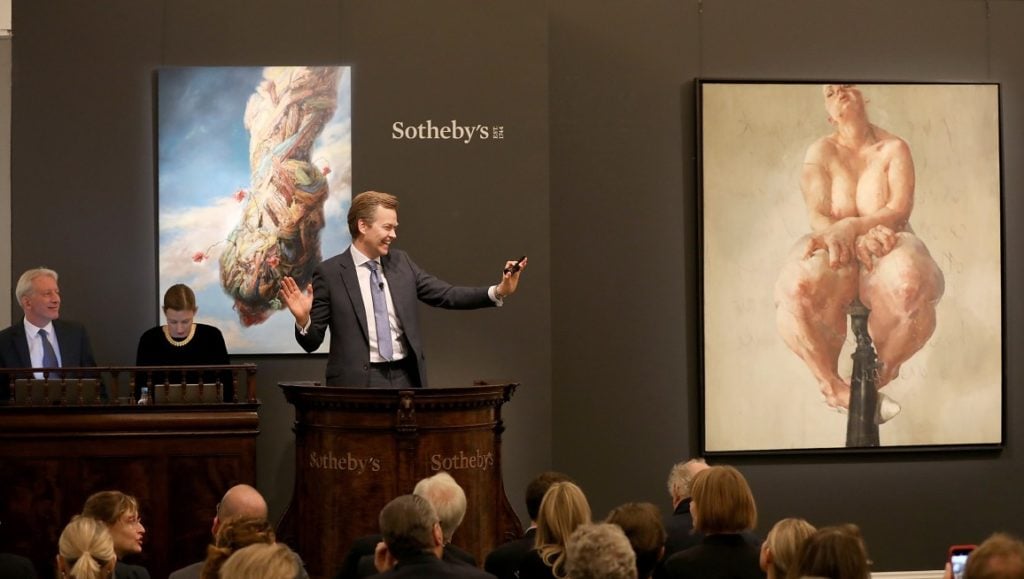
Jenny Saville’s Propped led the
Sotheby’s London auction in October 2018. Image courtesy
Sotheby’s.
Artists themselves are painfully
aware of these discrepancies. “I know the world is the way it’s
shown to be in your numbers,” says photographer Catherine Opie, who
is in the top 25 female artists collected by US museums, according
to our data. “I have done well in my career but, at the same time,
there is no comparison with my male counterparts. The men do so
much better than I do because they rule the roost in relationship
to capitalism. They are still the default go-to for collecting by
museums and the market.”
The Winner-Takes-All Dynamic
The market for art by women is
not only smaller, it is also disproportionately concentrated on a
few artists. Just five account for $1.6 billion of the $4 billion
total spent on work by women over the past 11.5 years. That 40.7
percent market share was split between, in descending
order, Yayoi Kusama, Joan Mitchell,
Louise Bourgeois, Georgia O’Keeffe, and Agnes
Martin.
By contrast, sales are
distributed far more equitably among male artists. The top five
(Pablo Picasso, Andy Warhol, Zhang Daqian, Qi Baishi, and Claude
Monet) account for just under a tenth (8.7 percent) of the total
$192.6 billion spent on work by men at auction since
2008.
“The numbers are devastating,”
says Hauser & Wirth vice-president and partner Marc Payot. “We
think we are going in the right direction, but the perception has
changed more than the reality. If you take away the top five female
artists, in essence, nothing has changed.”

Clockwise: Louise Bourgeois, Yayoi
Kusama, Joan Mitchell, Georgia O’Keeffe, Agnes Martin. Composite ©
artnet News, courtesy Getty Images.
Buyers are still reluctant to
pay high prices for work by female artists, says Marina Gertsberg,
a visiting research scholar at Yale University’s School of
Management. Furthermore, she says, what is known as the “superstar
effect”—whereby a small number of elite artists generate a
disproportionate amount of the profits—is “even stronger for
minorities like female artists or African American artists. Within
those groups, competition is even greater because those minorities
are competing even more for the few spots on top.”
The disparity is particularly
flagrant when one considers the impact female artists have had on
male artists—and, indeed, the entire history of art. Allan
Schwartzman, chairman of Sotheby’s Fine Art Division, notes that
the work of female artists, particularly those active during the
women’s movement of the 1960s and ’70s, changed the language of
art. “Before the women’s movement,” he says, postwar American art
“couldn’t be psychologically vulnerable, personal, diaristic,
fragile, tender, self-revealing, small, colorful, eccentric,
handmade. Since then, much of the most valued contemporary art is
many of these things.”
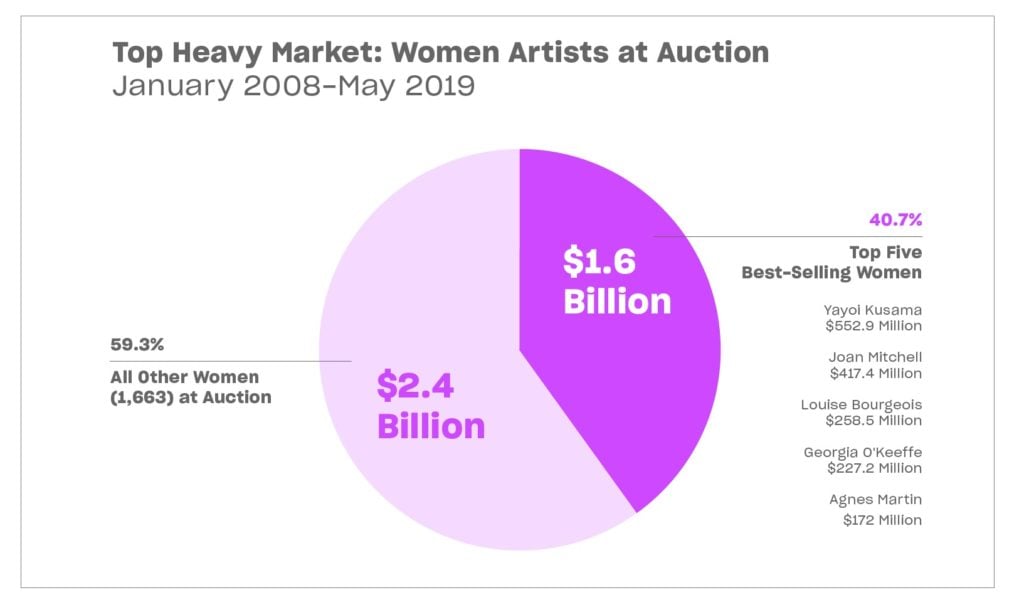
Courtesy of artnet News and In Other
Words at Art Agency, Partners.
Schwartzman adds that “even the
most muscular of male artists of these decades, like Richard Serra,
openly acknowledge the vast impact of women artists on their own
work. This is one of the great unspoken hypocrisies of the art
market. And one of its silliest oversights.”
Gallery Representation and Revenue
Galleries also bear
responsibility for correcting these biases. “There is a structural
issue in that galleries don’t represent enough women in their
programs. You need to educate collectors,” Payot says. “You need to
confront them with quality.”
We surveyed some of the leading
galleries about the number of female artists they represent and the
proportion of sales those artists bring in. The figures were
significantly ahead of auction results—though not anywhere near
parity.
“These are important artists of
the 20th century, and collectors are realizing that if they don’t
have the right painting in their collection they’re not telling the
story properly,” says Bellatrix Hubert, senior partner at David
Zwirner. The gallery’s 66-artist roster is 29 percent female (19
out of 66), but those women (including market heavyweights Yayoi
Kusama and Joan Mitchell—both in the auction top five—as well as
Marlene Dumas, whose market ranks 13th among the best-selling
female artists at auction) account for 39 percent of the gallery’s
total sales.
At the international galleries
Pace and Lisson, female artists and estates bring in a
disproportionate amount of revenue: almost a quarter of the artists
at Pace are female (21 percent or 19 out of 92, including Agnes
Martin—the fifth best performing female artist at auction), but
they account for more than a third (39 percent) of overall sales. A
fifth of Lisson’s artists are female (20 percent or 13 of 65
artists, including Marina
Abramović and Carmen
Herrera), and they account for around a third of all sales, the
gallery estimates.
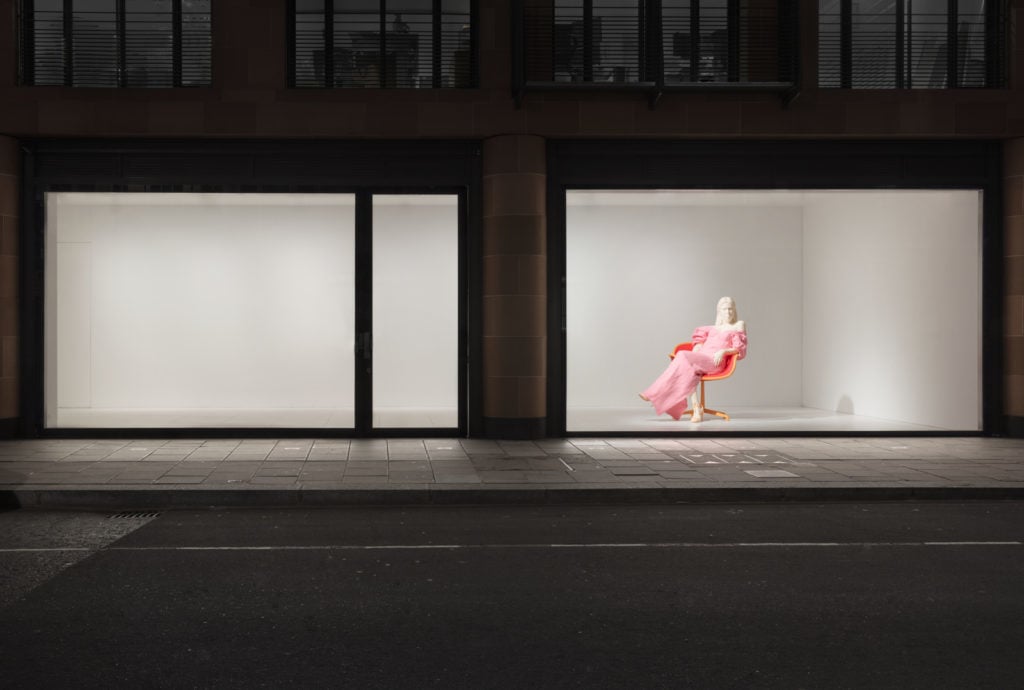
Urs Fischer’s Dasha (2018).
Photo: Stefan Altenburger, courtesy the artist and Gagosian.
Of the 88 artists and estates
represented by Hauser & Wirth, 30 are female (34 percent) and they
account for 33 percent of the gallery’s sales, Payot says.
Representing female artists is in the gallery’s DNA, partly a
function of the interests of its co-founder, Ursula Hauser, and
partly borne of necessity. Now one of the world’s leading dealers,
with locations around the globe, Hauser & Wirth began “operating
out of an off-place, marketwise, in Zürich, so to get access to
fantastic art wasn’t that easy,” he says. “But women were
under-represented and undervalued in the market, so for us it was
an opportunity.”
Artist Micol Hebron, who has
tracked the representation
of women on gallery rosters since 2013, points out that many
galleries that profess to promote equality still fall short: “A
65-35 ratio is repeated over and over—that’s still almost twice as
many men as women,” she says.
At the Art Basel fairs, the
leading industry events that take place annually in Basel, Miami,
and Hong Kong, the numbers are even lower. Women made up less than
a quarter of the artists on view at these fairs over the past four
years, according to an analysis of the lists that galleries
submitted of the artists they planned to bring.
The under-representation in
galleries and art fairs has an impact on the long-term prospects of
women’s markets: if they sell fewer works on the primary market,
then their secondary markets will necessarily be
inhibited.
Limiting Markets From the Get-Go
Bias is built into the way works
are priced. The value of a work of art is usually decided by
drawing a comparison with artists from similar eras or schools. But
in market transactions, women artists are siloed.
While men are compared with other
artists that have similar profiles and trajectories, some market
players say it is common practice to compare women only with each
other. “We always go to female artists as opposed to an
artist who has a similar trajectory,” Hubert says.
“We tend to create the
comparisons but limit the possibilities from the get-go. Everyone
does this. We really need to stop.”
These kinds of prejudices are
built into the system, and often go unnoticed. “I don’t think
people are even conscious of the bias, they just accept it,” says
Mary Sabbatino, partner at Galerie Lelong. She says her career has
been shaped by the fact that she has chosen to champion artists on
the margins. “I knew it was going to be a lot more difficult than
if I had developed an expertise in mid-century heroes, but I’ve
worked so long in this area that it seems quite normal to me to
encounter resistance. It doesn’t discourage me to hear some
unconscious misogyny or disrespect,” she says. On the contrary,
“there is a deep satisfaction when an artist who has been
under-recognized takes center stage. There is no revenge like
success.”
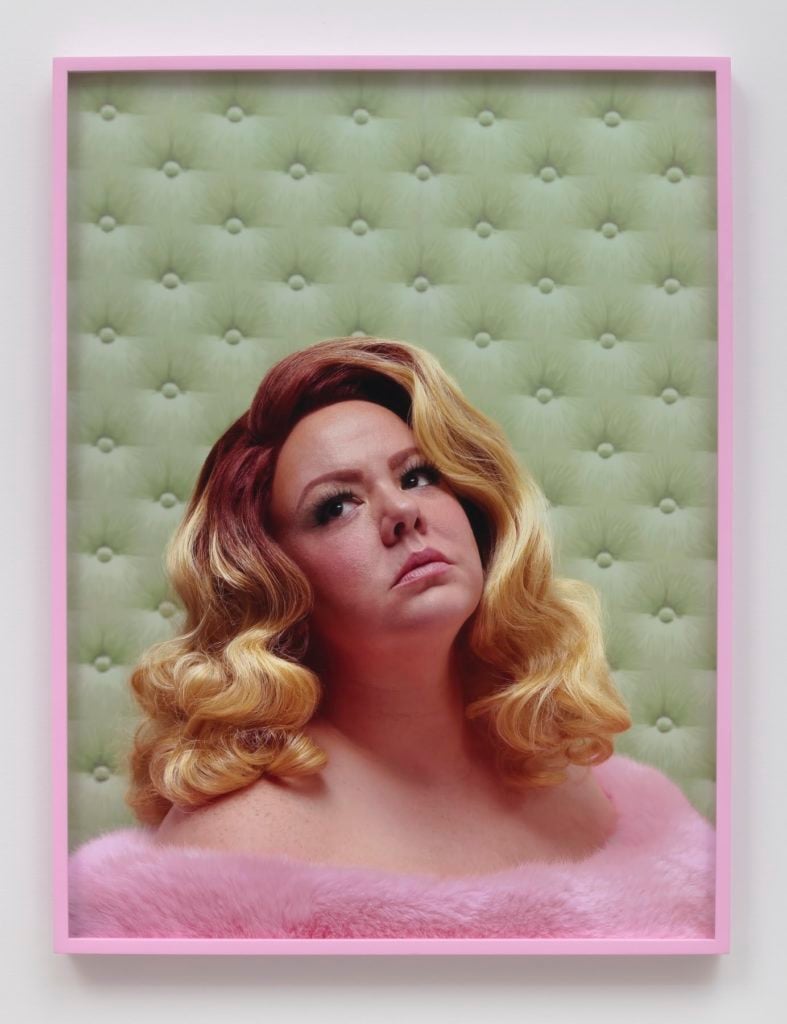
Genevieve Gaignard, Ladybirds (I’m a
Canary), (2019). Courtesy the artist and Vielmetter Los
Angeles. Photo: Robert Wedemeyer.
Such outright sexism has not
been limited to artists. Lisa Dennison, the chairman of Sotheby’s
Americas and a former director of the Guggenheim, points to
generations of female curators who “didn’t fight for female artists
because they were just happy to be curators in major
museums—usually under male bosses.” She notes that the great female
gallerists who emerged during the 1980s and ’90s did not fight to
build stables of women artists, either. “They had to prove they
could hold their own against the male dealers,” she
says.
The 2000s were not much better.
LA gallerist Susanne Vielmetter founded her business at the start
of the new millennium and says that, for the first decade, “you
couldn’t tell a collector that you counted the number of female
artists in museum shows or in your gallery program. People would
think you either had some kind of early childhood trauma—that there
was something psychologically damaged about you—or that you were so
hopelessly stuck in the 1990s identity-politics era that you simply
couldn’t be helped,” she says. “At least we are having the
conversation now.”
Hello, Bias? It’s Me, the Art Market
Dealers, collectors, and others
cite many reasons why the market for work by women remains
disproportionately small: there were fewer female than male artists
working until the 20th century; women have made art that is less
easily commodified than that made by men; there is less research
published on the work of women, which makes it more difficult to
create value around them.
But there is also ample evidence
of an even simpler explanation: bias. Academic studies have
found larger price gaps between male and female artists in
countries in which there is more gender inequality. The correlation
“suggests that it’s not the quality of the art that matters,” says
Renée Adams, a professor of finance at Oxford University. “It’s
discrimination.”
Courtesy of artnet News and In Other
Words at Art Agency, Partners.
Our cultural understanding of
what artistic genius looks like is still overwhelmingly
male.
This belief system was evident
in a study Adams conducted in 2017, which found that wealthy men in
particular tend to have a lower regard for art by women. She asked
2,000 participants to rate computer-generated paintings that were
randomly assigned fictitious male and female names. Wealthy
men—especially those who said they visit an art gallery at least a
few times a year, and therefore were more likely to collect
art—consistently rated works with female names lower than the
rest.
These prejudices absolutely
“become self-reinforcing,” according to New York gallerist
Alexander Gray, who says the situation is exacerbated at
high-stakes art fairs. Dealers are more likely to place
lower-priced work by female artists further back in their booths or
inside closets rather than on the most visible “money walls.” The
calculation is: “That wall cost $100,000, so I need to make
$300,000 back,” Gray says.
Change Ahead?
All hope is not lost. Although
it remains a tiny slice of the whole, the market for work by women
is experiencing an upward trend, more than doubling from $230
million to $595 million in the decade since 2008. That’s a rate of
growth faster than the art market as a whole, which increased by 72
percent over the same
period.
Data suggests this shift is
taking hold in some parts of the world more quickly than others.
Notably, the only Art Basel fair to have consistently grown the
proportion of female artists on view over the past four years is
the Hong Kong event, which
went from 21.1 percent women artists in 2015 to 26.5 percent last
year. Both the Swiss and US fairs peaked in 2017 before dropping
last year to around a quarter each, falling behind the Asian
city.
Perhaps not coincidentally,
China is home to more than half the world’s female self-made
billionaires. The fact that women now have their own independent
sources of money is a historical anomaly—one that could go on to
shape the market. “The notion that a female collector can walk into
a gallery and spend $200,000 on a work for her collection is
radically new,” Vielmetter says. “Thirty or 40 years ago, female
collectors were either married to wealthy men or inherited money
from their dads. The notion that you could be a wealthy CEO and
have enough dough to spend on art was unimaginable.”
This is beginning to create
subtle shifts in the dynamic. “I have had more collectors telling
me they are only collecting women artists than ever before,” says
Joeonna Bellorado-Samuels, a director at Jack Shainman Gallery.
“It’s only three or four instances, so not exactly a wave, but five
or eight years ago I would never had heard of people actively
trying to build collections just with women artists—and in some
instances women of color.”
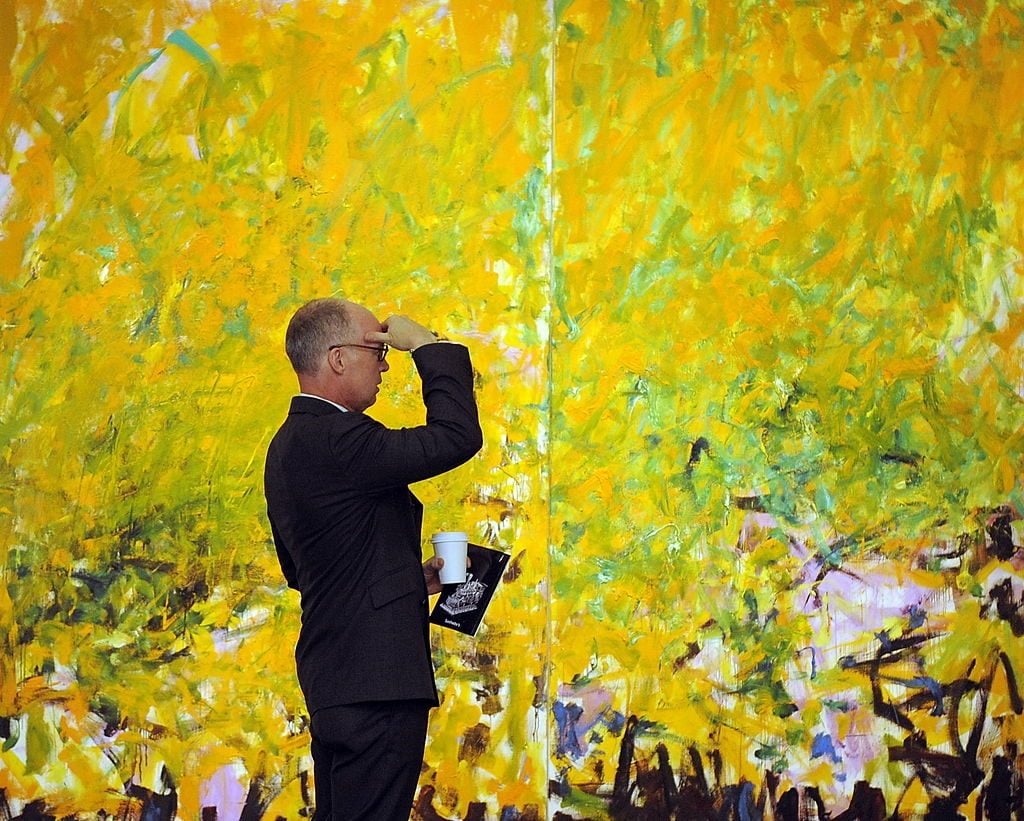
Joan Mitchell’s “Two Sunflowers” at
Sotheby’s New York. Photo: Timothy A. Clary/AFP/Getty Images.
There are also signs that the
market value for work by women will continue to grow significantly
in the near future. Recent data commissioned by In Other Words from Sotheby’s Mei Moses index, which tracks
the art market through repeat sales of objects at auction, reveals
that work by women is outperforming that by men
when it returns to the auction block. According to the findings,
prices for female artists’ work that sold at auction more than once
over the past six years increased by 72.9 percent, compared to a
much more modest 8.3 percent for repeat sales by male
artists.
This marks a change from the
previous 50 years, when resale markets for both performed roughly
in parallel (albeit at different volumes). The findings show
deepening auction traction for work by women, especially those who
have received some commercial validation in the past. But, as Amy
Cappellazzo, chairman of Sotheby’s Fine Arts Division,
says, “It would be much better for
female artists to trend at 9 percent and have many more artists in
that trending pool.”
Like any overlooked area of the
market, art by women represents an opportunity. “Our research
suggests that you can get high-quality art at a bargain price,”
says William Goetzmann, a finance professor at the Yale School of
Management. “Now is a great time to be rebalancing your
collection.”
In recent years, the art world
has witnessed an “incredible herding around a few female artists
because collectors and museums have been very conservative, playing
follow-the-leader as if it is a big popularity contest,” Goetzmann
says. But he believes that some enterprising players are bound to
break the mold soon: “And then there is going to be a gold rush
because some wonderful art and phenomenal artists have been
neglected.”
None of this is likely to
happen, however, until more equity is given to women (or taken by
them). Asked whether she feels women have more seats at the table
today than they did a decade ago, Dennison laughs: “Not the tables
I’m sitting at.” The fundamental balance of power has yet to
radically shift. As Vielmetter points out: “You can have moral
conversations about the market but first of all we need to be able
to sit at the big table with the big guys and eat that cake too.
Then we can talk about what we want to do next.”
This story is part of a research project on the presence of
work by female artists in museums and the market over the past
decade. For more, see our examination of museums;
four case studies on
museums making change; visualizations of our
findings; our investigation into
maternity leave in the art world; art-world reactions to
the data; and our
methodology.
Research by Julia Vennitti.
The post Female Artists Represent Just 2 Percent of the
Market. Here’s Why—and How That Can Change appeared first on
artnet News.
Further reading


Leave a comment