
Christie’s Kicks Off Frieze Week With a Bang With the $28 Million Sale of British Businessman Jeremy Lancaster’s Collection
Christie’s kicked off a busy series of
Frieze Week contemporary art sales in London this evening with the
collection of Jeremy Lancaster, a British businessman who died in
April. The 53 lots were estimated at £13.7 million to £19.5 million
($16.8 million to $24 million) and 48 of them sold for £23 million
($28.2 million). (Sale prices include the buyer’s premium;
estimates do not.)
Attendance was good considering the
Frieze fairs open tomorrow and the capital was awash with parties
and gallery events. This sale had been perceived as a mainly modern
British art sale, but bidders from 25 countries from four
continents registered, 30 percent of them from Asia.
Lancaster began
collecting art in his early 40s, five years after he became
managing director of Wolseley, a heating and plumbing firm. His
first purchase was a painting by Patrick Caulfield from Waddington
Galleries. Over the next 10 years he bought steadily from London
galleries—eleven of them, to be exact— buying primarily British
art, including Howard Hodgkin and Bridget Riley. By the 1990s,
Lancaster’s loyalties cemented with Leslie Waddington who took him
on a more classic international path, buying works by Philip
Guston, Josef Albers, Pablo Picasso, and Alberto Giacometti. The
pace and twin direction of the collection continued until about
2006, when he bought his final Hodgkin (he owned five), this one
from Gagosian Gallery.
Guston’s paintings don’t often turn up
in London auctions, but this collection had two late works in his
cartoonish figurative manner whose market history demonstrates how
tastes have changed. Language 1 was painted in
1979, and had gone unsold twice before Lancaster bought it from
Waddington in 1995. In 1987 it had been in the Whitechapel Art
Gallery sale, masterminded by Nicholas Serota before he went to the
Tate, with a £45,000 ($55,300) estimate; and in 1993 it went unsold
in New York with a $200,000 low estimate. Now, with a £1.5 million
to £2 million ($1.7 million to $2.5 million) estimate, it attracted
bidding from the Acquavella Galleries and others before selling to
a phone bidder for £3.8 million ($4.7 million), making it the top
lot of the sale.
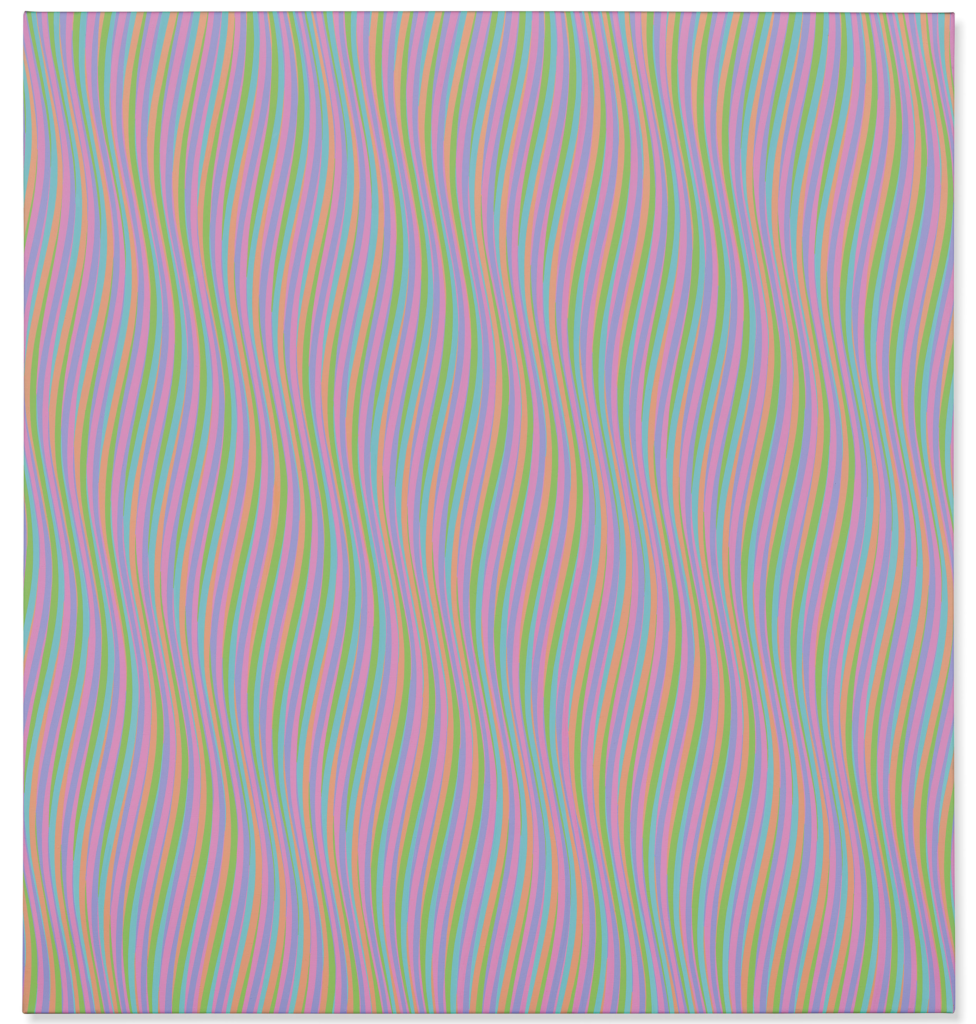
Bridget Riley, Orphean Elegy 7
(1979). Courtesy of Christie’s Images Ltd.
A smaller, late Guston work showing
two hooded figures had been bought by Lancaster in New York for
$40,250 in November 1994 and saw a healthy return for his estate as
it sold for a double estimate £1.1 million ($1.4 million).
The other main result for American art
was a classic 1962 red Study for Homage to the
Square by Josef Albers that saw competitive bidding from
David Zwirner before selling on the phone for a double estimate
£1.6 million ($2 million). Former Waddington Managing Director, Tom
Lighton remembers Lancaster often joking that he’d paid the gallery
too much for the Albers – until in 2014, a similar red square
painting sold for close to 1 million pounds. That was more than 15
times what he paid, said Lighton, so the joke ended.
On a par estimate wise with the big
Guston work was an undulating, colored Op Art painting, Orphean
Elegy 7 (1979) by Bridget Riley, whose market has
improved consistently over the years. She has joined the David
Zwirner stable and, with a major retrospective traveling from the
Edinburgh Arts Festival to the Hayward Gallery in London later this
month, the painting attracted a posse of international phone
bidders before selling for £2.8 million ($3.5 million)—probably the
best price for a painting in color by Riley, as opposed to her
earlier black-and-white works.
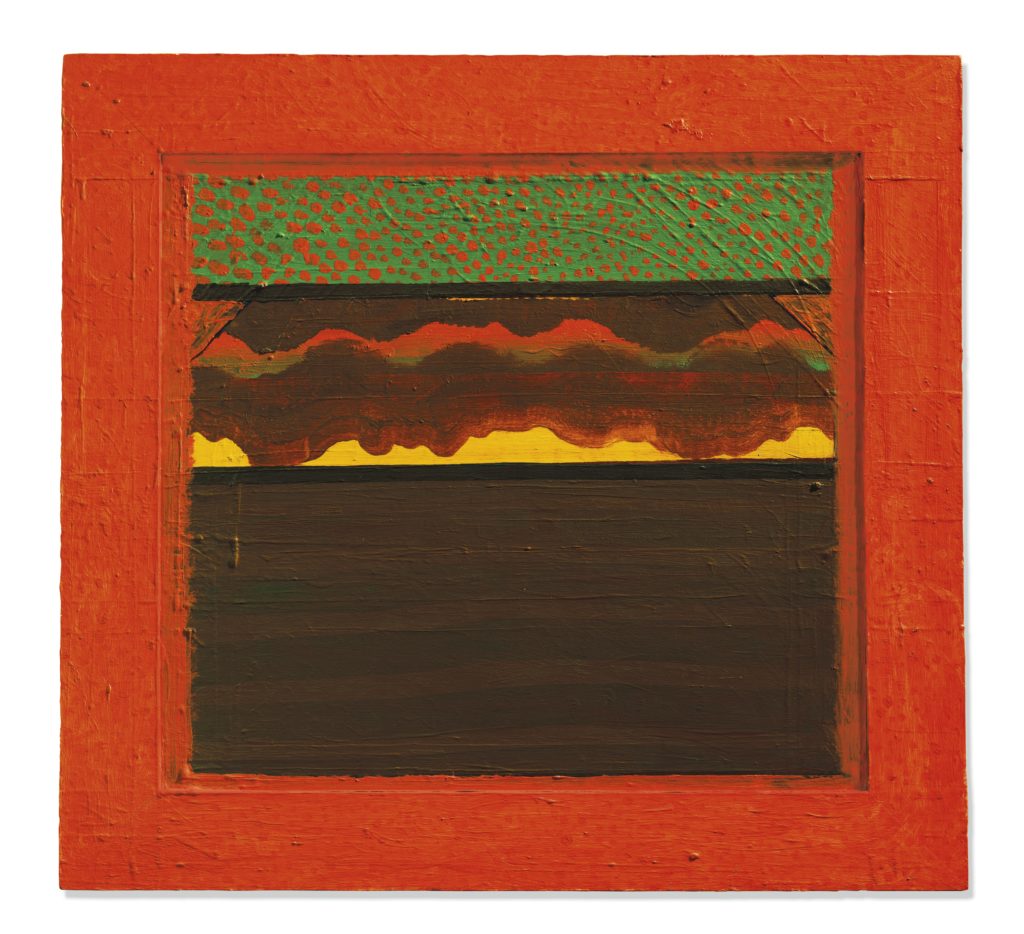
Howard Hodgkin, Bombay Sunset
(1972-3). Courtesy of Christie’s Images Ltd.
Lancaster’s strongest suit was in
Howard Hodgkin, a much-loved British artist whose poetic
color-drenched compositions that flowed out over their frames never
quite cracked the international market, despite Gagosian’s best
efforts later in his life. Five works went under the hammer this
evening and four sold.
An orange framed Bombay
Sunset (1972-3) saw unpredicted bidding from Victorian
art specialist Martin Beisly, who was seated with an Asian client,
but he was outgunned by a phone bidder who won it at a mid-estimate
£731,250 ($899,200), the most expensive of the five. Although that
was far from a record, a Hodgkin record for a gouache on card (more
a work on paper than an oil on canvas or board) was set when the
very early, futuristic Tea Party in
America (1948) sold to British art advisor Wentworth
Beaumont for a triple estimate £250,000 ($307,000).
Modern British art dealer James
Holland-Hibbert persevered to buy Hodgkin’s small
oil Venice Sunset above estimate for
£371,250 ($456,500) and Beisly finally won another Hodgkin
work for his client, taking a heavily dabbed Mrs
C (1964), below estimate for £225,000 ($276,700).
The best return for a British artist
in the collection was for Frank Auerbach’s thickly encrusted early
portrait, Head of E.O.W. (1955). Lancaster
bought it in 1996 for £54,300 ($66,700) and it sold this evening to
Simon Stock of Gagosian Gallery near the high estimate for £1.2
million ($1.5 million).
Of the foreign artists, apart from
Guston, a Picasso sculpture, bought from Waddington in 1998, sold
to London’s Pyms Gallery below estimate for £899,250 ($1.1
million), and a Morandi still life, the only Italian work in the
sale, sold to Milan dealer, Giulio Tega at a top estimate £731,250
($899,200).
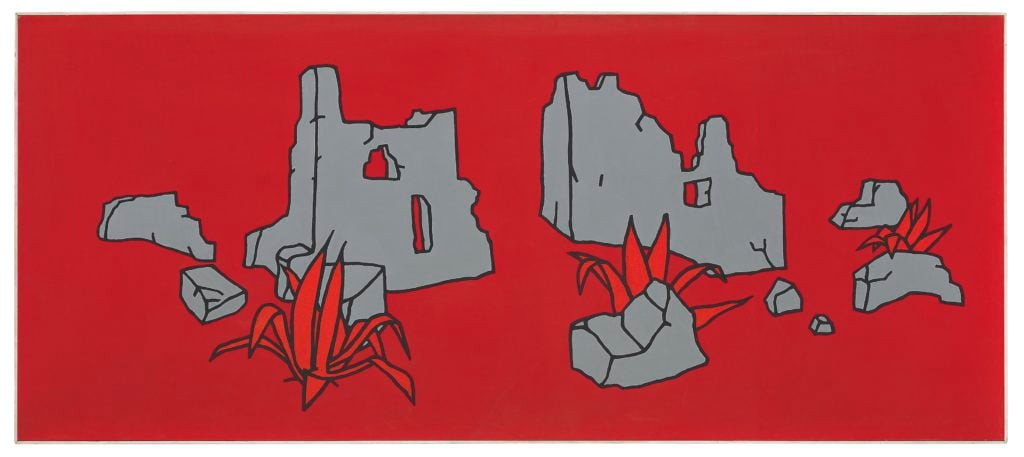
Patrick Caulfield, View of the
Ruins (1964). Courtesy of Christie’s Images, Ltd.
Lancaster had three works by Patrick
Caulfield, an artist who resisted the “British pop” label that had
been bestowed upon him, one each from the 1960s, ’80s, and
noughties. Caulfield has slightly slipped from view since his death
in 2005, though the David Bowie sale in 2016 chalked up a record
for him of £665,000 ($817,700). The artist is currently the subject
of a mini retrospective at London’s Waddington Custot gallery,
where prices range up to£ 490,000 for a large early work.
At Christie’s the gallery bought
Caulfield’s Rosso (2001), a small, late work of
a bottle of wine lit by a bright lamp, above estimate for £137,500
($169,000). A larger and earlier 1964 painting of ruins graphically
outlined against a red background was estimated at £250,000 to
£350,000 ($307,400 to $430,300) and was chased by Beisly, but it
sold above estimate again for £491,250 ($604,000)—one of the
highest auction prices for Caulfield.
Overseas dealers were in a minority at
the sale, but some were in the running. Apart from those already
mentioned was Michael Haas from Berlin who underbid on a small
painting by Giacometti and bought an unusual 1940s Jean Dubuffet
gouache of three standing nude women above estimate for £287,250
($353,200), as well as a playful abstract work by British artist
Roger Hilton on the high estimate for £62,500 ($76,800).
Mopping up some other British
abstraction was art advisory Gurr Johns, which snagged a 1966 Color
Field painting by John Hoyland (who’s the subject of a survey show
at Tate Britain currently) for £68,750 ($84,500), and a
historically significant abstract work by Victor Pasmore (made
shortly after he relinquished figuration, around 1948) for a double
estimate £200,000 ($245,900).
The collection also included some all
but forgotten names, such as Lisa Milroy, a Canadian figurative
painter whose repeated imagery was well regarded in London in the
mid-1980s when the work on sale tonight, Three
Skirts, was bought—before the arrival of the YBA’s.
Although Milroy’s auction prices have perked up to reach £35,000
($43,000) this was tamely estimated at £5,000 ($6,100) and sold,
after some underbidding from Waddington Custot, for £16,250
($20,000).
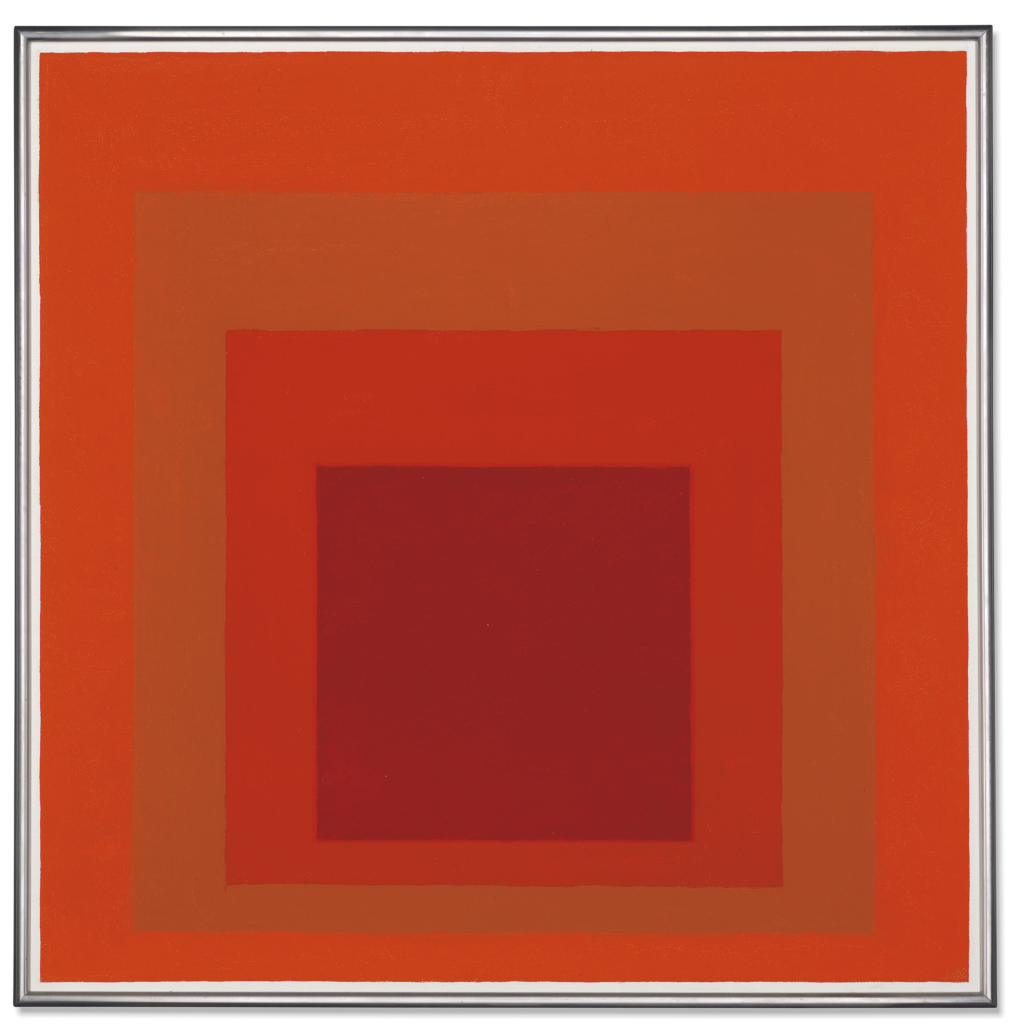
Josef Albers, Study for Homage to the
Square: Red Tetrachord (1962). Courtesy of Christie’s Images
Ltd.
A strange fit into this painterly
collection was a conceptual drawing by Art & Language. From a
series of works critiquing museum displays and
acquisitions, Index: Incident in a Museum(i) is
in fact a drawing of the inside of what is now the Met Breuer in
New York. It had been an early buy in 1985, soon after the work was
made, and seemingly the only one Lancaster made from the Lisson
Gallery. The British artists have neither courted nor been courted
by the art market. Their dealer, Nicholas Logsdail, might beg to
differ, but this work attracted no bids and went unsold with a
£20,000 ($25,000) low estimate.
All told, the sale was a great
success, if not quite the “electric launch” to Frieze Week that
Christie’s had claimed. Certainly Lancaster’s family, and Tom
Lighton, who advised them, should be extremely happy with the
result. The sale also helped, as dealer Robert Travers said upon
exiting, to put the more contemporary end of modern British art on
the map. He and 53 other dealers will be exhibiting works by some
of these artists at the British Art Fair in the Saatchi Gallery,
which opens on Thursday.
The post Christie’s Kicks Off Frieze Week With a Bang With
the $28 Million Sale of British Businessman Jeremy Lancaster’s
Collection appeared first on artnet News.
Read more https://news.artnet.com/market/christies-lancaster-sale-1666876
Further reading


Leave a comment