
What Makes Someone Attack a Work of Art? Here Are 9 of the Most Audacious Acts of Art Vandalism—and What Inspired Them
What could possibly motivate someone to try and destroy a work
of art? One might imagine that art vandals must be suffering from
some form of mental instability, but in many cases works are
targeted for a reason, often political, and the aesthetic
aggressors aim to get their cause in the headlines by trashing a
cultural treasure. (They might succeed with the latter, but we
don’t yet know of any acts of art vandalism that have changed
public policy.)
Here, we’ve outlined eight of the most egregious art attacks and
rated them on a scale of one to five, taking into account the
severity of the attack, the likelihood of successful restoration,
and the perpetrator’s audacity.
1. Barnett
Newman’s Who’s Afraid of Red, Yellow, and Blue III
(1967–68)

Barnett Newman, Who’s Afraid of Red,
Yellow and Blue III (1967-68). Courtesy of the Stedelijk Museum
in Amsterdam.
When and Where: 1986 and 1997; the
Stedelijk Museum in Amsterdam
Whodunit? A disgruntled 31-year-old
painter named Gerard Jan van Bladeren
What and Why? The story of this painting’s
multiple attacks has been so widely publicized it has spawned both
a documentary, titled The End of Fear, and an episode of Roman
Mars’s podcast “99 percent Invisible.” The painting itself
shocked audiences when it first debuted at the Stedelijk
Museum in Amsterdam—the massive size (almost 18-feet wide and
eight-feet tall) was compounded by the fact that the seemingly
endless red canvas is interrupted by just two lines of colors, blue
and yellow, that Newman called “zips.” The museum received letters
describing visitors’ disgust and dismay that the institution would
deign to show such a work, which in their opinions fell firmly into
the category of “my kid could do that.”
The painting was the pièce de résistance in a show in 1986 that
purported to pose questions about what, in fact, does constitute
art. One man in attendance, Gerard Jan van Bladeren, was adamant
that this painting did not. He stormed into the museum with a box
cutter and ravaged the canvas. He was sentenced to five months in
prison, but some in the community agreed with him, with
one writing to the museum that “this so-called
vandal should be made the director of modern museums.”
Aftermath and Legacy: Conservator Daniel
Goldreyer, who had worked with Newman during his life, spent four
years restoring the canvas—but he actually ruined it by painting
over the entire thing with house paint.
In 1997, van Bladeren returned to the museum and when he
couldn’t find Red, Yellow and Blue III, he turned to
the closest Newman he could find, Cathedra, and
slashed it with a small blade. The museum’s press office said van
Bladeren didn’t like “abstract and realist art,” but in interviews
with Dutch radio, he claimed that he was just returning to finish
the job he had started 11 years earlier.
Vandalism Rating:  This painting has
suffered enough.
2. Auguste Rodin’s The Thinker (1881)

The bombing victim: Rodin’s Le
Penseur at the Cleveland Museum of Art.
When & Where: 1970, outside of the Cleveland Museum of
Art
Whodunit? No one was ever
arrested for the crime, but there were rumors that it was the work
of the radical activist group Weather Underground.
What and Why? In the
early morning hours of March 24, 1970, an explosion shook the large
cast of Rodin’s most famous sculpture, knocking off the lower legs
and damaging the statue’s base with the force of what authorities
imagined to be three sticks of dynamite.
Though no one was injured in the
blast, the brazen act of violence brought the community, like the sculpture, to
its knees. If Weather Underground is to blame—and we’re just guessing here—then perhaps the
radicalized group of students protesting the war in Vietnam
targeted the work as a symbol of the elitism of those in
power.
Legacy and Aftermath? Officials at the museum considered a few
options after the bombing, but since it was damaged to such an
extent, any alterations would have compromised the artist’s
original intent. In the end, the museum opted to keep what was left
of the work on display without repairs—ensuring that anyone who
visited would know the sad history of the pensive
figure.
Vandalism Rating:
3. Anish Kapoor’s Dirty
Corner (2011)

People look at the graffiti on Anish
Kapoor’s Dirty Corner in Versailles. Courtesy of
Versailles Patrick Kovarik/AFP/Getty Images.
When and Where: Once,
twice, maybe three times in 2015 and 2016, but it depends on who’s
counting; The lawn of
Versailles
Whodunit? We don’t know, but Anish Kapoor called one of the vandalizations an
“inside job”
What and Why: The
cavernous sculpture, which is shaped like the mouth of a French
horn, became the center of controversy for its possible anatomical
associations, earning the unflattering nickname the “queen’s
vagina” (Marie Antoinette’s, we guess?). Kapoor assured an incensed
French public that there were a variety of interpretations, but to
no avail. After cleaning up a first attack where the work was
splattered with yellow paint, it was later scrawled with numerous
anti-Semetic slurs (Kapoor’s mother is
Jewish).
Aftermath and Legacy: Kapoor insisted that the hate-filled graffiti
should not be removed from the sculpture and instead serve as a
reminder of intolerance and racism. But after a
court case instigated by the Councillor of
Versailles—against the artist’s wishes—Dirty Corner was
ultimately covered in gold-leaf.
Vandalism Rating:
4. Rembrandt’s The Night
Watch (1642)
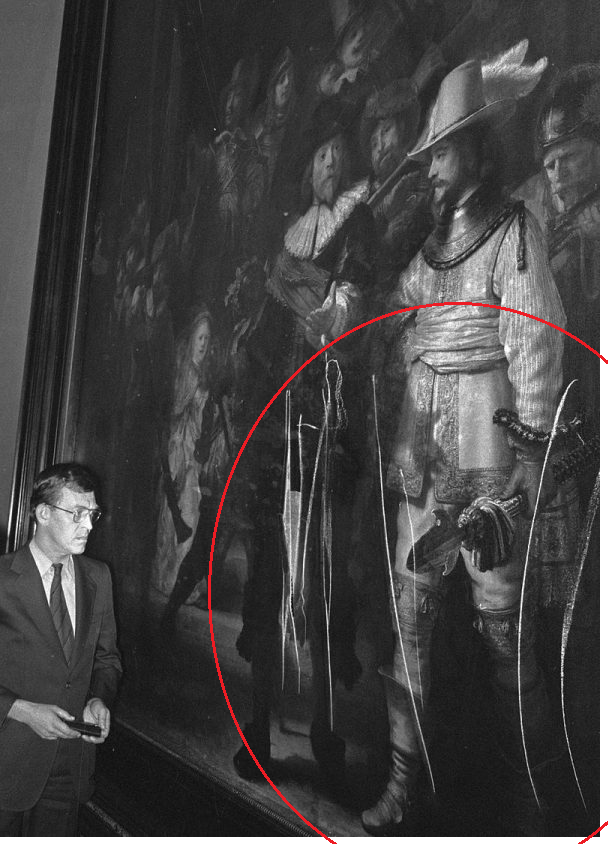
The scarred surface of Rembrandt’s
The Night Watch after the second attack. Courtesy of the
Dutch National Archives.
When & Where: 1911, 1975,
1990; the Rijksmuseum in Amsterdam
Whodunit? An unemployed
chef, a former school teacher, and an escaped psychiatric
patient
What and why? Rembrandt’s
colossal depiction of the Militia Company of District II under the
command of Captain Frans Banninck Cocq is by all accounts an exceptional work of Dutch
Golden Age painting that defies earlier, more boring compositions.
Rembrandt was able to capture the feeling of excitement within the
company using dramatic light and shadow, and its grand scale makes
it an imposing figure in the country’s history.
Alas, with great prominence
comes misguided attention, and this painting has become the
repository of aggression for many disgruntled museum
goers. In 1911, an
unemployed Navy chef attacked the painting with a knife, but
ultimately failed to pierce the thick varnish. (Perhaps, as artnet’s Tim Schneider posited, his
lackluster cutting abilities factored into his
joblessness.)
The second attack came on September 14, 1975, when
former schoolteacher William de Rijk walked up and began slashing
at the work before being overpowered by guards. Why, you ask? The
man shouted that he “did it for the Lord.” And he was especially
angry because he had attempted to visit the museum the night
before, but arrived after closing. De Rijk was committed to a
psychiatric institution, where he died by suicide just one year
later. His was the most effective attack on the Rembrandt,
resulting in a six-month restoration process that could not undo
the deep gashes in the canvas.
The last (and hopefully, final)
incident to befall The
Night Watch was in 1990,
when an escaped mental patient concealed sulfuric acid in a spray
bottle and aimed it at the painting. Luckily, guards were able to
quickly douse the work in water and the acid did not damage any
paint below the varnish.
Vandalism Rating:
5. Leonardo da Vinci’s
Mona Lisa (1503)
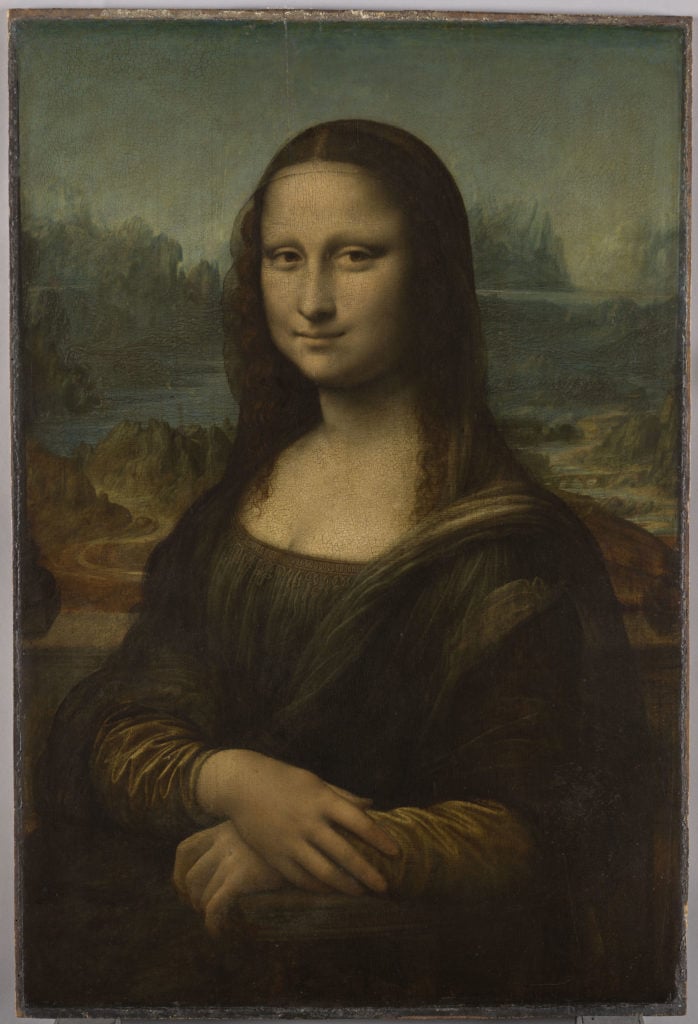
Leonardo da Vinci, Mona Lisa.
Courtesy of the Louvre.
When and Where: Twice in 1956, 1974, 2009; The Louvre and the Tokyo National Museum
Whodunit? A homeless man,
a vandal, and a Russian
émigré
What and Why? Her
enigmatic smile and knowing eyes have beguiled adoring viewers for
centuries, but the Mona Lisa has been on the receiving end of her
fair share of hatred as well. The first attack came in the winter
of 1956 when a homeless man named Hugo Unzaga Villega hurled a rock
at the masterpiece. Why? He wanted to go to prison for the warm
bed. Meanwhile, a few months prior, a vandal had tossed acid at the
iconic visage while the painting was on view in a museum in
Montauban,
France. Eighteen years
later, in 1974, a disabled woman doused the painting in red spray
paint when it was on loan to the Tokyo National Museum, purportedly because she disagreed with the
museum’s accessibility policies. The painting’s most recent assault came at the
Louvre in 2009, when a Russian woman, apparently fuming over having
been denied French nationality, flung a coffee mug at the serenely
unflinching Mona Lisa.
Aftermath & Legacy: The
addition of a case of bulletproof glass shielded the painting from
the 1974 and 2009 attacks. And in part due to its theft in 1911
(which launched her to international super-stardom) Mona
Lisa reigns unperturbed by would-be destroyers as the world’s
most famous artwork.
Vandalism Rating:
6. Michelangelo’s
Pieta (1498–99)

Michelangelo’s Pietà (ca.
1488-89) in St. Peter’s Basilica. Courtesy of Wikimedia
Commons.
When and Where: Pentecost
Sunday, May 21, 1972; The Vatican
Whodunit? Laszlo Toth, a
Hungarian-born Australian geologist
What and Why? Toth was 33
years old at the time of the incident—the same age as Jesus at the
time of his death. According to bystanders, the unwell geologist
shouted “I am Jesus Christ—risen from the dead“ before
leaning over the protective railing and striking the sculpture of
the Virgin Mary and figure of Christ with a dozen blows of a
hammer. The damage was swift and severe. The tip of Virgin’s nose
was shattered into three parts. Her left arm was snapped off and she suffered damage
to her cheek and left eye.
Aftermath and Legacy: Toth was not criminally charged for the
offense, but was declared “socially dangerous” and hospitalized in
Italy for two years before being deported to Australia. After some
discussion, the sculpture was restored in a grueling 10-year
process. But it was not without a silver lining: During the
restoration, Michelangelo’s hidden signature was discovered. Today,
the work is shown behind bulletproof glass.
Vandalism Ranking:
7. Diego Velázquez’s
Rokeby Venus (1651)

Diego Velázquez, Rokeby Venus
(1649), the victim of a suffragette attack. Courtesy of
Wikimedia.
When and Where: 1914; The National Gallery of Art in
London
Whodunit? A Canadian
woman named Mary Richardson, who was active in Emmeline Pankhurst’s
Women’s Social and Political Union, walked into London’s museum
with a concealed meat cleaver. She attacked the canvas,
successfully slashing the exposed backside of the
Venus.
What and Why? The attack
was meant to draw attention to the violent arrest of the
suffragette Emmeline Pankhurst, leader of the Women’s Social and
Political Union, which had taken place the previous day.
Richardson, a student of art, had wrestled with her choice, but
ultimately felt that targeting this representation of female beauty
was necessary and that any outrage felt about the destruction of
the representation of a woman should be outweighed by the violence
against a living one. “You can get another picture, but you cannot
get a life,” she said.
Aftermath and Legacy: The
painting was successfully restored and Richardson was sentenced to
a (maximum) six-month imprisonment.
Vandalism Ranking:
8. Pablo Picasso’s
Guernica (1937)

A guard at the Museum of Modern Art
stands watch over Picasso’s Guernica after it was
restored. Photo by Allan Tannenbaum/Getty Images.
When & Where: 1974;
the Museum of Modern Art in
New York
Whodunit? Art dealer and collector Tony Shafrazi
What and Why? Before he
became a world-class art collector, Tony Shafrazi was a gimlet-eyed
artist with dreams of changing the world. On the afternoon of April
30, he ran into the Museum of Modern Art wielding a canister
of red spray paint and
scrawled the words “KILL LIES ALL” across the Picasso masterpiece
in broad daylight, to the astonishment of visitors and museum
guards. In his fervor, he shouted “I’m an artist” to stunned
onlookers and then implored the group to “call the
curator!”
As luck would have it, a
conservator from the Brooklyn Museum had been dining in the
museum’s restaurant and was quickly dispatched from her niçoise
salad to assist.
Aftermath & Legacy: In just under an hour, the team was
able to remove the paint. A
layer of varnish had “acted as an invisible shield,” meaning that
conservators were able to erase Shafrazi’s frenzied, foot-sized
lettering swiftly. Shafrazi was arrested on charges of criminal
mischief, but still managed to become a successful art
collector and gallery owner in New York.
Vandalism Ranking:
9. Ai
Weiwei’s Colored Vase (2013)

Installation view of Ai Weiwei’s
Colored Vases (2006). Courtesy of Cathy Carver, Perez Art
Museum.
When and Where: Pérez Art Museum in Miami,
February 2014
Whodunit? Maximo Caminero, 51, a local artist
and, according to the Miami New Times, a pretty well-known
one at that.
What and Why? A spokesperson from the recently
inaugurated museum said that 51-year-old Caminero strode into the
gallery and picked up one of the many color-dipped vases by Ai
Weiwei (worth about $1 million, according to the museum) and, when
a guard asked him to put it back, Caminero threw the vase to the
ground, shattering it.
Caminero told the New Times that he “did it for all the
local artists in Miami that have never been shown in museums here.”
He added that the museums “have spent so many millions now on
international artists.” Caminero, upon learning the value of the
vase, said it was a spontaneous protest, in part inspired by Ai’s
own art: One of the artist’s most famous works, Dropping a Han
Dynasty Urn (1995), involved smashing a 2,000-year-old vase, a
cultural object he said is “powerful only because someone thinks
it’s powerful and invests value in the object.” The vases in Miami,
too, were themselves the victims of vandalism of sorts. Ai had
acquired 51 vases dating from the Neolithic Age and then dunked
them in common paint.
Aftermath and Legacy: Surprisingly, many people
in the community praised Caminero’s deed, drawing parallels between
Ai’s political troubles in China and those Caminero experienced as
a native of the Dominican Republic. Ai himself wasn’t pleased by
the vandalism, but said “I’m OK with it, if a work is destroyed,”
he says. “A work is a work. It’s a physical thing. What can you do?
It’s already over.”
The post What Makes Someone Attack a Work of Art? Here Are 9
of the Most Audacious Acts of Art Vandalism—and What Inspired
Them appeared first on artnet News.
Read more https://news.artnet.com/art-world/9-acts-of-art-vandalism-1630771
Further reading


Leave a comment