
The Gray Market: Why Kickstarter May Be the Next Battleground for Ethical Arts Patronage (and Other Insights)
Every Monday morning, artnet
News brings you The Gray Market. The column decodes important stories from the
previous week—and offers unparalleled insight into the inner
workings of the art industry in the process.
This week, more proof that the
only thing separating offline and online conflicts is a
screen…
KICKSTARTING AND SCREAMING
Last Saturday, Nathan J. Robinson,
editor-in-chief of the bimonthly progressive political
magazine Current
Affairs, wrote a
searing firsthand account of what happens when an institution has
partnered with a digital platform, only to find out that that
platform may not align with its values. Current
Affairs was in the midst of a Kickstarter campaign when
Robinson and his team learned of Kickstarter management’s reported
opposition to the staff’s efforts to form the tech
sector’s first white-collar union. That turbulence included a heated exchange
with the crowdfunding startup’s CEO and ended with
Current Affairs
deciding it could no longer work
with Kickstarter.
And while the saga has only thin
direct connections to the art world so far, I suspect it could open
an online theater in the largely offline war over ethical patronage
that has consumed several museums (and much of the art-media cycle)
in 2019.
First, the context: Before
Robinson and his team concluded that their principles left them no
choice but to abandon Kickstarter, Current Affairs and two like-minded publications published
a statement that expressed solidarity with the startup’s
labor force and blasted the company for its alleged union-busting
tactics, including the firing of two staff
members heavily involved
in the organizing process. (Kickstarter contends that the
dismissals were unrelated to their unionization efforts and pledged
to fight allegations to the contrary in court if
necessary.)
The magazine also set up
an online submission
form for anyone else
interested in pledging their support for Kickstarter workers, and
Robinson has been posting pro-labor
testimonials from other
Kickstarter project creators on his Twitter account for days. By
the time he published his essay on September 28, vocal allies
included artist Molly Crabapple, best-selling author Neil Gaiman,
and Anita Sarkeesian, the media critic behind the Feminist
Frequency video platform.
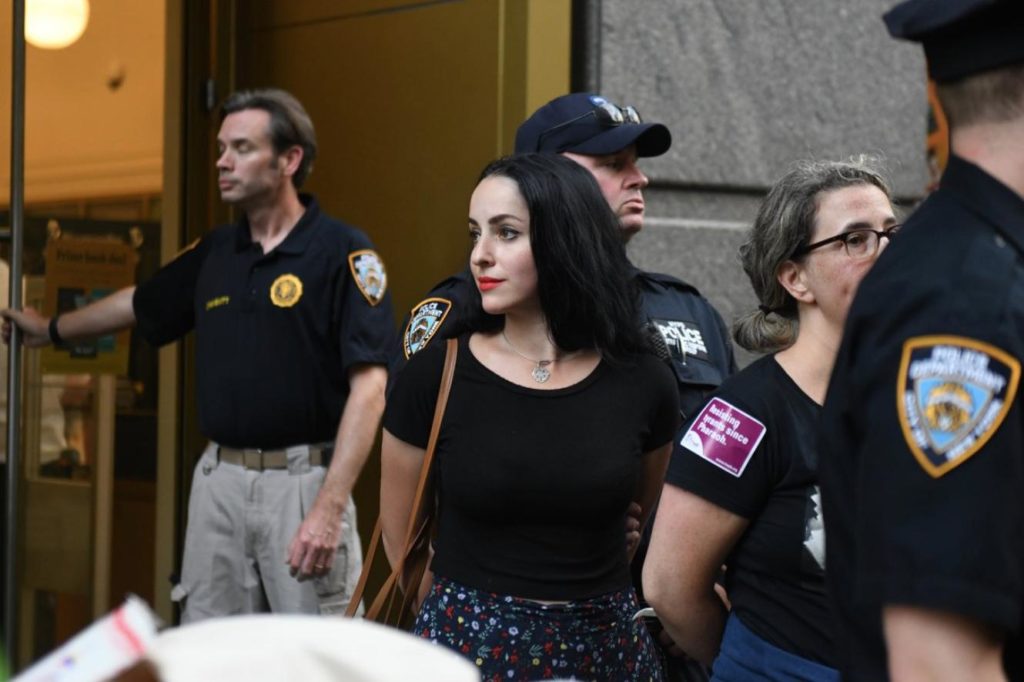
Artist and activist Molly Crabapple, one
of the Kickstarter projector creators who has come out in support
of a Kickstarter union, is arrested during a protest of Amazon’s
affiliation with Immigration and Customs Enforcement (ICE) in
August 2019. Photo courtesy @mollycrabapple via Twitter.
A few days after Robinson’s post
went live, Kickstarter took to
Twitter to proclaim that
it “will recognize a union if [its] staff votes for one,” but only
if they do so in an anonymous election certified by the National
Labor Relations Board. The startup also released a statement from CEO
Aziz Hasan and updated
an online FAQ about
the situation. All of
these transmissions are shot through with explicit and implicit
messaging that the pro-union segment of Kickstarter’s staff A)
isn’t as big as the media would have you believe, B) is unfairly
and unduly pressuring undecided colleagues, and C) doesn’t
understand how good they have it at the company
already.
In short, the two sides aren’t
exactly racing toward common ground, and this clash will probably
get worse before it gets better.
Now, I’m not going to pretend
that I have a comprehensive understanding of every twist and turn
in the unionization saga at Kickstarter. But my natural inclination
is always to side with workers over management, and nothing I’ve
binge-read about the situation this weekend gives me a good reason
to deviate from that position. To paraphrase Jeff “the Dude”
Lebowski, that’s just,
like, my opinion, man.
But the point of this column is
not to try to get to the bottom of what is, or isn’t, the truth of
Kickstarter United’s struggle for recognition. The point is to show
that artists attempting to build their careers through online
patronage platforms are now being faced with some of the same
ethical dilemmas as artists attempting to build their careers
through traditional patronage platforms—and to consider what that
means for the future.
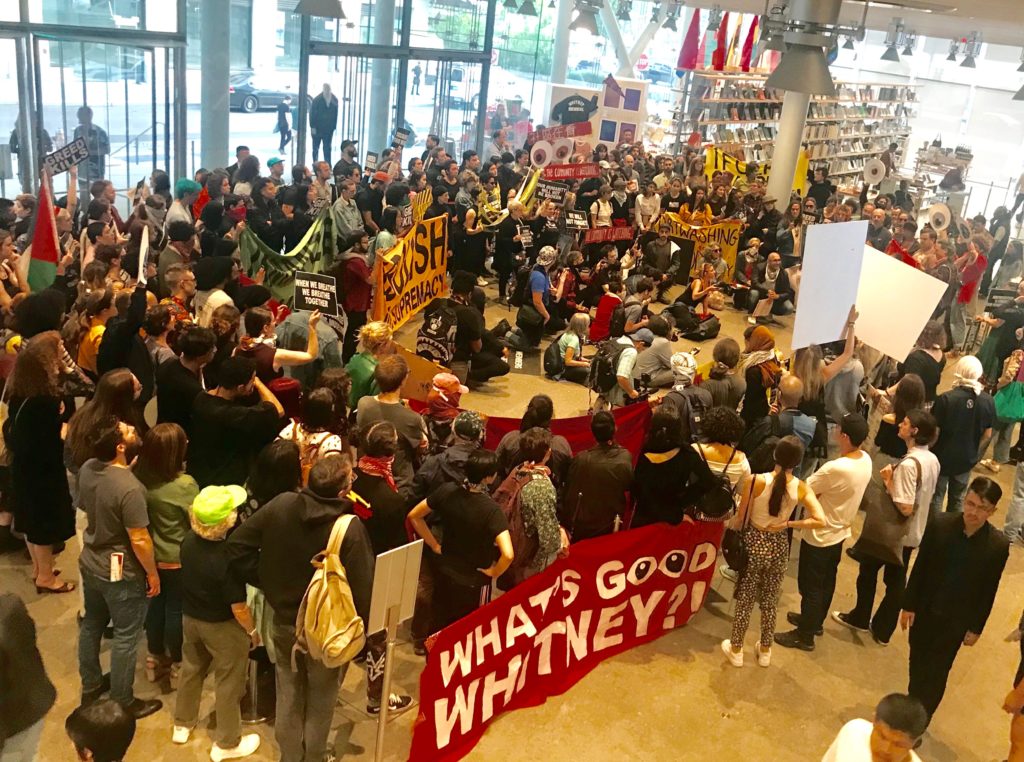
Protesters at the Whitney Museum.
Courtesy of Decolonize This Place.
IMMORAL EQUIVALENCY
The months-long
campaign by Decolonize
This Place and other activist groups to oust now-former Whitney
Museum trustee Warren Kanders is almost inarguably the
highest-visibility and highest-stakes conflict we’ll see in the art
establishment this year. As my colleague Ben
Davis wrote in the
immediate aftermath of Kanders’s paradigm-shifting resignation from
the museum’s board this summer, “The Tear Gas
Biennial,” a virtuosic
essay by Hannah Black, Tobi Haslett, and Ciarán Finlayson published
online at Artforum, proved to be the final turning point in the
struggle—not just because it renewed a call for artists
participating in the Whitney Biennial to withdraw their works from
the show, but because it seemed to convince eight of
those artists to actually listen.
What made “The Tear Gas
Biennial” so effective? Davis contends that it managed to drill
through the wall of sound regarding the need for more systemic
institutional change and articulate a clearly defined, achievable
response in the moment. As the authors write, “If we believe that
our capacity to act against this evil”—meaning the powerful
influence of dirty money in the art world—“is limited, we should
take every opportunity given to us to act.”
In other words: Yes, the problem
is bigger than this one specific trustee’s business and politics.
But this specific trustee is a
part of that bigger problem, and he is close enough to you, WhiBi
artists, to actually make an impact. All you need to do is claw
back your work from this specific exhibition, and you will strike a
blow that radiates upward and outward. Conversely, to leave your
work on view in this tainted platform is to tacitly support the
ethically bankrupt business and politics that make it
possible.
You don’t need otherworldly aim
to fire a harpoon from the animus that brought down Kanders to the
animus that triggered Current Affairs’ departure from Kickstarter. So how far off can we be
from politically progressive visual artists and art organizations
feeling like they have to jettison their own Kickstarter campaigns
to be able to navigate to the right side of the ethical
line?
Well, it turns out we’re already
there.
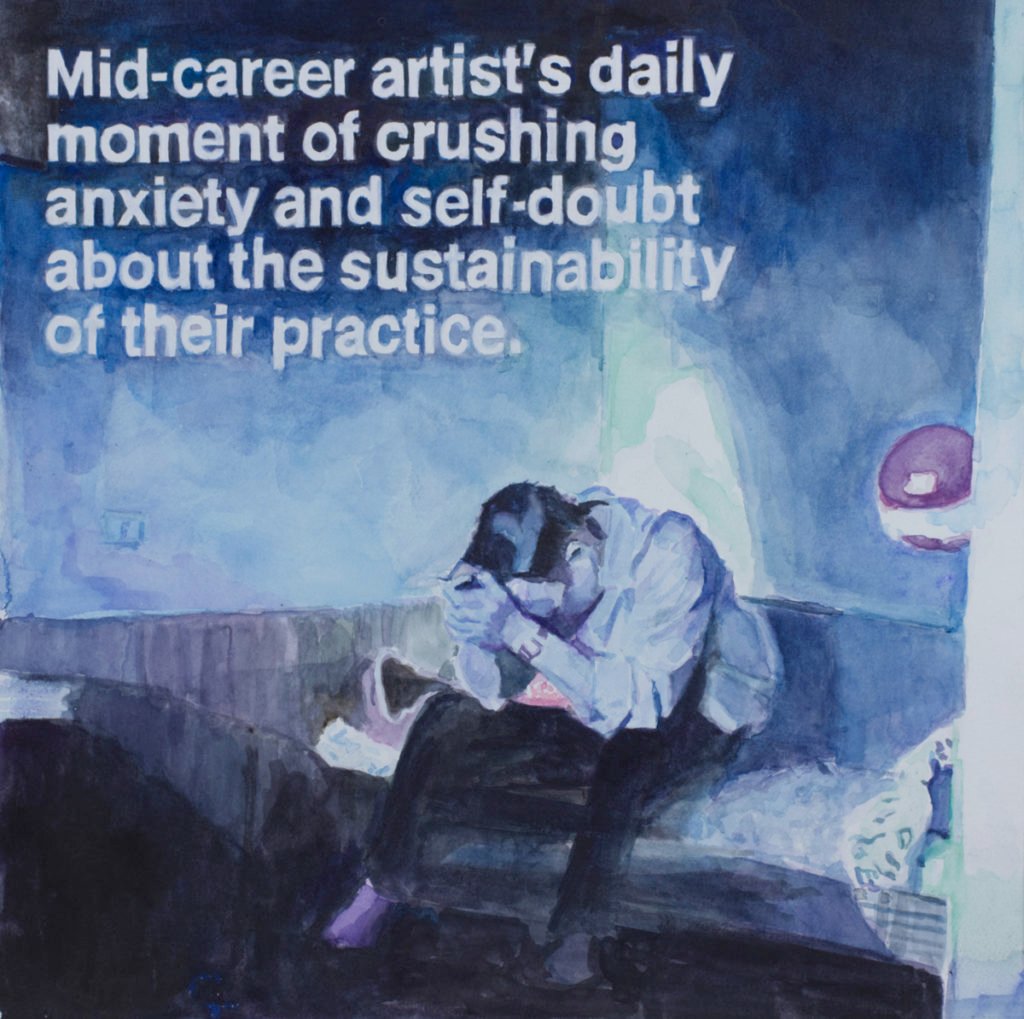
William Powhida, Crushing Anxiety
(Chernobyl) (2019). Courtesy of the artist and Postmasters.
NOWHERE TO RUN?
True, you’d be hard-pressed to
find many people willing to argue in good faith that the types of
union-busting tactics that Kickstarter’s leadership is being
accused of are as morally reprehensible as tear-gassing unarmed
children at the border or, in the case of allegations against the
scandal-plagued Sackler
family, profiting off of thousands of lives destroyed by opioid
addiction. Also true: the momentum toward organizing among staff at
major arts institutions—most recently the New Museum, whose freshly
formed union just finalized a
contract with management last Wednesday—has not yet compelled artists to
pull their work, or publicly reject an exhibition opportunity, over
perceived anti-union activity. (Prominent artists such as Tauba
Auerbach, Nayland Blake, Andrea Fraser, and, not coincidentally,
Hannah Black did sign a letter of
support for the New
Museum union in January, but that’s obviously a lower-key
contribution than a boycott.)
That said, Robinson states
that Current
Affairs patrons on
Kickstarter “began revolting” after they caught wind of the labor
battle at Kickstarter, and that he had to try to “convince them not
to pull donations” because they couldn’t stomach five percent of
their funding being siphoned off by the union-resistant company
acting as an intermediary. Also important for our purposes: some of
the same artists who took part in actions against Kanders are now
pivoting some of their focus to Kickstarter. In addition to
Molly
Crabapple,
artist William Powhida
told me in a text message this
weekend that he “won’t support anything on Kickstarter again if
they continue to maintain their anti-union
stance.”
I’m not concerned about the
heavy hitters who have benefited from projects launched on the
crowdfunding platform if support for a boycott does gain more
traction in the art world. I’m confident that Robert
Irwin, Ugo
Rondinone, and
Olafur
Eliasson, among others,
are going to be just fine with or without
Kickstarter.
But what about the hundreds, if
not thousands, of lesser-known artists, many of whom began working
with Kickstarter precisely because they have not managed to get
traction in museums, galleries, or other players in the legacy art
world? If they feel pressured to abandon arguably the most
prominent online-patronage platform around, how do they replace the
lost revenue? (Patreon, Kickstarter’s most direct competitor for
crowdfunding creatives, has faced its own scandals over
increased
fees and alleged political
bias, albeit from the
opposite side of the aisle.)
To be clear, I am
not—repeat, not—saying inclined artists and art professionals
should think twice about boycotting Kickstarter because of the
temporary pain it could cause to project creators. That would be
the same kind of scare tactic that anti-union executives have
spouted for decades to try to maintain a pro-management status quo.
Meaningful change almost always requires meaningful
sacrifice.
Still, the consequences are
real, and the solutions uncertain. Regardless of your personal
stance, it seems clear that the online-patronage ecosystem is
becoming as tumultuous as the offline one for which it was supposed
to be a healthy, inclusive alternative. It just goes to show, once
again, that the internet is not necessarily an escape from IRL
challenges. Often, it’s just a new arena for us to fight the same
battles. But the more aware artists are of that fact, the better
the odds that they can find a way to emerge victorious in a digital
setting—or, at the very least, survive.
[Current
Affairs | artnet
News]
That’s all for this week. ‘Til
next time, remember: changing your scenery is pointless if it’s the
only thing you change.
The post The Gray Market: Why Kickstarter May Be the Next
Battleground for Ethical Arts Patronage (and Other Insights)
appeared first on artnet News.
Read more https://news.artnet.com/opinion/kickstarter-ethical-arts-patronage-1671133
Further reading


Leave a comment