
‘Even If You Don’t Get All the Details, You Can Still Follow Along’: How Charles Gaines Taught a Generation of Artists
During his new lecture series at Hauser & Wirth in Los Angeles,
the artist Charles Gaines encourages class participation,
especially as he broaches denser topics.
“What I expect to happen is that I will say things or articulate
ideas and nobody will understand,” he tells his classroom of 26
students, at which point they should “just interrupt and say, ‘Can
you explain that?’”
The 10-week lecture program coincides with “Palm Trees and Other
Works” (through January 5), Gaines’s first exhibition at Hauser &
Wirth. (He joined the gallery late last year at the age of 74.)
Since 1989, he has been an influential force in the Los Angeles art
scene as a professor at CalArts. His list of prominent former
students includes Mark Bradford, Henry Taylor, Lauren Halsey, and
many others, who fondly recall his mentorship and theoretical
rigor—as well as their confusion.
Bradford, reminiscing about his time at CalArts during the
Institute of Contemporary Art gala last year, said, “[Taylor] and I
would have conversations about Charles Gaines, like, ‘god
damn, did you understand what he said?’”
Titled “Library of Ideas: A Course by Charles Gaines,” the
classes on aesthetic and critical theory are free and open to the
public (a steal, considering CalArts’s $50,850 annual tuition). The
idea was Gaines’s, inspired by “a certain nostalgia I had for when
artists were pretty well read,” he says. As far as “philosophy and
critical thinking,” he adds, artists today are lacking “big
time.”
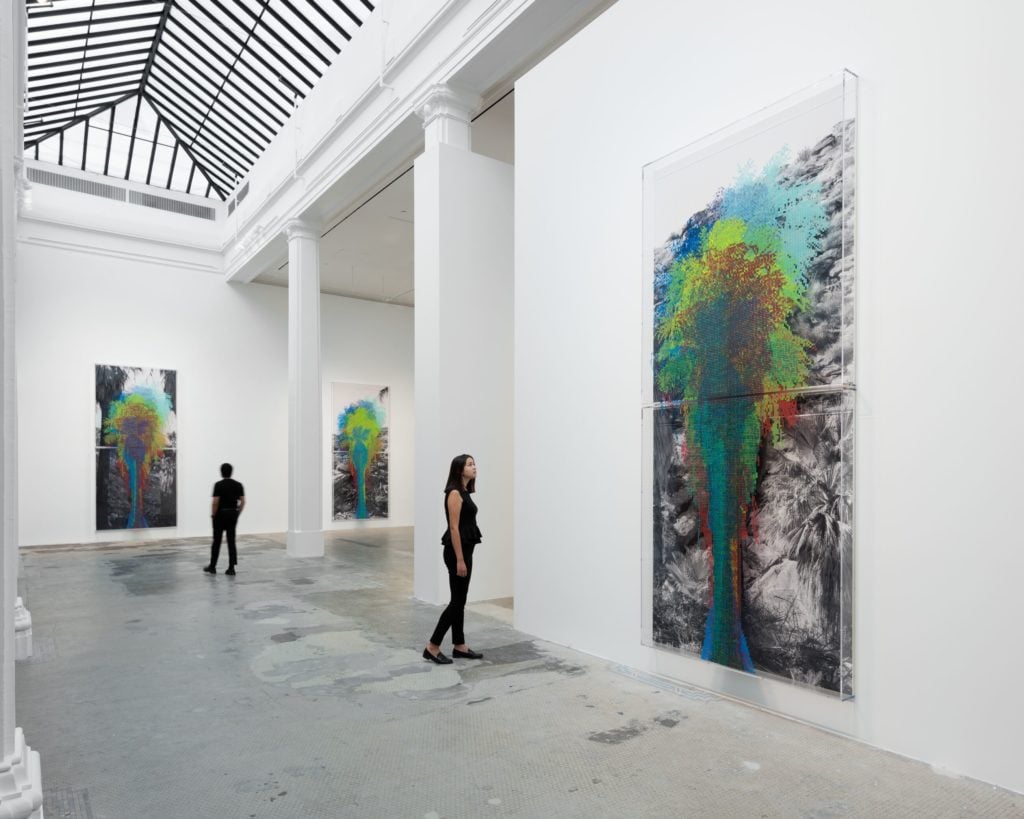
Installation view, “Charles Gaines: Palm
Trees and Other Works” at Hauser & Wirth, Los Angeles, 2019. ©
Charles Gaines. Courtesy the artist and Hauser & Wirth. Photo:
Fredrik Nilsen.
Gaines is known for the conceptual practice that he developed in
the 1970s, when he wanted to diverge from what he describes as a
“Eurocentric model” of creating art.
“The whole idea that a work of art is based on the creative
imagination and expressivity, to create something from nothing—that
didn’t work for me,” he says. “What I started to do was to develop
a system, like an algorithm, that set the terms for the production
of images.” (Given the geometry involved in his work, Gaines
delights in telling people that he has “absolutely no interest in
math.”)
His earliest works took photographs of walnut trees and remapped
their silhouettes onto numbered grids, effectively pixelating them.
At Hauser & Wirth, he’s applied this treatment to the desert
landscape of Joshua Tree, overlaying tall, black-and-white
photographs of palm trees with multiple sheets of gridded
plexiglass.
Each sheet is painted with the manually pixelated ghost of a
different tree in a different color—red, cerulean, neon green.
Stacked on top of one another, they amount to a single, dynamic,
full-bodied tree deeper than the sum of its parts.
Gaines was born in 1944 in Charleston, South Carolina, and at
age five, moved to Newark with his parents during the Great
Migration. He speaks frankly about the oppression of living under
Jim Crow. “At the time, I was convinced the best thing to be in
America was white,” he says.
He has written and curated exhibitions on the topic of the art
world’s marginalization of black artists, notably in his 1993 group
show, “The Theater of Refusal: Black Art and Mainstream Criticism”
which featured David Hammons, Adrian Piper, and other then-emerging
black artists. His current Hauser & Wirth exhibition is scored with
the somber piano riffs of his 2018 work Manifestos 3, a
musical transliteration of texts by Martin Luther King, Jr., and
James Baldwin.
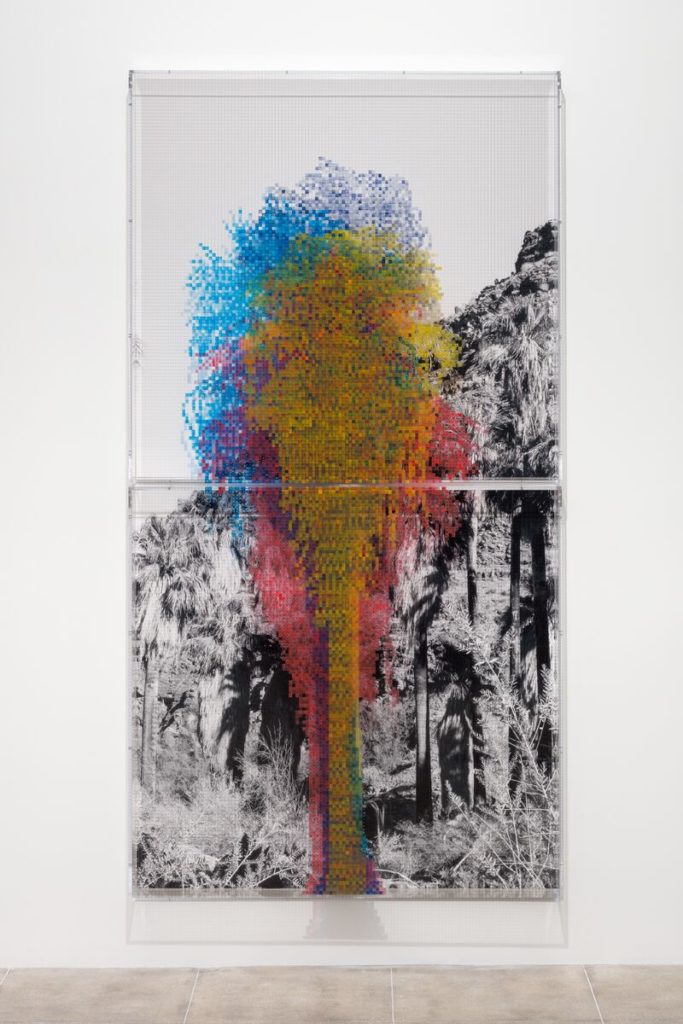
Charles Gaines, Numbers and Trees:
Palm Canyon, Palm Trees Series 2, Tree #4, Kumeyaay (2019). ©
Charles Gaines. Courtesy the artist and Hauser & Wirth. Photo:
Fredrik Nilsen
The absence of black figures in Gaines’ work, however, was a
marginalizing factor in his early career. “I would be making
so-called ‘white art’ because I wasn’t making certain images people
thought I should be making,” Gaines recalls. “This presupposition
about how to show the black experience in your art was formulaic
and didn’t make sense to me.”
“For an artist of color working in the ’70s, post-Conceptualism
was a pretty lonely place,” says artist and former Gaines student
Edgar Arceneaux. The ’90s didn’t show much progress. At the Art
Center College of Design in 1995, when Gaines was a visiting
professor and Arceneaux was a student, Gaines was the first
Conceptual artist of color Arceneaux ever met.
“I found a real kinship with him,” Arceneaux says. “I was one of
those artists who didn’t fit into the identity politics track that
the professors were trying to push me into, and he was the person
who helped give me the language and concepts to [express] my own
thinking.”
Despite the different practices Gaines’s former students have
pursued, they’ve expressed a similarly profound sense of gratitude
for the wisdom he’s imparted. Artist Andrea Bowers, who was a
student of Gaines’s in 1990, credits her own political engagement
to his activist discourse. “Had it not been for Charles, his
questioning of notions of genius, of who has privilege and who
doesn’t, I don’t think I could make the work that I make.”
“He’s been the best of the best mentor,” Halsey says. “He’s the
first person I ever asked, ‘How do you make an invoice?’” Yet the
conceptual tenets of his practice remain a mystery. “Charles, one
of these days,” she says, “I’m going to get the courage to ask
you—what are the systems?”
“It’s not that hard to understand,” says Gaines, taking a moment
to show his gridded notations of a walnut tree. At Hauser & Wirth,
his lesson plans will span aesthetic theory from Classical to
Modern times, from Plato through Immanuel Kant and onto Rosalind
Krauss.
Nothing to be afraid of, according to Arceneaux. “Even if you
don’t get all the details, you can still follow along.”
The post ‘Even If You Don’t Get All the Details, You Can
Still Follow Along’: How Charles Gaines Taught a Generation of
Artists appeared first on artnet News.
Read more https://news.artnet.com/art-world/charles-gaines-hauser-wirth-lectures-1669411
Further reading


Leave a comment