
So, Is MoMA Woke Now? Not Quite. A Q&A With Director Glenn Lowry on Why ‘You Can Never Be Comprehensive in Some Absolute Way’
The scaffolding is down, the dust has settled, and
after a six-year expansion project led by Diller Scofidio + Renfro,
the Museum of Modern Art has been reborn. The $450 million
undertaking has increased the preeminent institution’s exhibition
space by nearly a third, adding warrens of vast, austere new
galleries, a performance “studio” in the museum’s center, and
enough other changes that longtime MoMA visitors in particular will
find themselves grasping for a sense of orientation. Looking at the
map of the new fifth floor, where the canonical modern-art
galleries reside, it’s as if your favorite golf course had suddenly
added another nine holes. If only MoMA had golf carts, too.
But while the architectural changes are bracing, the
most dramatic transformation has occurred within the galleries
themselves, where the curatorial staff has accompanied the
expansion with a rehabilitation project, of sorts—a noble attempt
to correct lacunae in the collection displays that failed to
reflect the truly diverse (i.e., not just
white-and-male-and-Eurocentric) nature of the past century and a
half of art. As a result, all of the art has been
re-contextualized, with the masterworks gaining eye-opening new
neighbors, and gallery displays adopting a 360-degree view of a
subject across mediums—a big change from before, when each
department was more or less kept separate. If you think of the
museum as one big party, it’s become a much more interesting party.
There are plenty of intriguing strangers to meet and acquaintances
to get to know better. There are new people to talk to, in other
words, and the conversation is livelier than ever.
So, should we think of this new iteration of the
museum as woke MoMA (or WoKE MoMA)? Not quite. As MoMA director
Glenn Lowry explains, the curators found it impossible, or
impractical, to try to correct every previous oversight in one
go—which is why the museum’s collection displays will remain in
flux, revolving out in regular intervals to be refreshed with new
twists on the historical narrative.To find out more about what it
means to remake the Museum of Modern Art, and where things go from
here, artnet News’s Andrew Goldstein sat down with Lowry in his
spacious office—tucked away in the labyrinth of offices, noticeably
untouched by the renovation—to talk about MoMA’s newest
chapter.
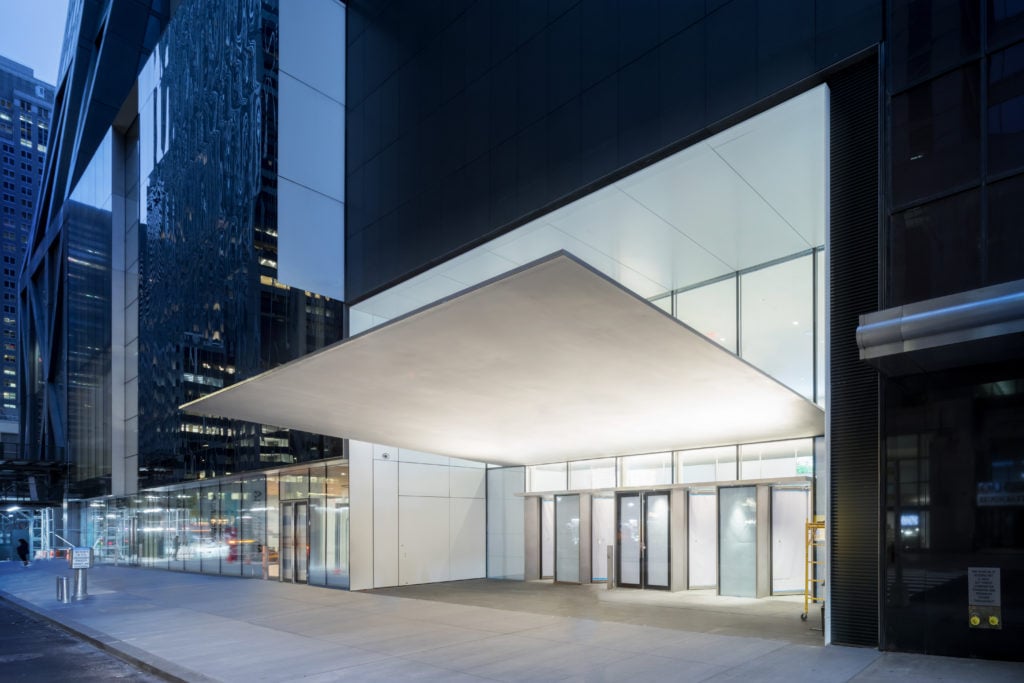
Exterior view of The Museum of Modern
Art, 53rd Street Entrance Canopy. The Museum of Modern Art
Renovation and Expansion Designed by Diller Scofidio + Renfro in
collaboration with Gensler. Photography by Iwan Baan, Courtesy of
MoMA .
The reopening of the museum this month represents
a deep rethinking of MoMA’s collection, and, by extension, of the
history of art for the past century and a half. What does
“Modernism” mean to MoMA today, and is it still
capitalized?
That’s a great question. I wouldn’t capitalize it,
but it still means a foundational idea that we are committed to
exploring. What has been interesting, over the last decade as we
delved deeply into what we wanted to achieve in this iteration of
the museum, was a recognition that one of the foundational ideas
behind the museum was that it would be a work in progress—that it
wasn’t actually finished, it was evolving and changing and
developing over time.
I’m inspired by that, and I think our curators were
deeply inspired by this notion that the definitions that had begun
to accrue around a narrow reading of modernism or modern art could
be expanded productively to embrace a much broader and more
generous understanding of the concept, and a recognition that there
were many different modernities that evolved over time in different
places, and that they talked to each other. They weren’t
independent and isolated conversations.
As we looked at this carefully and started
interrogating what we wanted to do, it became very clear that,
actually, when you go back into our history, our collection, and
the exhibitions we did over the last almost 90 years, there are
many, many instances where there was a deep interest in what was
going on elsewhere in the world. And the collection itself is much
richer and broader than came to be seen through its display.
What I took away from that is that over time, we had
become two museums: a museum that was on display, which was refined
and carefully focused on iconic works of European and North
American art, by and large; and a museum in storage that was much
larger, more varied, more complicated, and that included great
works by artists from many different regions.
These artists were clearly of interest to curators at
one moment; that’s why they were acquired. But now, many years
later, they had been either forgotten or overlooked. By committing
ourselves to going back and exploring what was already there, we
found so many lineages to build on. It’s been an extraordinary
journey.
It’s a tribute to the extraordinary scope of
MoMA’s collection that, now that there’s an impulse towards the
rediscovery of overlooked artists, all you have to do is rummage
around the attic to be able to say, “Hey, we’ve got those people,
too.”
Well, to be fair, the curators also added enormously
to the collection. Over the last decade we have dramatically
expanded the number of objects in our collection. And, even more
importantly, we have expanded who’s represented in the collection.
So we’ve made a really significant commitment to ensuring that we
focus on women as much as we have focused on men; on collectives as
much as on individuals; on artists working in different geographies
as much as those in Europe and North America. So, yes, the kernel
for that was already in the collection, but we were able to expand
it.
For instance, now we have our first curator whose
focus is on contemporary art from Africa, because we were able to
get this core group of works of contemporary African art through a
gift from Jean Pigozzi. We now have two curators whose field is
Latin American art, building on this extraordinary gift of Latin
American art from Patty Cisneros, as well as acquisitions we have
made. So it’s a combination of what was there with a lot of
new friends and voices.
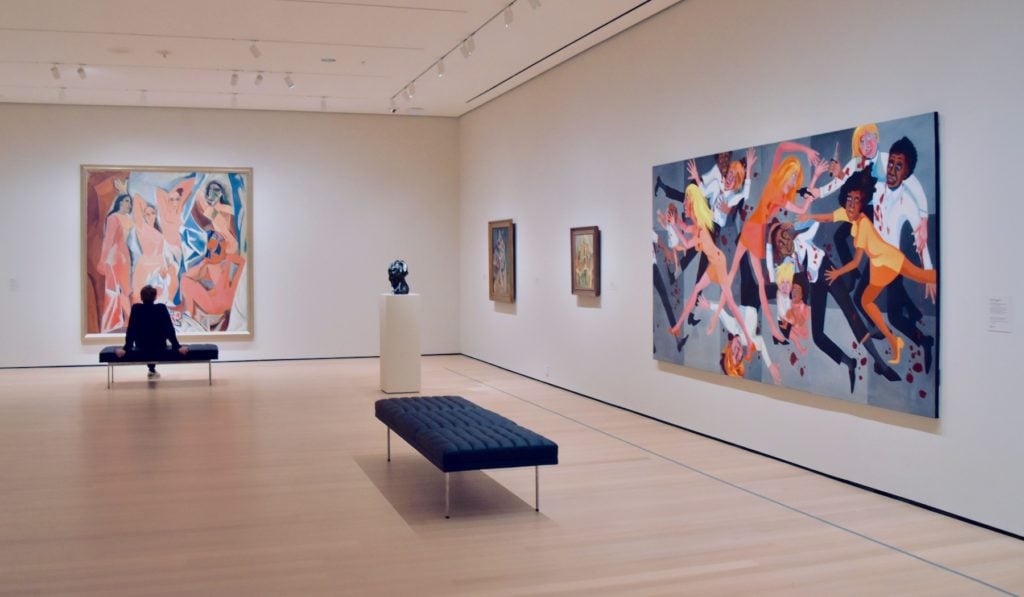
Pablo Picasso’s Les Demoiselles
d’Avignon on the left, and Faith Ringgold’s American
People Series #20. Image: Ben Davis.
In addition to the wealth of new perspectives,
there are also some moments in the rehang that will be powerful and
unexpected for longtime MoMA devotees and new visitors alike—most
prominently, the decision to display Les Demoiselles
d’Avignon next to Faith Ringgold’s painting of a bloody race
riot. What do you hope the viewer will think, other than,
“Whoa”?
I’ve been thinking about that, of course. So, first
we want people to stop, and realize what a frightening, difficult
painting the Demoiselles d’Avignon really is. One hundred
years on, it’s iconic, and to some extent we take it for
granted.
I think the the introduction of Ringgold—and also
Louise Bourgeois [whose sculpture Quarantania, I (1947–53)
is also in the gallery]—into this conversation recenters this
painting. Picasso, when he was painting it, wasn’t thinking about
formal problems like Cubism, even though the painting is often seen
as an essential moment in the evolution and development of Cubism.
He was thinking about the power of African art. He was thinking
about the ways in which this brothel operated. He was looking at
the kind of fraught, tense nature of these women who populate the
painting. So I think this installation acknowledges all of the
important formal dimensions that Picasso represented, but it also
says: there are other readings, too.
And Ringgold, who spent a lot of time at this museum
looking at the Demoiselles d’Avignon, and looking at
Guernica when it was here, absorbing the lessons of
Picasso—she’s in conversation with him. She is engaging him.
Obviously she deals with a whole other set of issues as well,
around race and the fraught politics of the ’60s. But I think
linking them together creates a different way to see Picasso.
The other day I was in the galleries with Philippe de
Montebello, the legendary director of the Metropolitan Museum of
Art and somebody who I admire a lot, and who has always been
incredibly thoughtful and generous to me and to this institution.
And he looked at the Ringgold and said, “Great painting. You know,
she painted my portrait 15 years ago.” So for him, it wasn’t so
jarring. He understood who she was, and what she was doing.
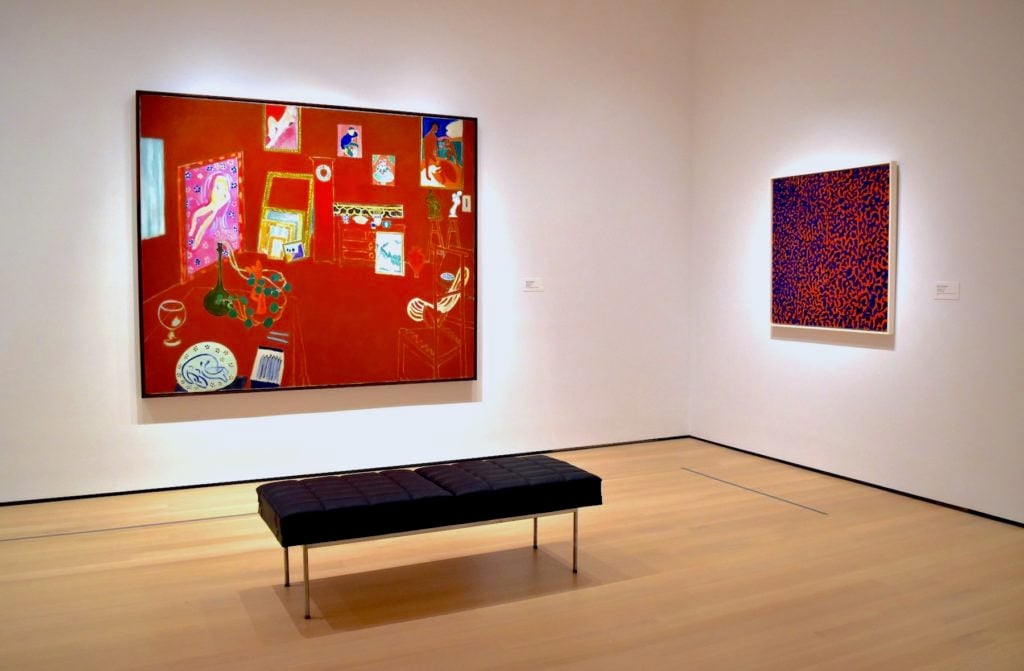
Henri Matiesse, The Red Studio
(1911) and Alma Thomas, Fiery Sunset (1973). Image: Ben
Davis.
The other thing that is interesting, of course, is
that everyone who comes to MoMA to see the great Demoiselles
d’Avignon, arguably the most essential textbook example of
modernism, will also perforce, and in an arresting manner,
encounter this 89-year-old African American artist who lives just a
mile or so north of the museum, in Harlem. That’s a powerful way to
flex the museum’s muscles in terms of directing viewer’s attention
and educating an audience.
Although I think the more radical move is actually in
the previous gallery, where we introduce film and photography as
utterly foundational to any reading of the 20th century. Before,
the museum had this march from Post-Impressionism to Cubism to
Abstract Expressionism to Pop art to so on. It felt like it was an
inevitable march of progress, and it was all about painting and
sculpture. With the introduction of film and photography, which are
the radical media of the 20th century, it changes the whole
narrative at the museum.
So, in a way, Ringgold is a painter, and she’s
fighting with all the demons and ghosts of other painters. But, in
fact, early 20th-century artists were fascinated by photography.
They were fighting with that, but they were using it. You know, the
great Cèzanne Bather, which is often considered one of the
iconic, foundational paintings of the Museum of Modern Art, wasn’t
painted from a live subject—it was painted from a studio
photograph. So right at the outset, even at the end of the 19th
century, photography is being deployed for many different uses,
including by artists.
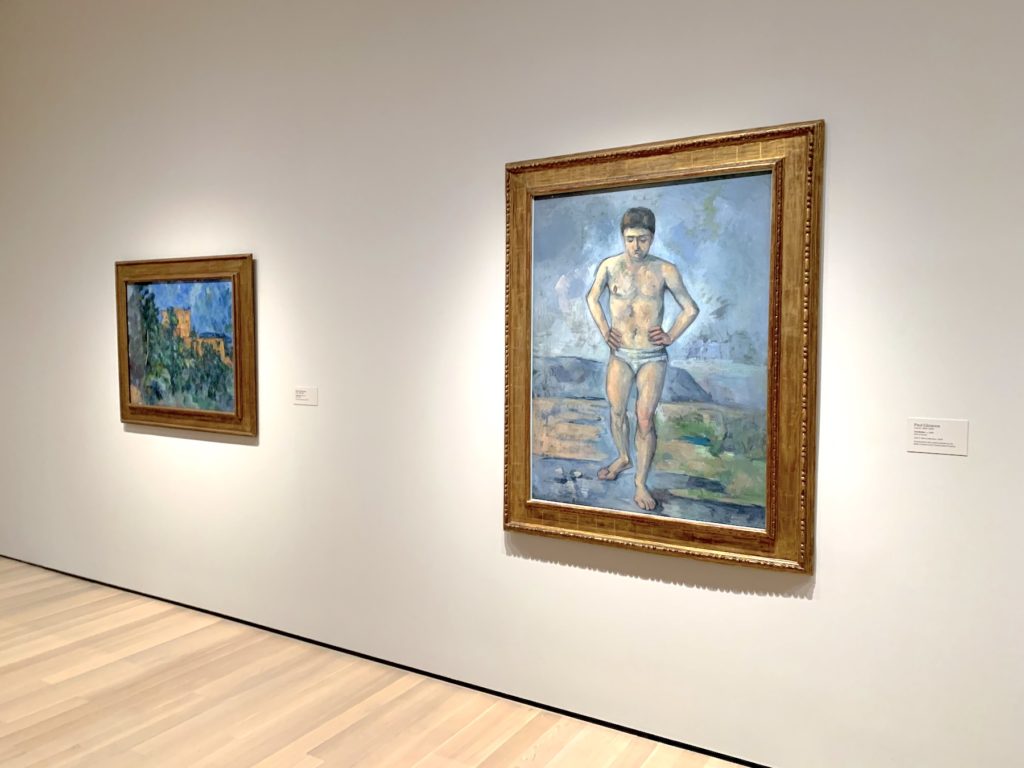
Paul Cézanne,
Château Noir
(1903-04)
, and Paul Cézanne, The Bather (ca. 1885).
Image: Ben Davis.
Since you embarked on this project in the middle
of 2013, our world has undergone some extraordinary changes: Trump
and the rise of populist nationalism, the #MeToo movement, a
piercing awareness of climate change, a powerful rejection of
colonialism’s trappings, and ever more digitization. How have these
pressures shaped the new museum?
They certainly were present in the way we were
thinking. Like artists, like everyone, we live in the real world.
We’re surrounded by the debates and controversies and critical
issues of the moment. I think there was a real effort on the part
of the curatorial teams that worked on these installations to be
attentive to issues around gender, around race, around climate
change, around immigration, and, for sure, the fraught politics not
just of the current moment, but of the last century.
The 20th century was a very brutal century, rolling
back to the First World War, followed by the Second World War,
followed by the Korean War and the Vietnam War, followed by the
events of 1989. We’ve lived in turbulent and difficult times, and
that’s reflected in many of the works of art that are on display.
This is to say, all of these forces are present to a lesser or
greater degree, depending on the works of art we had in our
collection that could make those issues manifest.
More recently, there’s been this phenomenon where
people are not just grappling with the issues themselves—of race,
of gender, et cetera—but also paying close attention to how others
are grappling with them, and judging them as a result. In reopening
the museum, was there any trepidation in terms of, “Are we leaving
anyone out? Is there somebody who might see this as
problematic?”
Well, I’m not quite sure how to respond to that
beyond saying that anytime you do an exhibition—and it doesn’t
matter what scale it is, whether it’s a single gallery or a whole
museum—you recognize that it’s only a partial view of something.
You can never be comprehensive in some absolute way. So, in a way,
we’ve gone in the opposite direction and decided we’re not even
going to attempt to do that. Instead, we are going to engage again
and again and again.
The way we are looking at it is that, rather than
thinking of this display—which sprawls across almost 170,000 square
feet and consists of almost 2,500 works of art—as somehow permanent
or even quasi-permanent, we think of it as a point in time that
over a two-to-three-year period will virtually entirely change
again. Critical works that people travel long distances to see,
like Matisse’s Dance, van Gogh’s Starry
Night, the
Demoiselles d’Avignon, Monet’s Water Lilies—we’re not
going to change those. But we might change where they’re located,
and we certainly will change their neighbors.
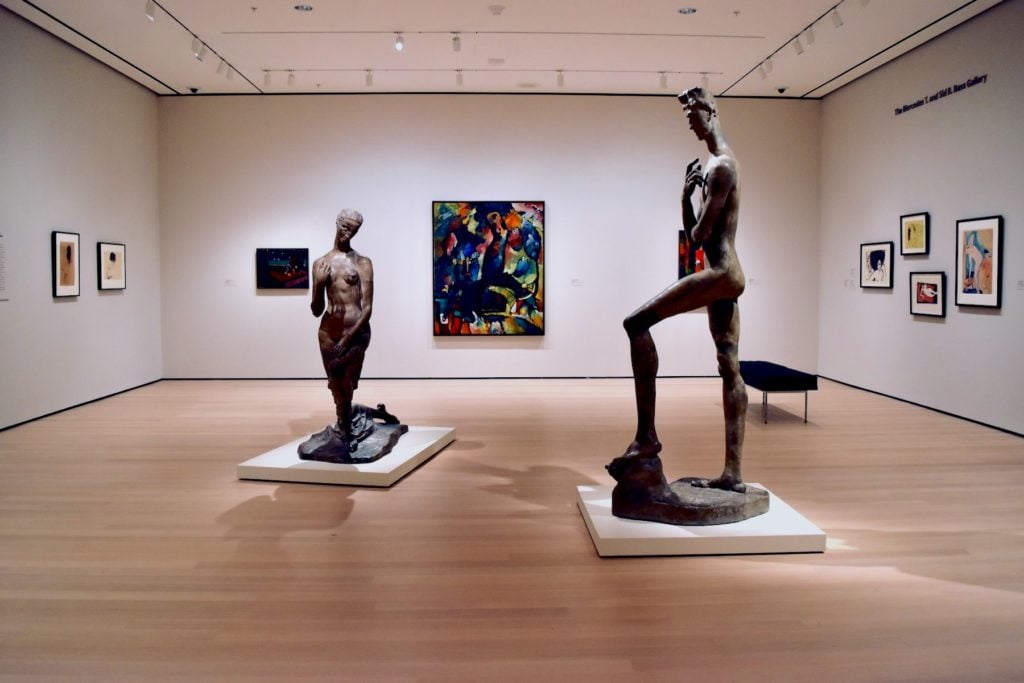
The “New Expressionism in Germany and
Austria” galleries. Image: Ben Davis.
The gallery that you mentioned with Faith
Ringgold? In just over a year, it will be a completely
different installation. And we want to do that for multiple
reasons. One, we have all of these extraordinary works of art in
our collection and we want to bring them out, to put them in
conversation. And even more importantly, we know that there are
dozens of issues that were left on the table when we made hard
decisions about what to show in the museum. We want to come back to
those issues.
We did literally hundreds of storyboards about
potential installations, because the other thing we’ve done is move
away from thinking that our galleries are purely sequential. Now,
each gallery is a self-contained unit linked only by broad
chronology, so you can pull one of those units out and put another
unit in and it’s like substituting one chapter with a different
chapter.
In other words, they’re modular.
For us that’s very important, because we weren’t able
to address some of the urgent issues that you mentioned. We’ll be
able to address them the next time around.
In second half of this interview, to be published tomorrow,
Glenn Lowry will address the legacy of Marina Abramovic’s
blockbuster show, protests of a MoMA patron, and his thoughts on
his own succession plan.
The post So, Is MoMA Woke Now? Not Quite. A Q&A With
Director Glenn Lowry on Why ‘You Can Never Be Comprehensive in Some
Absolute Way’ appeared first on artnet News.
Read more https://news.artnet.com/the-big-interview/glenn-lowry-moma-reopening-interview-part-1-1678816
Further reading


Leave a comment