
A New Exhibition of Artworks Recovered From Shipwrecks Reveals Some Fascinating—and Troubling—Histories
Salvaged from watery depths, the sunken treasures from a pair of
shipwrecks lay underwater for hundreds of years before being
acquired by the Asian Art Museum in San Francisco.
Now, these artifacts, including a pair of massive 12th-century
stone statues and a trove of blue and white ceramics, will star in
“Lost at Sea: Art Recovered From Shipwrecks,” a new exhibition
drawn exclusively from the museum’s collection.
But while there is a certain romance to shipwrecks, one of the
museum’s main goals is to educate viewers about three conflicting
viewpoints among marine archaeologists about how to conduct
excavations.
“Some believe that nothing should be brought up. You should just
look, record, and leave it there,” the show’s curator, Natasha
Reichle, tells artnet News. “Some believe you can bring it up, but
with only an academic crew.
“A third group believes that most countries cannot protect these
sites from looting, and that excavations in conjunction with
private–public [entities] are the only way of protecting and
learning about these materials.”
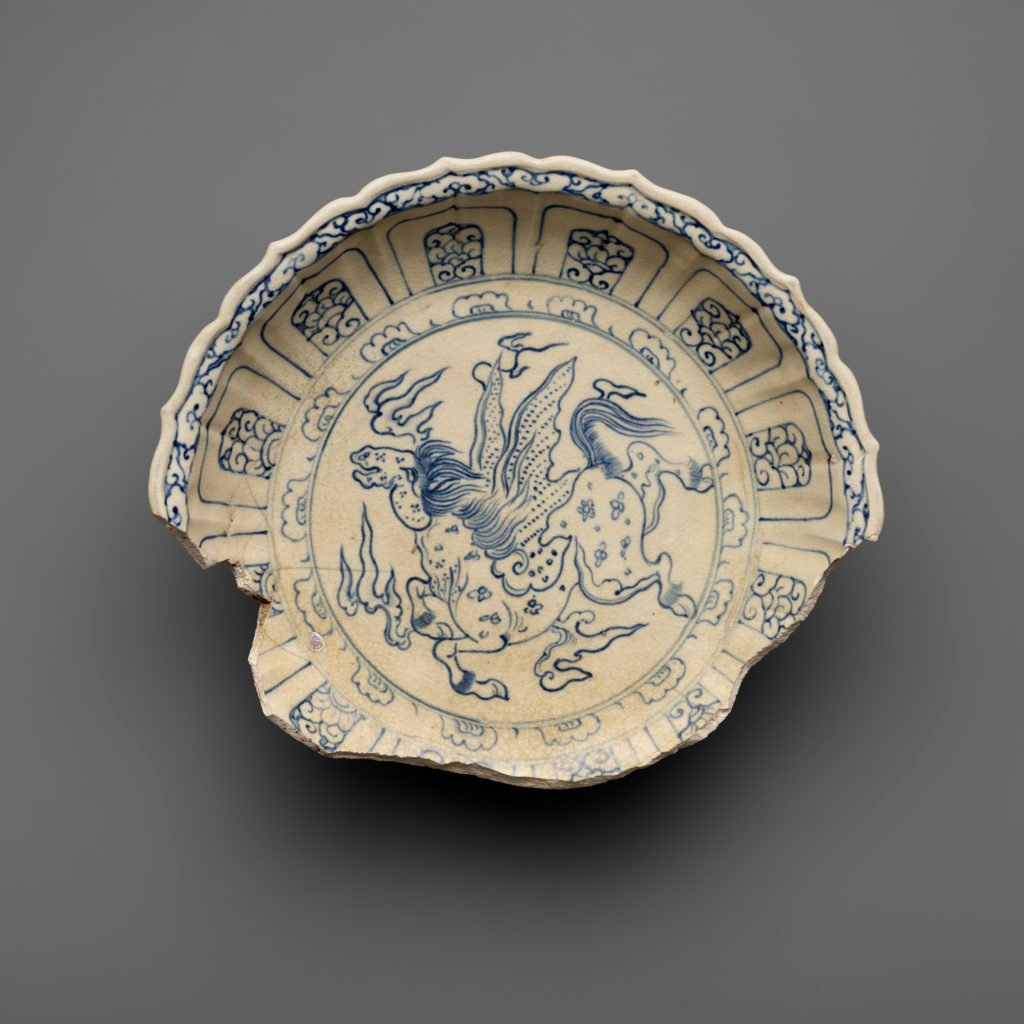
Fragmentary dish with design of a winged
horse (circa 1450–1500) from northern Vietnam. Photo courtesy of
the Asian Art Museum, San Francisco. Photo courtesy of the Asian
Art Museum, San Francisco.
Beyond those perspectives, the show also offers an intriguing
look at how recoveries are actually done. “These objects that
you see in museums often have these interesting life stories behind
them,” curator Natasha Reichle told artnet News.
The ceramics in the show come from the Hoi An,
a 15th-century trading vessel that was carrying around a
quarter of a million individual ceramics when it crashed in the
South China Sea.
No one knows exactly how the ship went down. “There are no
reefs, and there is no evidence of a fire,” Reichle says. The only
promising clue recovered from the wreckage were seeds from fruits
that grow late in the season. “One theory is that for some reason
the ship took off very late in the year, encountered a seasonal
typhoon, and sank.”
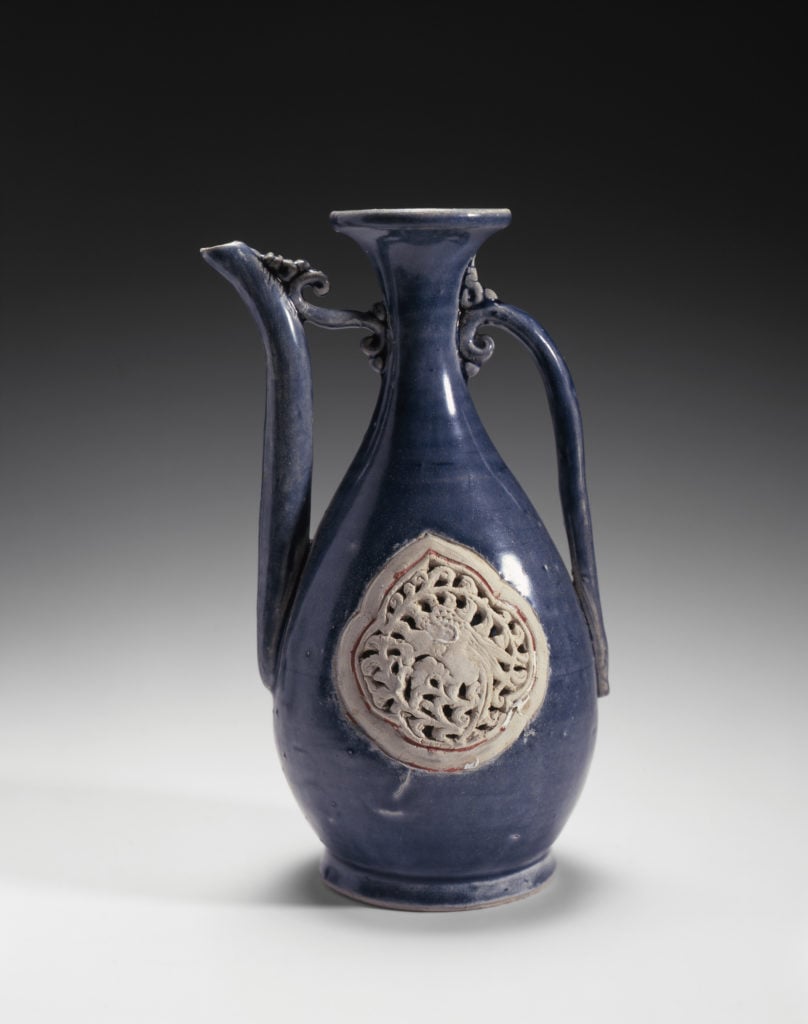
Pouring vessel with openwork panels
(circa 1450–1500) from northern Vietnam. Photo courtesy of the
Asian Art Museum, San Francisco.
The wreck was found after smugglers were caught in the
Vietnamese airport with suitcases full of ceramics in the
1990s.
“The government tracked down the wreck and formed an alliance
with an Oxford archaeology team and Vietnamese and Malaysian
salvage companies,” Reichle says. “The ship was in very, very deep
water—at that point, it was the deepest marine excavation ever
attempted.” The first attempted recovery was dashed when the
recovery ship was almost capsized by a typhoon, she says.
To safely retrieve the ship’s contents, the only option was
saturation diving. “You keep the divers down underwater for a
period of weeks,” Reichle says.
Among the objects eventually acquired by the museums is a lump
of assorted materials that grew together due to corrosive
conditions on the ocean floor. Included in that lump were a deer
antler and a Chinese coin.
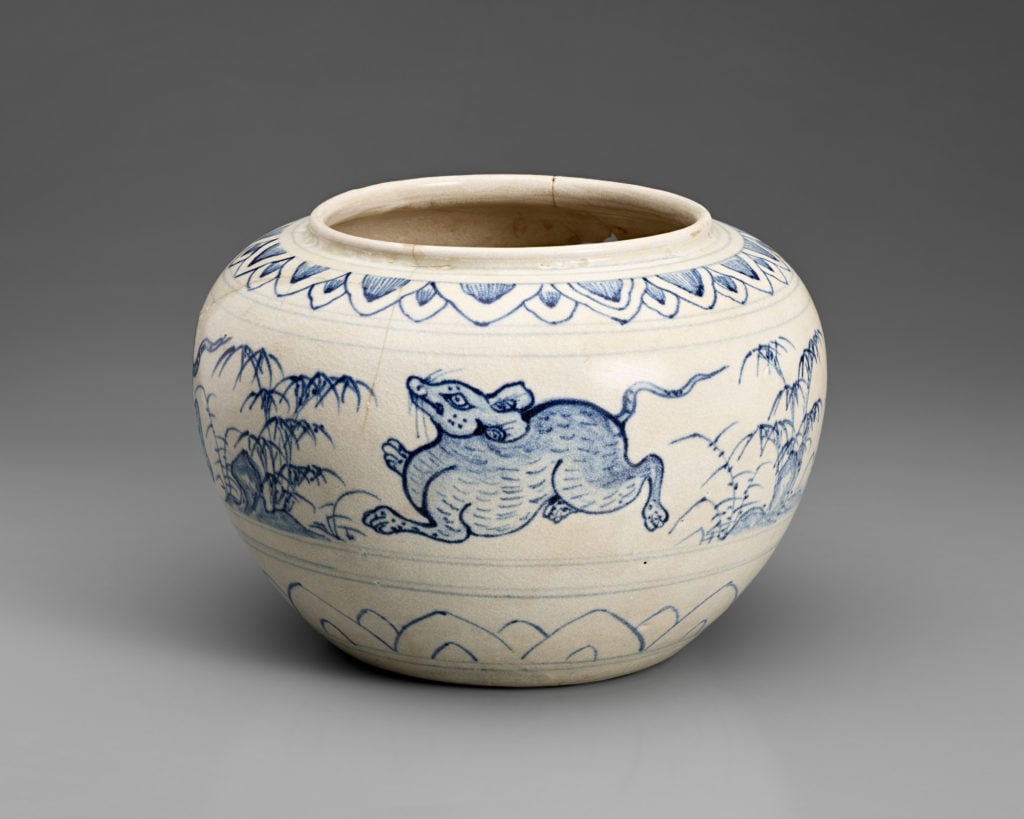
Blue-and-white jar (circa 1450–1500)
from northern Vietnam. Photo courtesy of the Asian Art Museum, San
Francisco.
The second wreck featured in the show was a French steamboat
discovered 5,000 miles away in the Arabian Sea, just off the
coast of Somalia. Aboard that ship were a pair of 12th-century
stone sculptures from central Vietnam. (The works were taken from
the country around 1875 by Albert Morice, a naturalist stationed at
Vietnam’s French embassy.)
“Almost all the people survived [the wreck], but almost
everything on the ship was looted, except these sculptures
that were so heavy, they just sank to the bottom,” Reichle
says.
In 1995, amid the Somali Civil War, French marine
archaeologist Robert Stenwi went out to cover the boat’s
contents.
“Robert was negotiating with the faction that was in
control of the northeast area of Somalia,” Reichle says. “The
team needed to get armed guards to protect them, and to use
dynamite to blow up the hull.”
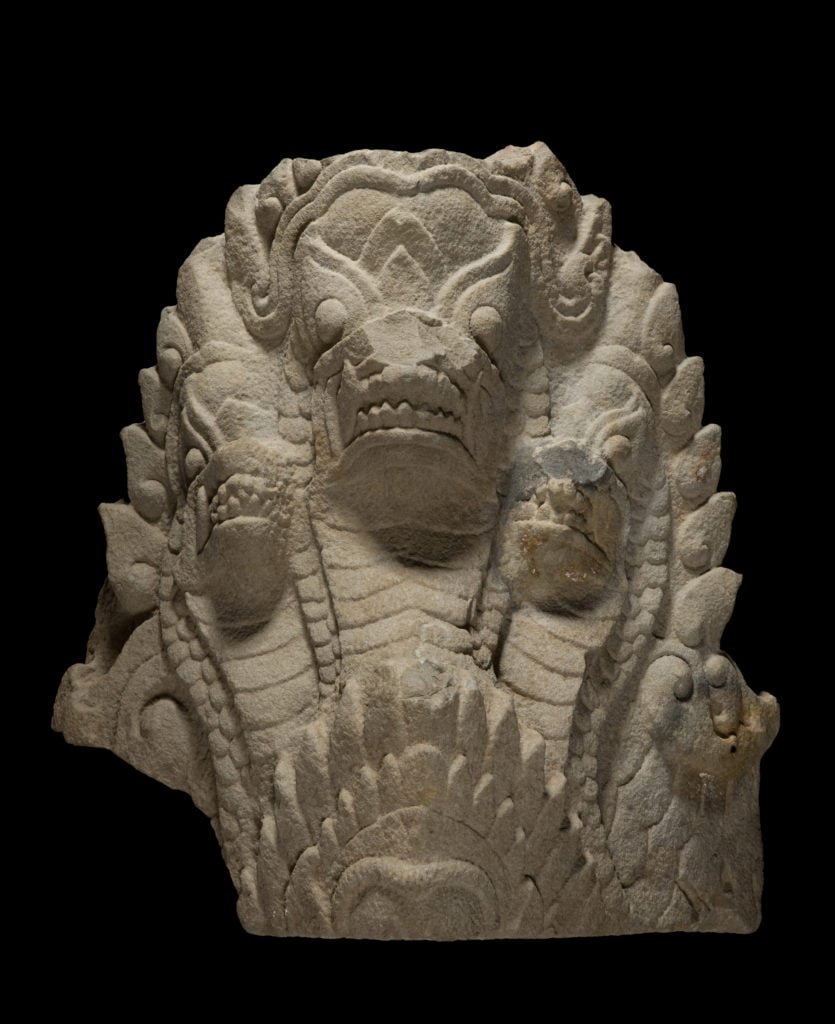
Architectural element with a
multi-headed mythical serpent (circa 1150–1250) from Vietnam; Binh
Dinh province, former kingdoms of Champa. Photo courtesy of the
Asian Art Museum, San Francisco.
The statues eventually went to England for conservation before
being sold at auction, and two of them were since donated to the
Asian Art Museum.
But the recovery raises some ethical questions
that Reichle’s show directly addresses.
“The people who produced these sculptures no longer have a
state,” Reichle says. “The Cham are now a diasporic
community scattered throughout Southeast Asia. If one were to
restitute the object, where would you even return it?”
“Lost at Sea: Art Recovered From Shipwrecks” will
be on view at the Asian Art Museum, 200 Larkin Street, San
Francisco, California, November 26, 2019–March 22,
2020.
The post A New Exhibition of Artworks Recovered From
Shipwrecks Reveals Some Fascinating—and Troubling—Histories
appeared first on artnet News.
Read more https://news.artnet.com/exhibitions/asian-art-museum-shipwrecks-1643746
Further reading


Leave a comment