
Can MoMA’s Expansion Ever Really Be Finished? Glenn Lowry on Where the Museum May—or May Not—Go From Here
The grand, gleaming architectural and curatorial
complex that is the new Museum of Modern Art is the work of
hundreds of specialists, patrons, designers, and other visionaries.
But it is above all the towering achievement of one person: MoMA
director Glenn Lowry. Having come to the museum in 1995 after five
years of leading the Art Gallery of Ontario—and, before that,
curating Near Eastern Art, his specialty by training, at the
Smithsonian—Lowry is the longest-serving director ever to steer the
institution, or at least he will be when his contract expires in
2025.
To ensure this would be the case, the board of
trustees winked at MoMA’s normal retirement age of 65, signing him
to stay at the helm until he is 71. Why they did this is no
mystery. Having enormously expanded the museum’s audience, raised
hundreds of millions of dollars for improvements, united it with
Long Island City’s PS1 art center, overseen multiple architectural
projects, and maintained the excellence and—with some
exceptions—scholarly rigor that puts MoMA at the forefront of art
institutions worldwide, he is probably the most accomplished museum
director in the field today.
So what comes next? For the immediate future, the
focus will be on learning how to pilot the newly re-envisioned
institution through the choppy cultural waters of the present
moment, which includes questions about the very model of patronage
that has made this new building possible. Sooner or later, however,
MoMA is going to need to face the question of its longer-term
vision—who will lead it into its next chapter to come, and what
kind of museum will it be.
In second half of a two-part interview,
artnet News’s Andrew Goldstein spoke to Lowry about how we got to
this point, and where he sees things going from here.
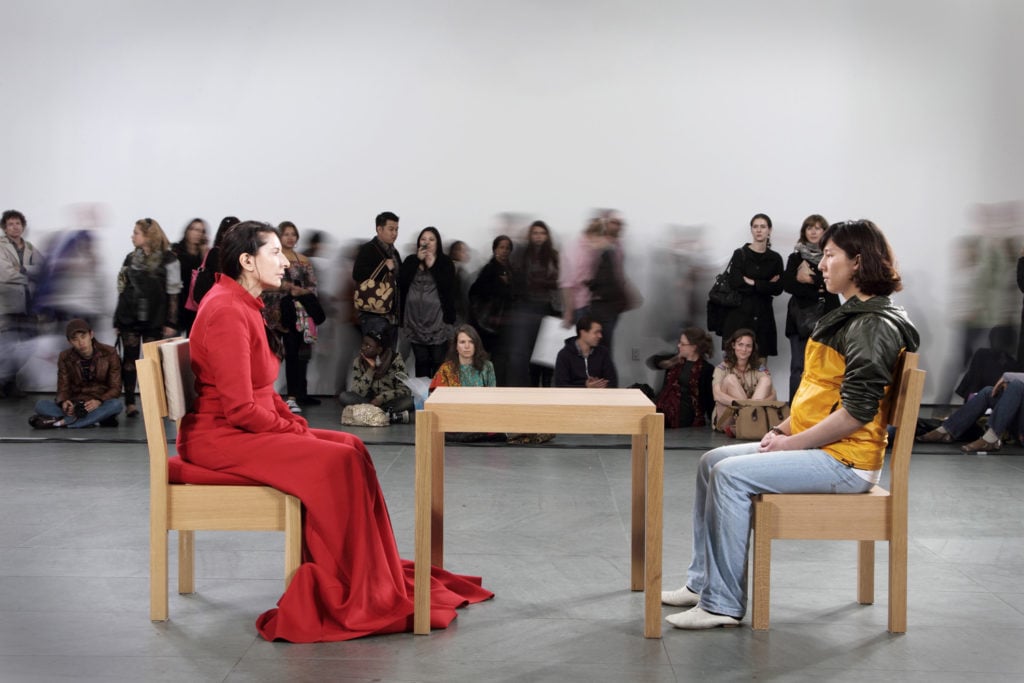
Marina Abramović‘s “The Artist Is
Present” at the Museum of Modern Art. Photo by Marco Anelli. ©
2010 Marco Anelli. Courtesy Sean Kelly Gallery.
We’re coming up on the 10-year anniversary of
Marina Abramovic’s blockbuster MoMA survey, which at the time was a
revelation in terms of showing both how performance art can be
displayed in a museum, and how incredibly popular experiential,
be-here-now shows can be. What did you learn from that show’s
success, and how did you incorporate those lessons into the new
MoMA?
For sure, that was a watershed moment, on many
different levels. I remember at one point talking to one of our
trustees about the exhibition and they they said, “Performance art.
So… what’s that going to be?” And I said, “Well, she’s going to sit
in a chair, there’s going to be another chair next to her, with a
table in between her in that chair, and people will be invited to
come and sit for as long or as little as they want.” And they said,
“Are you out of your mind? Nobody’s going to come!”
They thought we were going to end up with a financial
crisis. I said, “Eh, I don’t think that’s the case. I think there’s
something extraordinarily compelling about the gesture that she is
offering the public.” And, of course, as you know, the exhibition
was an extraordinary success, and literally some 700,000 people
came. But what it marked was the importance of performance as an
art form that we needed to embrace.
It isn’t that performance had been absent before;
there were many instances of performance at the museum dating back
to the 1960s, and perhaps even earlier. But what that show marked
decisively is the degree to which performance had become an art
form that was going to be central to museums in the future. And if
you think of that as the seed, what grew out of it was this
fantastic studio that now is embedded in
the heart of our collection galleries, designed precisely for
artists to use for performance.
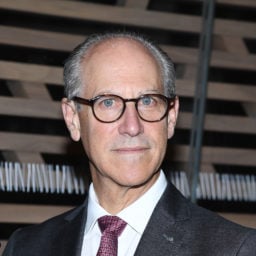
So the newly expanded MoMA has been upgraded to
encompass performance in a central way, and to combine artworks and
mediums in new configurations. How does this upgraded building
anticipate where you expect art to go from here? In other words,
how long of a shelf-life do you think this container will have as
art and its audiences continue to evolve?
We’re going to be 90 years old in November, and we’ve
actually had roughly nine different iterations of the museum over
our history. We started in rented office space on Fifth Avenue,
then we moved to a townhouse leased from the Rockefellers on 53rd
Street—hence our address—and then to our first custom-built
building in 1939.
So in a decade we had three different homes. And no
sooner did we finish the 1939 expansion that we began to build the
garden, which opened in 1954, and then a suite of buildings
designed by Philip Johnson adjacent to the garden in the ’60s. Then
[we built] two different buildings on 53rd Street on either side of
our 1939 building, and on and on and on. Each of those was a
response to some programmatic need of a generation of curators.
So here we are. There’s not a whole lot of room to
expand, so we’ll end up reconfiguring galleries and we’ll end up
finding new spaces when we need them. And at some point in the
future, and I don’t know when that will be, we may run out of the
energy or commitment or desire to change as much as we have
changed, and that will be the point when we transition from being a
work in progress—which is what I think of us as—to a different kind
of institution. And I have no way of knowing whether that’s in a
decade, or in 10 decades.
It may never happen. Maybe there will be sufficient
energy and commitment and desire to continuously reinvent ourselves
that we will be able to continue to do that.
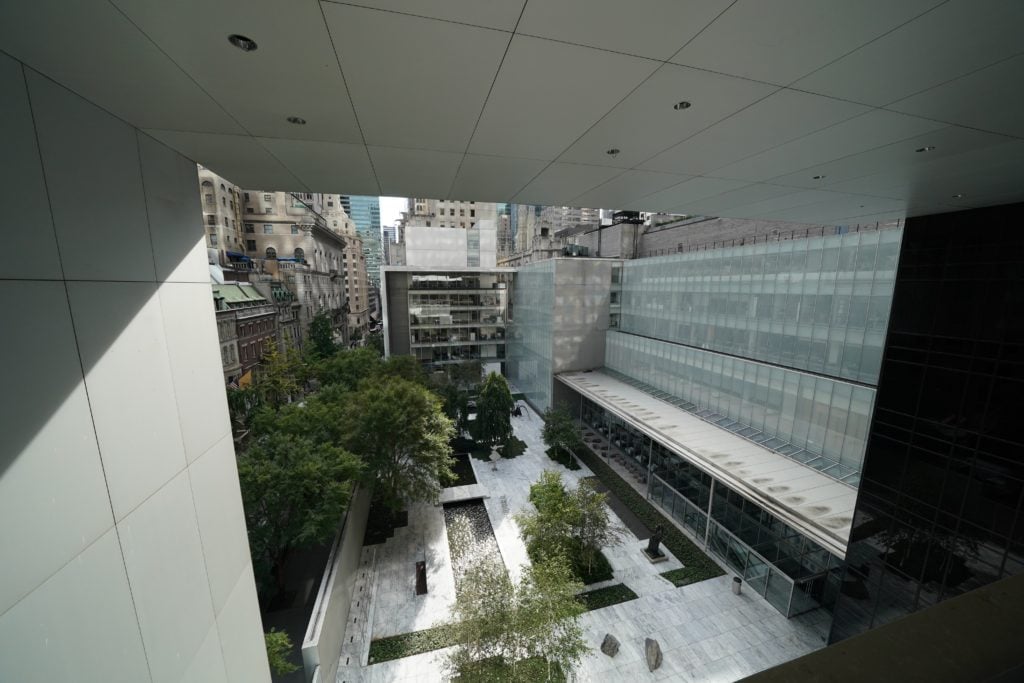
New views inside MoMA designed by
architects Diller Scofidio + Renfro in collaboration with Gensler.
Photo by Timothy A. Clary/AFP via Getty Images.
Or you can just put it all in the cloud.
Who knows? I mean, if you’d asked me when I joined
the museum in 1995 if we would have an expansion, I would have
said, “Oh, that’s possible.” Two? In 25 years? I would’ve said,
“That’s mad. There’s no way we would be able to do that.” But in
actual fact, the first expansion grew out of responding to a whole
set of needs from the late 1980s and early 1990s that the curators
felt, and in that expansion we learned that we could expand to the
west.
So, [architect Yoshio] Taniguchi designed the 2004
building knowing that if we ever built again we would build to the
west, so all of the infrastructure that was required for the second
expansion—art corridors, elevators, all the stuff that’s behind the
scenes but that eats up space—was built into the 2004 project,
which meant that when we had the opportunity to expand in 2014–15,
it was all there already. We could focus on just adding gallery
space.
And in the intervening decade, after 2004, an
entirely new generation of chief curators arrived, and they came
with a different set of ambitions, a different set of ideas, and a
different way of working together. So, now, this new architecture
simply becomes a platform for that to be realized.
I guess it’s like the Yankees—every generation
gets their own team. Often when I interview a museum director, I
talk about financial challenges, but that doesn’t seem to be
operative here. MoMA brought in $300 million in just two gifts
alone in the past few years. How did you manage to raise money so
successfully at a time when every other major New York museum was
expanding, and bigger capital campaigns, like LACMA’s, were
stalling? What was your pitch?
We’ve been very lucky that our trustees believe
deeply and passionately in the mission of the museum. The vast
majority are collectors of modern and contemporary art, so they
they live and breathe what we do. They’re incredibly generous. They
believe in the staff. The Rockefeller family set an admirable
example of philanthropy, of giving and giving generously. So
there’s a culture among our trustees of generosity—generosity of
ideas, generosity of time, generosity of knowledge, and generosity
of capital. They all go together—you can’t pull one of those apart.
These are people who really believe in the mission of the
institution.
So how could someone who believed in the museum of
2004 be comfortable with this version of the museum? Because this
is quite different. And the answer is: they want the museum to be a
work in progress. They want to feel that they are contributing to
that idea of Alfred Barr’s that the museum is a laboratory in which
the public is invited to participate in the experiments. What they
bought into was this sense that they could add a new chapter to
that, and that they could enable a new set of conversations to take
place. So we were very lucky.
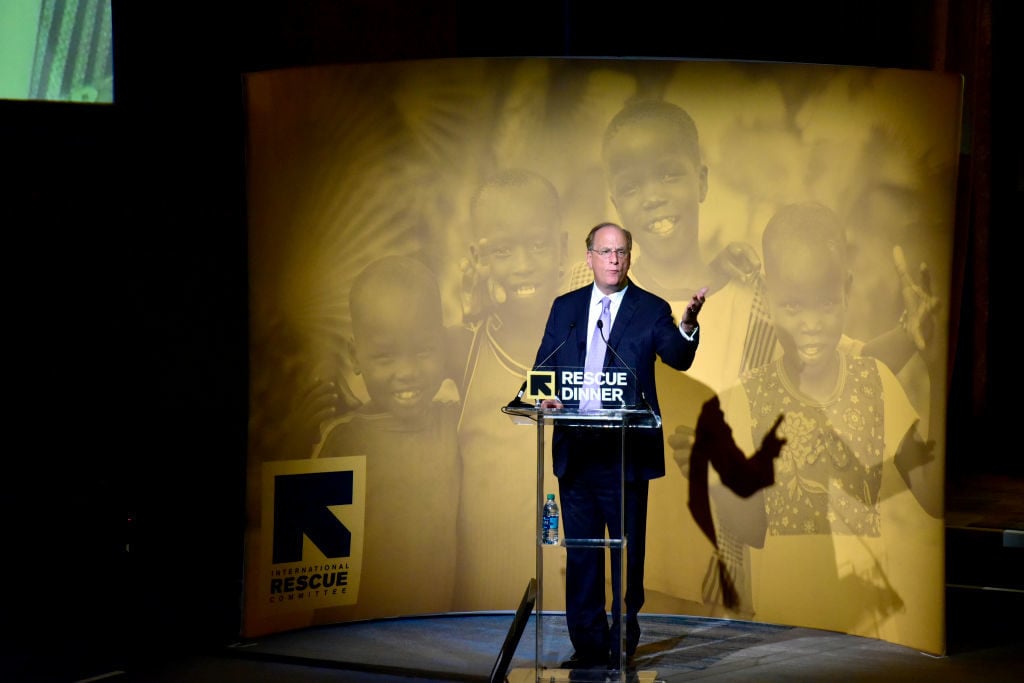
BlackRock CEO Larry Fink speaks onstage
during the 2018 Rescue Dinner in New York City. Photo by Eugene
Gologursky/Getty Images for IRC.
There’s no question that MoMA’s patrons are
extraordinarily generous. At the same time, a protest movement that
challenges patrons with ties to less-than-savory businesses
continues to grow. Right now there is a renewed call for MoMA board member
Larry Fink, the CEO of BlackRock, to divest from being the
second-largest shareholder in two prison companies that are said to
run 70 percent of the country’s immigrant-detainment activities.
What is your perspective on shielding board members, who have given
so generously to your museum, from such protests? How does one deal
with these situations when they crop up?
I think for every cultural institution, and probably
every educational institution and hospital, we’re all living in the
real world, and we’re all acutely aware of the issues that are
being brought to the surface and that have to be contended with.
There’s no formula for that, and our trustees are aware of
that.
At the same time, the vast majority of American
institutions like ours are privately funded. We don’t get federal
funding. We don’t get state funding in our case—we got a very
modest amount of city funding for our capital project, and we get a
little bit on occasion beyond that. But we’re not a CIG—a member of
the cultural industries group—so there’s no line-item funding.
We live and die by the amounts of money we can raise
privately. Some of that is self-earned through admissions,
membership, retail, general fundraising. A very considerable amount
of that is through the generosity of our trustees. So there is a
balance that we tried to strike, but we are acutely aware that this
is a different climate than it was a decade ago.
To pivot to another financial issue, most curators
try to remain antiseptically separate from the art market, but the
market nonetheless impacts what is shown in museums, just as what
is shown in museums impacts the market. The tastes of
art-collecting patrons, for instance, are often seen as a pressure
on acquisitions. How does a museum like MoMA keep itself pure? Is
there such a thing?
Of course it is possible. Again, we who are involved
in the building of a collection live in the world of artists,
dealers, collectors, other academics, scholars, curators—we’re all
part of a ecosystem. We talk to each other, we see each other, we
think about these issues collectively, and I think the answer to
that is that you have to really believe in the integrity of your
curatorial staff. And I believe fundamentally in the integrity of
our curatorial staff. So, yes, there are artists who emerge and
become darlings of the art world, and some of those are artists
we’re interested in. There are other artists who emerged who are
not that interesting to us. It isn’t that they aren’t good artists
or market darlings, it’s just that our focus is somewhere else.
The way our process works is that the only works of
art that can be acquired at this museum are works of art that have
been proposed for acquisition by our curators. So, if they’re not
interested in acquiring something, it’s not going to show up. Now
those acquisitions have to be approved by our various collecting
committees, but it isn’t like a committee member can bring a work
of art to the committee and say, “I want you guys to buy that.” The
only way a work of art gets in front of the committee is with the
approval of the chief curator of that committee.
That’s why you have to believe in the integrity of
those curators, which I do, and over time I’ve seen really heated
debates: “Why aren’t we interested in that artist?” We aren’t
because we’re interested in other artists more. We can’t have
everything. That doesn’t mean it’s perfect. It’s not perfect. The
record of acquisitions will always be a record of successes and
misses until the next director comes along and recalibrates.
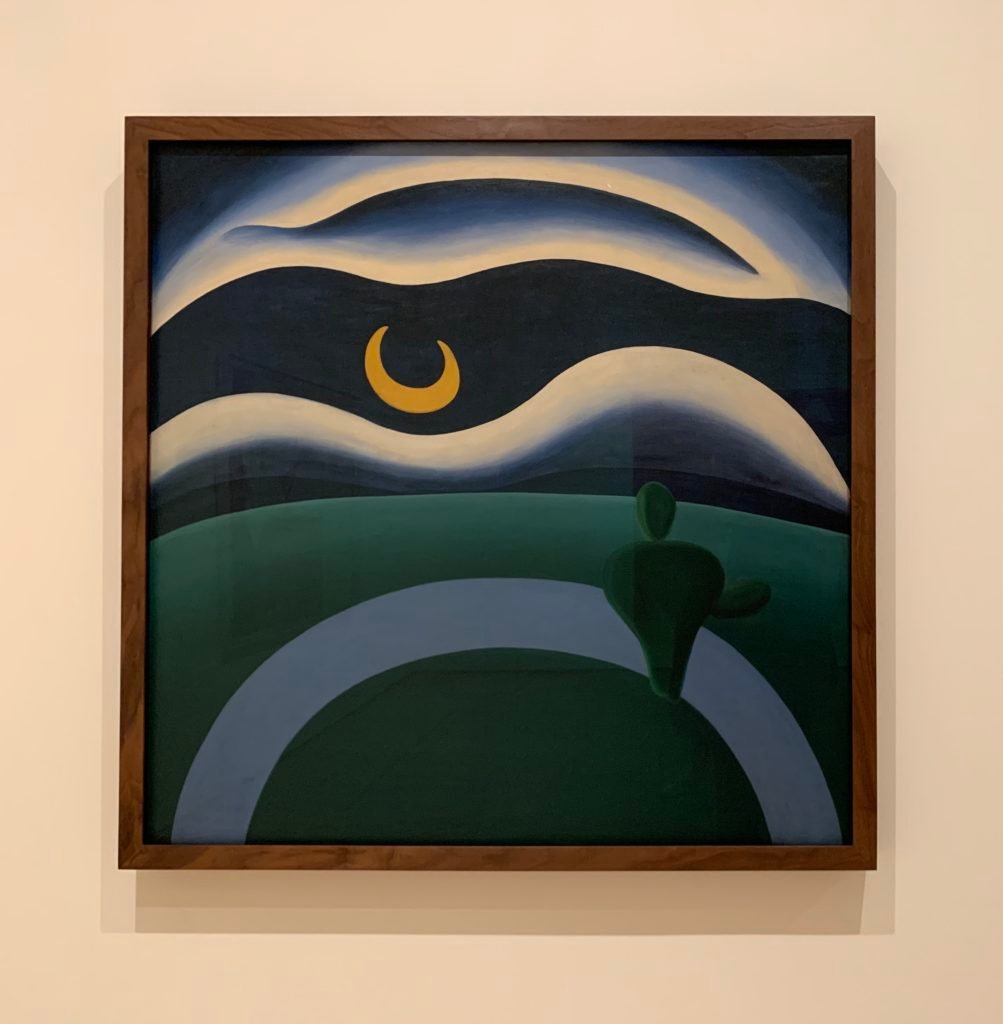
Tarsila do Amaral’s The
Moon (1928) is one recent acquisition at the museum.
On that note, you have been the director of this
museum since 1995, and the board of trustees has deemed fit to
overlook the retirement age of 65 to extend your extraordinary run
to 2025, when you will turn 71. What are you thinking about for
your succession plan? Is that something that is being looked at
with the same 10-year-out planning as an architectural
project?
It’s really an issue for our trustees to think about.
Me, I’m focused on doing the best I possibly can every day—I don’t
really think about the future. Of course, I try and anticipate what
questions might arise in the future, but I live in the moment. The
question of long-term succession at the museum is really a question
for our trustees, because it’s their responsibility.
I was surprised, and actually humbled, that I was
asked to continue. It was not part of what I was thinking, but I
was delighted that our trustees understood that the completion of
the architecture wasn’t the end of the project, it was actually the
beginning of the project—that the architecture enables a new way of
engaging the collection and engaging our public and thinking about
the way the museum can be.
I also think they wanted some stability, and I was
thrilled to have the opportunity to play it out a little bit,
because obviously I’m deeply invested along with all of our
curators and scholars and educators in what we’ve created. Day one
is just the beginning of how this actually works.
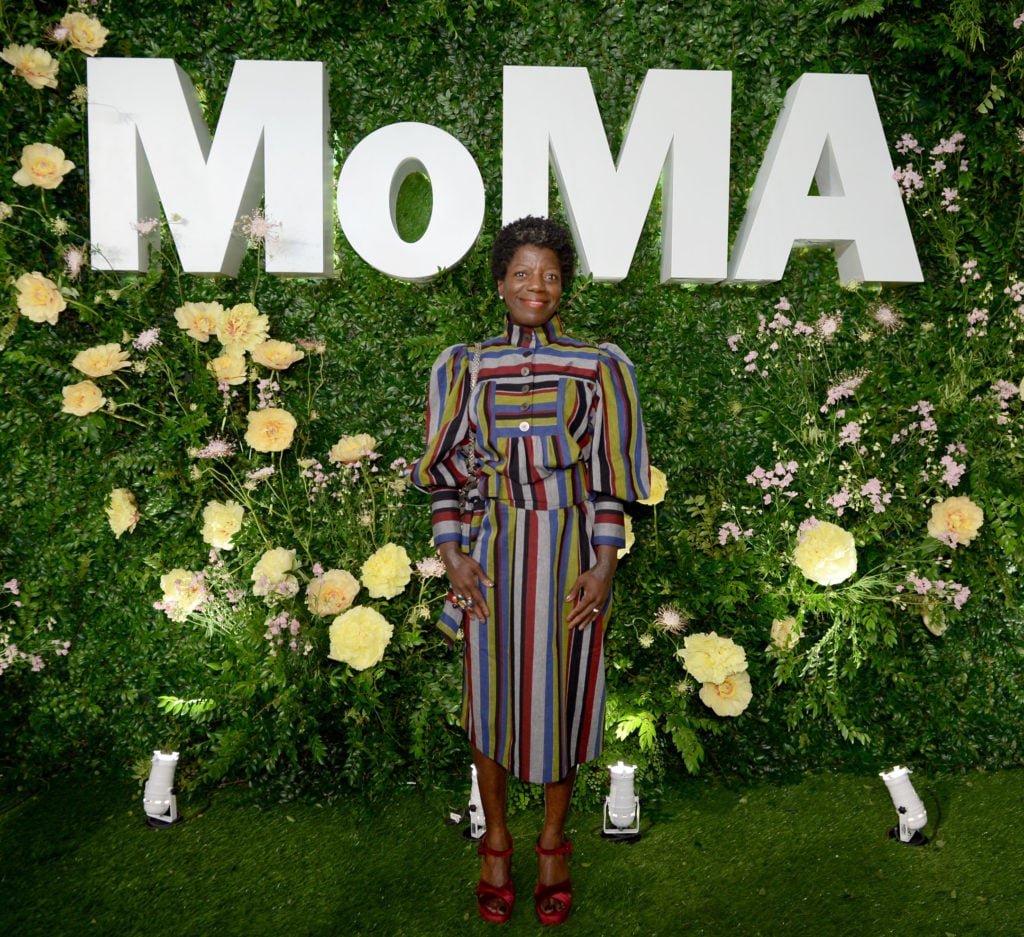
Thelma Golden at MoMA’s Party In the
Garden in 2018. Photo by Andrew Toth/Getty Images for The Museum of
Modern Art.
Day one also sees the inauguration of a new
partnership with the Studio Museum in Harlem, with that museum’s
director, Thelma Golden, inaugurating a new Studio Museum at MoMA
project series with a show of paintings by Michael Armitage. Why
did that seem like a necessary partnership at this time? It seems
especially notable given that Golden would make an excellent
candidate to be your successor.
First of all, it’s not an entirely new partnership.
Thelma and I started a project about four years ago, the Studio
Museum in Harlem MoMA fellowship program, where African American
men and women spend a year at the Studio Museum and they spend a
year at MoMA. Each fellowship is two years, so they get the
experience of working in a large, complex museum and in a small,
very focused museum. It’s part of our commitment together to build
the next generation of great curators and museum professionals.
So the partnership started there, and actually you
can go back even further because many people at the Museum of
Modern Art were instrumental to the founding of the Studio Museum.
In any event, Thelma and I enjoy working together, and when it
became clear that the Studio Museum was going to have to close for
four or five years because of their construction project, I simply
said, “Thelma, if you ever need a space to do a project, we’d love
to be part of an equation.”
Over time the Studio Museum decided that, since they
couldn’t replicate what they do while they were under construction,
they would disperse across the city. We decided that there would be
one exhibition a year at MoMA, the Studio Museum at MoMA series,
and there would be one exhibition a year at MoMA PS1 of their
artist-in-residence program.
So, it’s just a way of being a good citizen, helping
another institution that we admire greatly. I also think it’s good
for everybody. It perhaps introduces some artists into our program
that we might not have focused on, or focused on as early as the
Studio Museum. It shows that museums don’t have to compete with
each other. You can be partners to get things done.
It also introduces Thelma Golden to MoMA’s staff
and trustees in a very concrete way.
Although Thelma hardly requires an introduction—she’s
a fantastic, brilliant curator and director, and I think this works
in part because she is admired greatly by her colleagues and our
trustees.
This has clearly been an extraordinarily busy time
for you. I’ve heard that, remarkably, with all of this herculean
activity taking place, you have somehow managed to find the time to
write a book about contemporary art in the Middle East. Is that
true?
Well, I’ve been working on it for a while. It’s a
book that I’ve wanted to write, and it’s called In-Between
Places: Contemporary Art in the Middle East. It goes back to my
own interests, because I began as a scholar of Islamic art, and so
it’s a way of trying to marry that interest in the region with what
I do today, which is work on modern and contemporary art. I hope it
will be published within a year. The editor had the end of
September as my deadline, and I only just made it.
Just.
The post Can MoMA’s Expansion Ever Really Be Finished? Glenn
Lowry on Where the Museum May—or May Not—Go From Here appeared
first on artnet News.
Read more https://news.artnet.com/the-big-interview/glenn-lowry-moma-reopening-interview-part-2-1678819
Further reading


Leave a comment