
‘They Seized the Opportunities:’ A New London Exhibition Tells the Remarkable Stories of the Women of the Pre-Raphaelite Movement
Why have there been no great women Pre-Raphaelites? Well, it
turns out there were quite a few.
The first exhibition to focus on the women behind the movement
that took Victorian Britain by storm reveals that the
self-proclaimed “brotherhood” was, in fact, also a “sisterhood” of
remarkable female models, writers, and artists who played a crucial
role in its success.
“An art movement is a collective,” says Jan Marsh, the guest
curator of “Pre-Raphaelite Sisters,”which opens at London’s
National Portrait Gallery this week. The show presents a
revisionist, feminist history of the group that could not be more
timely. “The models, artists, and what we would call back-room
girls—the office and studio managers—and wives were all part of the
creative process.”
The exhibition is a double first. “The National Portrait
Gallery has never done a Pre-Raphaelite show before,” Marsh points
out, and she was as surprised as anyone. The movement’s male
artists and leading lights—John Ruskin, Dante Gabriel
Rossetti, William Morris—are stalwarts of the Tate’s and Royal
Academy of Arts’s exhibition programs.
When asked to propose an idea for the show, Marsh, who is an
expert on the Pre-Raphaelites, suggested putting its female members
in the foreground. “There was a lot hiding in plain sight,” she
says, adding that she is excited by how much of the artists’ work
has only recently emerged from obscurity.
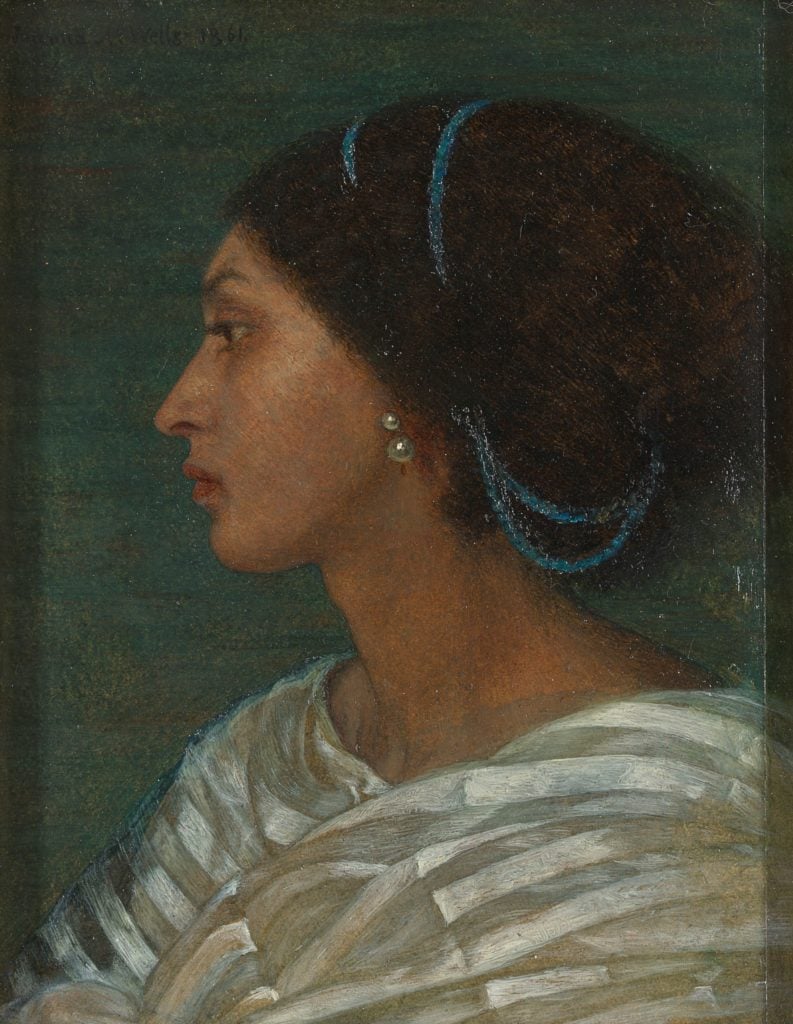
Joanna Wells, Study of Fanny
Eaton (1861). Yale Center for British Art, Paul Mellon
Fund.
The exhibition is the latest to reframe the mainly male
art-historical canon by acknowledging the role of not only artists,
but female models. Until the 1990s, Fanny Eaton was largely
overlooked by art historians even though she was a favorite of
several artists. Born in Jamaica, probably of mixed heritage,
Eaton’s striking features and dark skin appear in several works by
Victorian artists, including Pre-Raphaelite heavy hitters John
Everett Millais and Ford Madox Brown.
Eaton also sat for the leading female Pre-Raphaelite painter
Joanna Boyce Wells, whose promising career was cut short at age 29.
The artist, who had made her successful exhibition debut at the
Royal Academy in her early 20s, died during her third pregnancy.
“There was no limit to what this wonderfully gifted woman would not
have reached in her art,” wrote William Rossetti, the art critic
who was the brother of Dante Gabriel Rosetti. A study for a
portrait of Eaton by Wells is one of the stars of the show.
Elizabeth “Lizzie” Siddal is a Pre-Raphaelite model who many
people will recognize. Marsh has pulled off a coup in
borrowing from a private collector a rarely seen autograph copy of
story of Siddal as Ophelia in Millais’s great
canvas. The full-scale version is a star painting at Tate
Britain. As well as a muse to Millais and Rossetti, Siddal was a
poet and painter in her own right.
Of all the women in the show, the works of Siddal and another
“aspiring artist,” Georgiana Burne-Jones, stand out, Marsh
says. Siddal, who eventually married Rossetti, died at 32, her
health ruined by an addiction to opium, and suffering from
depression. Georgiana Burne-Jones, wife of Edward, was tiny is
stature but made of stern stuff.
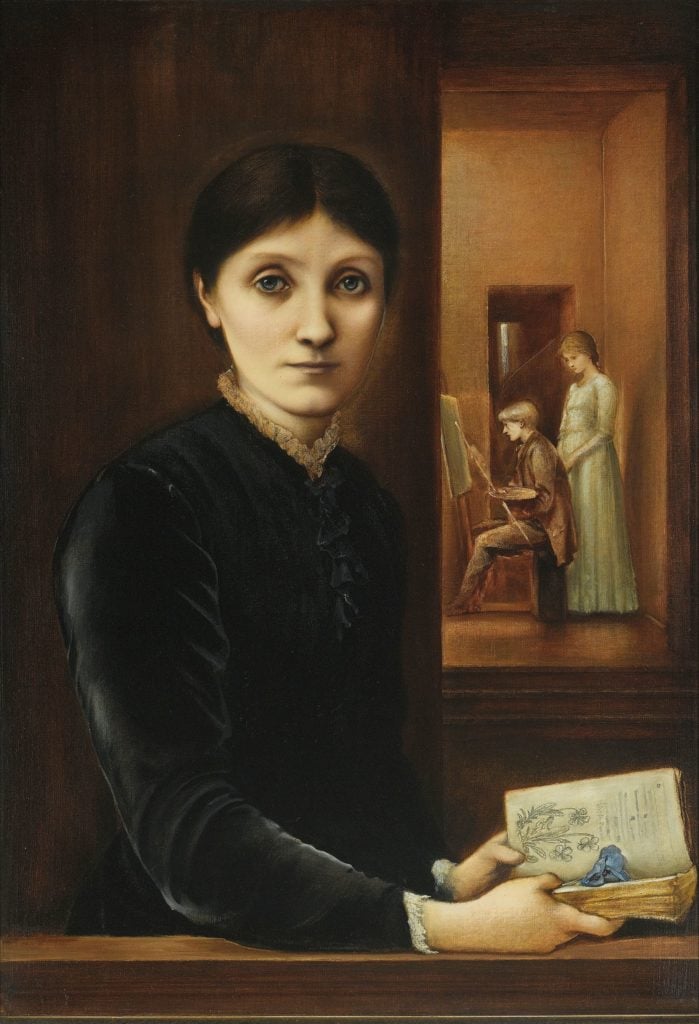
Edward Burne-Jones’s portrait of
Georgiana Burne-Jones with her children Philip and Margaret (1883).
Private collection, Image courtesy of Sotheby’s, London.
“Georgie was a very determined little woman, and in some ways
very unhappy because of the way Ned behaved,” Marsh says. “I hope I
have foregrounded her own attempts at art at the beginning of her
life” by showing works that have never been displayed in public
before. These include ink drawings and verses that she made before
she married. She also made fine woodcuts. “There was a book of
fairy stories that she and Lizzie Siddal proposed to publish,”
Marsh adds.
Burne-Jones had to all but give up art when her husband shut her
out of the studio after the birth of their first child. “It was a
tragedy,” Marsh says. “She recorded in her biography of her
husband, which is also a wonderful autobiography, how she sat in
the other room weeping silently.” To add insult to injury, when
Edward Burne-Jones was unfaithful with the artist-model Maria
Zambaco, she was allowed into his studio while his wife was
not.
Georgiana Burne-Jones was what would today be called an
activist-artist. A confidant of William Morris, they were kindred
spirits who stoically endured problem marriages. “She became close
to Morris as he moved into politics,” Marsh says. They both
believed in art for all, uniting the arts-and-crafts movement with
an idiosyncratic version of socialism. She was instrumental in the
founding of the South London Gallery in Camberwell, then as now a
largely working-class district.
She became one Victorian Britain’s first female politicians,
standing as a parish councilor in her village, which she set about
reforming with zeal. Her most courageous act of political protest
took place in the village of Rottingdean near Brighton on the South
Coast of England. At the height of the Boer War, she stitched an
anti-war banner and hung it from the family home. It declared: “We
have killed and also take possession.” It caused such outrage that
her nephew, the pro-war Rudyard Kipling, had to rush to save
Georgiana from being mobbed. Sadly that piece of textile art has
not survived.
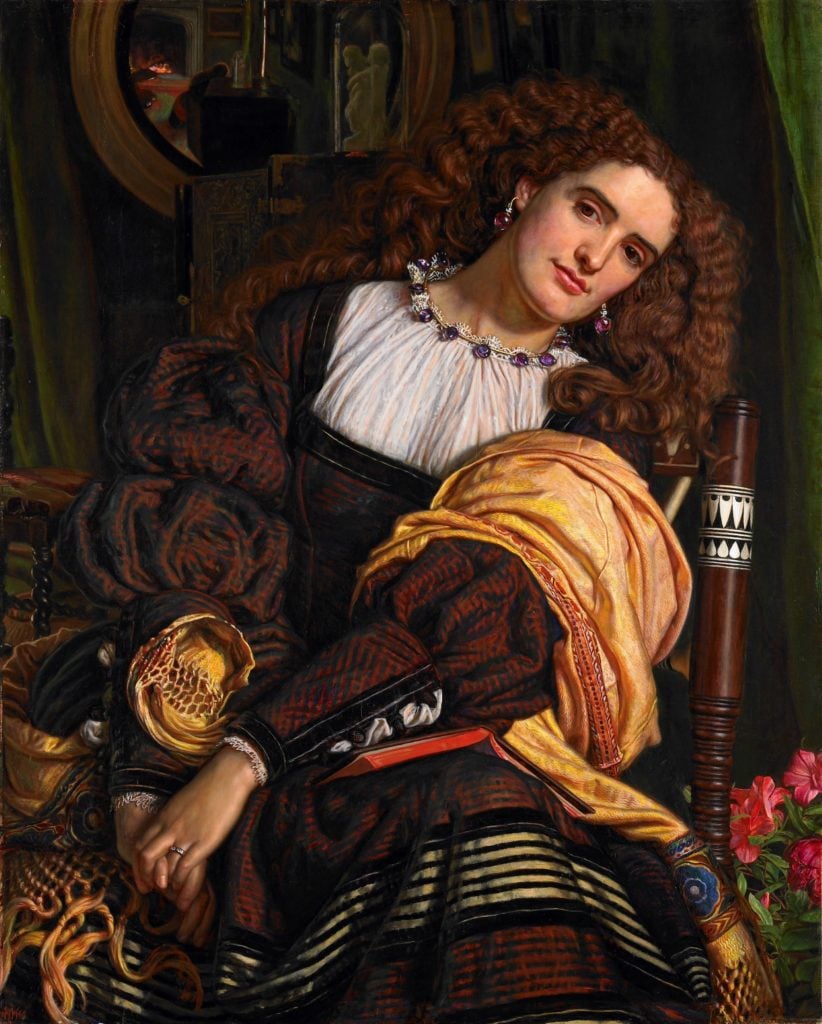
Annie Miller is the model in Il
Dolce far Niente by William Holman Hunt, 1866. Private
collection, care of Grant Ford Ltd.
“I would like to re-write the whole narrative of the
Pre-Raphaelite women being exploited and hard done by,” Marsh says.
“They were active agents in forging their own futures. They seized
the opportunities, especially the models,” she says. Women like
Annie Miller escaped their social class and probable fate of
domestic service, she points out. Siddall was destined to be a
seamstress.
“If you think of celebrity models today, someone like Kate Moss,
she wants to be an active part of the creative process.” The male
Pre-Raphaelites’ muses, or “stunners” as male members called them,
were neither victims nor clothes horses. “They were cast in roles
and made the most of them,” Marsh says.
“Pre-Raphaelite Sisters,” October 17 through January 26,
2020, National Portrait Gallery, London.
The post ‘They Seized the Opportunities:’ A New London
Exhibition Tells the Remarkable Stories of the Women of the
Pre-Raphaelite Movement appeared first on artnet
News.
Read more https://news.artnet.com/exhibitions/pre-raphaelite-women-london-1677964
Further reading


Leave a comment