
‘I Had No Idea What the Outcome Was Going to Be’: What Three Non-Performance Artists Learned by Doing Their First Performa Commissions
Performa, the New York performance biennial that’s now in its
16th year, has developed a reputation for forcing artists into
unfamiliar territory. Indeed, for many artists, Performa
commissions are their first opportunities to arrange events, which
presents unique challenges.
The learning curve can be steep, and artists often have to learn
on the fly. For many artists, the unpredictability is
precisely the appeal: the chance to take a big risk can be a
transformative opportunity.
As Performa comes to a close this weekend, we spoke with three
artists doing live events for the first time to see what they
learned from their experiences.
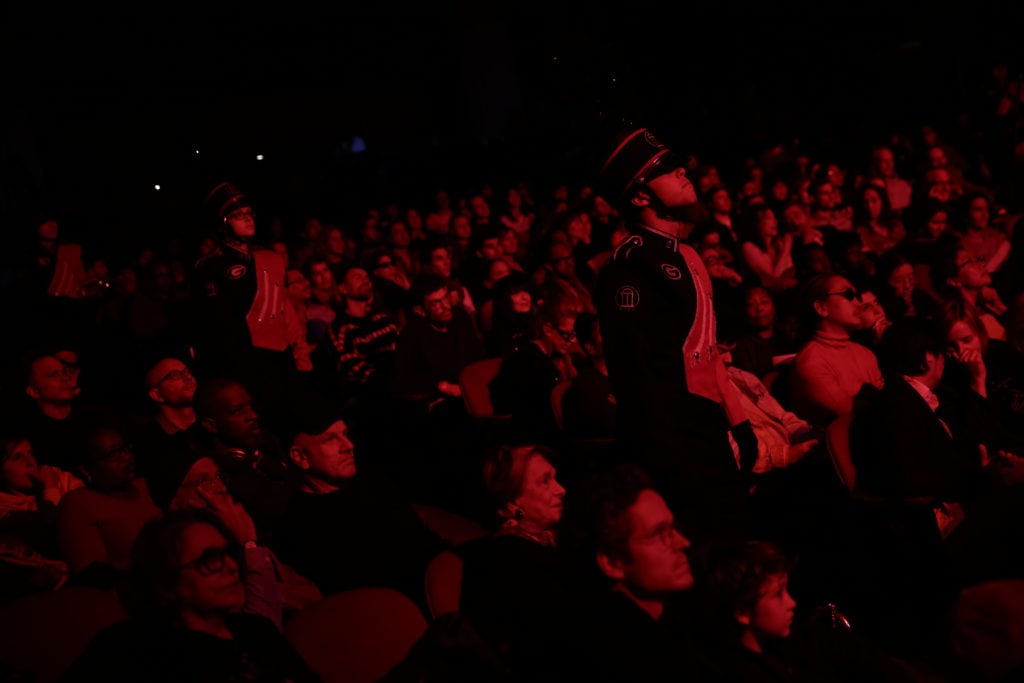
Paul Pfeiffer, University of Georgia
Redcoat Band Live (2019). Photo: Paula Court.
Be Ready to Completely Rearrange Your Plans
When Paul Pfeiffer planned to
bring the University of Georgia’s marching band to New York for his
Performa outing, he envisioned them playing in an empty stadium.
The original idea was to recontextualize how the band is perceived
(they usually perform at football games) by placing them in an arena with no athletes in
sight.
Pfeiffer even had one of the city’s major stadiums
lined up for the performance. But late in the process, the NBA
swooped in and outbid the artist for the venue.
The irony that the NBA quashed
his performance—which emphasizes the corporate spectacle of
professional sports—was not lost on Pfeiffer. But it still left him with a problem
to solve: where would the 50-member band play now? Eventually, he
locked down the historic Apollo Theater in Harlem, which opened up
new possibilities, Pfeiffer explains.
“The band is nothing if not a
machine; they are constantly on script,” the artist says. “To turn
them into performers in a different context was a total unknown.
And to an extent beyond what I anticipated, they performed their
roles as hype generators in an amazing way. The audience had access
to them, not just as a group, but individually. There were
interactions happening that I did not expect. Individual
personalities of the band members came out.”
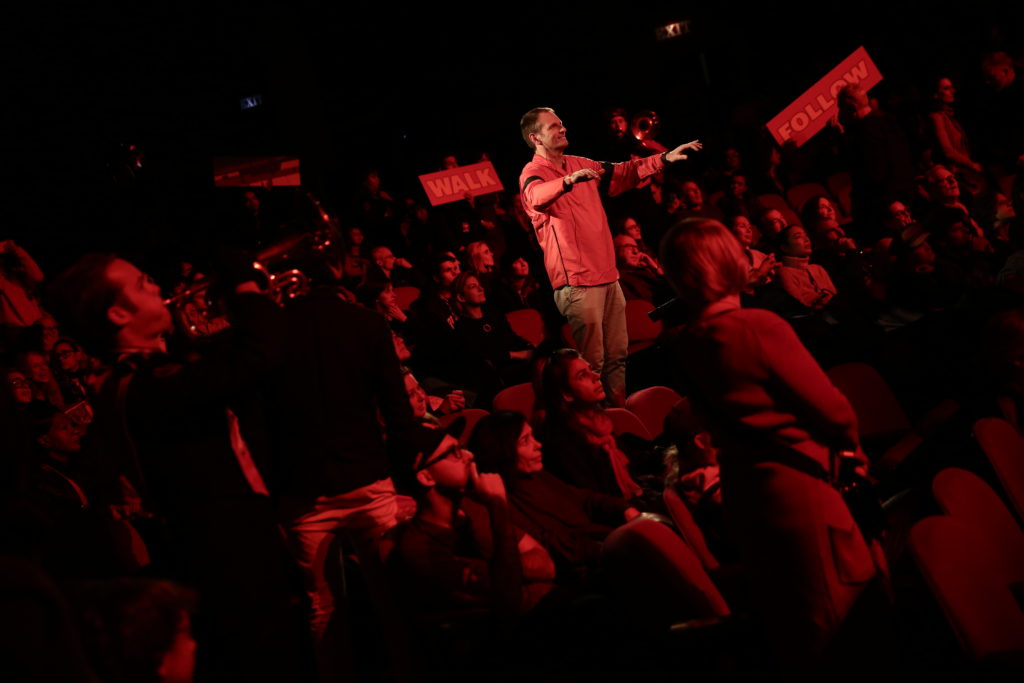
Paul Pfeiffer, University of Georgia
Redcoat Band Live (2019). Photo: Paula Court.
The change also spurred Pfeiffer
to expand the piece: while some members of the band played in New
York, those who didn’t make the trip
performed simultaneously at the vacant University of
Georgia stadium. Their performance was then live-streamed at the
Apollo.
“The whole thing was an
improvised negotiation happening in real-time,” Pfeiffer
says.
“There’s a grey area between the
notion that performance is something that happens on a stage, and a
wider idea of performance as all human behavior,” he adds. “That’s
absolutely fascinating to me. That’s what makes performance so
exciting and pertinent right now. As an artist, that’s where the
action is.”
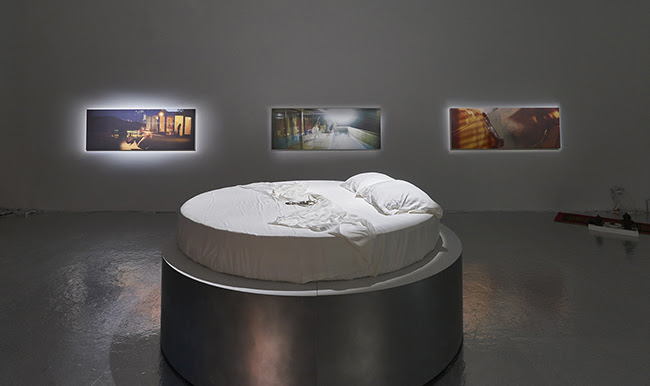
Installation view of Tara Subkoff’s
“DEEPFAKE,” 2019. Courtesy of the Hole.
Don’t Be Afraid to Let Your Children Get
Involved
“It was a very personal piece,”
says Tara Subkoff of her Performa commission, Deepfake.
An exploration of chaos theory
and the way in which our lives are shaped by the choices we make
moment-to-moment, the work was simultaneously staged at four
different locations, which forced viewers to pick just one
perspective on the sprawling event. Dancers moved to a
capella renditions of a Nina Simone song at two separate
churches uptown, while in Brooklyn, another group performed a water
ballet.
And at the Hole, the gallery
where Subkoff currently has a solo show, she staged a three-ring
circus with jugglers, a mime, a magician, and a contortionist. As
they pranced about, the
artist chased her daughter around in a circle while her cousin, a
tap dancer, performed nearby.
"background:#FFF; border:0; border-radius:3px; box-shadow:0 0 1px 0 rgba(0,0,0,0.5),0 1px 10px 0 rgba(0,0,0,0.15); margin: 1px; max-width:500px; min-width:326px; padding:0; width:99.375%; width:-webkit-calc(100% - 2px); width:calc(100% - 2px);">
View this post on Instagram


Subkoff didn’t plan on being in
the piece herself. (The one time she starred in her own work was,
according to her, “the worst piece” she’s ever done. “It was worse
than the time I sang karaoke in Tokyo and cleared the room,” she
says.) But her three-year-old daughter insisted on being part of
the work, and so Subkoff decided to participate
too.
“It was a comedic version of
what it’s like to be a female in our society, trying to be all
these things to all these people at the same time,” Subkoff says of
the performance. “As a single mom, I feel like I’m always running
in circles and juggling.”
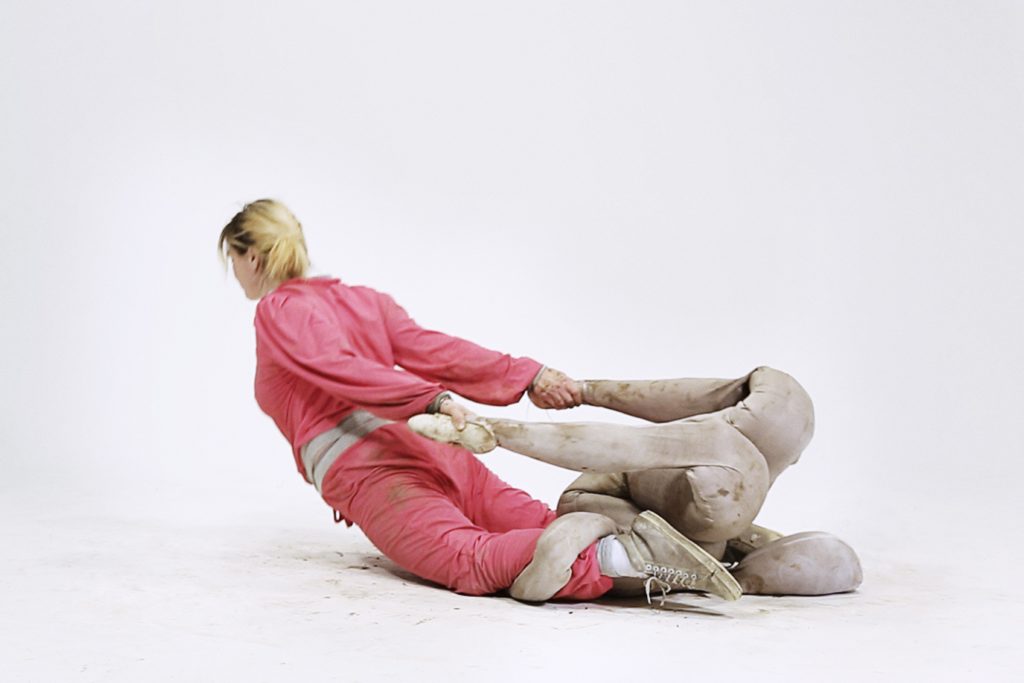
Éva Mag, Stand Up, still (2015).
Courtesy of the artist.
Trust Performa
There’s a Swedish expression
(köpa grisen i säcken, which translates roughly
to “buy a pig in a
sack”) that’s used to describe a situation in which you agree to do
something without really knowing what it is.
Éva Mag, a Swedish sculptor and
performance artist, says Performa was her pig in a
sack.
“It was a challenge for me to
understand what this is, who the artists are, and how I fit in,”
Mag says. “I’m doing a project I haven’t done before in a new
environment. I had to figure out how to get the help I needed. I
had no idea what the outcome was going to be.”
As a performer, Mag explains,
“you have to learn not to be totally nervous and freeze, but
actually trust yourself and go on.”
"background:#FFF; border:0; border-radius:3px; box-shadow:0 0 1px 0 rgba(0,0,0,0.5),0 1px 10px 0 rgba(0,0,0,0.15); margin: 1px; max-width:500px; min-width:326px; padding:0; width:99.375%; width:-webkit-calc(100% - 2px); width:calc(100% - 2px);">
View this post on Instagram
 30min till
 Thank
ThankMag’s work, Dead Matter Moves, is a durational
performance that took place across six nights at the historic
Judson Memorial Church. It features 10 performers erecting lifesize
figures of clay and stuffing them into patchwork “skins” made of
found textiles.
Mag says that talking with
Performa curator Kathy Noble played a big part in shaping the
piece, as did working with a production team—something she’s never
done before.
“They helped with small details
like scheduling throughout the day, and setting up the space for me
to totally develop myself and investigate my techniques,” says the
artist. “They pushed me
to do more and to grow. That is really American—you can dream
big!”
The post ‘I Had No Idea What the Outcome Was Going to Be’: What
Three Non-Performance Artists Learned by Doing Their First Performa
Commissions appeared first on artnet News.
Read more https://news.artnet.com/exhibitions/performa-2019-1713579
Further reading


Leave a comment