
Most Know Photographer Dóra Maar as Picasso’s Spurned Lover. But a New Exhibition Argues We Got Her Story All Wrong
For many people, Dóra Maar
is simply Picasso’s jilted ex-girlfriend, an independent spirit who
turned into his clingy “weeping woman.”
But a
new show at Tate Modern in London seeks to overcome those
preconceptions and place Maar—a photographer with an eye for absurd
and erotically-charged images—at the forefront of the Surrealist
movement.
Gathering over 250 works, including
photographs, photomontages, and printed matter, the survey, which
first opened at the Centre Pompidou in Paris, includes lesser-known
works, such as her street photographs of the 1930s and paintings
from the 1940s onwards.
Born
Henriette Theodora Markovitch in Paris in 1907, Maar grew up in
Buenos Aires. On her return to France, she studied painting and
dabbled in photography, and her artistic talent was quickly spotted
by her teachers. At 23, she reinvented herself as Dóra Maar. By
1932, she had established a successful photography studio, where
she undertook commercial work in fashion and advertising, shot
portraits, and even took nudes for erotic
magazines.
The
early 1930s were hectic and glamorous years for Maar. One
fascinating wall in the exhibition is dedicated to portraits taken
of Maar by the likes of Brassaï, Paul Éluard, Cecil Beaton, Irving
Penn, and Lee Miller. It was Éluard who first introduced Maar to
Picasso in 1935. They met on a film set where she was working as a
photographer. (He did not remember the encounter.)
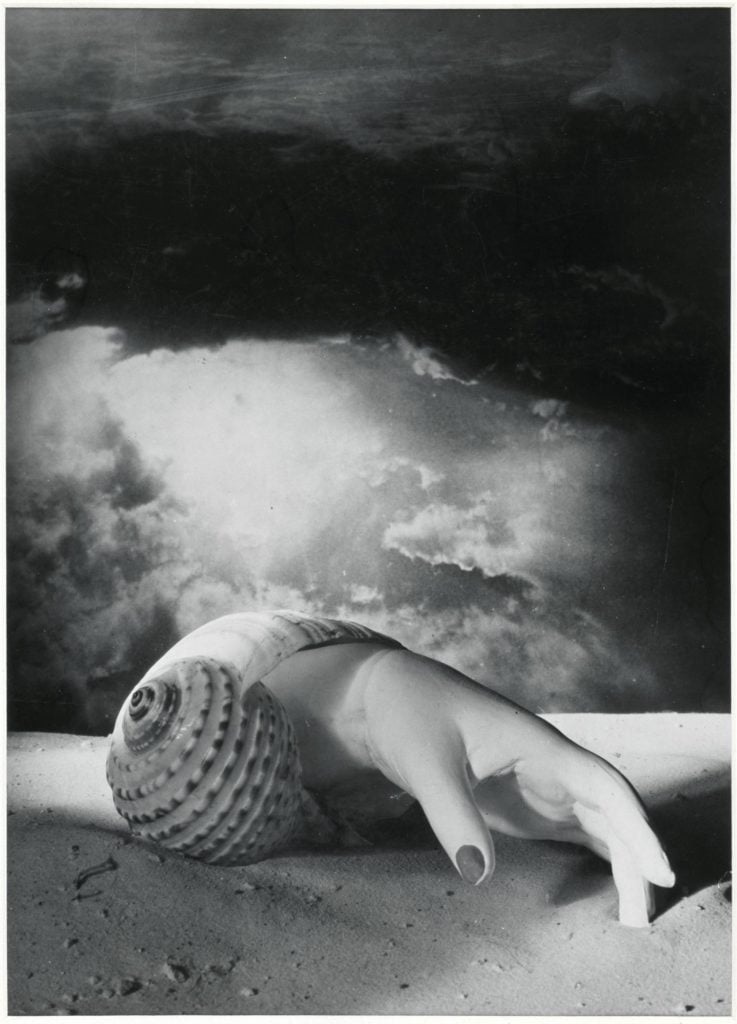
Dora Maar, Untitled
(Hand-Shell) (1934). © Centre Pompidou, MNAM CCI, Dist.
RMN. Grand Palais/image Centre Pompidou, MNAM -CCI © ADAGP, Paris
and DACS, London 2019.
Restless
Ambition
The
Tate’s curators have done an excellent job conveying Maar’s
creative restlessness and ambition by dividing her early work into
four rooms. One is devoted to her commercial assignments; two are
focused on her street photography, photojournalism, and cityscapes;
and a large room, painted dusty pink, showcases her extraordinary
Surrealist output. She zealously pursued all these strands in the
same heady period, from the early 1930s up to around
1936.
The
standout room of the show is the Surrealist one. Here hang all her
best-known photographic masterworks, including
The Pretender
(1935), where a boy contorts
himself backwards while standing on a vaulted ceiling turned upside
down. Her Portrait
of Ubu (1936) is a
disturbing yet tender close-up of a strange, otherworldly creature
thought to be a baby armadillo. Untitled (Hand-Shell) (1934) is a disembodied hand, stiff like a
mannequin’s, which protrudes from a seashell against a backdrop of
apocalyptic clouds.
But
the show also provides a chance to discover lesser-known but
equally dazzling works, such as the suggestive
Untitled (Villa for
Sale) (1936), an erotic
collage in which a naked woman pulls her long, dark hair upwards
while standing on the steps of a derelict house.
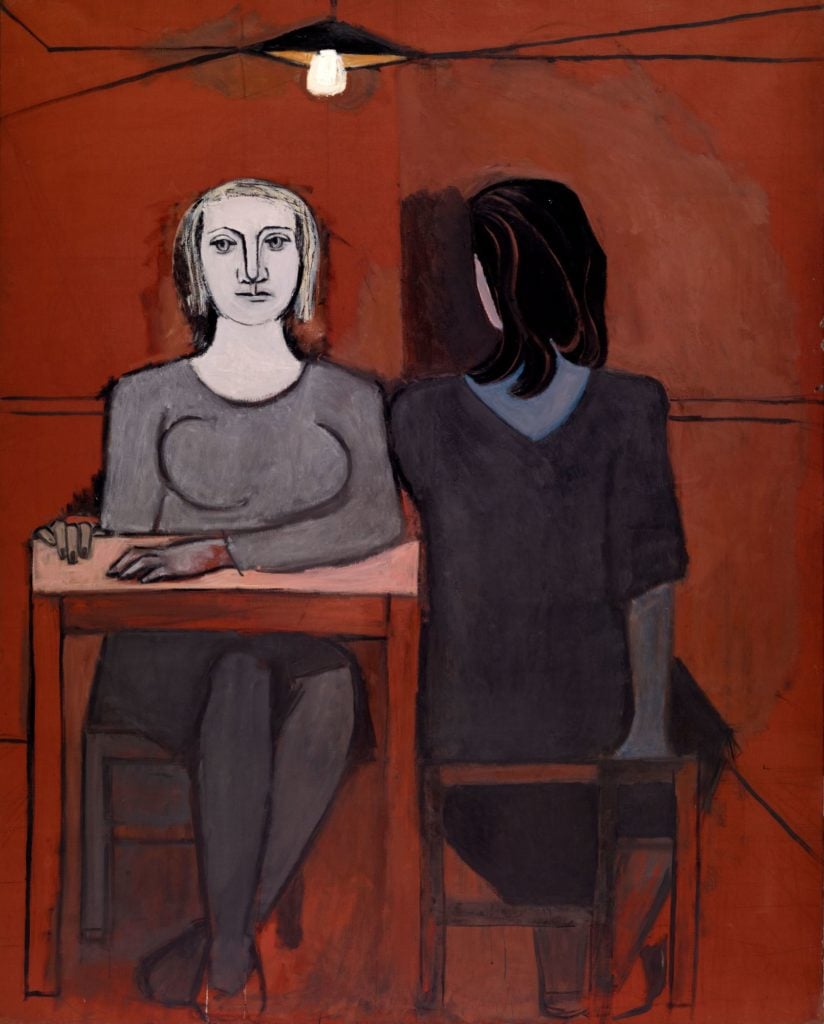
Dora Maar, The Conversation
(1937). Fundación Almine y Bernard Ruiz. Picasso para el Arte,
Madrid © FABA Photo: Marc Domage © ADAGP, Paris and DACS, London
2019.
Dóra Maar and Guernica
The
year that bookends Maar’s most creative period as a
photographer—1936—is also the one in which her orbit collided with
Picasso’s, which brings us to the (Picasso-sized) elephant in the
room. The Tate’s curators address this thorny issue in a positive
way by focusing on their collaborative endeavors, and how they
mutually influenced one another.
On
show, for example, are the photographs that Maar took of Picasso
painting Guernica in 1937, and we are told of how she urged
Picasso to take a more public stance on the Spanish Civil War,
which he had previously refused to do. She also taught him the
complex technique of cliché verre, which combines photography with
printmaking. There are also a few portraits of Maar
painted by Picasso, most notably his 1937 Weeping Woman,
which is in the Tate’s collection.
Perhaps more problematic is Maar’s abandonment
of photography for painting in the late 1930s. Picasso had an
ambivalent relationship with photography. (He is quoted as having
said: “Inside every photographer is a painter trying to get out.”)
One cannot help but wonder how much influence Picasso had on Maar’s
decision, and what role his own insecurities may have played. Tate,
however, frames Maar’s shift from photography to oil painting as an
active choice, a return to her roots as a painter.
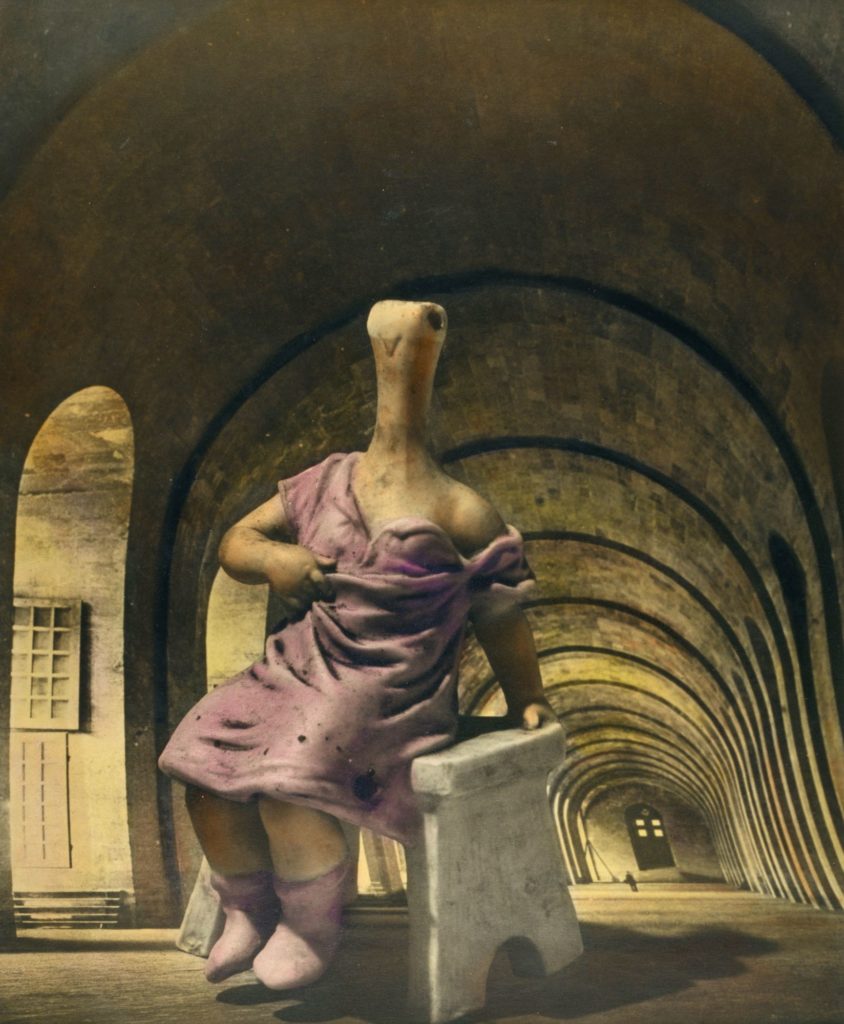
Dora Maar, 29 rue
d’Astorg (around 1936). Photo © Centre Pompidou, MNAM.
CCI/P. Migeat/Dist. RMN. GP © ADAGP, Paris and DACS, London
2019
There
are two rooms dedicated to Maar’s paintings. The first canvases are
painfully obedient to Picasso’s Cubism. She is so resolutely in his
shadow that her works seem mere knockoffs.
But The
Conversation (1937),
which has only been publicly exhibited twice before, is truly
fascinating. The large canvas depicts Picasso’s mistress,
Marie-Thérèse Walter, and Maar sitting back-to-back in a red
domestic interior. The style is still quite Picasso-like, but here,
Maar seems to have found a greater sense of agency, driven perhaps
by her growing frustration at having to share her charismatic lover
with Walter, the mother of his daughter, Maya. The painting
features an electric ceiling lamp, a motif that appears in
Picasso’s Guernica—possible proof, we are told, that the stream
of influence went two ways.
The
rest of the exhibition explores Maar’s later pictorial output,
ranging from dull-colored portraits and still lifes in the post-war
years, to more vivid abstract works.
We
learn that Maar suffered a breakdown after her relationship with
Picasso ended for good, and that the French psychoanalyst Jacques
Lacan helped her regain her energy and drive. But her paintings
never reach the creative heights that her photography did. Still,
the show’s commitment to giving a complete and fair portrayal of
her career is commendable, as well as necessary.
There
was plenty of life post-Picasso, after all. Maar died at the age of
89. In the 1980s, she returned to the darkroom, and created a
series of photograms combining photographic techniques with
abstract marks, merging all the techniques that she perfected
during a lifetime of art-making. Maar was looking for new creative
avenues right until the very end.
“Dóra Maar” is on view from November 20, 2019
through March 15, 2020, at Tate Modern in London.
The post Most Know Photographer Dóra Maar as Picasso’s
Spurned Lover. But a New Exhibition Argues We Got Her Story All
Wrong appeared first on artnet News.
Read more https://news.artnet.com/exhibitions/dora-maar-picasso-tate-modern-1710780
Further reading


Leave a comment