
‘The Vultures Are Circling’: The Market for Young Artists Is Taking Off in Miami—But Can They Get Out Alive?
If you were under the impression
that all you needed to buy a work of sought-after contemporary art
was money, a trip to Art Basel Miami Beach this week would quickly
prove you wrong.
Collectors at the glitzy Miami fair,
which runs through the weekend, jostled for the privilege of
spending five to six figures on works by rising stars such as
Amoako Boafo and Loie Hollowell. In
order to get an edge, some promised to donate their work to a
museum within just a few years; others agreed to buy something by
another artist from the gallery’s stable to sweeten the deal. And,
of course, they pledged not to resell the work at auction—at least
for a number of years.
These sorts of arrangements are
symbolic of today’s market moment, in which some of the energy
appears to be shifting away from vintage
work by rediscovered figures from the 20th century and
masterpieces by blue-chip names (which are currently in short supply). In
their place, the intensity has been redirected to young guns—many
of whom have yet to turn 30 or have their first museum
exhibition.
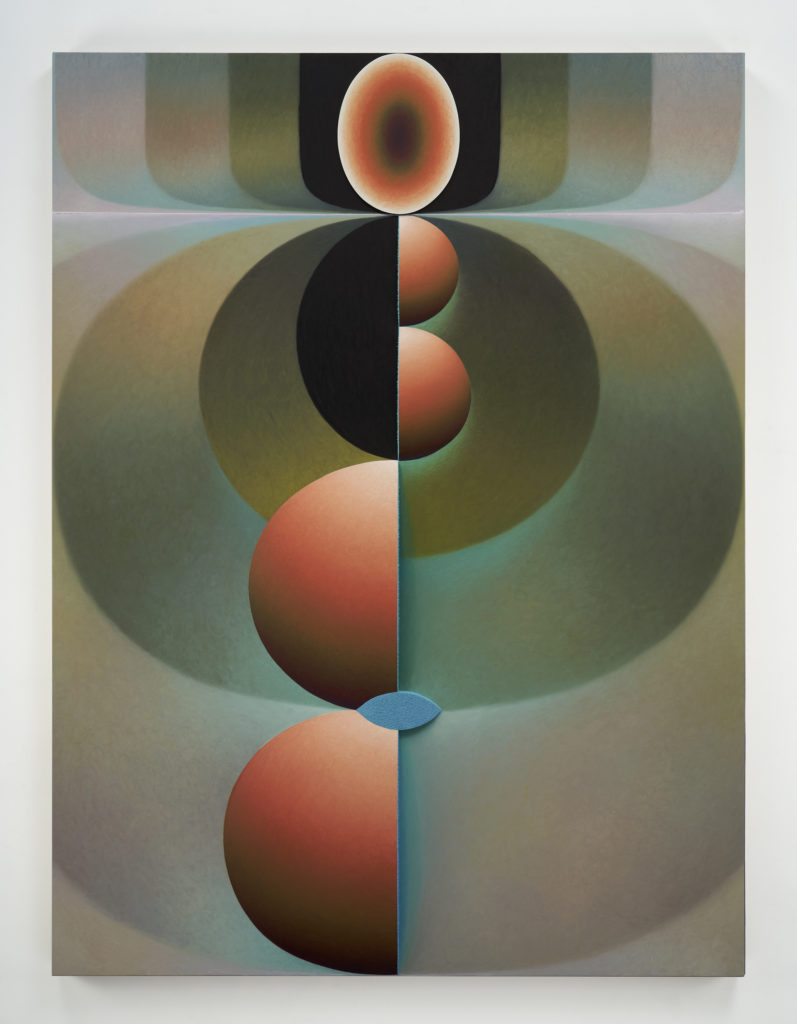
Loie Hollowell, Standing in Water
(2019). © Loie Hollowell, courtesy Pace Gallery.
The art world has always been
afflicted with a next-big-thing obsession. But due to a combination
of factors—including the speed with which information travels
online, collectors’ desire to win big but spend comparatively
little, and, of course, the genuine thrill of discovery—the
market’s yen for youth, which had waned over the past few years, is
back.
Art advisor Liz Parks recalls
how, in the days leading up to the fair, she and a client looked
through previews that “included very strong work by established and
mid-career artists that she already has in her collection,” yet the
client told her, “‘This is great… but I want to see something
new.’”
Young Guns Blazing
Plenty of new art was on hand at
the Miami fairs, and selling swiftly from emerging and established
galleries alike. Hauser and Wirth—which just last year poached two Impressionist and Modern
specialists from Christie’s, suggesting a shift in focus toward
the secondary market—prominently displayed a landscape pastel by
Nicolas Party, who at 39 is one of the newest and youngest
additions to its roster. The work sold for $385,000 to an
American institution.
Almine Rech Gallery, whose
recent fair presentations included an installation by 74-year-old
Conceptual pioneer Joseph Kosuth, sold two works by 27-year-old
recent Yale MFA graduate Vaughn Spann for prices ranging from
$35,000 to $50,000; a painting by 29-year-old Canadian artist Chloe
Wise for between $35,000 and $50,000; and a painting by Marcus
Jahmal, also 29, for between $20,000 and $50,000.
Meanwhile, Mariane Ibrahim
Gallery sold out of bold portraits by the 35-year-old Ghanaian
painter Amoako Boafo at prices ranging from $15,000 to $45,000—and
left many eager buyers lining up on the waiting list. Two of the
works sold are promised gifts to institutions. (Such conditions are
meant to benefit collectors who truly love a work of art—or at
least love the cachet of owning it for a little
while.)
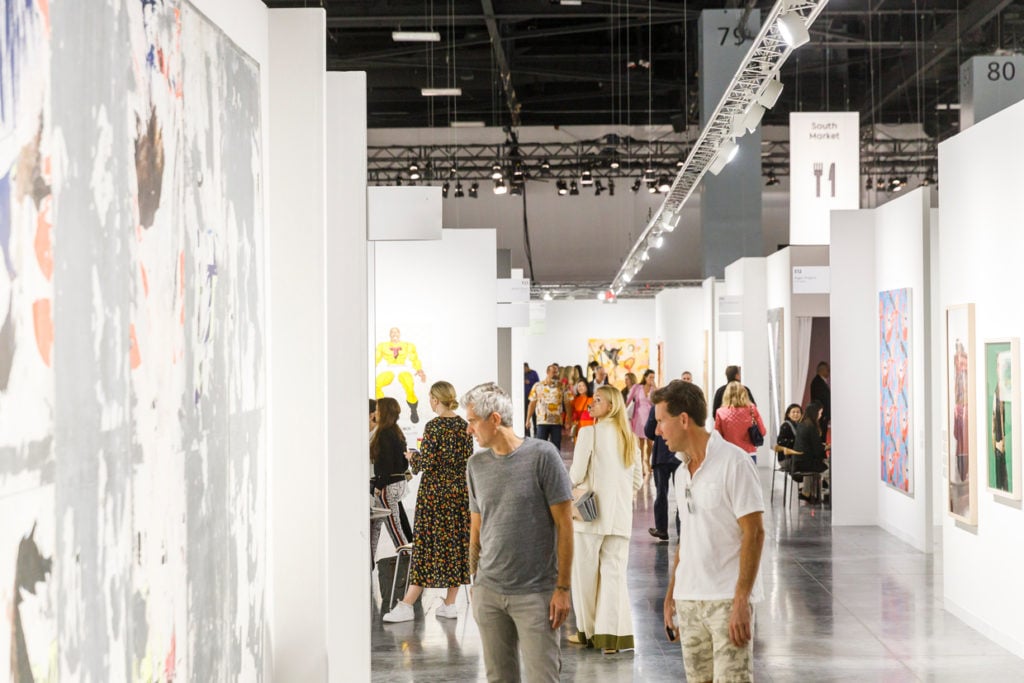
Art Basel Miami Beach 2019. Photo:
Courtesy of Art Basel.
“Collectors used to have the
luxury of following an artist’s career through their first few
shows before deciding if they wished to acquire a piece,” says art
advisor Kristy Bryce. “Now there’s a feeling that one needs to buy
the moment you encounter an artist for fear that otherwise you’ll
be stuck at the back of an interminably long wait list—behind every
museum or collector with deep enough pockets to gift it to a
museum.”
This sense of urgency, she
notes, is compounded by the perception that “by the time you get
your chance to acquire something, the prices will have risen beyond
your reach.”
The Dark Side
The overwhelming demand for a
relatively small handful of anointed young talents—which was also
on full display during the
November day sales in New York last month—can be harmful for
those still finding their footing in the art world. “Generally
speaking, artists just want to work and the attention can interfere
with this process,” Ibrahim says.
Unlike an artist whose career
takes off after two or three decades of working in the studio,
recent graduates have not had the opportunity to experiment and
evolve outside of the spotlight—and may fall victim to the pressure
to produce more of the same to satisfy demand.
The glare can also be difficult
for dealers, who must suss out opportunistic buyers and keep the
artist happy while, at the same time, encouraging them to eschew
immediate gratification (not to mention avoid burnout) in favor of
building a sustainable career.
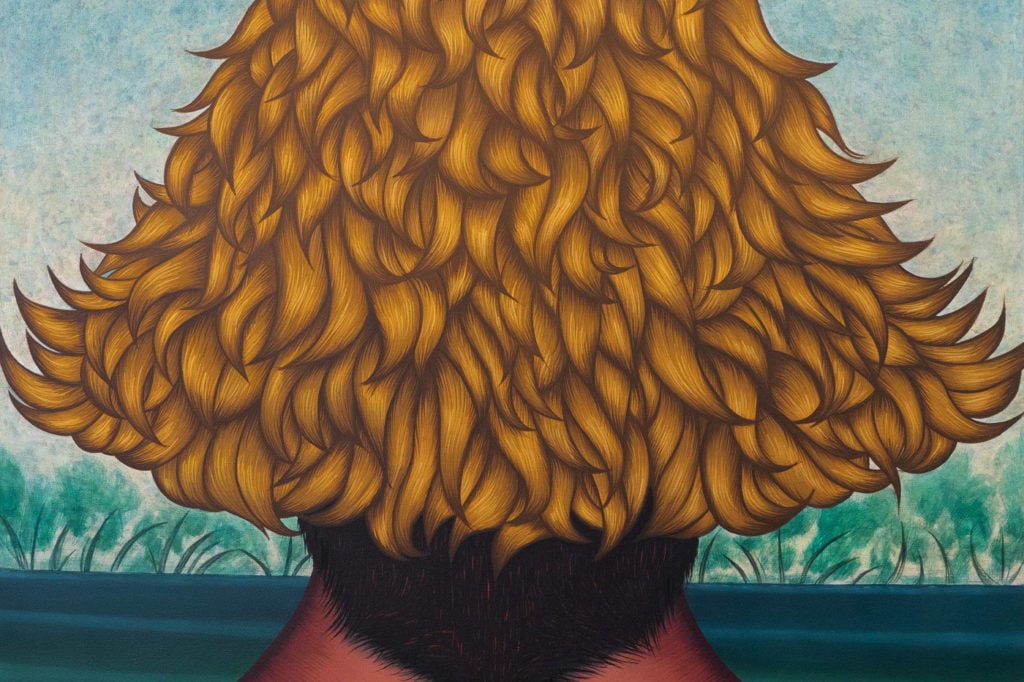
Julie Curtiss, Outlook (2019)
[detail]. Photo: Anton Kern Gallery.
for the artist, continue an open dialogue, and maintain a close
relationship,” says Anton Kern, who recently began representing the
French artist Julie Curtiss. Her surreal, tightly cropped portraits
and still lifes have sold at auction for
nearly $500,000, well over than 10 times what they cost from the
gallery.
At Art Basel Miami Beach, Kern
sold a Curtiss painting of the back of a head to a collector who
promised to donate it to a museum within five years. “It’s
difficult when there is such a big disparity between the primary
and the secondary market—you buy something and you know it is worth
more instantly,” Kern says. “The responsibility of a dealer, among
lots of other things, is placing the work right—not to flippers but
to real collectors.”
Zombie Redux?
This dynamic is not new. Just
five years ago, the market experienced what has become known as
the “Zombie Formalism
apocalypse,” when a group of artists who made
Instagram-friendly abstraction became a sensation, saw their prices
rise by more than 1,000 percent at auction, and promptly fizzled
out. “I had a really successful Zombie Formalist painter who sold
50 works, then some popped up at auction and it ruined his career,”
recalls dealer Michael Benevento.
And while the trade isn’t in a
moment as overheated as it was during the Zombie craze, the hype
cycle has become even more condensed since then. When Ibrahim
applied to Art Basel Miami Beach with a solo booth of Boafo’s work
this past spring, for example, most collectors did not know his
name. Six months later, those same people do not have a shot at
acquiring his work.
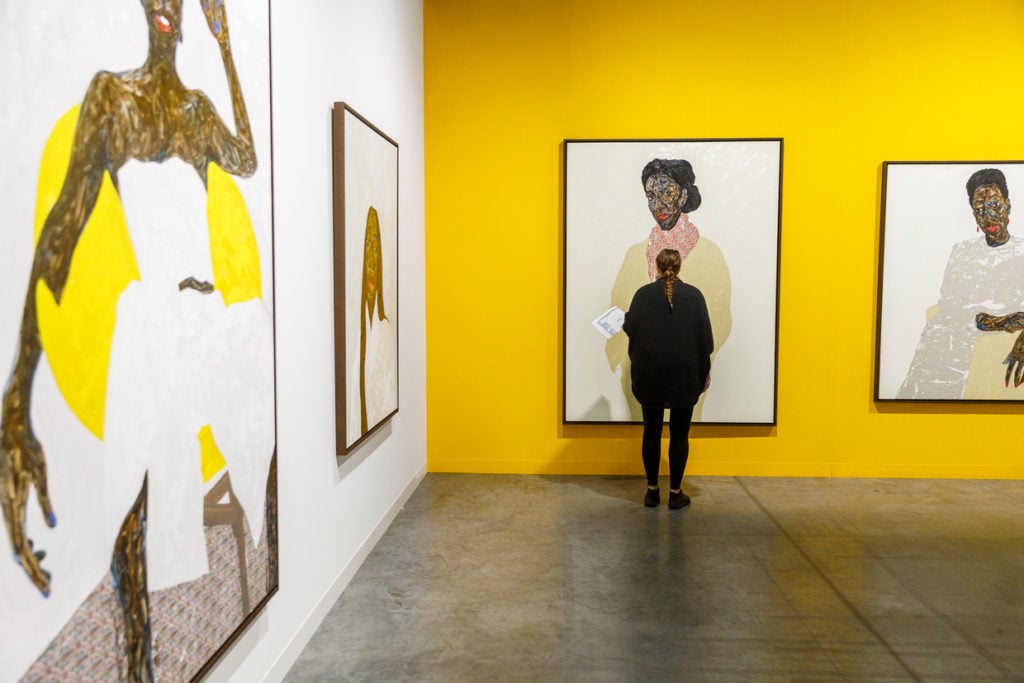
Mariane Ibrahim Gallery’s presentation
of Amoako Boafo at Art Basel Miami Beach 2019. Photo: courtesy of
Art Basel Miami Beach.
Boafo is not alone, either. Just
three years after her first show, 31-year-old Asuka Anastacia Ogawa
is drawing hefty demand
at Blum & Poe, which sold her painting of two surreal figures for
$25,000 during the fair’s VIP preview. “I have emails pouring in
for her—it’s a $25,000 painting and the vultures are circling,”
says the gallery’s Tim Blum. “With younger artists, you have to be
more careful.”
But despite a gallery’s best
efforts to avoid speculation, the market, like the weather, has a
way of exerting its will. “At a certain point, many collectors stop
looking at the object on their wall as an artwork,” notes art
advisor Todd Levin. “When the numbers get high enough, they start
seeing it as a bag of money, and the larger that bag of money gets,
the bigger the temptation to sell.”
As one dealer of young artists
acknowledged, “You really can’t control it—at the end of the day,
the work protects itself if it’s good. You have to believe in the
artist.”
The post ‘The Vultures Are Circling’: The Market for Young
Artists Is Taking Off in Miami—But Can They Get Out Alive?
appeared first on artnet News.
Read more https://news.artnet.com/market/art-basel-young-artists-2019-1725303
Further reading


Leave a comment