
Why We Founded the Yes Women, an Art Group Demanding Justice for Divorcées in the Former East Germany
On November 9, the day Germany celebrated the 30th anniversary
of the fall of the Berlin Wall, standing on Alexanderplatz, we
observed something extraordinary: nobody was there. There seemed to
be an enormous gulf between the official state version of the
event, the sentimentality and excitement over the Victory of a Free
Society against Totalitarian East Germany, and the almost complete
lack of interest on the part of the population.
The loudspeakers in the square screamed with enthusiasm as vast
projectors filled the walls of Alexanderplatz’s commercial
buildings and offices with 80-foot-tall video images of the crowd
that stormed the Berlin Wall 30 years ago and political speeches
filled with passion and faith in the future. Meanwhile, it appeared
as if no more people were standing in the square itself than there
would have been on any other weekend evening, perhaps a hundred at
any given time. Most of them were staring at their phones, moving
sluggishly from shop to shop. Perhaps three or four, at most, were
actually staring at the pathos unfolding above them.
30 Years Later
It seems that no one in Eastern Germany had any doubts about
what those promises of freedom, equality, and brotherhood meant
now: these had proved empty. Instead of prosperity, the entire
Eastern bloc found itself deindustrialized, those with secure wage
labor jobs thrown into precarity as most middle-class GDR residents
and almost all highly trained professionals either moved to the
West or were reduced to low-paid “service workers.” The
educational doctrine whereby GDR children were once
taught to see themselves as heirs to the anti-fascist resistance
has been displaced completely by the doctrine emphasizing
the eternal guilt of the Germans. The resulting climate of
disillusionment and bitterness is cleverly manipulated by
right-wing parties to increase hatred of strangers, allegedly
taking jobs away from the local population and redistributing
political power in their favor.
All this, of course, is not just happening in Germany. What
everyone now understands is that what the fall of the Berlin Wall
really marked was the beginning of the dismantling of the social
state everywhere. It wasn’t trade unions and progressive workers’
movements, let alone First Wave Solidarnost or feminists who won
the Cold War—even if they took the most risks and did most of the
decisive fighting—but the smug neoliberalism of Thatcher and Reagan
that immediately began its victory run around the planet.
That day in Alexanderplatz it felt as if everyone
understood that fact now, so that the only possible reaction was
simply to do nothing at all. Standing in a cold, dark, empty
square, among a few confused shoppers, we thought about how we’d
arrived at this point zero. After all, passivity isn’t really an
option. Not just Germany but the whole world seems to be faced with
a choice: either we go back 30 years and start over, storm the
walls that separate us again, or else accept that the only reaction
to the arrogance and betrayal of the authorities is literal
fascism.
What we were witnessing in Alexanderplatz, and was happening
simultaneously (and to a similar blasé reaction) at Brandenburg,
was an oxymoron: an attempt to whip up enthusiasm about the quest
for “normalcy.” Ironically, this lack of excitement resembled
nothing so much as the massively dull marches and demonstrations
that marked the political life of the GDR itself, where generously
paid designers were tasked with convincing citizens that everything
really was perfectly normal.
Today, millions of people are taking part in real marches and
demonstrations across the world, from Lebanon to Chile, Sudan to
France. The demands of the protesters are all very similar: social
justice, the removal of corrupt authorities, and the restoration of
a social state that has been dismantled since the fall of the
Wall.
In many countries, such as France, these demands also include
direct democracy; in others, such as Lebanon or Iraq, it means the
rejection of the various ethnic or sectarian identities that have
become the primary basis of political mobilization under
“normalcy”: Shiites and Sunnis, Christians, and Muslims. The people
of Lebanon have created a single living chain by holding hands,
that stretches across the country.
But these things were just what the people of the German
Democratic Republic too demanded when they crossed the destroyed
Berlin Wall 30 years ago.
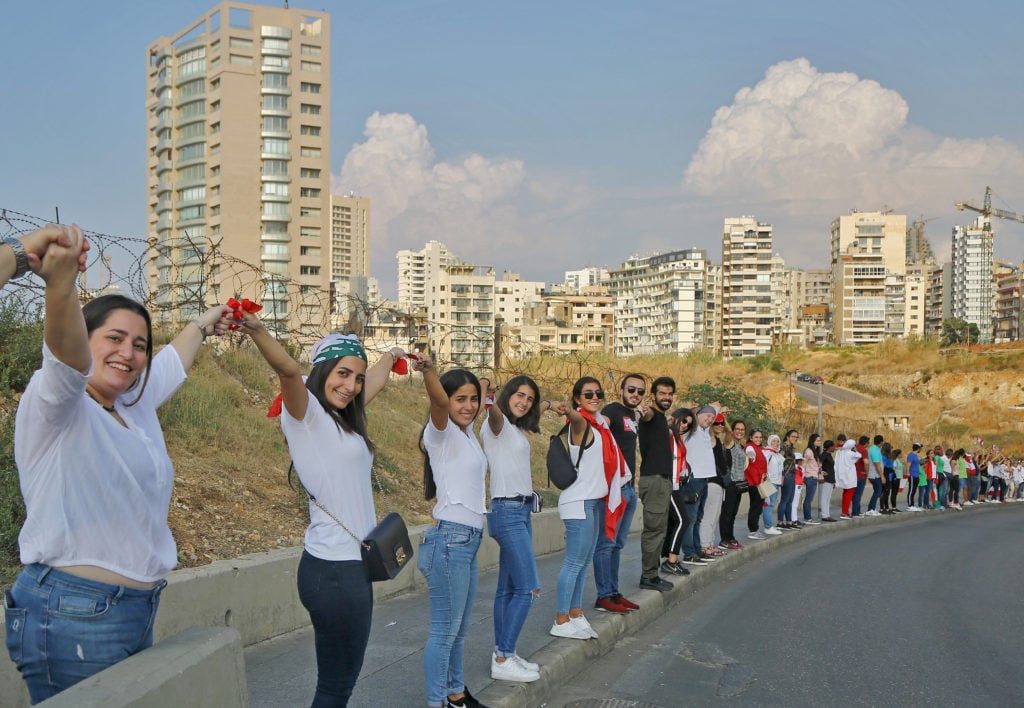
Lebanese people hold hands as they form
a human chain stretching along the coast from the capital
Beirut to northern and southern Lebanon, symbolizing national
unity, during anti-government protests across Lebanon. Photo by
Marwan Naamani/picture alliance via Getty Images.
The Birth of an Art Project
Perhaps the greatest contradiction in this newfound “normalcy”
is embodied in the fate of nearly a million divorced women from the
former GDR.
I (Nika) met Marion Boker, who has long worked to
publicize and pursue their case, five years ago through my friend,
a Russian activist and writer named Vesta. Vesta’s husband had
stolen her three-year-old daughter and completely cut her off from
any contact with her mother.
At the time I too was fleeing an ex-husband, who terrorized both
our child and myself with endless legal persecution. I spent a lot
of time in court. In my spare time, such as it was, I was
participating in feminist conferences and drawing a comic book
about my divorce.
Marion told us about the fate of hundreds of thousands of women
who, because they too had divorced, were deprived of up to 30
percent of their pensions after unification. This might not sound
terribly dramatic, but given rents and ordinary expenses, it
essentially means their disposable income is zero.
For 30 years now, these women have been fighting for their
rights. They have gone through every possible political and legal
channel; participated in innumerable demonstrations and petitions;
even reached the UN, managing to get the UN to recognize that the
German government was “structurally unfair” to them and issue a
demand that they be compensated.
Thirty years ago, there were 800,000 of these women.
Today, there are roughly 300,000 left,
and their average age is 80. Every day there are less of them. The
women themselves explained to us that the government is waiting for
a “biological solution.” So nothing happens. Decisions are
postponed, dates changed. Sometimes government officials literally
laugh in their faces.
It’s not just politicians. Most of the press and thus the
educated public doesn’t take their cause particularly seriously.
You can still read columns in German newspaper that effectively
say, “darlings, what do you want from us? You want the best of both
worlds, to pursue an ‘abnormal’ lifestyle and then let the rest of
us take care of you? If you’d pursued a normal life, you wouldn’t
have these problems.” (Divorce, it should be noted, was easy and
common in the East, unlike in the West, where until 1975 women
needed their husbands’ permission to work at all, though if
divorced, they did get a share of their husbands’ pension.)
This is the violence of “normalization” in its most brutal,
mocking form.
What Can Artists Do?
We are speaking of German women dying in penury in the one of
the richest countries on earth, the much-vaunted “winner” of the
economic war of all against all that followed the collapse of the
Cold War order. So we asked ourselves, what can we—as artists—do to
help hundreds of thousands of divorced women who have been
abandoned by politicians?
What can artists do in this world? How much power do we really
have?
First, we tried to “apply for grants” to get funding. We applied
to a German foundation which is supposed to work in the east of
Germany to provide support for artistic projects based in community
needs, but for a variety of reasons, we didn’t get a single penny.
We encountered an endless variety of cold shoulders. One of the
last, and perhaps the most comical, was a giant check awarded us by
politicians in Bundestag. By “giant” we do not mean that it was for
a large sum of money. Actually, it was for €1,000 euros, enough to
pay a couple workers for perhaps a week. But the check itself was
literally a meter long.
In the welcoming speech, it was said that “politicians could not
help women, but they have hope for the arts.” The women themselves
could continue to die penniless, that was inevitable; but at least
there might be some pretty pictures to encourage us to think about
their plight.
The women and those like us working with them were consistently
rejected. Each time in a different way.
A hundred thousand penniless young blondes might have received a
different reception. But these women were old, and not especially
glamorous. They were for the most part so careful, frugal, and
fastidious in their dress and bearing that they didn’t even look
particularly poor or miserable. They were precisely the people you
don’t really notice on the bus.
At first, we imagined as artists we could come up with a concept
so sharp that society could not help but see that what had happened
and what was happening to a million of their fellow citizens was a
monstrous injustice!
Well, we tried. Our first idea was to play on this irony with a
demonstration during Berlin Fashion Week on Unter del Linda. The
event would have been familiar to most members of the media who so
regularly mocked or ignored the Association of Divorced Women from
the GDR. This time, however, we imagined those women would be
passing under the Brandenburg Gate in costumes by Vivienne
Westwood. We hoped that the name would attract the attention of the
international press. After all, we thought, Vivienne Westwood
herself is old, had suffered due to an insufferable husband, but
still managed to survive and even emerge triumphant. Such, we
thought, is the magical power of art!
Except it turned out Vivienne Westwood wasn’t interested. Or to
be more precise, she expressed enthusiastic support for the women’s
cause, but told us (understandably enough) that all her political
energies were currently focused on climate change. Several equally
desperate attempts to advance the project failed.
Partly as a result, hundreds of thousands of German grandmothers
remain unable to find support for their demand for justice from the
German government, or, really, anybody else.
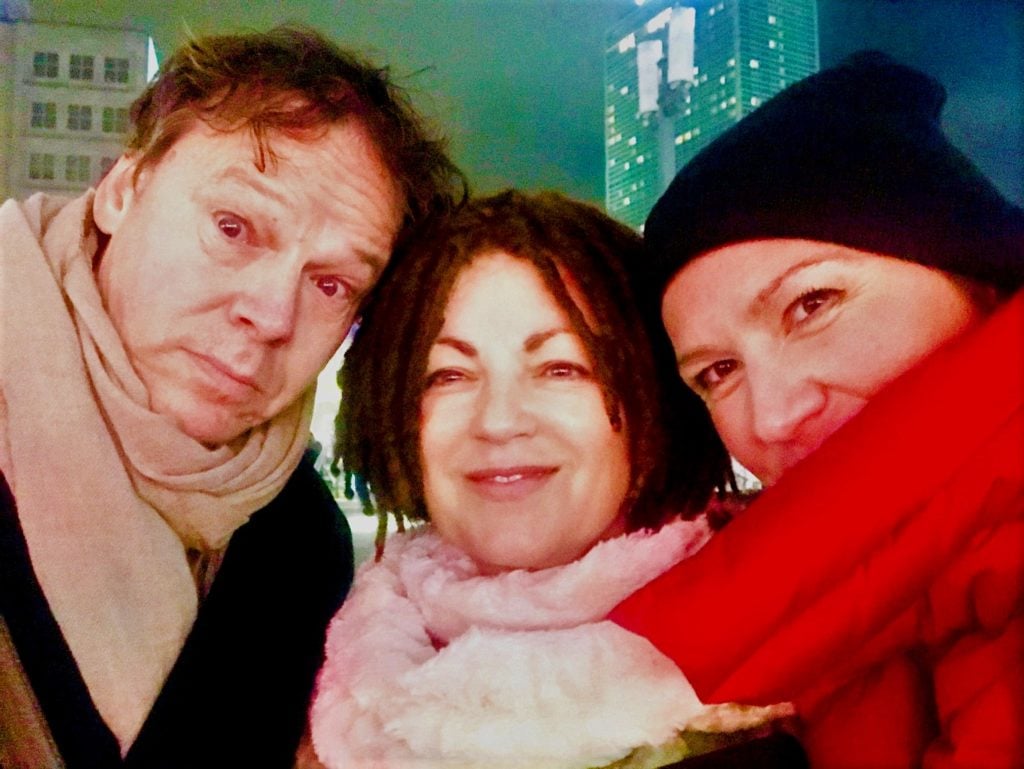
Left to right: David Graeber, Nika
Dubrovsky, and Julia Bardolim. Image courtesy the Yes Women.
What We Did
And as a result, the Yes Women Group was born!
The name is, of course, inspired by the famous Yes Men group. Indeed, one of the founders
of the Yes Men, Igor Vamos, who had worked with us for some time on
the project, gave us the nod (it was, in fact, quite literally a
nod) to proceed as such—in the same spirit of playful energy.
Why not? We didn’t have a lot to lose. The more time went on,
the fewer women there were to fight for. As the 30th anniversary of
the fall of the Wall approached, we decided to take our own
projection to Alexanderplatz, in the very center of Berlin.
Photographer Anastasia Khoroshilova visited
Malderburg at her own expense to take pictures of women’s
association activists. A designer from Riga, Lyudmila Ivakina,
helped to make a poster for a projection based on sketches by Nika
Dubrovsky. David Graeber, the author of the famous slogan “We are
the 99%”, came up with a slogan: “Never mind us!” Since normally,
people don’t.
So it was that an anthropologist (David Graeber), a playwright
(Julia Bardolim), and an artist (Nika Dubrovsky), one American and
two Russians, found themselves on a desperately dark and empty
Alexanderplatz.
Loudspeakers were lecturing the occasionally passing shoppers
about freedom and democracy; buildings were exploding with
projections of fireworks and really large talking heads.
In the shop across the street, we bought an inexpensive handheld
projector and started projecting a collage of women activists
staying shoulder-to-shoulder with a slogan: “Never mind us!”
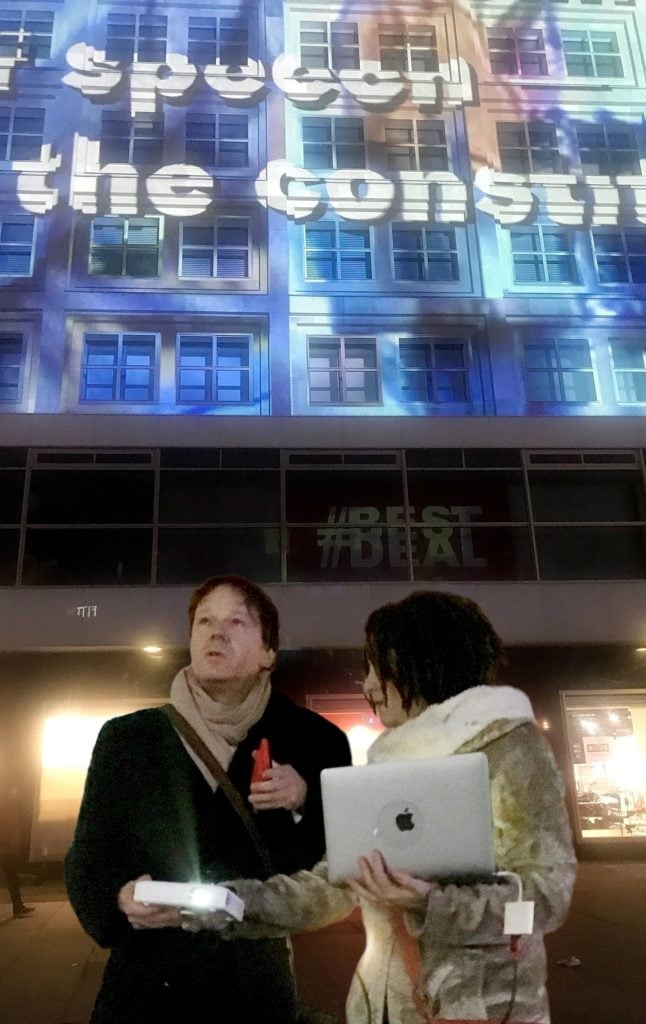
David Graeber and Nika Dubrovsky with
the Yes Women projection in Alexanderplatz. Image courtesy the Yes
Women.
We didn’t have the resources to do a large-scale video with
computer effects and powerful audio, so we made projections that
looked like an album cover or an advertisement in an inexpensive
store. Six members of a women’s association of GDR divorcees stood
on it, shoulder to shoulder. They seem proud and cheerful, and
arranged in a tight semi-circle (they actually do look a lot like
some kind of ’70s or ’80s rock band). Underneath is the
passive-aggressive caption: “Never mind us!”
We projected the image on the main buildings of Alexanderplatz,
on the booths with expensive equipment specifically installed for
official projections, and even on some of the vans moving equipment
in and out of the square.
We had been curious what the reaction might be. Would we be
interrogated, arrested, chased away? In fact, it was just as
passive as the reaction of the crowd to the larger spectacle.
Almost everyone ignored us. If they were curious—which some clearly
were—they mostly pretended to look at something else. Two police
stared at us for something slightly less than a minute. We actually
considered asking them to help document the action, but before we
even decided to approach them, they were gone.
It’s true a handful of curious passersby did stop, laughing
warmly (though they didn’t ask who the women were). After all, we
were living humans, unlike the anonymous giants on the screens
above who never actually appeared in the flesh, but just used
expensive machines to reconfigure the city’s future by streaming an
endless 18-minute cycle of their version of the heroic past.
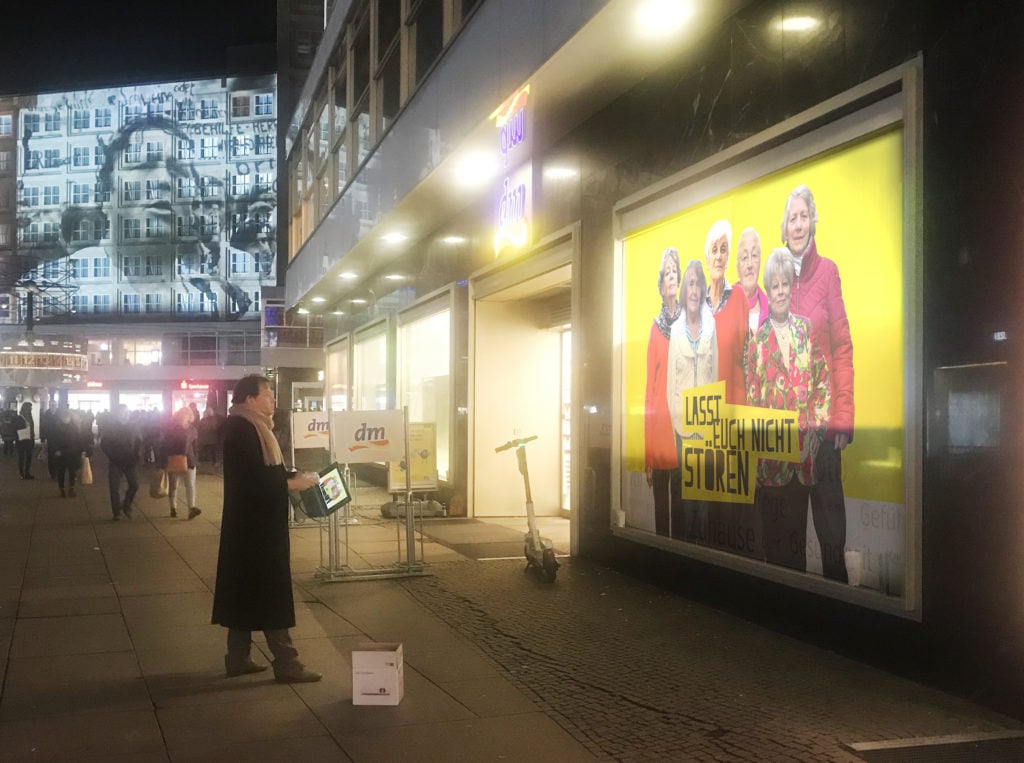
David Graeber with a projector for the
November 9 action in Alexanderplatz. Image courtesy the Yes
Women.
What’s Next?
We started our project in order to create art that would be of
practical help to the Divorced Women’s Association. We don’t know
if we will succeed in this regard.
But there is a larger significance to trying. Women from the
association told us several times that even if they get reasonable
compensation, we must never forget the 500,000 women who have died
in the past 30 years who will never see the “celebration of
justice.”
Many people believe that power is based on violence. Is it true?
If the authorities have nothing to say to the people; if the people
do not believe and even despise the authorities; if power does not
share a common language with the population… how long can such
power last?
Do we want Germany to repeat the same scenarios already in full
swing in so many other EU countries?
Hungarians, Poles, Bulgarians, who for exactly 30 years have
welcomed democracy and international Europe, hoping for equal
integration, all seem to have recently changed their minds. Instead
of the prosperity and democracy they originally desired, they got
neocolonialism, de-industrialization, a radical increase in the
social inequality, along with painful austerity everywhere across
the EU. Essentially, they thought they were fighting for Norway.
Instead they got Honduras.
As a result, from progressive, technologically advanced
countries once demanding democratic reforms and self-government in
workplaces, we witness the emergence of hyper-nationalist regimes.
The population itself is changing. Instead of the educated middle
class of 30 years ago, eastern Europe is populated by a service
sector precariat (waiters and security guards), trapped in bad
debts to German and Scandinavian banks.
The point is that our cause is not only about the discriminatory
experiences of deprivation and poverty of one group. It involves a
conversation about what a fair society would look like, and how
leaving an injustice toward one group of people unaddressed can
affect the entire body politic.
The struggle of the GDR Divorcee Association comes from the same
contemptuous forces that led to the shuttering of some 4,000
factories in eastern Germany after 1989. West Germans complained
that they are being forced to pay a “solidarity tax” to maintain
“unproductive” Easterners. Should we not consider ourselves
responsible for pushing these people into the abyss? Do we not
understand that we will all be going to hell together unless we
restore the trust that was broken?
Our art group is an initiative of stubborn optimists. We are
optimists not just because it seems to annoy people (though this is
a plus), but because we feel it’s the right thing to do. Still,
let’s be realistic for a moment! We should not forget about our
responsibility, not only to marginalized groups of the population
but also to ourselves, to do something about the conditions leading
to rising reaction across Europe.
Around the world people are starting to make new promises to one
another. Perhaps we should join.
The post Why We Founded the Yes Women, an Art Group
Demanding Justice for Divorcées in the Former East Germany
appeared first on artnet News.
Read more https://news.artnet.com/art-world/yes-women-david-graeber-nika-dubrovsky-1731399
Further reading


Leave a comment