
Amateur Archaeologist Finds Prehistoric Fossil While Walking His Dogs in Southwestern England
Most pet owners can’t tell the difference between a
fossilized ichthyosaur and a dolphin skeleton. But in
southwestern England, where prehistoric bones wash up on the
coastline every so often, even dog walkers can spot extinct marine
reptiles that predated dinosaurs. Jon Gopsill, an amateur
archaeologist from Somerset, was walking his dogs on the beach on
Saturday when he happened upon the 5-and-a-half foot long
fossilized remains of an ichthyosaur many million years old. Stormy
weather conditions had exposed the fossil, revealing a recognizable
pattern of thin ribs extending from a hunched and extended
spine.
“I realized that it was amazing, museum quality stuff, as soon
as I saw it I knew I found something special,” Gopsill explained to
The Daily Mail. He immediately reported his find to
Somerset Heritage and the Natural History Museum in London.
Ichthyosaurs (from the Greek for ‘fish lizard’) were marine
reptiles that lived roughly 201 and 194 million years ago. They
resembled dolphins, and were abundant during the Jurassic
period.
“Based on the number of bones in the pectoral paddle, the
apparent absence of a pelvic girdle, as well as the distinctive
‘hunch’ of the back, this is likely to be the remains of an
ichthyosaur,” Dr Mike Day, curator of fossil reptile collections at
London’s Natural History Museum, told The Daily Mail. “It
is not possible to identify the exact type of ichthyosaur from
these images alone however.”
Ichthyosaurs are not a completely outlandish sight in Gopsill’s
stomping grounds. Stolford, the beach where he was walking his
dogs, is an hour-and-a-half drive from what is known as the
Jurassic Coast. Dorset and East Devon, along that coast, have been
classified as a UNESCO World Heritage Site since 2001 and people
there are always on the lookout for prehistoric finds.
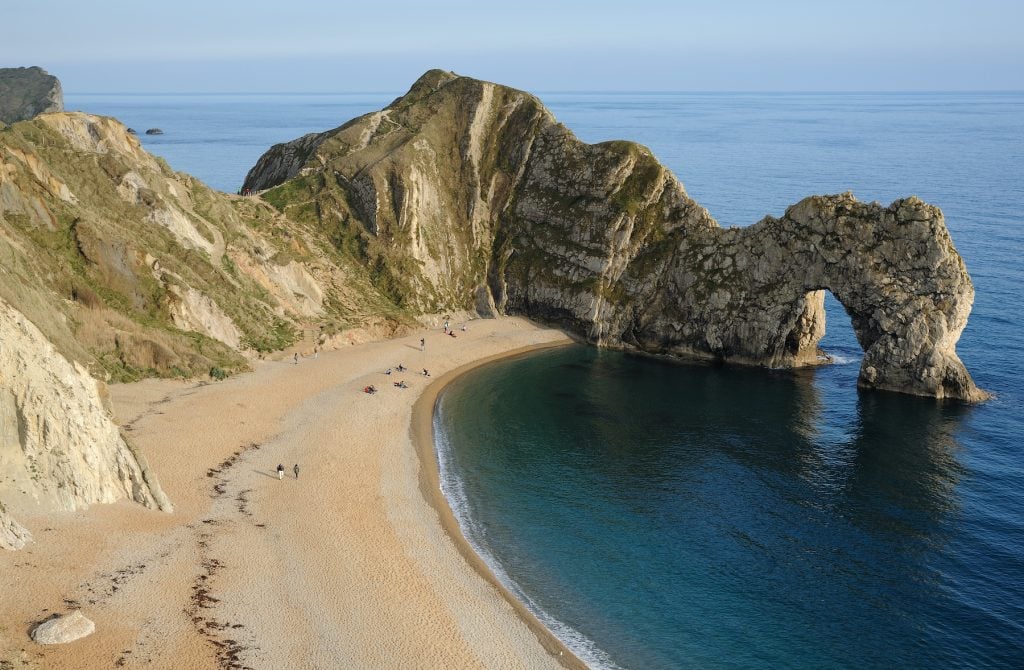
Jurassic Coast. Image via Saffron
Blaze/Wikimedia Commons
The first identified ichthyosaur was discovered on the Jurassic
Coast, in Lyme Regis, in 1810. Joseph Anning found an ichthyosaur
skull and a year later his 12-year-old sister, Mary Anning, found
and excavated the rest of the 17-foot-long skeleton. Their
discovery (now in the collection of London’s Natural History
Museum) was studied for years, and eventually named
ichthyosaurus.
Gopsill may have found a museum-level fossil, but the specimen
has no head. He’ll keep looking for it, he says. Maybe on his next
dog walk.
The post Amateur Archaeologist Finds Prehistoric Fossil
While Walking His Dogs in Southwestern England appeared first
on artnet News.
Read more https://news.artnet.com/art-world/amateur-prehistoric-fossil-england-1735404
Further reading


Leave a comment