
How Rising Art Star Alvaro Barrington Charmed London’s Top Galleries Into Breaking Their Own Rules for the Chance to Work With Him
It’s unusual to hear about an
emerging artist who has 10 years’ worth of work already mapped out
in his mind. It’s even more unusual to hear that that artist is
rolling out his magnum opus at top galleries—just two and a half
years out of art school. But 36-year-old Alvaro
Barrington doesn’t let
tradition dictate his career. In fact, he’s made it a point to
break the rules.
Most surprisingly, Barrington
insists on having collaborative representation with six different
galleries, four of which are in London. He also combines his
erudite art shows with spirited happenings outside the white cube,
like backlot concerts, a pop-up jerk chicken stand, and a Caribbean
carnival float.
Since he graduated from London’s
renowned Slade School of Art in 2017, Barrington has rocketed from
relative obscurity to the center of the city’s art scene, where
he’s best known for his muscular canvases consisting of heavy paint
on burlap. Though his
works have not yet hit the open waters of the secondary market, his
prices have been steadily rising and his schedule, growing
increasingly packed. Prices now reach up to $60,000 and all the
works at a recent exhibition at Sadie Coles—who represents the
artist alongside Blum & Poe, Thaddaeus Ropac, Corvi Morva,
Emalin, and Mendes Wood DM—were on reserve days after it
opened.
The Sadie Coles show came
on the heels of another exhibition that Barrington curated at
Thaddaeus Ropac last summer and, the year before that, legendary
art historian Sir Norman Rosenthal curated one of his first gallery
shows, also at Ropac. This year is absolutely bustling
for Barrington: He will have a solo booth with Sadie Coles at
Frieze Los Angeles next month; his co-curated show “Artists I Steal
From” sees a new iteration at Mendes Wood in New York; Emalin will
relaunch a music-based summer event series organized by Barrington;
and he will have a solo shows at Corvi Mora and Ropac Paris in
September. There will also be more carnival, more street parties,
more dancing.
In a market that’s been known to
milk young artists and leave them dry, how has Barrington taken
such impressive control of his career, and avoided the kind of
pressure and burnout that has plagued so many of his
peers?
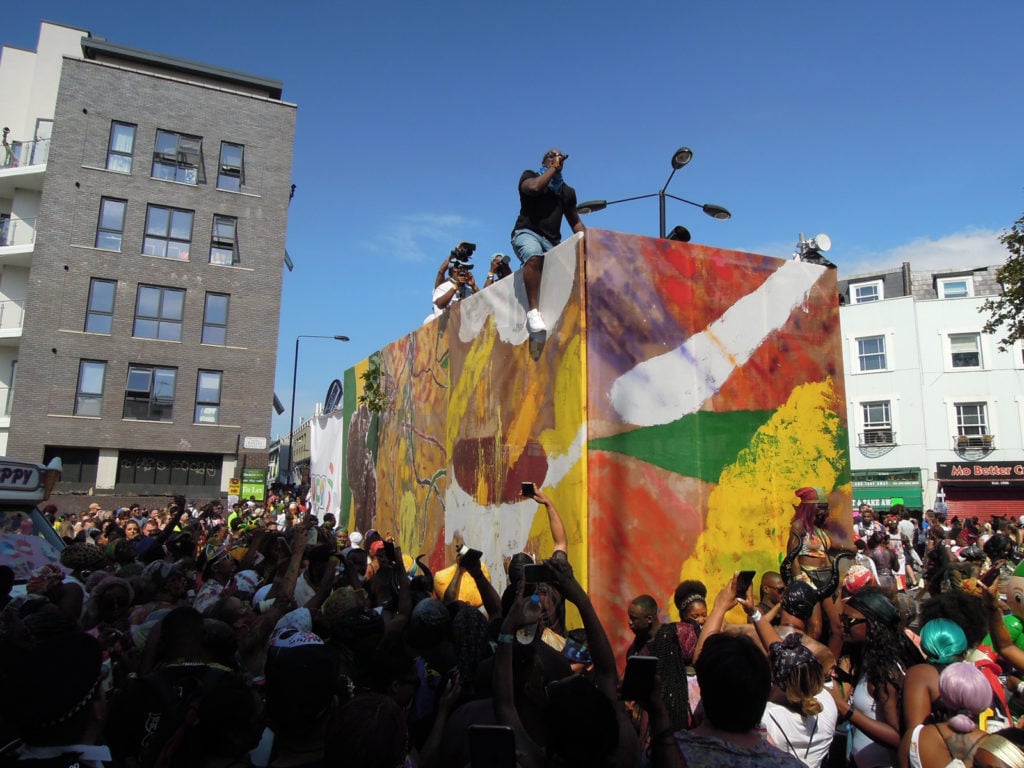
Alvaro Barrington’s Float for the
Notting Hill Carnival. Photo by Florain Reither.
A Non-Monogamous Arrangement
On a recent autumn
day, Barrington shows up to meet me at Emalin gallery on
his beloved red Brompton bike. We stroll over and sit down for
lunch where he listens
intently to my questions and answers slowly, exuding sincerity and
warmth while ordering one coffee after another.
A deep well of references
bubbles up: Albert Oehlen, Simone de Beauvoir, Tupac Shakur, Joseph
Beuys, Ghostface Killah, Picasso. He has a blueprint, he says, of a
decade’s worth of work already crystallized in his mind—and his
galleries are on board to support him through it all. He’s already
in the middle of a three-part show dedicated to the life of
Jamaican activist Marcus Garvey, the second chapter of which is to
come next fall at Ropac’s Paris space. (“How do you know what you
will be making 10 years down the line?” I ask. “The 20th century’s
already been written,” Barrington answers.)
The Tupac song “Keep Ya Head Up”
was the first piece of art that captured his
attention. “He was
real, honest, and spoke a lot of truths,” Barrington says. “He was
so magical and it changed my life and gave me a lot of things to
think about. Pac loved his community, he loved black people, and
how complicated they were at a time where a lot of politicians,
including black politicians, were asking for 13-year-old kids to be
locked up forever.”
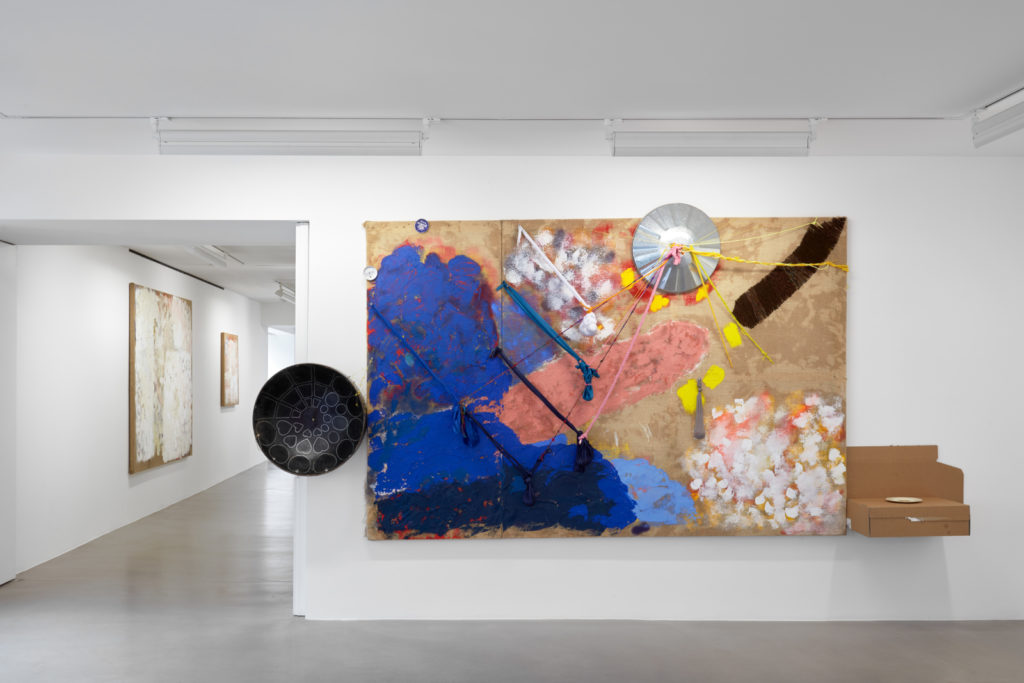
Installation view from Barrington’s
“GARVEY SEX LOVE NUTURING FAMALAY” at Sadie Coles.
Born in Venezuela and raised in
Grenada by his grandmother, Barrington eventually moved to Brooklyn
to live among a community of “aunties” after his mother died when
he was ten. There, he learned a key lesson about the need for
togetherness in order to survive, an ethic he applies to everything
he takes on—including the art market.
When I ask Barrington about the
collaborative nature of his gallery representation, he talks to me
about that love he experienced growing up. “Each one of those people in my community that
raised me gave me something different, and something wonderful
about myself that allows me to navigate the world,” Barrington
says. “That situation provided a different freedom from other
people who may have more stable relationships with the older people
in their life.”
His romantic relationships have
been polyamorous, too. “It’s all about encouraging who you want to
be—that question always comes up somewhere along the way,” he says.
“You have got to let go of a lot of ego in those
situations.”
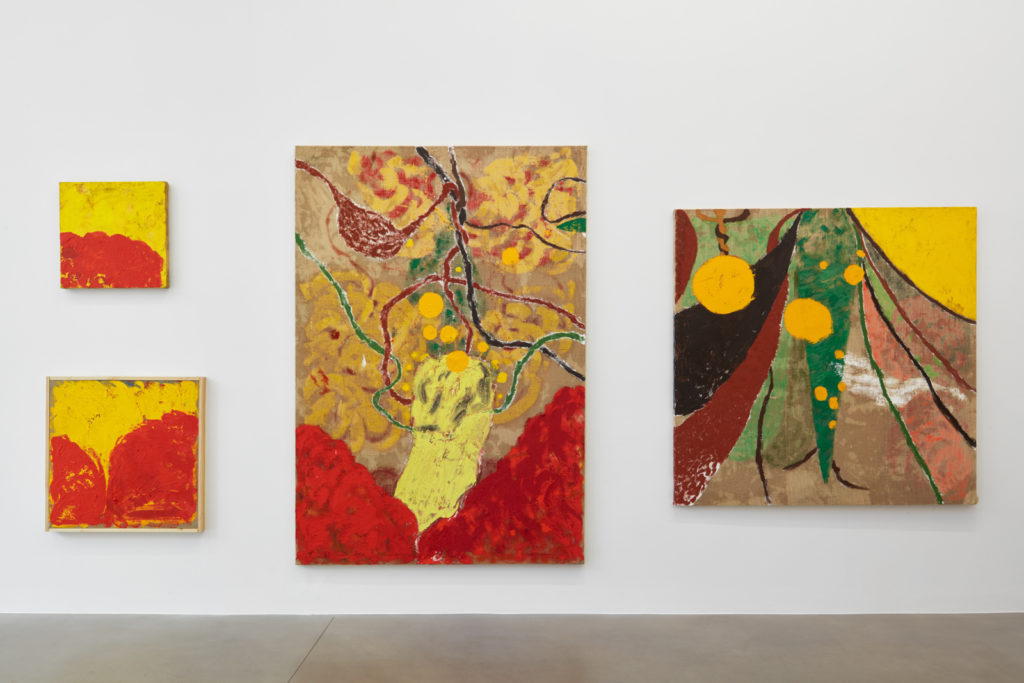
Installation view from Barrington’s
“GARVEY SEX LOVE NUTURING FAMALAY” at Sadie Coles.
Ego is an interesting way to put
it, especially when you flip the script and think about the
situation for his dealers. One might initially suspect Barrington’s
arrangement comes from having a strong ego—most artists command
seven-figure prices and long waiting lists before they manage to
shake loose from a gallery’s expectation of exclusivity (at least
in the city where they are located). But every dealer I spoke to
seemed to light up at Barrington’s fresh take on the typical
artist-dealer relationship.
Thaddaeus Ropac says he has
always been supportive of his artists working with more than just
his gallery, and is happy to share Barrington with three other
galleries in London. “As he says, it enables him to show a
different part of himself, corresponding to each gallery’s
identity,” Ropac tells me. “His connection with different
collaborators and communities is integral to his practice and each
gallery enables this in their own way.”
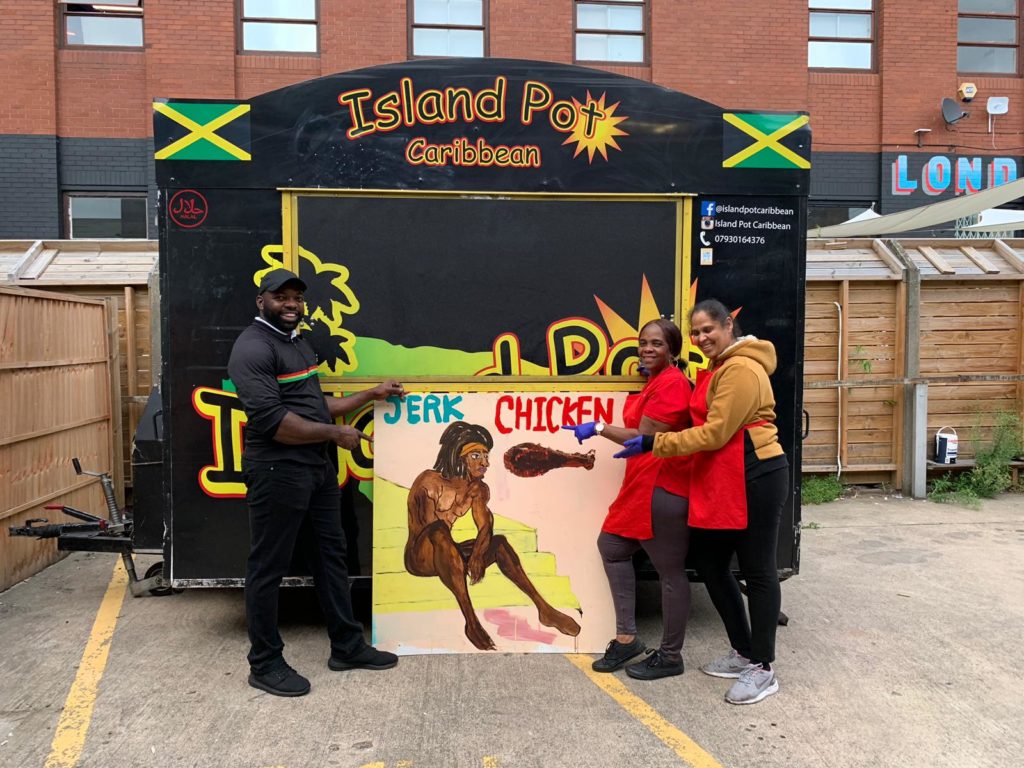
Island Pot at “Tall Boys A Double Shot
Espresso” opening at Emalin. Photo courtesy of: Emalin, London
Auspicious Beginnings
Before he began working with
Ropac, in April 2018, Barrington had his first show in London with
Emalin, one of the more prominent young galleries in London known
for its work with emerging Europe-based artists. As his career
continues to take off in new directions, he tries to work with each
gallery in a way that plays to their individual strengths. With
Emalin, he organized a summer series of musical events that took
place in their Shoreditch gallery, which culminated in a playful
exhibition that included works by Tt X AB, the collaborative
practice he shares with friend Teresa Farrell. It’s the kind of
experimental, grassroots endeavor that wouldn’t quite suit a
blue-chip gallery like Ropac.
Of course, Emalin benefits in
its own way from its association with Barrington and his blue-chip
dealers. “He is questioning what exclusive representation means,”
says the gallery’s co-founder Angelina Volk. “It forces us all to
think individually about what each gallery can do for an artist,
and what these unique circumstances can collectively foster.
Different kinds of galleries can provide different kinds of
audiences, spaces, and conversations.”
Barrington implies that there
may be a time in the future when things settle down for him. “I
never wanted to be someone who allows the relationships through my
art to determine what I can do in my art,” he says. “There are
going to be moments where I might have to choose, make a
commitment, and be responsible to it—like one day if I have a kid,
I can’t be running around town like an asshole.”
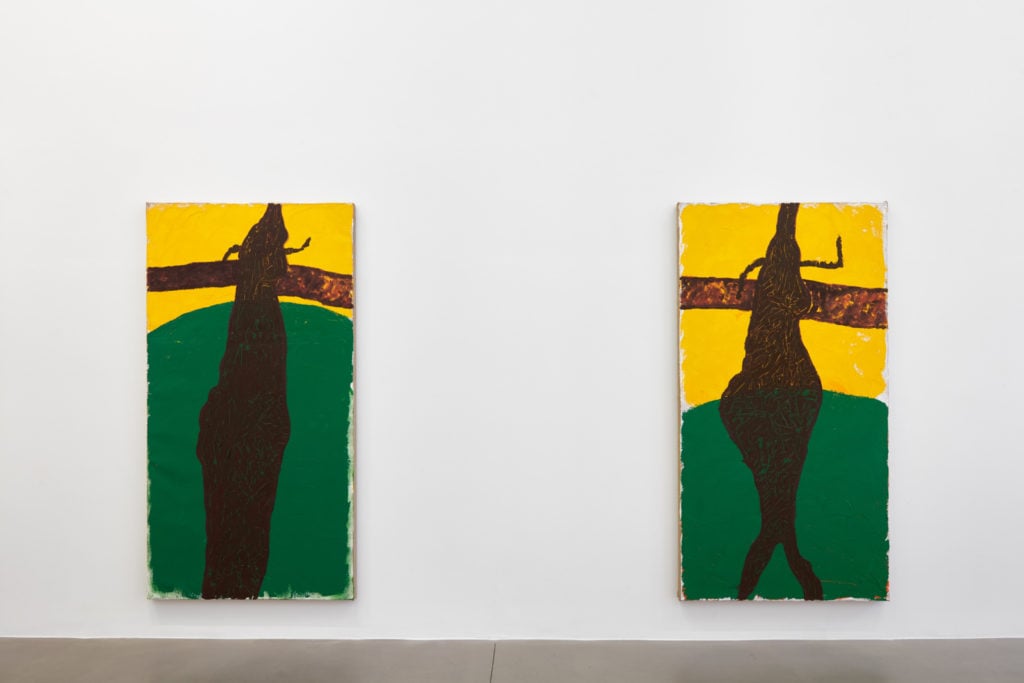
Installation view from Barrington’s
“GARVEY SEX LOVE NUTURING FAMALAY” at Sadie Coles.
Strong Roots
We walk back over to Emalin,
where the two of us hover over a few of his works. His paintings
look both earthy and alien, coded with rich references. Brash
strokes are meticulously layered and planned out, sketch by sketch,
before he touches his brush to the burlap canvases. He often sews
thick panels of yarn onto his works. Perhaps what is most beautiful
is how he manages to weave seemingly disparate references into
something immediately coherent: He brings together West Coast
rappers, fraught histories of the Black diaspora, and German
postwar art history into a smooth mix. In one work from his
collaboration with Farrell, a portrait of a seated man was
part of her design for an A$AP Rocky music video before Barrington
added a floating chicken and put it in the show.
A root-looking painting catches
my attention; Barrington explains it is part of an ongoing series
about trees, inspired by German artist Albert Oehlen’s series of
tree paintings, but also revolutionary American activist Assata
Shakur, Tupac’s godmother who has been on the run from the FBI
since 1977. “I imagine them as views she is looking at,” Barrington
says.
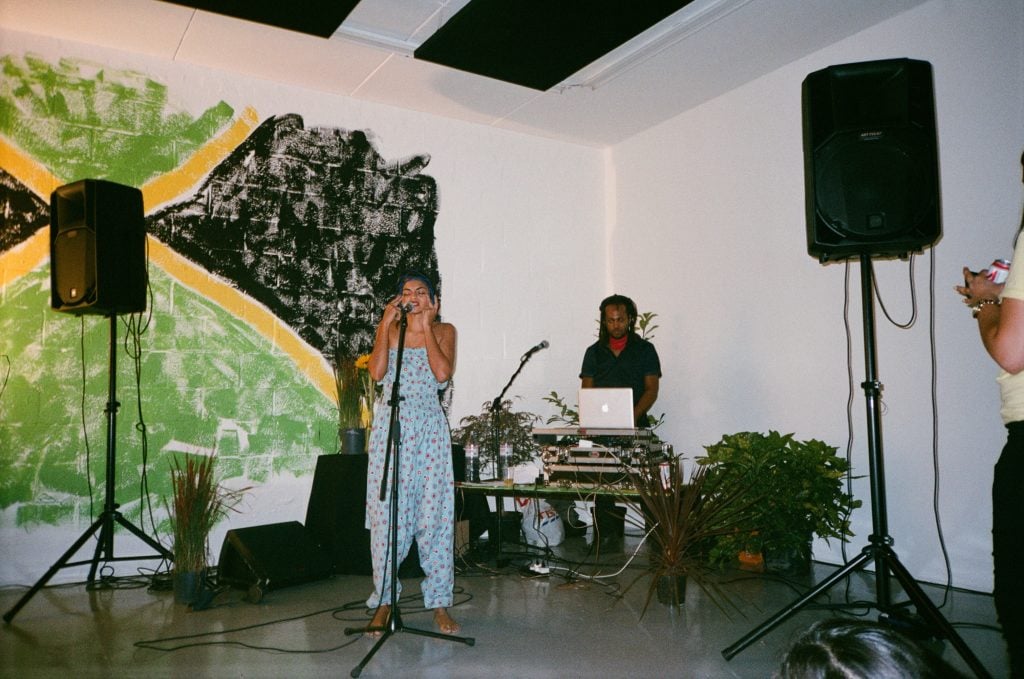
Performance view of 10K at Emalin,
London. Photo courtesy of Melkorka Katrin.
At Sadie Coles, alongside
posters of Garvey, there are more of these treelike works, as well
as dark brown roots and exploding hibiscus flowers. Barrington’s
stream-of-consciousness manifesto is printed out as a large poster
tearaway. The canvases in Pan-African colors had been hanging
on the carnival float Barrington made for Notting Hill Carnival, a
hugely important Caribbean festival and one of the world’s largest
street parties. Barrington’s bright canvases hung from the
float as 4,000 people danced around them. At this year’s edition,
Barrington will oversee the design of the judge’s station as well
as launch two art prizes for the costume designers who work at the
carnival: there’s the Emelda Barrington Prize, named after the
artist’s mother, and the Fredrica Graham Prize, named after his
grandmother.
As his manifesto says, “art is
about learning how to be,” all the way from Mayfair’s pristine white cubes to the
graffitied walls of Shoreditch, to a breezy ride on his red Bronco
from home to the studio; to memories of Grenada and running
wild in Brooklyn. Barrington synthesizes the pains of loss (the
paint hangs extra heavy in places), the West’s troubled histories,
political revolution and celebration, old friendships,
intersectionality, and long fights to fight—it’s all woven up in
the lines of yarn stitched across his painted
flora. Both his
practice and his enterprise as an artist are an invitation to see a
whole world of relations not simply as a point of critique—more
than that, he’s offering new ways of existing in the
world. And that seems
to be a personal and a public mandate, and it’s teeming with
life.
The post How Rising Art Star Alvaro Barrington Charmed
London’s Top Galleries Into Breaking Their Own Rules for the Chance
to Work With Him appeared first on artnet News.
Read more https://news.artnet.com/art-world/alvaro-barrington-profile-1750455
Further reading


Leave a comment