
Treasures From a 16th-Century Venetian Shipwreck Have Been Hidden Away for Centuries. Now, a Curator Is Planning to Make Them Public
A
chance conversation with another Getty research fellow in Los
Angeles prompted a dramatic career change for a Danish art curator.
Line Clausen Pedersen, who is an expert on Degas, embarked on a
deep dive into a
16th-century Venetian shipwreck. She is now helping to
turn the mystery
surrounding the sinking of the Gagiana in 1583 into a
major international exhibition. On board was a trove of luxury
goods and everyday objects destined for the Ottoman
ruler.
“The
Wreck of the Believable” could be a good working title for the
show, Clausen Pedersen says, referring to Damien Hirst’s fictional
underwater archaeological extravaganza in Venice, “Treasures from
the Wreck of the Unbelievable.”
The
very real Gagiana set sail from the Italian city packed with goods
made by Europe’s finest craftsmen and women. The trove of recovered artifacts, made in
cities including Venice, Vienna, Berlin, Nuremberg, and Lubeck,
includes chandeliers, thousands of wine glasses, beads,
leather-framed spectacles, and a miraculously preserved 170-foot
length of embroidered silk along with hundreds of cannons and
cannonballs. It was a bulk order destined for the Ottoman Sultan,
Murad III, who was building a palatial new home for his
harem.
The
Gagiana might be compared to a container ship today, Clausen
Pedersen explains. But the vessel never reached its destination,
Istanbul. Instead it sank in mysterious circumstances in the
Adriatic Sea off the coast of modern-day Croatia.
“The legend is that the
captain sunk it and ran off with diamonds,” the curator says. Its
high-value cargo was insured, and much of the paperwork survives in
archives in Venice. “One set of diamonds is registered and another
was apparently on board but not registered. That is part of the
narrative,” she says.
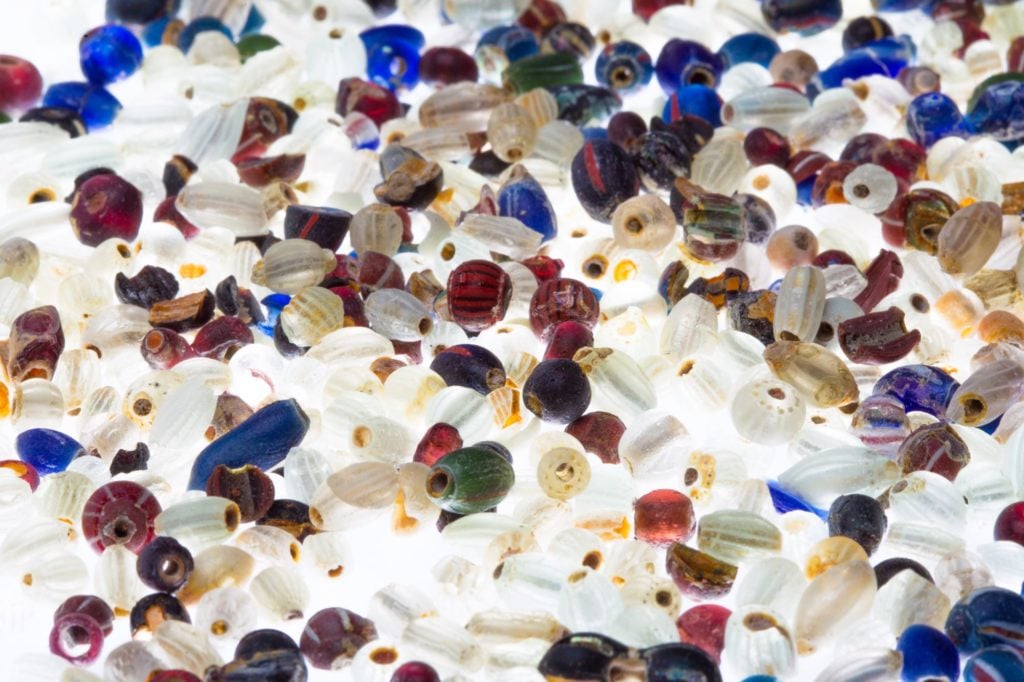
Glass made in Murano from the Gagiana
shipwreak.
The
sunken ship lay undisturbed until it was discovered by divers in
the late 1960s. Part of its contents, which are astonishingly well
preserved, have been recovered by underwater archaeologists, but
much of it remains on the sea bed. Clausen Pedersen describes the
trove as a rare time capsule of Renaissance Europe’s luxury goods.
Only a fraction of the items retrieved have ever been shown in
public, and then only in Croatia. Now the Croatian government is
keen to turn the wreck into a spectacular museum exhibition, which
is where Clausen Pedersen comes in.
Clausen Pedersen, who was previously deputy
director of Copenhagen’s prestigious art and archaeology museum,
the Ny Carlsberg Glyptotek, is working with a
large team in Croatia, which is led by the underwater archaeologist
Irena Radic Rossi. The ongoing research into the wreck will form a
key part of the exhibition.
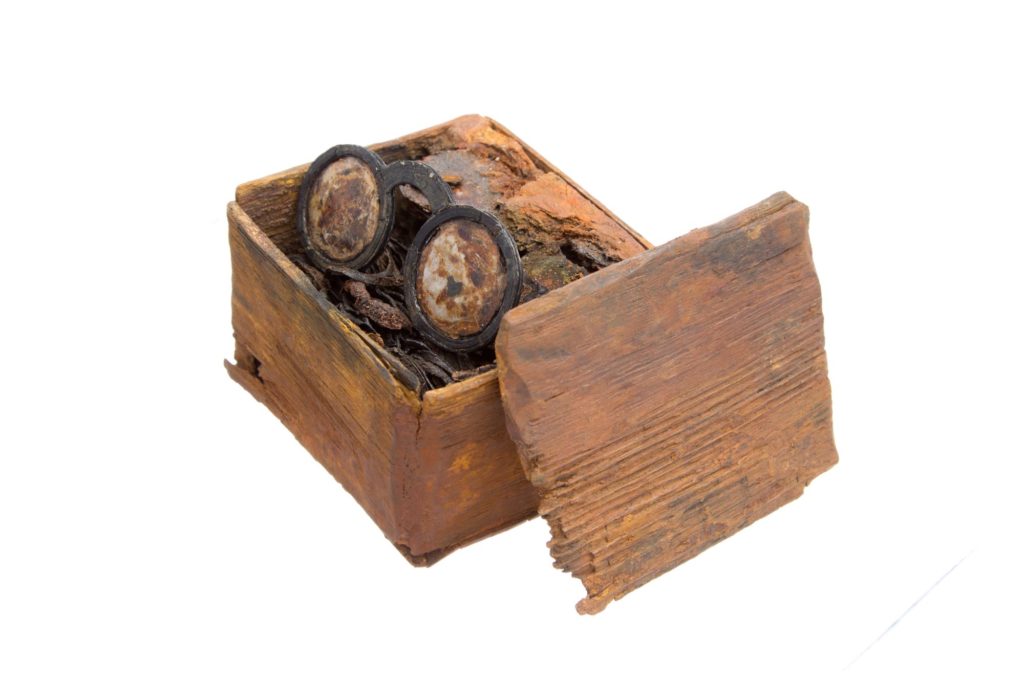
Leather-framed spectacles in their
packing box from the Gagiana shipwreck. Image courtesy of the
department of archaeology, University of Zadar.
The Danish curator has held early talks with major museums in
the US, Europe, and Asia, and is also approaching possible
sponsors. “My hope is to attract the shipping industry to get
involved in the development of the exhibition,” she says. “They
have so much money and they usually do not directly support art or
culture. I figured it is a new target group,” she adds. “A
shipwreck such as this obviously relates to the legacy of trade and
shipping, a large and growing industry even today, the potential of
collaboration is great.” She hopes the sponsor will fund some
“extravagant technology” that allows a visitor to the exhibition to
control an underwater exploration of the shipwreck—because “why
not?” she says.
Her
dream venue is a museum with a collection of decorative art of the
same era, so that connections can be drawn between the exhibition
and objects in the permanent galleries. “The Croatians are open to
having the exhibition at more than two or three venues,” she
says.
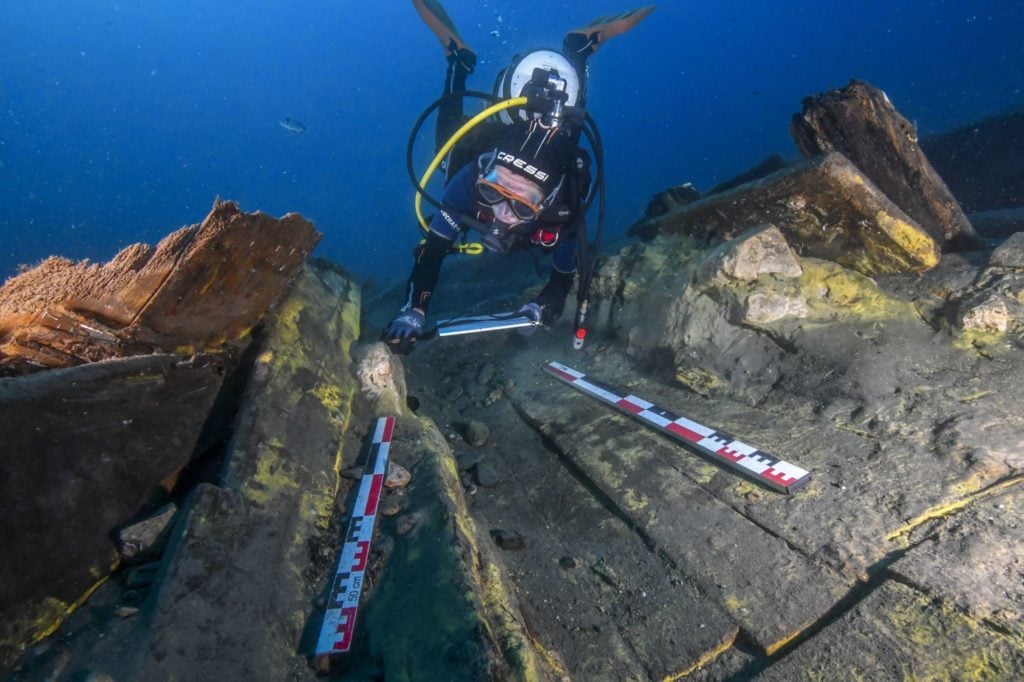
A diver explores the Gagiana shipwreck.
Image courtesy of the department of archaeology, University of
Zadar.
She
recalls that when she learned of the shipwreck just over a year ago
she was not a big scuba diver, but now she is now becoming one.
“It’s fun to be part of something like this after you have done
traditional museum work,” she says. New things are being discovered
all the time. So far they total more than 20,000
artifacts.
This
project is also a far cry from her previous exhibitions on the
likes of Degas, Gauguin, Rodin, and Théodore Rousseau, although there is an
intriguing art-historical angle: Among the cargo being recovered
are pigments used by Renaissance artists, preserved in their
original containers.
The post Treasures From a 16th-Century Venetian Shipwreck
Have Been Hidden Away for Centuries. Now, a Curator Is Planning to
Make Them Public appeared first on artnet News.
Read more https://news.artnet.com/exhibitions/shipwreck-venice-gagiana-exhibition-1747992
Further reading


Leave a comment