
How Did Edward Hopper Manage to Turn a Plain Country Road Into a Psychologically Charged Drama? A New Exhibition Decodes His Tricks
For Edward Hopper, a rugged coastline
or rural highway could be as psychologically charged as a café at
night or a deserted city street. But the American artist’s
landscapes tend to get overshadowed by his more famous paintings
evoking urban isolation.
That is set to change with an
exhibition opening this week at the Fondation Beyeler in
Switzerland that focuses on the American artist’s paintings of
rural scenes. Hopper, who grew up in upstate New York and spent
nearly every summer from the 1930s to the ’50s on Cape Cod,
was “always playing with the expectation of the viewer and
triggering something unconscious,” Ulf Küster, a curator at the
Fondation Beyeler, told Artnet News.
The show explores how Hopper used the same canny techniques to
evoke a sense of uncertainty and heavy pathos in his landscapes and
city scenes alike. “He is deliberately not doing traditional
landscape,” Küster says.
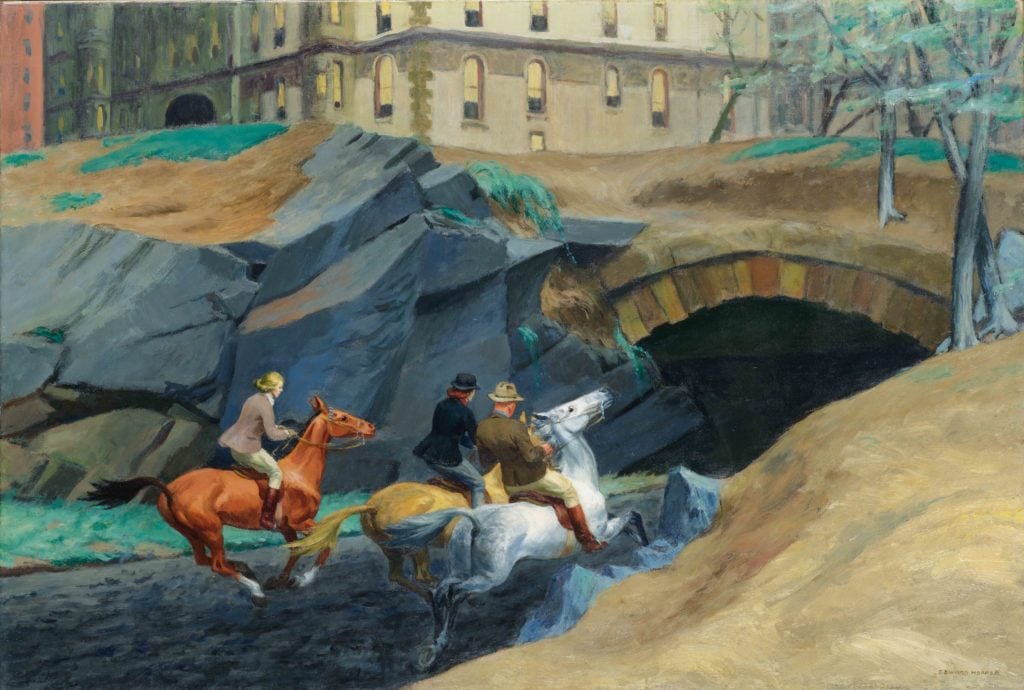
Edward Hopper, Bridle Path
(1939). Private Collection.
Among the loans from private collections is Hopper’s 1939
painting Bridle Path, which epitomizes
the artist’s ability to inject an unsettling note of drama into his
compositions. It shows three riders galloping towards a tunnel in
New York’s Central Park with the famous Dakota building in the
background. The white horse with a male rider appears spooked,
while the horses of his female companions charge ahead. The date of
the painting—1939—perhaps offers an explanation for its ominous
atmosphere. Hopper, who had spent time in Paris as a young artist,
may have been thinking about the increasing threat of war in
Europe.
How did Hopper manage to evoke this sense of foreboding and
mystery in his work, regardless of the subject? Often, Küster
explains, by creating a tightly cropped composition that suggests
more action is taking place outside the picture plane, as in
Bridle Path, or by including people who are looking at
something that is invisible to the viewer.
Consider another key and rarely seen painting in the show:
Hopper’s Cape Ann Granite (1928). A long way from a
conventional seascape, it pictures rocky outcrops that cast ominous
shadows across the painting; the sea can only be glimpsed in the
corner of the canvas, giving the viewer a sense of uncertainty
about what lies beyond.
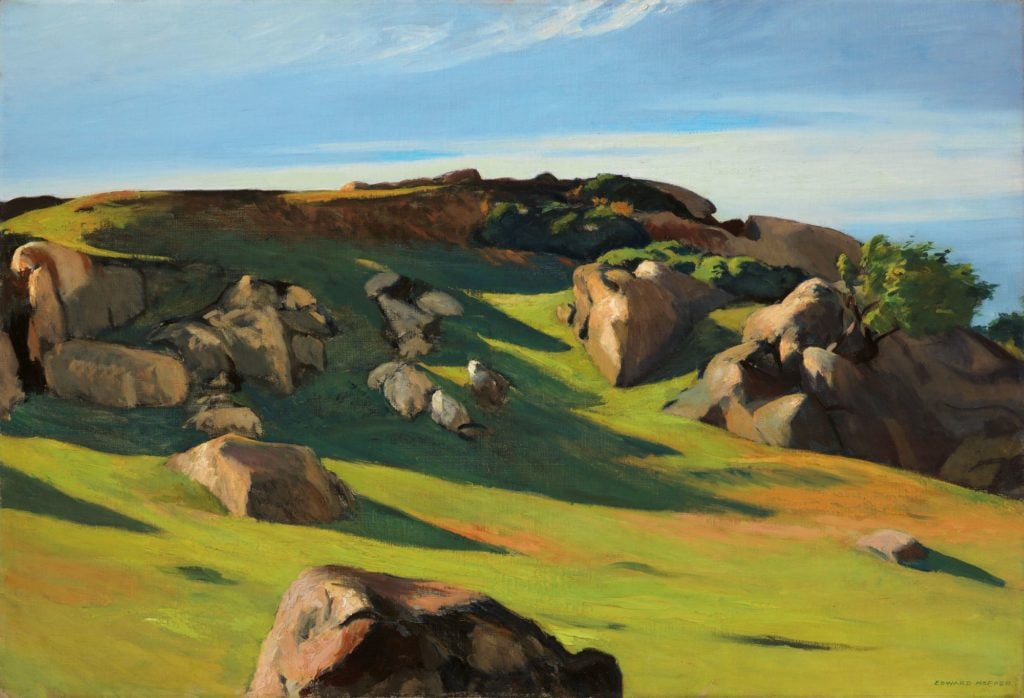
Edward Hopper, Cape Ann Granite
(1928). Private Collection © Heirs of Josephine Hopper / 2019,
ProLitteris, Zurich.
That picture was once owned by David
Rockefeller and was, in fact, the catalyst for the entire
exhibition. Its anonymous new owner bought it in the headline-grabbing
auction of David and Peggy Rockefeller’s collection in 2018 and
has since placed it on long-term loan to the Swiss private museum,
inspiring curators to look further at Hopper’s work.
An exhibition of the American Modernist in Europe is an
undeniably rare event. Most of Hopper’s paintings are held in North
America; only five of his oil paintings are in European
collections. The Beyeler worked closely with the Whitney Museum of
American Art, which has an unrivaled Hopper collection, to pull off
the show. “They are national treasure in the US,” the curator
says.
See below for highlights of the Beyeler’s exhibition.
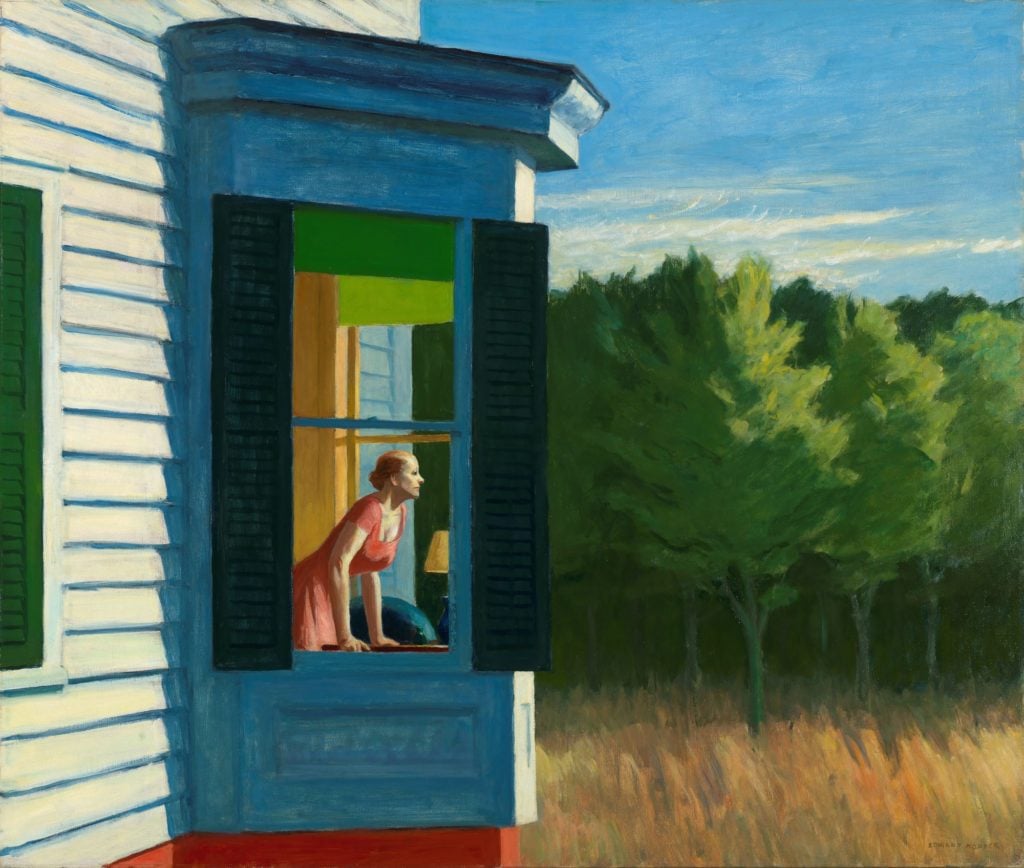
Edward Hopper, Cape Cod Morning
(1950). Smithsonian American Art Museum, Gift of the Sara Roby
Foundation © Heirs of Josephine Hopper / 2019, ProLitteris, Zurich.
Photo: Smithsonian American Art Museum, Gene Young
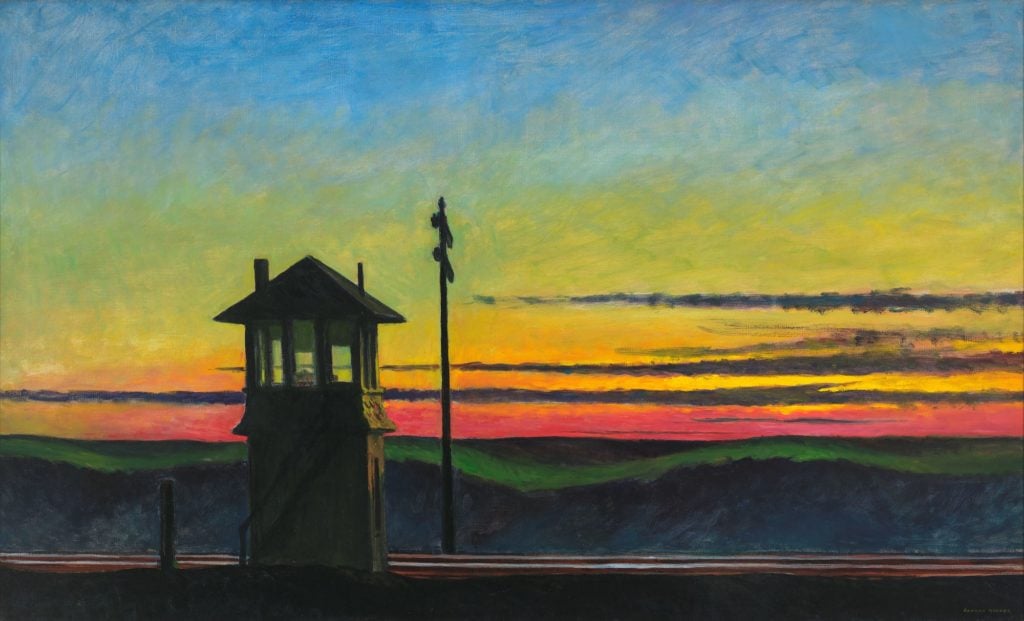
Edward Hopper, Railroad Sunset
(1929). Whitney Museum of American Art, New York; Josephine N.
Hopper Bequest, Inv. N.: 70.1170. © Heirs of Josephine Hopper /
2019, ProLitteris, Zurich Photo: © 2019. Digital image Whitney
Museum of American Art / Licensed by Scala
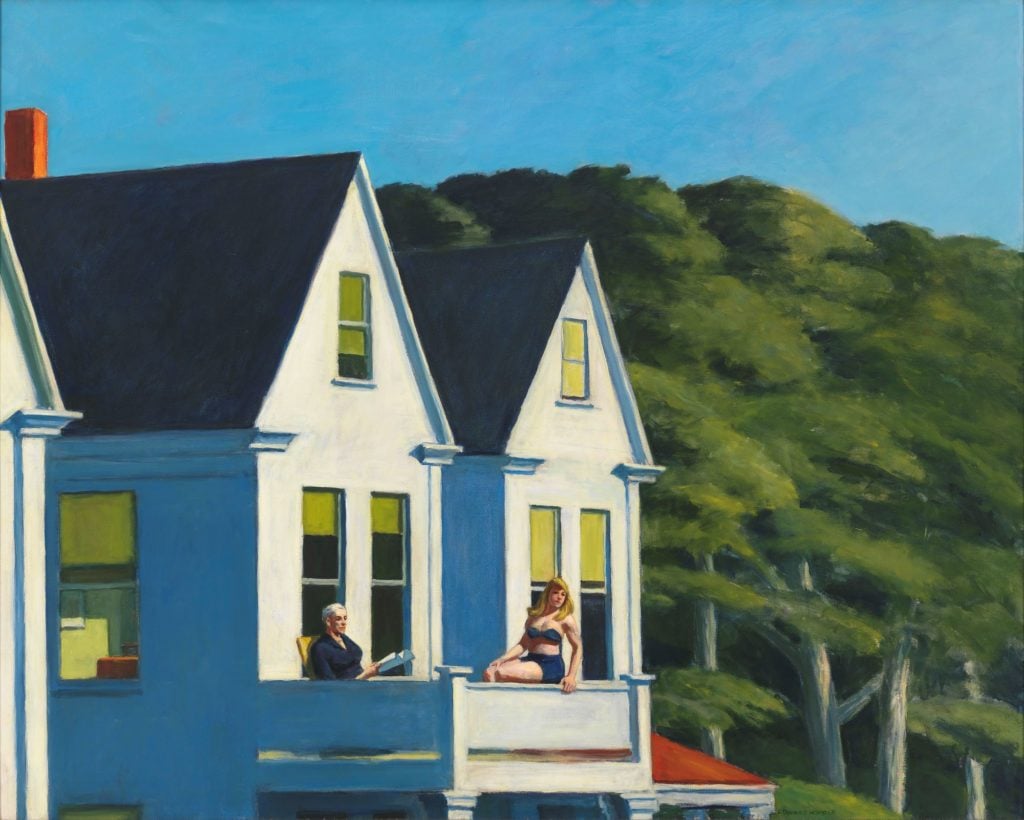
Edward Hopper, Second Story
Sunlight (1960). Whitney Museum of American Art, New York;
Purchase, with funds from the Friends of the Whitney Museum of
American Art., Inv. N.: 60.54. © Heirs of Josephine Hopper / 2019,
ProLitteris, Zurich Photo: © 2019. Digital image Whitney Museum of
American Art / Licensed by Scala.
“Edward Hopper” is on view from January 26 through May 17 at
the Fondation Beyeler, near Basel, Switzerland.
The post How Did Edward Hopper Manage to Turn a Plain
Country Road Into a Psychologically Charged Drama? A New Exhibition
Decodes His Tricks appeared first on artnet News.
Read more https://news.artnet.com/exhibitions/edward-hopper-beyeler-rockefeller-1748067
Further reading


Leave a comment