
The Gray Market: Why Carlos Ghosn’s ‘Grow or Go’ Business Strategy at Nissan Is a Cautionary Tale for the Art World (and Other Insights)
Every Monday morning, Artnet News brings you The Gray Market. The column decodes
important stories from the previous week—and offers unparalleled
insight into the inner workings of the art industry in the
process.
This week, mapping the potholes on the road to growth…
CASE STUDY
On Wednesday, Neal Boudette of the New York
Times worked through the curious tale of Carlos Ghosn,
whose historic run as the only person ever to run two Fortune
Global 500 companies at the same time turned from sordid to surreal
over New Year’s, when he fled multiple charges of financial
wrongdoing by successfully smuggling himself out of Japan by hiding
inside a customized case for a large musical instrument. And buried
inside the details of his rise, fall, and bizarre getaway is a
cautionary tale for the gallery and museum worlds alike.
For the uninitiated, Ghosn (rhymes with “loan,” FYI) became a
colossus of business by climbing through the ranks of French tire
manufacturer Michelin, then joining famed Gallic automaker Renault
as executive vice president in 1996. There, he played a central
role in returning the then-struggling company to strong health. His
merciless streamlining at Renault even led some in France to dub
him “Le Cost Killer”—notably, a moniker French labor unions would
later recycle for a young,
leanness-obsessed telecom entrepreneur named Patrick Drahi,
years before he would go on to acquire Sotheby’s.
But this isn’t the art-industry connection that matters. After
Renault acquired 43.4 percent of Nissan when the Japanese car giant
was teetering on the edge of the abyss in 1999, the company
installed Ghosn as CEO. His resurrection magic traveled well. By
2005, Renault’s board was so impressed by Ghosn’s cutback-spurred
success at Nissan that they tasked him with leading both companies
simultaneously.
In 2011, midway through what would ultimately become 12 years
spent manning both automakers’ steering wheels at once like some
executive stunt driver, Ghosn went even bigger. As part of what
Boudette labels an “ambitious” plan to boost Nissan’s market share
of global auto sales by 2.2 percent by 2019, Ghosn pledged that
Nissan and its high-end Infiniti sub-brand would level up from 8.2
percent of the US market to 10 percent in just six years. And this
is where the parallel to the 21st century art market emerges.
To accomplish his goal, Ghosn rearranged the incentives for
stateside Nissan dealers and buyers. Instead of offering rebates to
lure customers behind the wheel of its new cars, the company began
dangling extra-juicy bonuses to dealers who hit its increasingly
lofty monthly sales quotas. In theory, the handsome payouts would
be offset by the sales bonanzas they were designed to reward. But
if dealers missed those targets, the corporate office withheld
anything resembling sustainable compensation.
The strategy worked… until it didn’t. Here’s Boudette:
With the deadline for Mr. Ghosn’s goal of 10 percent market
share a few years away, Nissan’s United States executives
increasingly took aim at smaller dealers, imposing ever more
demanding terms to ramp up sales. Inside Nissan, the effort was
known as “Grow or Go.”
If that all-or-nothing phrase sounds familiar to your art-world
ears, it should.
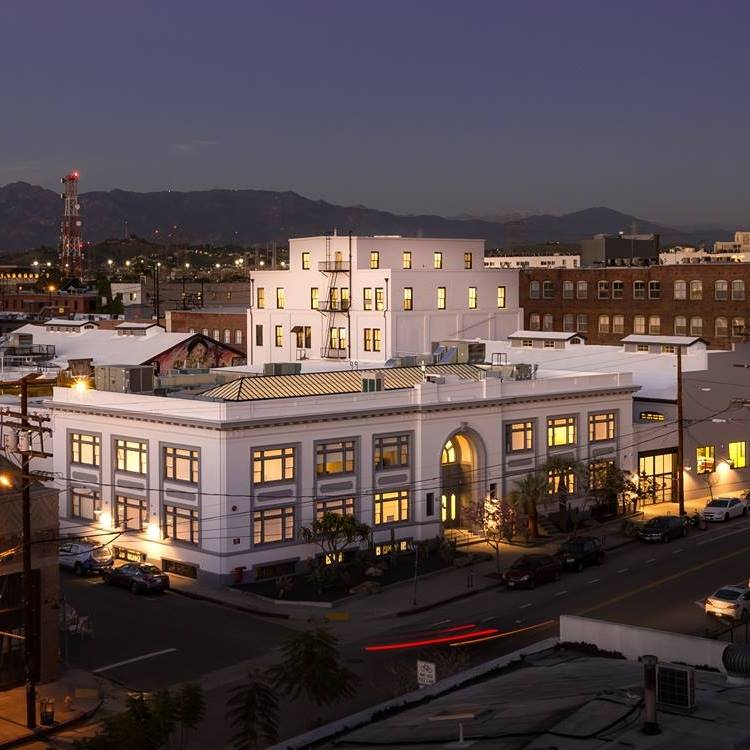
Hauser & Wirth’s sprawling, museum-grade
complex in Los Angeles. Courtesy of Hauser & Wirth.
PARALLEL DIMENSIONS
From where we stand today, “Grow or Go” has been part of the art
business’s vocabulary for roughly the past six years. To my
knowledge, it first appeared in 2014, when collector and analyst
Alain Servais used it to describe the dilemma facing modestly sized
dealers in an increasingly globalized,
polarized, and industrialized primary market. Once it was clear
that an outsize share of the world’s riches were leeching straight
into the economic topsoil and nearly all of those uber-rich art
buyers mainly wanted to compete for the same pricy artists, the
belief that it was still possible to run a sustainable little
regional gallery started to feel as dubious as believing you’d find
top-of-the-charts vocal talent inside every dive bar advertising
“the best karaoke in town.”
Some American Nissan dealers eventually began selling cars at
staggering discounts, or even buying their own inventory
themselves, to hit their ever-rising monthly targets when the
deadlines neared. Similarly, an ambitious art dealer might take
equally inadvisable measures when unsustainable growth takes
priority over everything else. Maybe they start hoping their brand
equity can glam up knowingly subpar work, or making it known that
buyers can acquire pieces by in-demand artists only by acquiring
work from an otherwise-unloved artist on the roster first, or even
playing a shell game with investors’ money in hopes they can ladder
their way out of big debts incurred for expansion’s sake. Nothing
warps a person’s moral parameters quite like desperation.
Boudette writes that, by 2017, Nissan’s US bonus system was
burning out dealers and “starting to eat into profits.” Which makes
sense, since what mattered to leadership was expansion, not
sustainability or good governance. By revving the “Grow or Go”
engine until it exploded, then, Ghosn triggered an avalanche of
self-defeating behavior that should be instructive to companies of
all types, including art nonprofits, where expansionist pressures
have helped spur the green-lighting of ill-conceived architectural
projects or international franchises in
locations with dubious human-rights records. At some point, the
only way to keep getting bigger is to start abandoning any wise or
ethical mission.
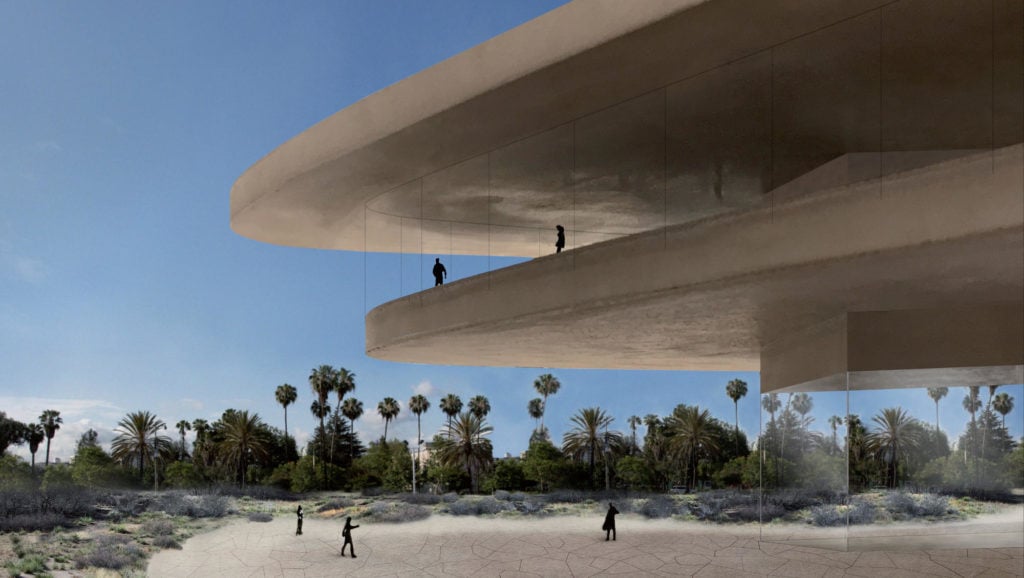
Peter Zumthor’s new LACMA design.
Courtesy of Atelier Peter Zumthor.
To be clear, Ghosn’s corporate strategy was hazardous, but it
wasn’t criminal. Japanese authorities arrested him on suspicion of
multiple white-collar crimes while at the helm of Nissan, including
under-reporting his compensation to the taxman by $85 million. He
claims the charges were fabricated as nationalist retribution for
proving a foreigner could run one of Japan’s greatest companies
better than a native executive, and that absconding to Lebanon
(where he is a citizen and can live without fear of extradition)
was the only way to prove his innocence.
So is Ghosn’s saga absurd? Absolutely! To drive it home, Yamaha,
the manufacturer whose modified double-bass case Ghosn and his
accomplices converted into a man-sized, breathable stash
box for his getaway, tweeted a warning this
week that, y’know, its products were not made to safely enclose
people. The membrane between true crime and performance-art homage
has rarely felt thinner.
But the weirdness of the latest chapter of Ghosn’s story doesn’t
negate the business relevance of what came before. So if the art
economy is making you feel like your only choice is to grow or go,
proceed with caution… and maybe, if the worst-case scenario
eventually hits, use something other than an instrument case to
flee the debt collectors. My guess is airports are scanning those
things a lot more rigorously today than they were a few weeks
ago.
That’s all for this week. ‘Til next time, remember: no reachable
destination will ever satisfy someone who wants the horizon
itself.
The post The Gray Market: Why Carlos Ghosn’s ‘Grow or Go’
Business Strategy at Nissan Is a Cautionary Tale for the Art World
(and Other Insights) appeared first on artnet News.
Read more https://news.artnet.com/opinion/carlos-ghosn-grow-or-go-1755066
Further reading


Leave a comment