
‘I’m the Kind of Guy Who Wants to Buy Everything’: Hollywood Executive David Hoberman Takes Us on a Joy Ride Through the Felix Art Fair in LA
Spoiler alert: covering an art
fair when you’re tagging alongside a collector with a known
pedigree and boundless energy is an entirely different experience
than when you’re roaming the aisles with nothing but a notebook and
a need to momentarily charm your way into dealers’ good
graces.
This became apparent shortly
after I met David Hoberman in the lobby of the Hollywood Roosevelt
Hotel in the opening minutes of the Felix art fair’s buzzy 2020
edition. Over the next two-plus hours, we would tear through all
three levels of the event and the lion’s share of its 63
exhibitors, as well as some of its assorted special projects. What
the odyssey would highlight isn’t just that sought-after collectors
enjoy tremendous access to information and miscellaneous perks; but
also that art fairs are crucial checkpoints in dozens of ongoing
relationships between buyer and seller, with individual exchanges
often being as much about past and future business as about
transactions in the here and now.
Outside the art-world bubble,
Hoberman is best known as a prolific feature-film and TV producer.
His Hollywood story is a classic. After starting off in the
mailroom at ABC, Hoberman climbed through the ranks to become the
head of the Motion Picture Group at Disney, then lit out on his own
soon after. In 1995, he founded Mandeville Films (now Mandeville
Films & Television), whose slate has since earned over $2.5 billion
in domestic box office revenue; multiple Oscar wins for films like
the 2011 reboot of family sensation The Muppets and David O. Russell’s 2010 boxing
drama The
Fighter; and a series of
first-look deals with Disney that have stretched past the
two-decade mark.
On this morning, though,
Hoberman’s studio-backlot bona fides felt like more of a burden
than a blessing. “I’ve had this day blocked out on my calendar for
two months, and now I have a three-hour meeting in Burbank at
2:30,” he lamented shortly after we shake hands. The last-minute
scheduling conflict meant he would have to completely abandon his
plans to follow up Felix with a visit to Frieze. But despite being
forced to choose between the fairs, there was no hesitation as to
where he would spend those precious few pre-meeting
hours.
As we ducked into the
Roosevelt’s ground-floor diner and bar for coffee to-go, Hoberman
explained that he first met his close friend (and Felix cofounder)
Dean Valentine when they were both working at Disney roughly 30
years ago. Hoberman was beginning to get interested in collecting
art, but he didn’t have any formal training in the field and wasn’t
sure where to begin.
“Dean gave me about 25 books,”
Hoberman said. “It was a way to start training my
eye.”
Hoberman went on to build a
collection focused on mid-century American modernism, headlined by
artists including Fairfield Porter and Alex Katz. But nearly a
decade into the journey, he hit a life-changing snag. “I wanted to
buy a [Richard] Diebenkorn painting, and I just couldn’t afford
it,” he said. “Dean said, ‘Why don’t you start collecting
contemporary art?’”
Hoberman took his friend’s
advice—and perhaps took it
further and faster than either one anticipated. Soon after pivoting to the new genre, he sold
nearly his entire collection of modernism and poured the proceeds
into collecting contemporary. A handful of holdovers aside, he’s
never looked back. The metaphor he conjures when describing his
obsession with new works could be interpreted as either medicinal
or addictive. He trails off, chuckling at himself, saying, “Dean
stuck the needle so far up my arm…”
A moment later, the coffee
arrived, and we headed to the Roosevelt’s service
elevator—so far, devoid of
any line at all, let alone the seemingly interminable one that
riled guests and exhibitors alike at the 2019 edition of the
fair—to blast our way up to
the exhibitors on the hotel’s 11th and 12th
floors.
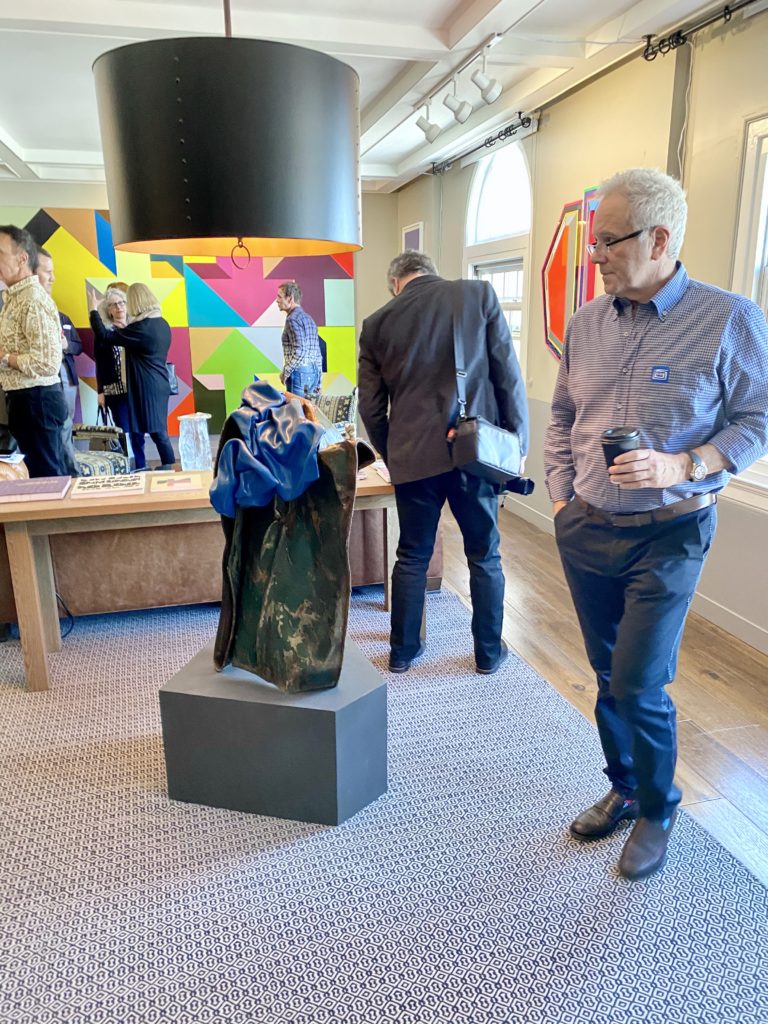
Collector and producer David Hoberman
contemplates Kennedy Yanko’s sculpture Anoint (2019) inside
Kavi Gupta’s booth at Felix 2020. Photography by Tim Schneider.
Rules Were Made to Be Broken
Apart from an exploratory stop
at Berlin’s Galerie Barbara Weiss, Hoberman immediately headed to a
quintet of galleries with whom he has longstanding relationships.
Nearly all of them happened to be showing artists in his
collection, too: Kim Dingle at Andrew Kreps, the immaculately named
Alteronce Gumby at Los Angeles’s Parrasch Heijnen, and Vincent
Valdez in the booth of young Texan-turned-Angeleno Matthew
Brown.
But it wasn’t until our sixth
stop—the suite occupied
by Chicago mainstay Kavi
Gupta—that Hoberman took his first real action.
Installed beneath a central ceiling lamp
was Anoint (2019), a John Chamberlain-esque sculpture by
Brooklyn-based artist Kennedy Yanko. The piece combines a squat
monolith of salvaged green metal with a crown of blue “paint skin”
(a layer of paint dried folded to resemble fabric), all atop a
pentagonal gray plinth. Hoberman knows Yanko’s work on sight and
was clearly intrigued by this particular example. “I don’t collect
sculpture. It’s just about the room [it takes up],” he explained.
“But I would get this piece.”
The next thing I knew, he had
pivoted to gallery associate Errol Harris (who only moments earlier
broke the news to Hoberman that travel complications had delayed
the arrival of Gupta himself) and requested the price. Upon
learning it was only $15,000, Hoberman asked the gallery to “hold
it for [him] for a minute.” They exchange information, and Hoberman
was on the move again.
As we made our way to the
stairway down to the 11th floor, I asked Hoberman if he came into
fairs with a budget in mind. He shook his head despite himself.
“No, I just bought a Fontana drawing and two other things. I should
be about tapped out,” he said. “But then you never
know.”
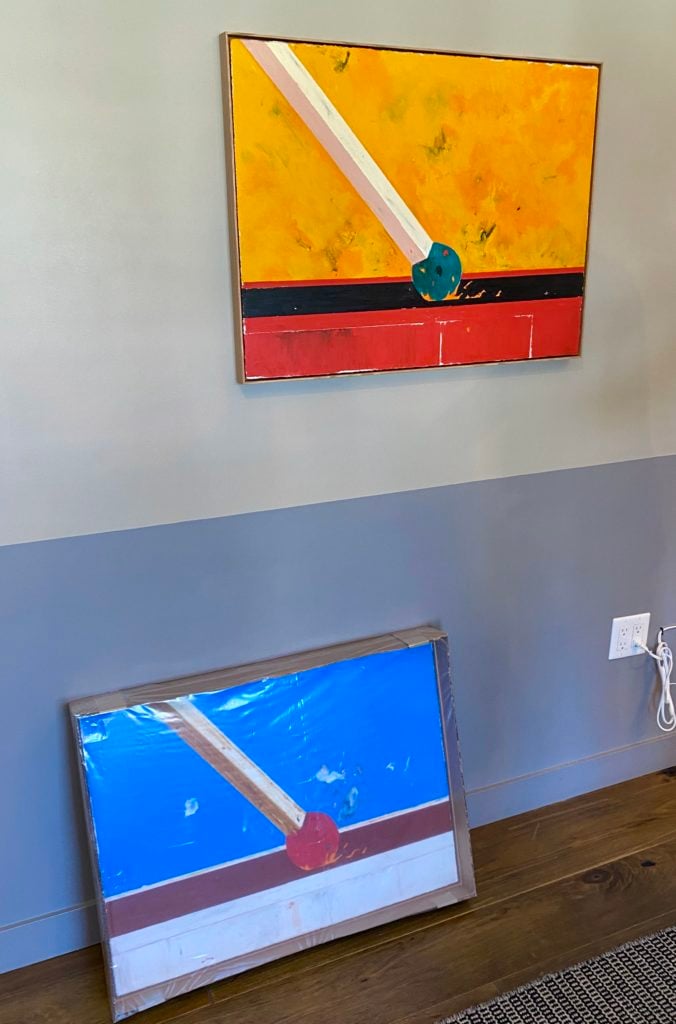
Two Harold Ancart paintings considered
by David Hoberman inside the CLEARING booth at Felix 2020.
(Hoberman chose the wrapped piece on the bottom.) Photography by
Tim Schneider.
The Past and the Future on Floor 11
By about 11:30 a.m., navigating
the 11th floor demanded darting between a steady stream of other
VIP visitors, not just darting between rooms. But Hoberman, who
dealer and artist Joel Mesler admiringly refered to later in the
day as “an old-school LA collector” (meaning one who bought artwork
before it was a standard trope of west-coast wealth) is
undeterred.
Our next stop was the suite
belonging to the highly respected New York and Brussels-based
gallery CLEARING. Founder Olivier Babin greeted Hoberman warmly,
and their exchange proceeded along two parallel tracks. On one
hand, Babin wanted to tour Hoberman through the installation to get
him interested in new work. On the other, Hoberman wanted to check
up on a Harold Ancart matchstick painting he acquired from CLEARING
before the fair—especially
when he saw another Ancart painting featuring the same composition
in a more bombastic, fiery color hanging inside the
room.
A staffer went to fetch
Hoberman’s Ancart while Babin talked him through a modestly sized
painting from a new series by Sebastian Black. Using a $49 iPhone
plugin, Black shoots thermal images of his cats, then paints the
resulting heat maps to harness the tension between domesticated
cuteness and technological unease. Hoberman listened attentively,
but concluded that he wasn’t sure if it was for him, prompting
Babin to pivot to a small metal wall sculpture by Koenraad
Dedobbeleer and a sculptural video installation by 2019 Whitney
Biennial standout Meriem Bennani in the next room.
By the time we completed the
circuit and returned to the main space, Hoberman’s Ancart painting
had appeared, collared in cardboard and wrapped in plastic, leaning
against the same wall where its still-available counterpart was
installed. He and Babin compared and contrasted the two works.
While it was never explicitly said, my sense was that Hoberman had
the opportunity to swap the two if he wanted. Ultimately, though,
he decided he still prefered the piece he’d already committed to;
the flatter, sky-blue background and white matchbox make the
combination and its tiny blaze-to-be pop more
distinctly.
With that matter settled,
Hoberman made his way to two other favored galleries normally
occupying opposite coasts. First, at Anton Kern, a director manned
an iPad to scroll him through a new series of large-scale Ellen
Berkenblit paintings depicting profile views of women’s faces in
intense anger. The works will premier at the venerable Upper East
Side gallery on February 20 in an exhibition titled “Sistergarden,”
but a handful of smaller examples were installed on the Roosevelt’s
ground floor as a part of Felix’s Special Projects
section.
Hoberman asked the gallery to
email him an image of a work described as “the big screamer” and
priced at $50,000, then mentioned that he would be in New York for
a shoot in the coming weeks, giving him a chance to see the
Berkenblit show in person—and, he added with a mischievous grin, for the
gallery to “show [him] all the Julie Curtisses.”
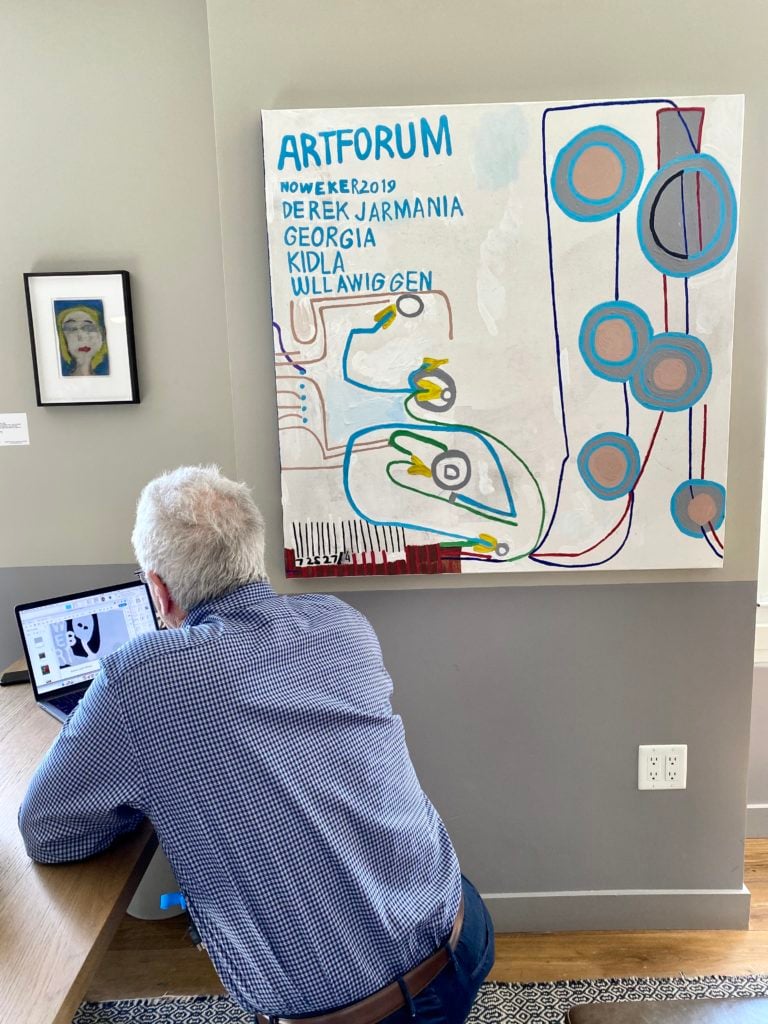
David Hoberman peruses a PDF of
available works by self-taught artist Marlon Mullen (also
responsible for the large painting to Hoberman’s right) inside
Adams and Ollman’s booth at Felix 2020. Photography by Tim
Schneider.
From there, Hoberman made his
way to the room occupied by Portland’s Adams & Ollman gallery. His
interest gravitated to a single large painting by Marlon Mullen, a
self-taught artist active since the mid-1980s. Mullen, who has a
solo show currently on view at the gallery’s permanent location, is
best known for creating paintings based on magazines sourced from
the library at Nurturing Independence Through Artistic Development,
a California art center that mentors and empowers artists born with
developmental challenges. Hoberman has been tracking Mullen
for some time, and he was unmistakably excited by encountering his
work at Felix.
Amy Adams, one of the gallery’s
co-founders, turned her laptop over to Hoberman so that he could
review Mullen’s other available paintings (priced at $5,000 to
$12,000 each). He was so eager to dive in that he didn’t even
bother to sit down. Instead, he took a knee like a quarterback
commanding a huddle, silently devouring images and information…
until he swiveled the screen towards Adams (by then talking with
another visitor) and excitedly called out, “This
one!”
The small digital image showed a
colorful canvas based on a cover of an Artforum issue.
“It’s available!” she replies happily.
But Hoberman didn’t put a hold
on the work. Instead, Adams informed him that Mullen would be one
of the two artists the gallery will feature in its presentation at
the Independent art fair in New York in just over two weeks, and he
wanted to see the preview before making any decisions. She promised
to send him a PDF, and we departed with Hoberman visibly energized
by the prospect of seeing even more work by an artist he
admires.
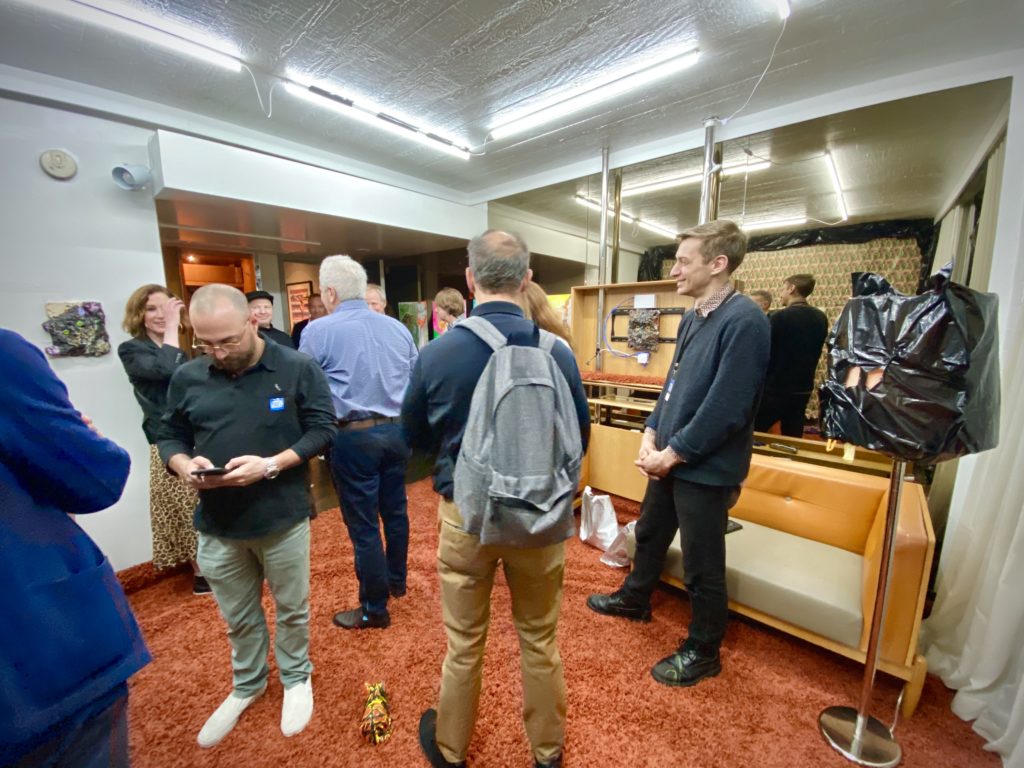
Artist Philip Hinge (right) inside his
installation at Brennan & Griffin’s booth at the 2020 edition of
Felix. Photography by Tim Schneider.
Collectors in Cabanas
With the line to the 11th
floor’s elevator now snaking out into the hallway, Hoberman and I
opted for the stairs down to the cabana level, where the last 25
exhibitors awaited. The trek gave us time to chat about his habit
and its history.
“I’m the kind of guy who wants
to buy everything,” he told me. “I can’t help myself.” At the same
time, he estimates that his collection has not many more than 100
pieces, partly because he tries to donate about one quarter of his
current holdings to institutions every year. The strategy provides
him both a tax shield and enough churn to keep adding new works
without being excessive.
When asked what piece has stayed
in his collection longest, he said it’s probably a Claes Oldenburg
print he bought as a teenager. But before I could manage to get the
backstory of that acquisition, we reached the ground floor, and he
charged out of the stairwell with the urgency of a first responder
leaping out of an ambulance—so much so that we temporarily got
turned around in the bowels of the hotel and nearly ended up on the
loading dock before winding our way back toward the
cabanas.
With the cursed 2:30 meeting
approaching, we had less than an hour before Hoberman needed to
hightail it to Burbank. (It isn’t terribly far distance-wise, but
actually getting from the Roosevelt to the 101 freeway during the
lunch rush eats up an uglier amount of time than out-of-towners
realize.) The atmosphere felt more chaotic than upstairs, but not
frantic. Part of this came from the choose-your-own-adventure
layout of the cabanas: more galleries than the tower floors, and
more ways to get to them, since visitors could crisscross the pool
area and enter cabanas from the back, in addition to rifling down
the corridors leading to the front entrances. But the crowd was
getting increasingly thick, which served as a minder that, in LA
and at art fairs generally, somehow practically everyone seems to
be a VIP.
The first gallery Hoberman hit
is his compatriot Nino Mier, who maintains permanent spaces in LA
and Cologne. The literal centerpiece of the cabana
was Ontario
International Airport, a
large painting by Jake Longstreth priced at $35,000: a skillfully
executed, intentionally too-picture-perfect depiction of a Radisson
hotel backdropped by a gradient-blue sky and an idyllic mountain
range.
Hoberman recognized a
“loneliness like [Edward] Hopper” in the work, but lamented that
the lighting in Mier’s cabana was perhaps not doing the work
justice. Mier leapt into action immediately, picking up from the
floor one of the lamps lighting up the space and shining it across
the work from chest level to try to improve the situation. (Never
underestimate a good dealer’s willingness to do what needs to be
done in pursuit of a sale.) Hoberman thanked Mier for his time and
left without making any promises on the painting.
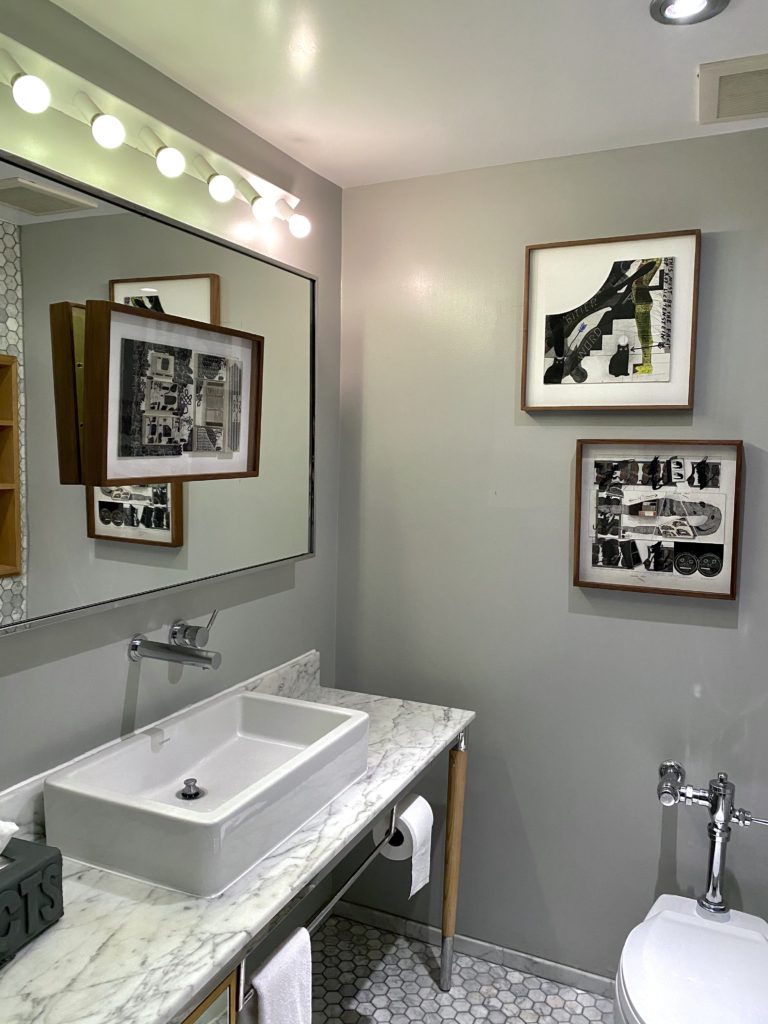
Three Ray Johnson works on paper inside
the bathroom of Corbett Vs. Dempsey’s booth at Felix 2020.
photography by Tim Schneider.
Instead, the work that seemed to
make the biggest impression came from Chicago mainstay Corbett Vs.
Dempsey, another gallery with which Hoberman has a deep comfort
level. There, co-founder Jim Dempsey wowed him with three works on
paper by the late collagist and mail-art progenitor Ray Johnson
(all of which were installed in the bathroom). Priced from $32,000
to $34,000 each, the beguiling, largely grayscale
text-and-layered-image pieces also offered a lead-in for the
gallery to mention that, in 2021, it will present its first solo
show with Johnson’s estate. Transfixed in the narrow space between
the countertop and shower, Hoberman deemed the works “awesome”
before the timer in his head started ticking too loudly to ignore
any longer.
Although we went into several
more cabanas afterward, it was the Johnson works that Hoberman told
me struck him as perhaps the best he’d seen at Felix when we parted
ways just before 1 p.m. Whether that meant he would ultimately
circle back to Dempsey and his partner about acquiring one (or
more) of them, I do not know. All I could say for certain after
these few hours was that, if he did, it wouldn’t be because he had
cut off the inflow of other possibilities. It would be because
Johnson’s pull was strong enough to temporarily arrest Hoberman’s
omnivorous hunger for the new.
And to think, the art market was
one affordable Richard Diebenkorn painting—and one
contemporary-art-evangelist confidante—away from never knowing how
much of an impact Hoberman’s interest could have. It’s a twist of
fate that any Hollywood executive would appreciate.
The post ‘I’m the Kind of Guy Who Wants to Buy Everything’:
Hollywood Executive David Hoberman Takes Us on a Joy Ride Through
the Felix Art Fair in LA appeared first on artnet
News.
Read more https://news.artnet.com/market/felix-fair-david-hoberman-1778157
Further reading


Leave a comment