
Frieze Los Angeles Opens With Big Sales to Mega-Celebrities and Hollywood Muscle Alike—and It’s All Live-Streaming on Instagram
Ari Emanuel, the Tinseltown star-maker and co-founder of
entertainment megalith Endeavor, walked into Frieze Los Angeles at
Paramount Pictures Studios on Thursday morning like he owned the
place. That’s because he does own it. Endeavor bought 70 percent of
Frieze in 2016, and at the end of this year, it has the option to
buy the last 30 percent, currently held by original co-founders
Amanda Sharp and Matthew Slotover.
Emanuel was not glad-handing art dealers and collectors. He was
wearing old-school headphones, complete with clips that went around
his earlobes, and the whole contraption was attached to his phone
via a dongle connector. As he worked his way through the booths,
Emanuel—immaculate in a polo shirt, white slacks, and pristine
white sneakers—was making calls as if he were in his Beverly Hills
office. “OK honey, I’ll take care of it,” he said into a tiny mic
affixed to the tangled headphones. “OK. OK. OK. Yes, it’s done, OK.
OK.”
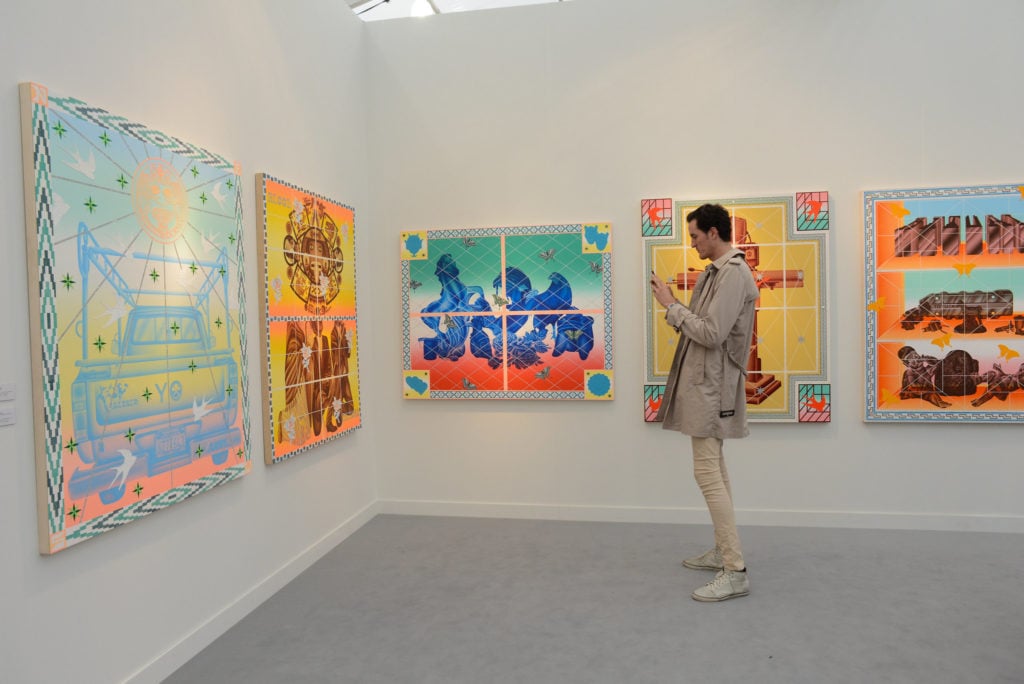
Charlie James Gallery in the Focus LA
section at Frieze Los Angeles 2020. Photo by Casey Kelbaugh.
Courtesy of Casey Kelbaugh/Frieze.
An advisor led Emanuel toward the large Christina Quarles
paintings at the booth of Regen Projects, but he quickly ducked out
and made his way to the fellow local gallery Overduin & Co., all
the while saying audible and inaudible things into his mic. At one
point, he ducked into the Gladstone booth and was greeted by
director Cooke Maroney (whose wife, Jennifer Lawrence, has notably
been without an agency since she left CAA at the end of 2018).
But while it appeared that Emanuel, the inspiration for Ari Gold
on the show Entourage, was just checking in on one of the
corners of his empire—an empire that was wounded by the aborted Endeavor IPO
last year—he was also there to buy. Frieze artistic director
Loring Randolph told me later that Emanuel had purchased a large
painting by Jordan Casteel from Casey Kaplan, which retail above
$50,000. “That shows how embedded he is in all this,” Randolph
said.
Star-Studded Buying
That sale was just one of the highlights of the second edition
of Frieze LA, a fair that was pretty much universally praised by
VIPs during the preview yesterday. After a rainy first edition last
year, the art gods let the sun shine on an event that has
managed to bottle the Hollywood Dream as best an expo can. The
attendees were young, chic, and, more often than you would
think, famous; that young woman who looked like the actress
Lily Collins really was the actress Lily Collins.
And yes, that really was Leo DiCaprio talking to Brendan Dugan,
the founder of New York’s Karma, checking out an Alex Da Corte. And
that really was A-Rod and J. Lo chatting with Per Skarstedt about a
Richard Prince painting. Kendall Jenner didn’t show up—but she did
drop $750,000 on a James Turrell work through an advisor. Was that
Usher? Yeah!
And if this phalanx of celebs didn’t make things surreal enough,
the proceedings were all simultaneously reflected back out to the
world on Instagram. Alex Israel, whose practice relies heavily on
both the Hollywood origin story and its current selfie-addled
state, was both at the fair (via his work) and in the fair (in
person) posing for pictures and snapping them himself. (He also
gave me directions to the Cha Cha Matcha stand, which felt like
peak La La Land something.)
At one point, I was summoned by the omnipresent curator
Hans-Ulrich Obrist to chat about the fair, as we do, but then got
an eerie feeling I was being watched; I looked, and an assistant
was filming our conversation, live-streaming it on Instagram.
I rolled with it. We were, after all, at a movie studio.
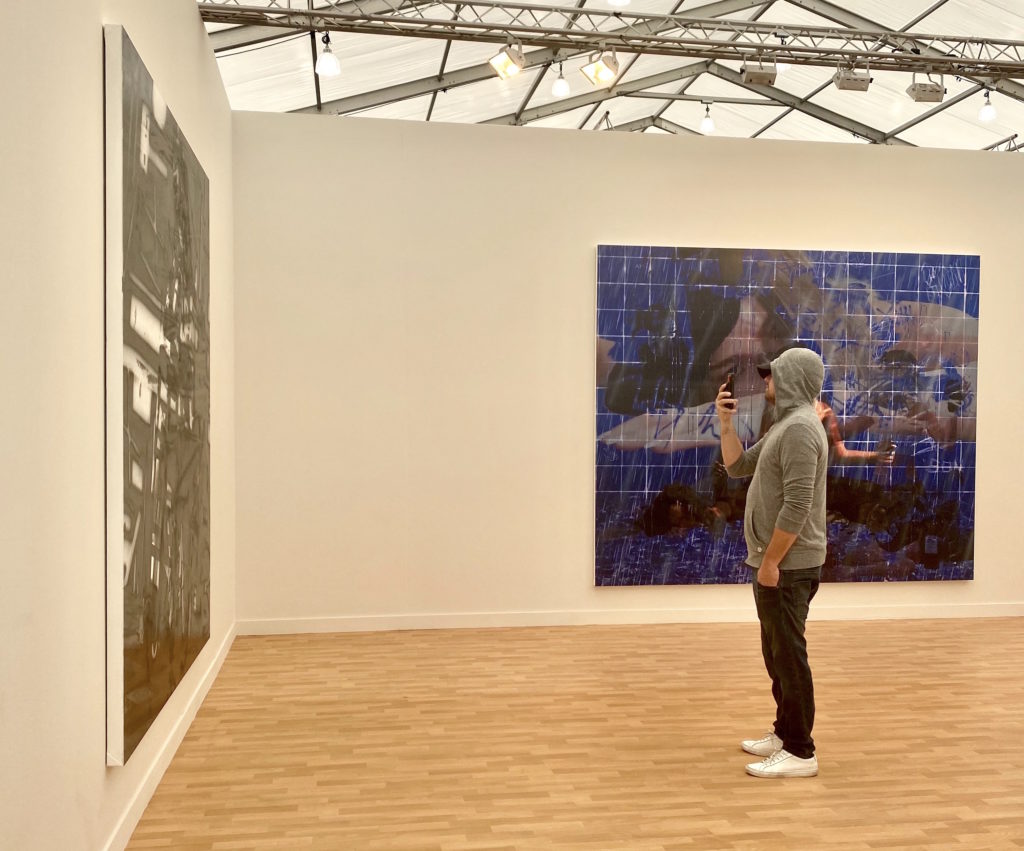
Leonardo Di Caprio photographs work by
Avery Singer from Hauser & Wirth at Frieze Los Angeles 2020. Photo
by Sarah Cascone.
Intoxicated by LA
All this star power—which the art world can pretend it doesn’t
care about, but Instagram tells a different
story—created a giddy feeling inside the tent.
“Right now, we’re at the center of the art world—it’s right
here,” said Jeffrey Deitch, the art dealer who has long been an
advisor to Emanuel and opened a spacious new Hollywood gallery
around the time of Frieze’s first LA edition. “And to say that Los
Angeles is the center of the art world, it’s incredible.”
Deitch has been one of the more visible figures during what’s
now called “Frieze Week in Los Angeles.” (“We didn’t come up with
that,” Sharp, the Frieze co-founder, shrugged when I asked her
about the moniker.) The dealer opened a show on Saturday that drew
2,000 over the course of the night. At the fair, he sold works by
Pat Phillips, Alake Shilling, and Theresa Chromati for between
$5,000 and $28,000. And he’s become indispensable to budding
collectors in the entertainment industry. Miley Cyrus was at the LA
gallery for a personal walkthrough on Saturday, and as I approached
the booth at Frieze, Deitch was speaking with singer The
Weeknd.
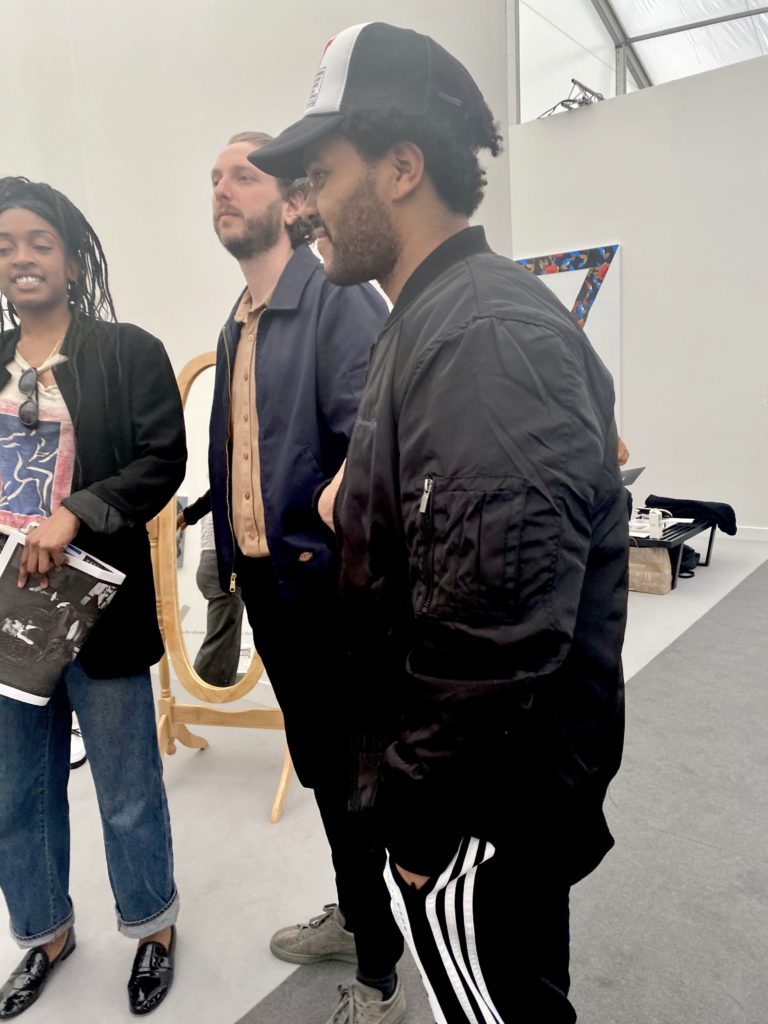
The Weeknd at Frieze Los Angeles 2020.
Photo by Sarah Cascone.
The dealer posited that perhaps this kind of intermingling can
only happen in LA. “I’ve had a vision for a long time where I don’t
observe the border between fine art and popular culture, art and
music and film—I’m very interested in creative people who
themselves blur lines,” Deitch said. “It’s a very connected
community here.”
Frieze managed to successfully eventify the
proceedings, making the experience feel more like being at
Coachella than on the Messeplatz—especially in the New York
backlot, where special projects and performances spilled out of
fake apartment buildings and storefronts. But even if Frieze wants
to position the fair as something other than a trade event, it
still needs to please its exhibitors, and that means ensuring that
all those celebrities and influencers and models in attendance
actually, you know, buy art.
After last year’s slight hiccup due in part to the dismal
weather (LA and rain do not mix), sales this year were solid,
especially in the mid-six-figure range—though Gladstone sold a
Keith Haring painting for $3.75 million, Zwirner placed a very
large Neo Rauch painting priced at $2 million, and Jack Shainman
sold a major Barkley Hendricks painting and said, somewhat
cryptically, that major paintings by Hendricks range from $1.5
million to $5 million.
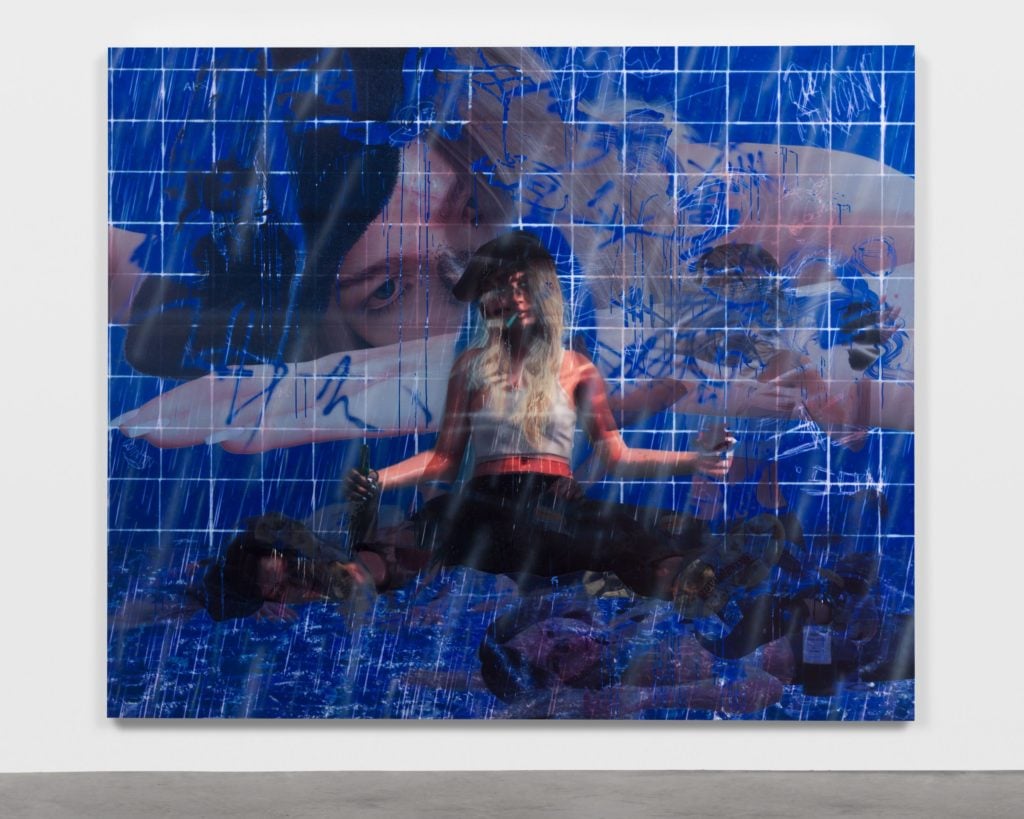
Avery Singer, Jordan, a new
work making its debut at Frieze Los Angeles. © Avery Singer.
Courtesy the artist, Hauser & Wirth, Kraupa-Tuskany Ziedler,
Berlin
Elsewhere at the fair, local mainstay David Kordansky sold two
works by Angeleno Jonas Wood for $500,000, and one work by Angeleno
Mary Weatherford for $310,000. Jack Shainman sold Lynette
Yiadom-Boakye’s Seven Stitches South (2020) for
$325,000, and London’s Alison Jacques sold a giant new work by
Sheila Hicks for $550,000. All the Avery Singers at Hauser & Wirth
sold for prices up to $495,000. Meanwhile, Metro Pictures placed
works by Cindy Sherman, Camille Henrot, and Gary Simmons for as
much as $150,000. And White Cube sold a Julie Mehretu for $360,000,
while Lehmann Maupin sold Liza Lou’s Shelter From the
Storm (2020) for $275,000.
All this activity marked a significant uptick from the first
edition. “Last year was a bust, last year was a total
bust, because it rained,” Lisson director Alex Logsdail told me.
“The organizers should not have had it rain, that was poor planning
on their part!”
The other benefit of year two is a better understanding of what
price point sells. Notably, the popular six-figure range here is
a bit higher than at the
larger Frieze New York fair, where sales have recently
congregated in the five figures. But by the same token, Frieze LA
may not be ready for Basel-style nosebleed prices. Last year,
Logsdail said, Lisson “brought out A-game, and our A-game is a bit
too expensive.” Now, “we’ve recalibrated and it’s
great.” During the fair’s opening hours, the gallery sold 10
of the 14 works on its booth, including a mirrored Anish Kapoor for
$700,000 and a 2019 Stanley Whitney painting for $350,000.
Thaddaeus Ropac also did slightly better than last year, and
sold a work on the higher end of the offerings: Robert
Rauschenberg’s Bowery Parade (Borealis) (1989) for
$1.35 million. “Last year, someone said to me, ‘Oh, don’t bring
expensive things, bring things less than $500,000,’” Ropac said.
“We brought expensive work—and we sold it. There’s some of the best
collectors in the world here. At Frieze New York, it’s expected
that you bring young artists, but here, you bring important
artists.”
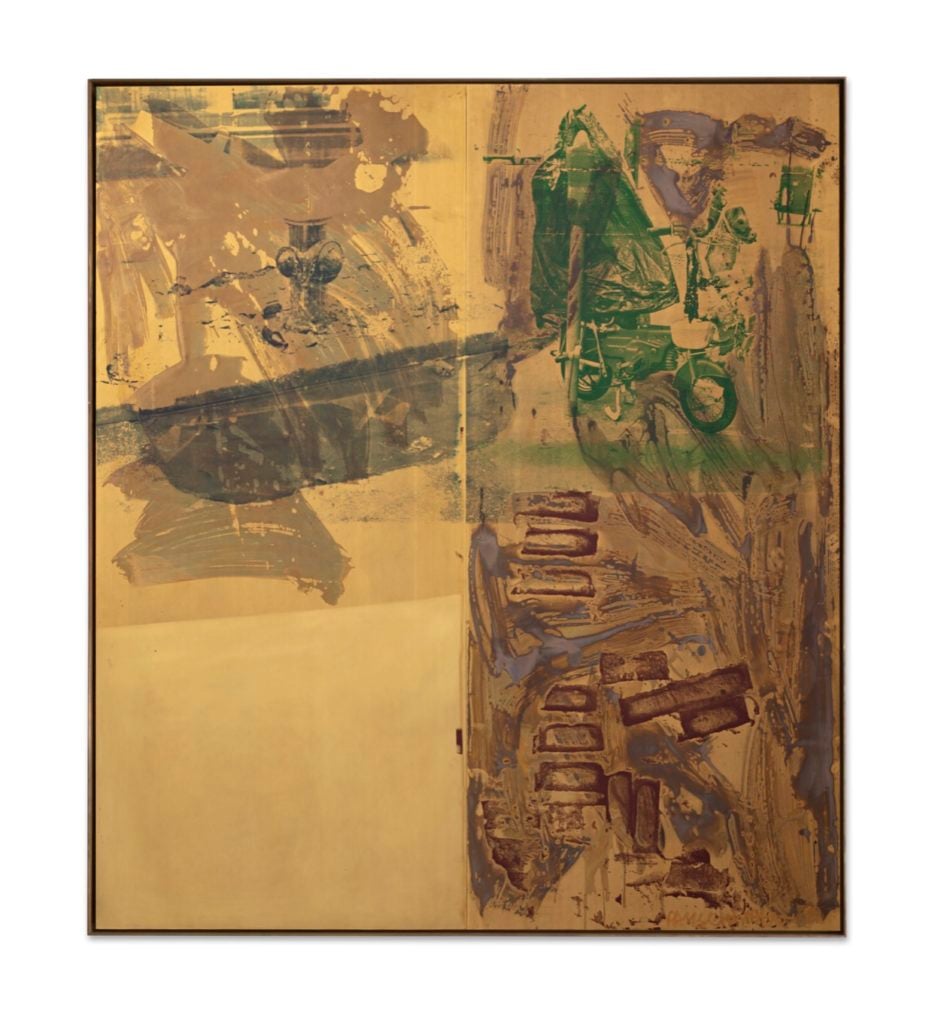
Robert Rauschenberg, Bowery Parade
(Borealis) (1989). Photo: Glenn Steigelman. © The Robert
Rauschenberg Foundation, Adagp, Paris, 2020
(Perhaps the most-talked about sale of the day
was of a work by a young artist, but it took
place in London, where Amoako Boafo’s The Lemon Bathing
Suit (2019), sold for $880,000 at
Phillips on a high estimate of $65,000. The work was consigned
by rabble-rousing LA collector Stefan Simchowitz, and when I ran
into him at the Felix Art Fair—the rollicking event that also
returned for a second go of it this year—Simchowitz said, “I have
to pay my artists, so it’s all going to go to good homes. It’s not
going to buy me a Ferrari.”)
Old Hollywood, New Hollywood
The fact that this city could have such a jam-packed art fair
(not to mention the well-attended Felix) was kind of shocking to
older LA lifers; Jonas Wood told me that when he first moved to LA
in 2003, he was told: “Save your best stuff for New York.”
William Hathaway, the sales director at Night Gallery, has been
working in LA for nearly two decades, and didn’t think a major fair
could succeed in such a vast city that lacks a unified art
district. “Fifteen years ago—no, I would never think this would
happen,” Hathaway said. “The only time anybody came here was for
the Oscars.”
Frieze LA’s director, Bettina Korek, attributed its success to a
potent mix of factors, including a bevy of supplemental events and
an eager audience. “A lot of people hoped that an international
fair would establish roots in LA,” Korek, who will be leaving after
this edition to become CEO of the
Serpentine Galleries in London, told me. “The combination of
the context and the timing—honestly I think Uber is helpful, it’s
easier to get around LA.”
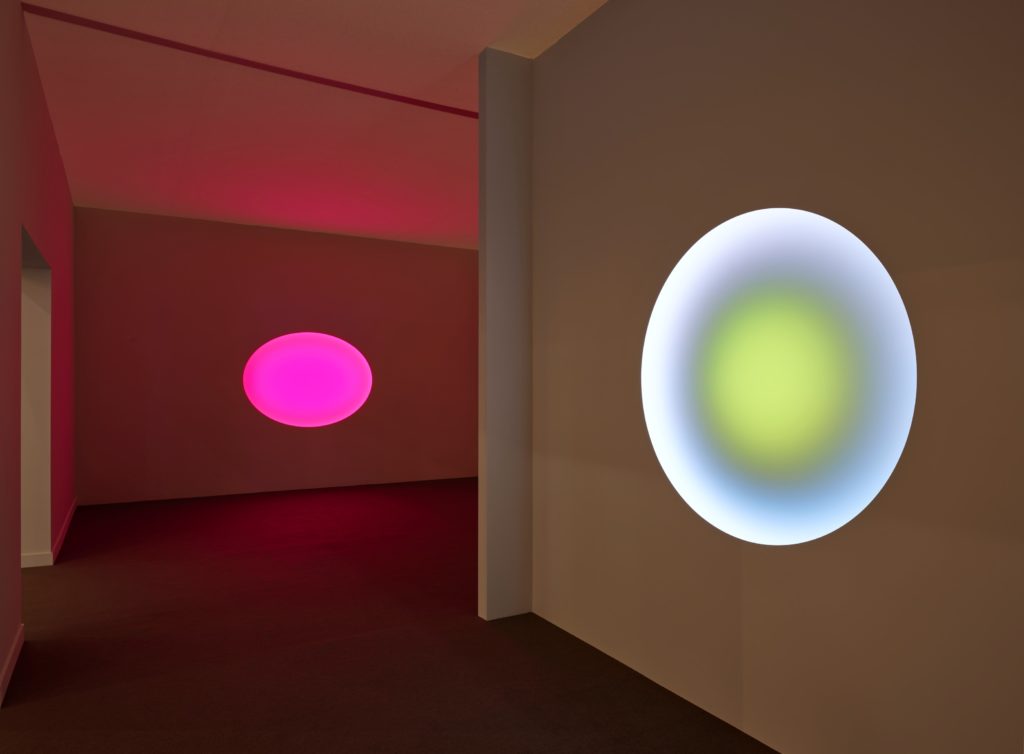
Installation view of Pace Gallery and
Kayne Griffin Corcoran’s booth at Frieze Los Angeles at Paramount
Studios. Photography by Flying Studio
Perhaps the best recipe for success at this new fair is to to
follow the lead of Pace and Kayne Griffin Corcoran, who combined
booths to show a series of works from James Turrell’s recent
“Glass” series, glowing chameleonic orbs that light up whatever
parcel of wall they inhabit. The gallery sold two elliptical works
and two circular works—one went to Kendall Jenner, whose
brother-in-law-Kanye West recently filmed an IMAX
movie at Turrell’s masterwork, Roden Crater—priced at
$750,000 each. (The works will raise money for the Crater, though
collectors could also directly give money to the long-gestating
artwork in the desert. Naming the amphitheater will cost you $36
million.)
It was the booth most evocative of the California ethos, the one
that best distilled the spirit of LA—and of the fair, which sought
to turn a pedestrian industry event into something bigger. “So much
of painting is about how to deal with light, but this is
light, and it’s about the thingness of light,” said Bill
Griffin, the gallery partner who has worked with Turrell for
decades. “This work exists in the art world, but it also exists in
the world. It goes beyond white walls.”
The post Frieze Los Angeles Opens With Big Sales to
Mega-Celebrities and Hollywood Muscle Alike—and It’s All
Live-Streaming on Instagram appeared first on artnet
News.
Read more https://news.artnet.com/market/frieze-los-angeles-opening-sales-1777923
Further reading


Leave a comment