
‘Museums Can Learn From the Entertainment Industry’: Why the Van Gogh Museum Is Launching an Experiential Pop-Up in London
Van Gogh is getting the high-tech, 21st-century treatment, as
Amsterdam’s Van Gogh Museum brings a new experiential attraction to
London.
Titled “Meet Vincent van Gogh,”
the pop-up offers up an audio tour of the artist’s life as told
through his letters, illustrated along the way by three-dimensional
reproductions of famous works, audiovisual scenes, large-scale
projections, and interactive activities. You can take selfies in
Van Gogh’s bed (or, rather, a snazzy copy of where he slept) or in
front of a life-sized backdrop of his yellow house in Arles.
Perhaps you want an image of yourself standing in the wheat field
where the artist fatally wounded himself? If that’s too morbid, you
can watch a shadow play of the artist arguing with Gauguin in his
studio.
With no actual art to insure or
secure, and previous, popular exhibition runs in Barcelona and
Seoul, the experiment could be a good object lesson for
cash-strapped museums looking to diversify their income streams.
But hopping on the experiential bandwagon is also a risky game.
Fun, immersive installations have a reliable track record of
bringing in large audiences—and their wallets—but if they’re
unsatisfying on an educational level, they run the risk of
alienating museums’ existing dedicated audiences, perhaps spelling
trouble for an institution’s reputation once the novelty wears
off.
Market Demand
“In our mission to develop and
explore new ways to reach the audience, we have recognized an
evident demand in the market for experiences,” the Van Gogh
Museum’s managing director Adriaan Dönszelmann explains. He’s not
wrong. A hunger for experiences has been well documented, and the
Van Gogh Museum was recently surpassed as one of the world’s most
popular single-artist museums by the Tokyo museum
dedicated to the immersive light art of the collective
teamLab.
This popularity has led to an
explosion of fairly empty, populist experiences from commercial
operators, while traditional museums
have struggled to strike a balance that does not distract from their primary
missions of providing a substantive educational or cultural
offering.
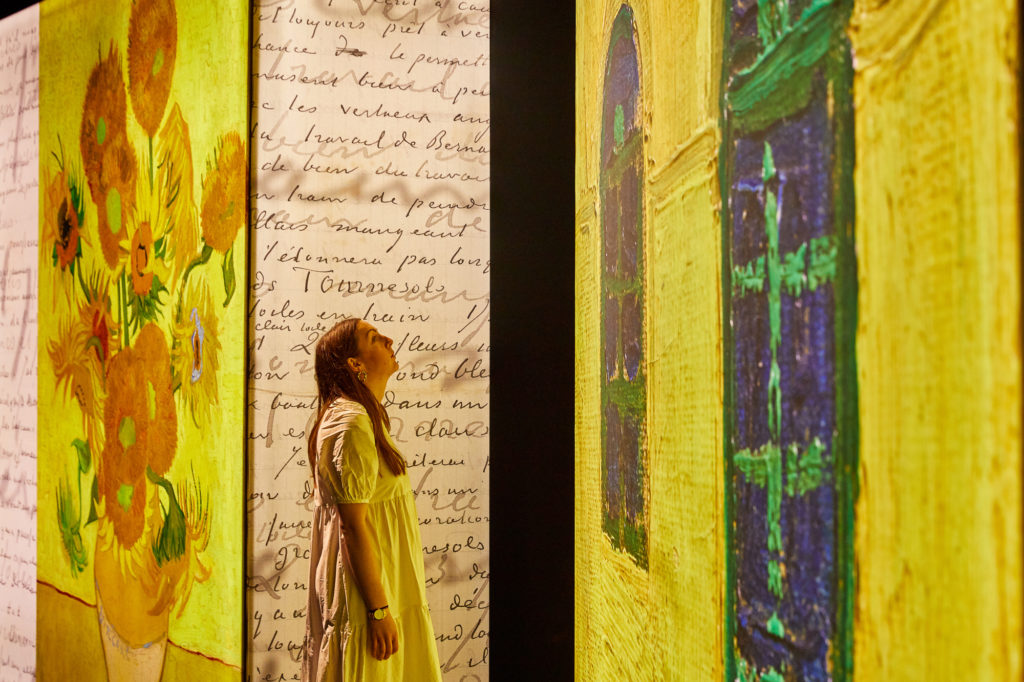
Installation view of “Meet Vincent van
Gogh,” London. Image courtesy of Meet Vincent van Gogh. Photo by
Luke Walker.
Dönszelmann notes that there has
specifically been an increasing demand for a Van Gogh experience.
If this sounds familiar, you might recall an experience called
Van
Gogh Alive, or another popular
project, organized
by the Atelier des Lumières
in Paris, which immerses
viewers in vast light projections of the Dutch artist’s
masterpieces (the same company also ran a similar experience centered around Gustav
Klimt).
Dönszelmann all but name-checked
these previous operators, but emphasized that “Meet Vincent van
Gogh” is “the one and only official experience created by the Van
Gogh Museum.” The director says that the museum’s offering is
“totally different” from the other Van Gogh offerings on the
market, explaining that unlike its flashy and not very cerebral
predecessors, it is meant to be a “complete” experience in which
education and entertainment go hand in hand.
Necessity Is the Mother of Invention
But why would a thriving museum
need something like this in the first place? The Van Gogh Museum in
Amsterdam welcomes around 2.2 million visitors each year,
but Dönszelmann says this income is
“vulnerable.”
“It is important for the museum
to broaden the sources of income,” Dönszelmann says. “So by doing
this we are generating income in a new way.”
The experience certainly has the
potential to become serious driver of cash. When “Meet Vincent van
Gogh” was launched in Barcelona, it drew 160,000 people; more than
80,000 turned up in Seoul. Before the experience opened in London,
they had already pre-sold just under 20,000 tickets. Full price
tickets will set you back £18 (around $23), which is more than the
€19 ($20) that it costs to enter the actual museum back in
Amsterdam. The space in London can accommodate up to 5,000 people
a day, and because it does not contain original artworks, the
museum soon hopes to be able to roll out the experience
simultaneously in multiple locations.
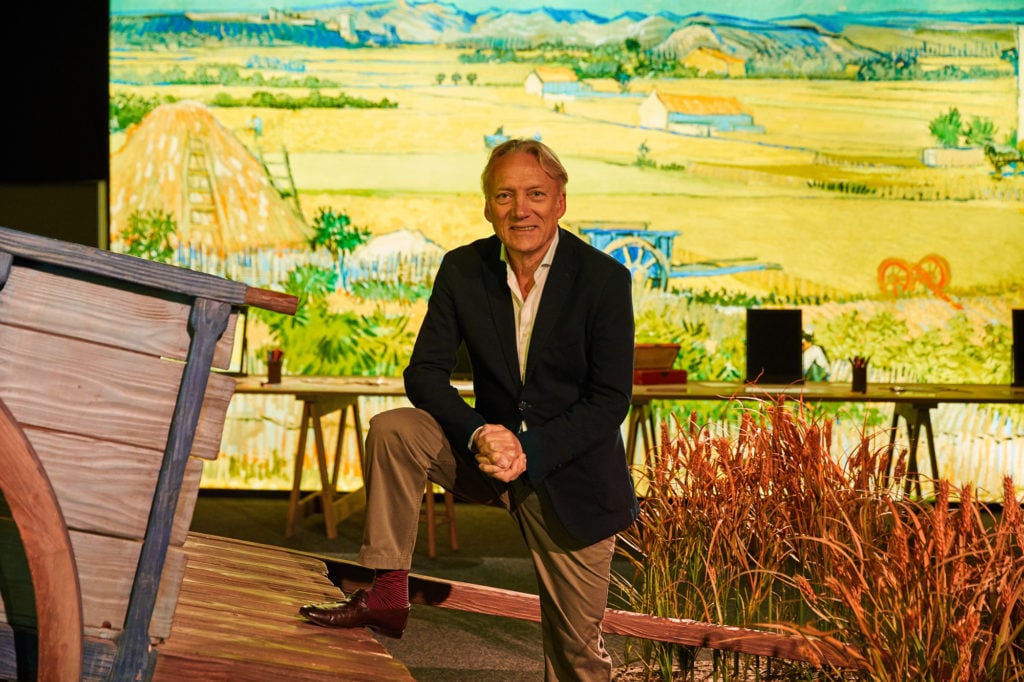
Installation view of “Meet Vincent van
Gogh,” London. Image courtesy of Meet Vincent van Gogh. Photo by
Luke Walker.
Beyond diversifying revenue
streams, there is the practical point that many historic works are
becoming too fragile to travel. Transporting and insuring valuable
pieces is also a costly endeavor. Meanwhile, the demand for culture is growing outside
of major cities, and there has been an ongoing discussion about
touring digital renderings of artworks to meet this demand. Right
now in France, for example, the culture ministry is rolling out an
ambitious project to introduce 1,000 “digital museums” around the
country and its territories in order to share the masterpieces in
its national collection more widely.
“I do think that in the future
we will see more museums operating in this sphere,” Arnold van de
Water, the general manager of the experience for the Van Gogh
Museum, tells Artnet News. “I like that we can cross borders, and
not be afraid to say that museums can learn a lot from the
entertainment industry. I think that that works both
ways.”
Van Gogh’s works are
particularly fragile. After an extensive
restoration effort, the
museum announced a travel ban on Van Gogh’s Sunflowers last January. Van de Water says that logistical
realities like this have forced the institution to get creative in
order to fulfill its mission of making Van Gogh’s life and work
accessible to as many people as possible. He added that as a
single-artist museum they are always thinking about fresh ways to
continue engaging audiences.
“It’s not only about eye candy
or video projections,” Van de Water stresses, noting that the
content of the experience came out of scientific research carried
out by the museum over the past 50 years. “Meet Vincent Van Gogh”
might be flashy and fun, but it was designed in tandem with the
museum’s curatorial staff and education department. “We publish
books, we create documentaries, and I think creating an experience
like this is another form of telling that same story,” Van de Water
says.
Audience Satisfaction
Asked what type of audience the
museum hopes to draw here, Van de Water says that it was designed
as “an experience for novices and experts alike.”
The trouble with such an
ambitious remit is that it means that “Meet Vincent van Gogh” has
to simultaneously contend with the expectations of London audiences
familiar with museums
like the nearby Tate Modern, as well as with fans of high-budget,
sensational selfie-factories like the Museum of Ice
Cream.
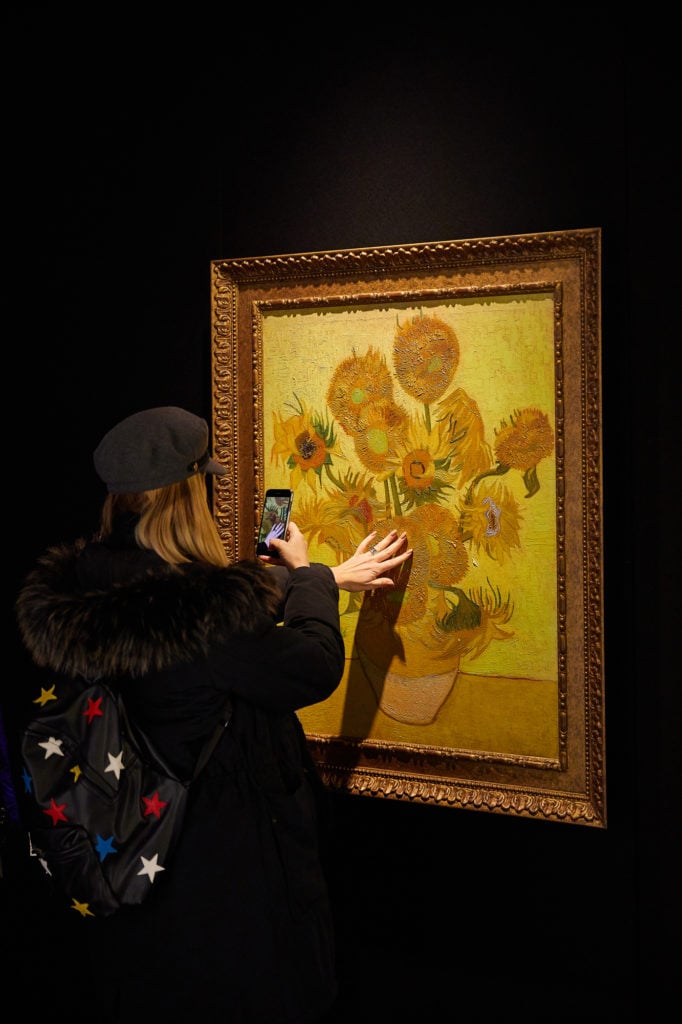
Installation view of “Meet Vincent van
Gogh,” London. Image courtesy of Meet Vincent van Gogh. Photo by
Luke Walker.
So what’s it actually like to
“meet” Vincent van Gogh in this way? For me, the rather
unspectacular displays fell flat. They neither satisfied my
millennial hankering for an experience worthy of my Instagram grid,
nor did they take the place of going to a real museum to experience
the original works of art. I was particularly disappointed in the
lack of truly high-tech wizardry. Why not have us meet a VR Van
Gogh? Or ask: Can we teach a computer to paint
like the master?
But perhaps I’m not the exact
target demographic. The show’s organizers don’t seem worried, and
after speaking to a number
of people attending the exhibition, I can see why.
Most of those I talked to about
the experience reacted positively. Admittedly, those who enjoyed
themselves tended not to hail from the creative industries: they
were finance and luxury wholesale industry workers, teachers, and
social workers. Tech industry worker Maria Koutoumanou said that it
was a “missed opportunity” to experiment with more advanced
technologies, but that she enjoyed the experience
overall.
“Meet Vincent van Gogh” was
especially popular with families. I received overwhelmingly
positive feedback from those with young children. Kids were a fan
of the interactive activities, where you can draw using a
perspective frame, or try your hand at your own self-portrait.
Ten-year-old Tillie Richardson and her teenage brother Jack both
deemed it “really interesting,” and said that they enjoyed the
experience even more than the King Tut exhibition at Saatchi
Gallery. (That’s high praise, given that the King Tut show,
currently ongoing in London, drew 1.4 million visitors during its
Paris run.)
While I was not satisfied by the experiential component, I
can see the potential for this type of museum-run standalone
exhibition to bring in money and educate new audiences. It
might also be a way to give avid selfie-takers a place to run wild,
which could give actual museums a break from the social-media
frenzy. It is an interesting first step; but if the museum wants to
tap into where the real money is at, which is in the hands of
experience-hungry Millennial and Gen Z visitors, they need to up
the ante. To capture such jaded attention spans, institutions will
have to serve up something more than what these young visitors can
already get on their screens.
“Meet Vincent van Gogh”
is on view at 99 Upper Ground, South Bank, London, through May
21.
The post ‘Museums Can Learn From the Entertainment
Industry’: Why the Van Gogh Museum Is Launching an Experiential
Pop-Up in London appeared first on artnet News.
Read more https://news.artnet.com/art-world/van-gogh-museum-experience-london-1777419
Further reading


Leave a comment