
‘I’m Constantly Learning’: How 85-Year-Old Sculptor Diane Simpson Kept Going Until the Art World Finally Caught Up With Her
Over the past decade, the trope
of the “rediscovered” female artist has become so widespread that
it’s even spawned its own acronym. Known as the OWAs (older women
artists), this disparate group of female creators—Lubaina Himid,
Phyllida Barlow, Sheila Hicks, Carmen Herrera, to name only a
few—are linked less by their practices than by their gender and
delayed success.
It would seem that 85-year-old
Diane Simpson, who until recently was barely known outside of her
native Chicago, is set to join these ranks. At one point making so
little money as an artist that the IRS became suspicious she’d been
lying on her tax returns, Simpson has recently undergone a
reappraisal, with prices for her sculptures now reaching upwards
of £70,000 ($90,000) and older pieces,
significantly more.
Not long after her inclusion in
last year’s Whitney Biennial—where
she was the oldest artist in a show dominated by
millennials—Simpson has also just opened a solo exhibition at
Nottingham Contemporary, her first institutional show in Europe.
Featuring extemporary pieces from each of her major series, “Diane
Simpson: Sculptures, Drawings, Prints 1976–2014” is on view through
May 4, and serves as a tribute to the elaborate and idiosyncratic
working method Simpson has developed over the past 38
years.
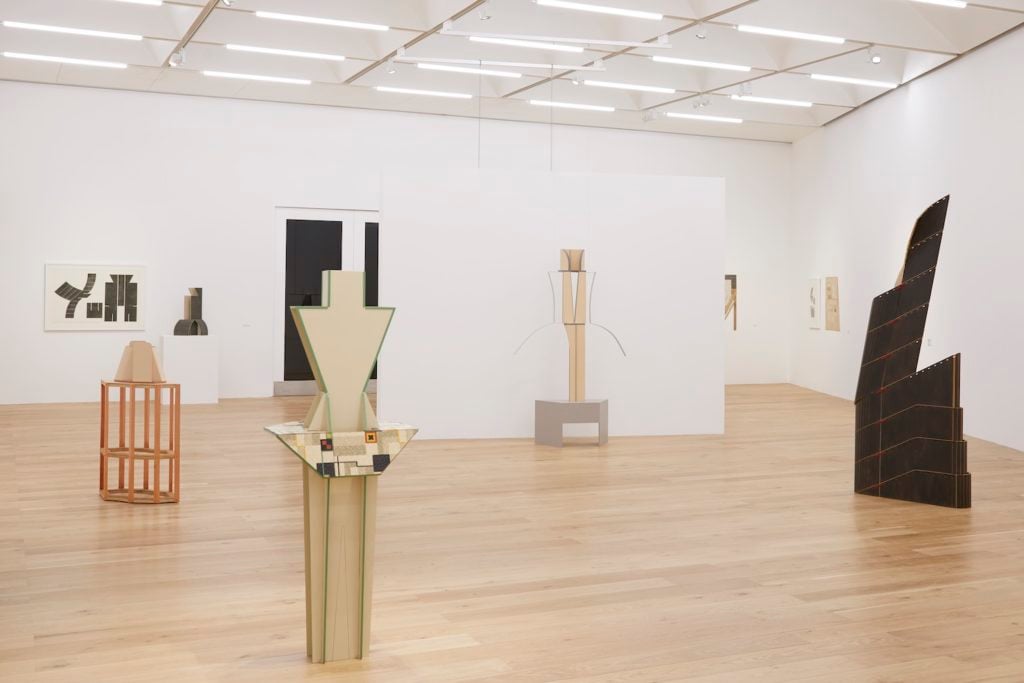
Diane Simpson: Sculpture, “Drawing,
Prints 1976–2014,” 2020. Installation view of Nottingham
Contemporary. Photo Stuart Whipps.
Impossible Sculptures
Formally trained in drawing and painting at the School of the
Art Institute of Chicago in the mid-to-late 1970s, Simpson had an
artistic breakthrough when a tutor encouraged her to turn the
isometric drawings she’d been making into three-dimensional
objects. Beginning with
corrugated cardboard and eventually moving on to using MDF, Simpson
interlocked panels to replicate the 45-degree angles of the
original gridded paper drawings, creating sculptures with a skewed
perspective that, when seen in person, often appear structurally
unfeasible.
“There is something [about
Simpson’s work] that doesn’t really translate in images or
reproductions,” explains Nicole Yip, the chief curator at
Nottingham Contemporary. “What struck me most about the sculptures
was just how terrifically strange they are in the way they occupy
space.”
I meet Simpson in the museum’s
café a few hours before the opening. Smartly dressed and remarkably
polite, she tells me she’s thrilled to be showing outside the US in
what is only her second museum solo show, and “very happy” with
Yip’s selections, the result of a trip the curator made to
Simpson’s Chicago home last year.
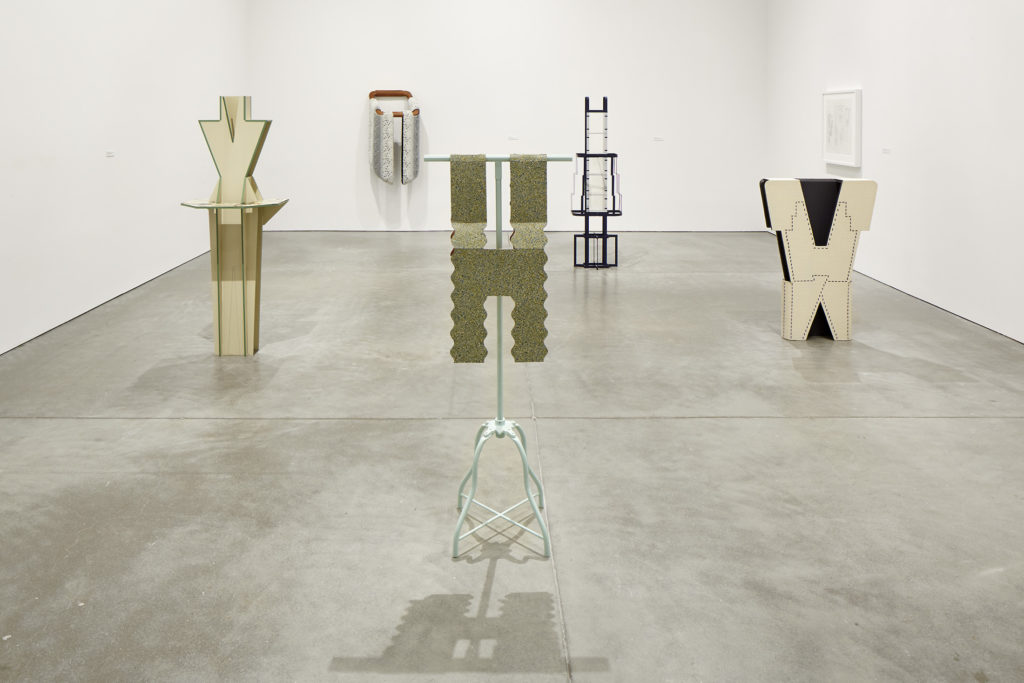
Installation view from “Diane Simpson”
at the Institute for Contemporary Art Boston in 2016.
Simpson has lived in the
Midwestern city her whole life—a factor, she admits, which has
undoubtedly had a negative effect on her career. “When I graduated,
this was the time where you just had to go to New York, you couldn’t possibly make
it any other way, but I don’t think I had the nerve,” she says.
“But not only that, I got married young and started a family very
fast, so I didn’t finish school and had to go back many years later
to graduate.”
Although she had some early
signs of success—shortly after finishing her studies, she was given
a solo show with legendary art dealer Phyllis Kind, where she
debuted sculptures based on Samurai armor—nothing stuck. Simpson
bounced between galleries, sometimes leaving because she was
unhappy and other times finding herself adrift when a gallery would
shut down. Still, she never stopped making art and, finally, she
was picked up in 2010 by Chicago-based
dealer Corbett vs.
Dempsey after the founders saw her 30-year retrospective at the
Chicago Cultural Center.
It marked a change in fortune
for the artist that would prove enduring. She went on to have a
well-received solo exhibition with New York gallery JTT in 2013 and
a two-person show at London’s Herald Street in 2015, which both
resulted in Simpson joining the galleries’ rosters.

Diane Simpson: Sculpture, “Drawing,
Prints 1976–2014,” 2020. Installation view of Nottingham
Contemporary. Photo Stuart Whipps.
But Simpson doesn’t seem to mind
her later-in-life success, although she understands that many in
her position might not have stuck with it for so long. “I had a
lucky situation,” she says. “My husband, I should say, was very
encouraging. I realize how tough it is. For so many young artists,
it’s really difficult to do their art and also earn a living and
they have to either spend a lot of time teaching or have another
job.”
The spotlight on Simpson’s work
comes at a time when the art world is taking a renewed interest not
only in the Chicago Imagists, many of whom she studied alongside
her at the Chicago Institute of Art, but also in older women
artists in general who may have been structurally shut out of the
art market because of their gender.
Simpson says she was always on
the periphery of Imagists and was never included in those early
Imagist exhibitions at Hyde Park Art Center in Chicago.
“I think for the most part,
stylistically and in regard to subject matter, my work was very
different from that of the Imagists,” she says. “I feel closest to [Chicago Imagist]
Christina Ramberg—her
imagery and interests are similar to mine, both being drawn to
clothing and the body.”
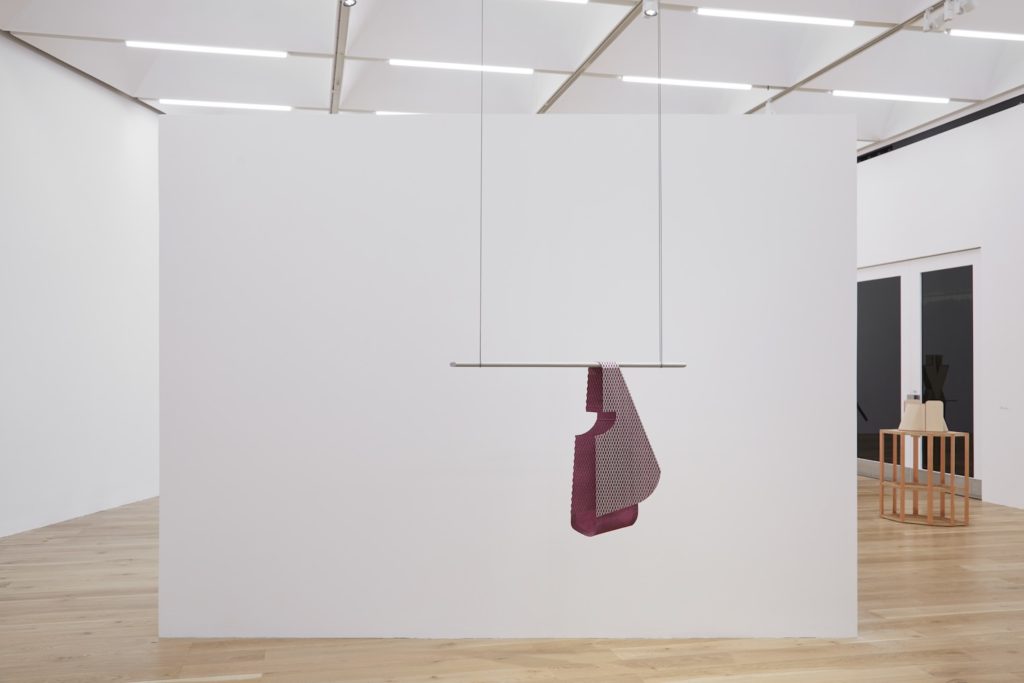
Diane Simpson: Sculpture, “Drawing,
Prints 1976–2014,” 2020. Installation view of Nottingham
Contemporary. Photo Stuart Whipps.
Indeed, there are certainly
similarities between the two: Ramberg, like Simpson, made detailed
preparatory drawings for her work based on divergent source
material, and, like the late artist, Simpson doesn’t see her
practice as overtly feminist, although she accepts that her way of
working is affected by her experience “as a woman and as a mother.”
If she mainly uses female garments as source material, she says,
it’s only because it’s more interesting than what men traditionally
wear, rather than to serve “any political agenda.” Simpson was
included in an exhibition on Ramberg at KW Institute for
Contemporary Art in Berlin that looked at her influence on and
discourses with her contemporaries.
One gets the impression that
what excites Simpson most is the physical act of making work, which
she still does by hand in her garage studio, an intense and
detailed process that, from start to finish, takes up to three
months for each object. “Even if I did want to have things
fabricated, it’s just something that I couldn’t preplan,” she says.
“Everything is self-taught, I’ve never really had a sculpture
class, and so I’m constantly learning new techniques on my
own.”
Ultimately, it’s this drive to
test herself and her abilities that has kept Simpson going over the
years. “I just had to do it,” she says with a chuckle. “Maybe I
felt that I couldn’t do anything else well.”
“Diane Simpson: Sculpture, Drawing, Prints 1976–2014” is on
view until May 3, 2020 at Nottingham Contemporary.
The post ‘I’m Constantly Learning’: How 85-Year-Old Sculptor
Diane Simpson Kept Going Until the Art World Finally Caught Up With
Her appeared first on artnet News.
Read more https://news.artnet.com/art-world/diane-simpson-profile-1773465
Further reading


Leave a comment