
Rem Koolhaas’s ‘Countryside’ Exhibition at the Guggenheim Suggests That the Architect Doesn’t Know What the Museum-Going Public Wants
The Guggenheim’s current exhibition, “Countryside, The Future,”
is based on a fundamentally silly premise: that after 40-plus years
of primarily building in, and theorizing on, cities, which account
for roughly 2 percent of the earth’s surface, Dutch architect Rem
Koolhaas is a reliable authority on the other 98 percent of the
globe.
In his assertion that the countryside has been a “neglected
realm” of undersung innovation and transformation, the celebrated
iconoclast (and a cohort of researchers at the Guggenheim, various
global universities, and his own architectural think tank, AMO) has
launched into a mission of course correction.
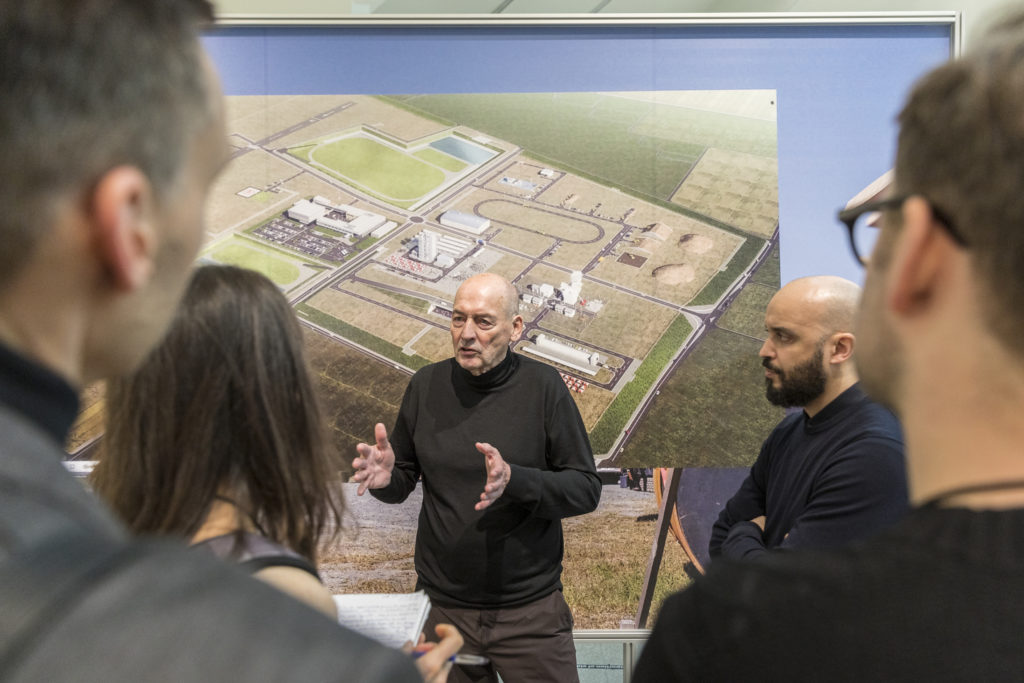
Rem Koolhaas explains his show. Image:
Laurian Ghinitoiu courtesy AMO.
Their 10-year effort to mine the obscure corners and various
histories of the planet’s enduring “back of house”—the space that
fulfills humanity’s need to grow food, sweep industrial byproducts
under the rug, and temporarily escape the stresses of city
life—culminate here in a wildly uneven, sometimes illuminating,
frequently tone-deaf homage.
The show’s organizers describe it as a “pointillist” portrait of
an enormous topic, although they’ve stretched the term
“countryside” beyond meaningful definition to include oceans,
beaches, and any non-strictly urban space. The exhibition unfurls
as a series of wide-ranging case studies, presenting plainly,
without judgment or urgency, the vast modernization campaigns of
20th-century fascists; acquisitions of Patagonian forests as
corporate philanthropy; and the countryside’s enduring place in
American pop culture. A feature called “Country Semiotics” that
runs the height of a rotunda column notes Lil Nas X’s historic
breakthrough into a predominantly white country music industry
and dissects the nuances of American pop culture, citing the
implicit country vs. city bias that Barbie and LEGO impart on young
children.
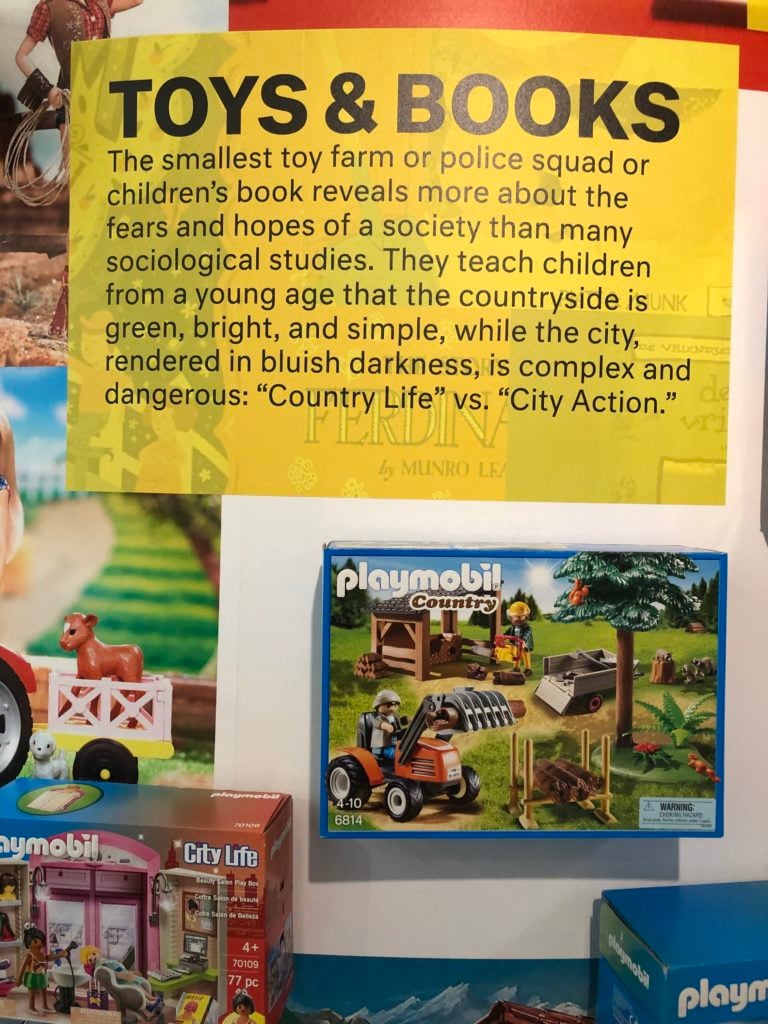
Rem Koolhaas’s explanation of how toys
teach children about the countryside. Photo: Janelle Zara.
The wacky applications of texts and cutouts all over the
museum’s surfaces do little to hide the fact that most of the
exhibition design is a failure of imagination, the cliché of
pasting museum walls with content better suited for books. (Mired
in air bubbles, crooked lettering and misaligned seams, they’re
poorly pasted, too.) Claiming to be neither art nor architecture,
the procession of case studies fills the niches between the
rotunda’s load-bearing walls with charts, graphs, and archival
photos, effectively transforming the atrium into a series of high
school science-fair displays.
Worse still, a fascinating conversation between two lecturers
from the University of Nairobi is mounted as a transcription. It’s
not that I’m opposed to reading; it’s just that
dissertation-as-exhibition suggests an embarrassingly clinical
misreading of the museum-going public’s interests.
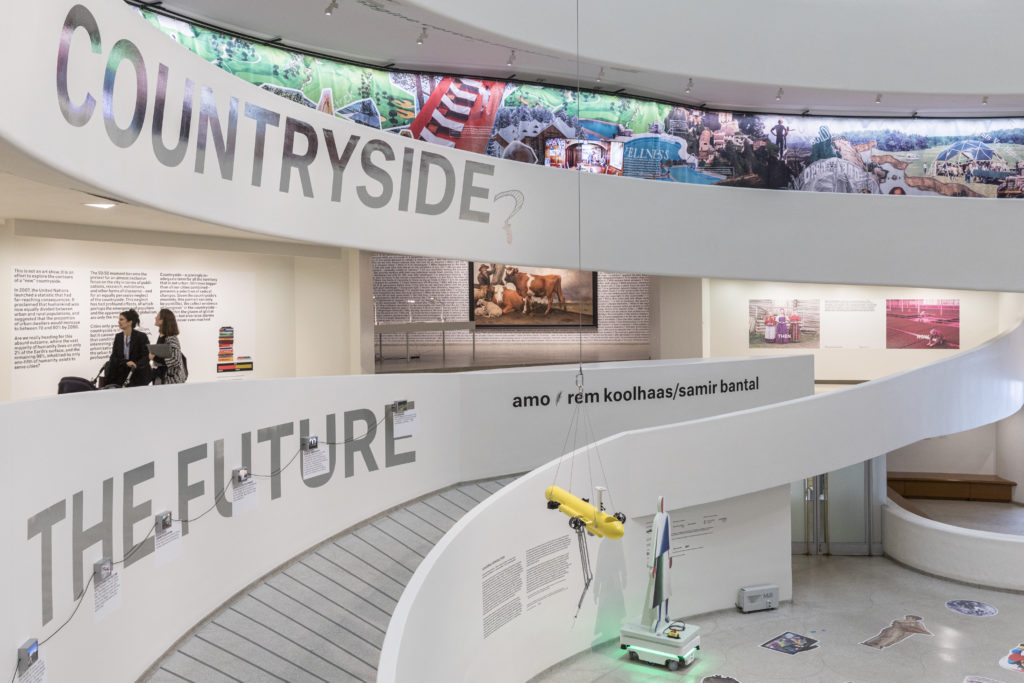
koolhaas
In defense of the exhibition’s text-heaviness, Guggenheim
curator Troy Conrad Therrien describes it less like reading a book and more
like “an opera or a film where you have an incredibly dense
playbill.” Hamilton, this is not, but “Countryside” aspires to
delivering an experience. The Guggenheim’s upward climb starts with
a historical survey, illustrating the Cartesian geometries
politicians have used to modernize and mobilize the countryside:
there are maps of Western Territories that Thomas Jefferson
parceled into six-square-mile townships, and photographs of
villagers in Maoist China tilling the land into uniform rows. (A
description of 20th-century political figures as “mostly white men”
sticks out as a woke flex—one that would be more effective had the
curators not completely omitted indigenous peoples from this
show.)
As the ramp ascends, the widening rotunda coincides with a
widening narrative, echoing Guggenheim director Richard Armstrong’s
claim that this marriage of “information and spectacle” has been
“choreographed to the spatial idiosyncrasies” of Frank Lloyd
Wright’s architecture. The path diverges from linear histories into
modern innovations, like those of remote Kenyan villagers who,
empowered by universal basic income paid out via mobile banking,
resist notions that they’re fated to urbanization. Faceless
architectures meant solely for robot-manned fulfillment centers
emerge east of Reno. AMO is now in partnership with Volkswagen to
develop an e-tractor. And formerly agrarian China, having
drastically reduced its poverty levels and embraced rural
e-commerce, is now a colonial power carving up large sections of
Africa.
Onward and upward, the science-fair booths grow increasingly
sparse the higher you go, as if all sense were evaporating through
the roof. Explanatory texts give way to seeming omissions, plainly
odd choices, and robots. Exhibits stumble on their own abstraction.
What look like actual slides from a Dutch environmental agency’s
Powerpoint presentation are reproduced on the walls. Plainly
inscrutable data visualizations appear without context. Roving
cutouts of Stalin and unidentified others, individually mounted on
Roombas, are consistently standing in the way. I am mildly offended
by the collage of commentary by solely non-Chinese intellectuals on
their impressions of Mao’s China (according to the late Roland
Barthes, “China has no color”) and I am haunted by unanswered
questions about a scrolling stock ticker paired with an
inexplicable illustration of the Himalayas.
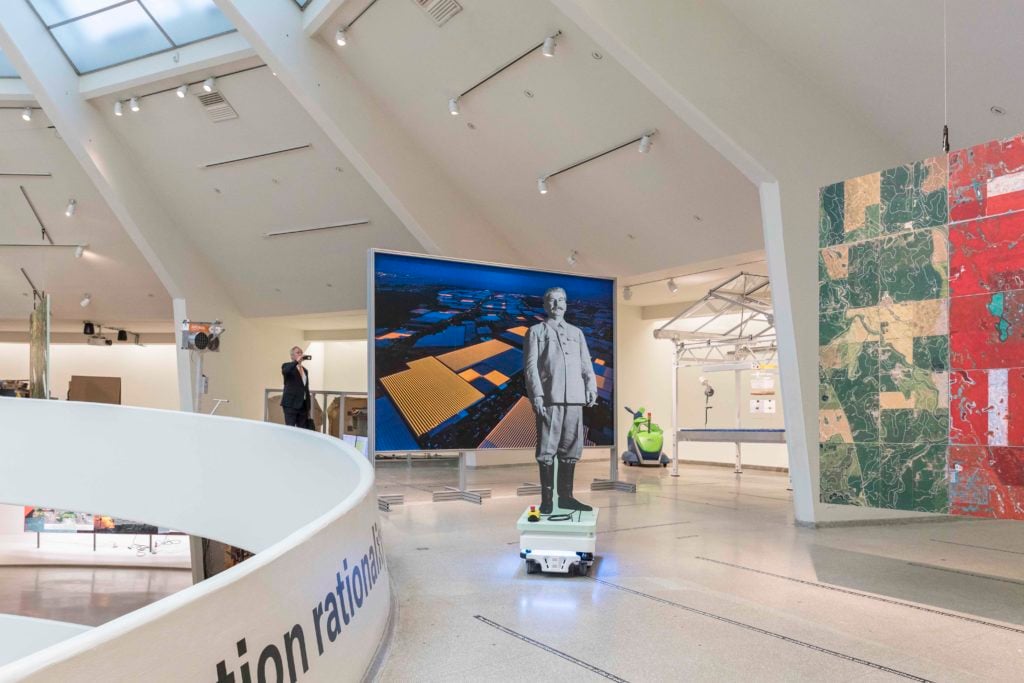
Stalin makes an appearance in the
exhibition. Laurian Ghinitoiu courtesy AMO.
At the very top, bars of text arranged on the floor in right
angles (a winking nod to Descartes) impose a mocking choreography:
reading them forces you into a kind of shoe-gazing waltz. Reading
the lengthy, swirling ode to the countryside inscribed on the
ceiling forces you to go all the way back to the bottom, look up,
and twirl.
There’s no subtly embarrassing dance required to read Koolhaas’s
aptly titled essay, “?,” which is printed in full on one of the
museum’s few straight gallery walls. The meandering train of
thought, verging on poetry but not quite, is a series of
questions:
Does grass always need cutting ? Why don’t they invent grass
that doesn’t grow ? Is hay still relevant ?
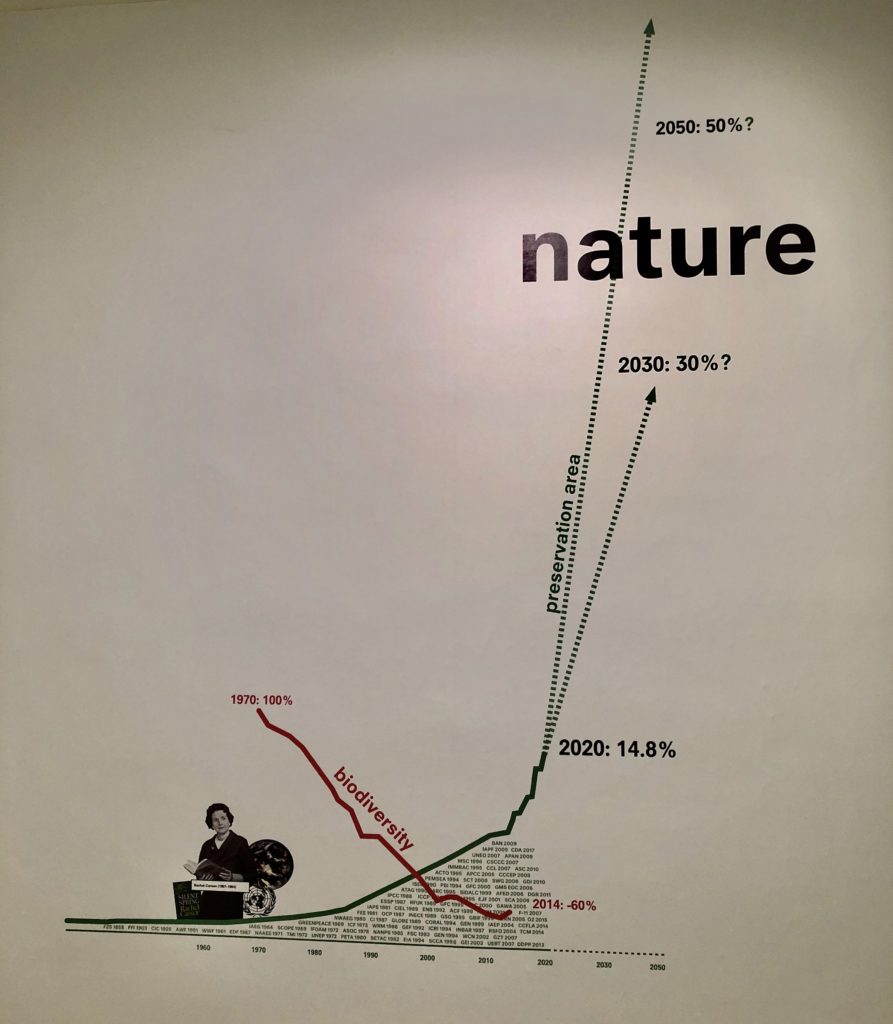
Indecipherable graphs leave much to the
imagination. Some might say too much. Photo by Janelle Zara.
This essay succinctly embodies the underlying obnoxiousness of
this show. In lieu of engaging exhibition design, an architect
capable of realizing Seattle Central Library and Beijing’s CCTV
Tower delivers literal and figurative wallpaper—a two-dimensional
compression of architectural imagination that occupies more space
than it’s worth. It savors quirkiness over relevance, landing just
outside questions of present urgency. Populism and waning globalism
are neatly brushed away as “only the most obvious effects” of rural
neglect. The existential crisis of climate change is limited to a
chapter on melting permafrost—important, yes, but the world is
literally on fire.
This pointillist opera, which is neither as culturally incisive
nor as wildly imaginative as “Delirious New York,” Koolhaas’s
seminal urban treatise, comes to no satisfying end. The countryside
is a pressing topic, just in ways not presented here. Approaching
the final stretch of the rotunda’s interior wall, the word “can”
appears, with the remaining phrase hidden around the curve. The
whole thing becomes visible at the very, very end: “Can today’s
extreme know-how be combined with goodness?” The question would be
infinitely less irritating had I not been asked to chase it
uphill.
The post Rem Koolhaas’s ‘Countryside’ Exhibition at the
Guggenheim Suggests That the Architect Doesn’t Know What the
Museum-Going Public Wants appeared first on artnet
News.
Read more https://news.artnet.com/exhibitions/rem-koolhaas-countryside-guggenheim-1802067
Further reading


Leave a comment