
Debating the Stakes of Criticism for Indigenous Artists + Two Other Thought-Provoking Things to Read (or Watch) From Around the Art Web
Every week, we scan the media for illuminating essays,
conversations, and anything else that offers valuable new ways of
thinking about art. Up this week: how a lack of criticism hurts
Indigenous artists, the limits of eco-art, and an artist
collective’s project about how to prevent an epidemic.
“Writing About Indigenous
Art with Critical Care” by David Garneau,
C
From the Spring issue of the Canadian art magazine C, a
hard-hitting and wide-ranging piece about the recent treatment of
Indigenous artists within Canada’s museum world, which also doubles
as a defense of the idea of criticism.
Garneau is an artist and teacher (he also happens to have
recently designed the official silver coin commemorating Métis
leader Louis Riel last year). Here, he gives the clearest
articulation of a theme I’ve noticed a lot of recent critical
writing feinting around: that the “ethical turn” in recent art
writing (and curating) towards emphasizing undoing the wrongs of
oppression within the arts risks a kind of flattening, where
evaluation becomes secondary to affirming the identity of the
person making the art.
Now, this can be a conservative criticism (“can’t we just get
back to talking about The Art instead of all this race and gender
stuff?”) So what I find powerful about Garneau’s essay is how he
makes a clear case for the harm this kind of writing does to
Indigenous artists:
Non-critical art writing about Indigenous art favours with
recognition only those aspects of Indigenous persons that are other
to the dominant. It encourages Indigenous folks to occupy the
appearance of a position rather than to earn one. The refusal to
engage Indigenous art and persons critically positions us as
permanently in a representational rather than a dialogic mode, as
transmitters rather than generators of knowledge.
I admire how Garneau takes the effort to model what he is
advocating. When he begins by citing an anonymous curator quipping
that the well-known Cree painter
Kent Monkman was “the Norman Rockwell of Native trauma,” I inwardly
cringed, expecting the article to be one of those that uses blind
gossip about “things people are saying” or social media chatter to
substitute for an authoritative critical reference.
But, in fact, the bulk of the essay is Garneau making the case
against this kind of argumentation. He lays out the
significant differences between that kind of casual sniping and the
“critical care” involved in producing a real critique. He surveys
Monkman’s practice as a whole, making the case for what his art has
done well when it works, and then draws distinctions about why he
thinks the specific artwork that is the target of the curator’s
criticism—the heightened-reality depiction of colonial violence
in The Scream from Monkman’s “Shame and Prejudice”
series—might be troubling. Even if you don’t agree with every
point, it’s a serious conversation starter of an essay.
“Remember When Contemporary
Art Solved the Climate Crisis?” by Sean Raspet, Art Asia
Pacific
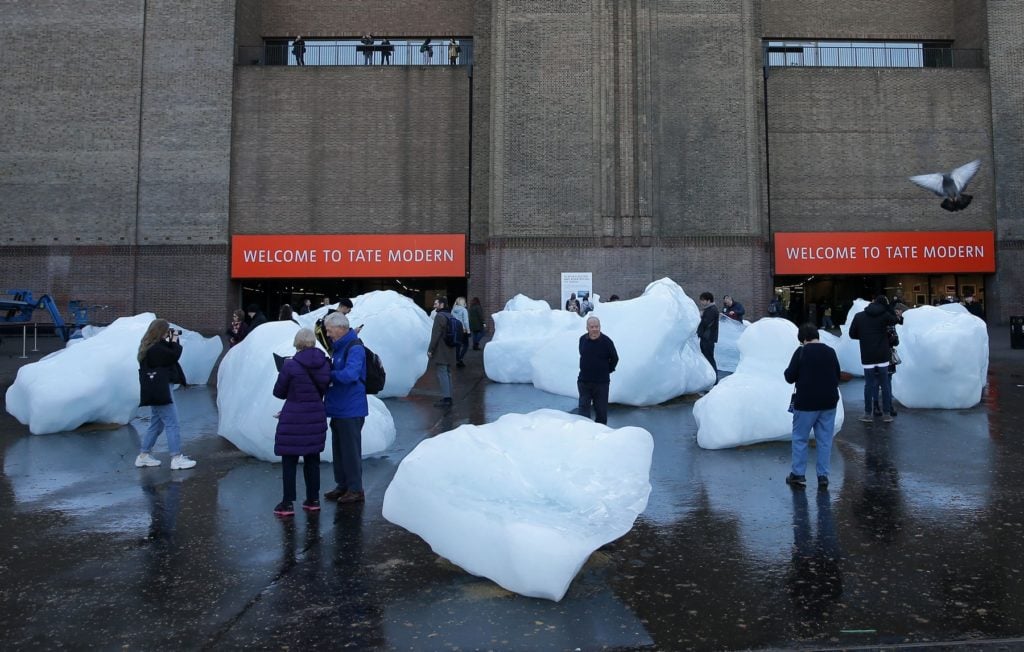
Visitors interact with blocks of melting
ice from an exhibit entitled Ice Watch created by
Icelandic-Danish artist artist Olafur Eliasson and leading
Greenlandic geologist Minik Rosing outside Tate Modern in central
London on December 11, 2018. Photo: Daniel Leal-Olivas/AFP/Getty
Images.
I’ve got a running joke in my head about how absurd all the
articles with various variations of the headline “can contemporary
art solve the climate crisis?” are. I mean, the answer is obviously
an exasperated “no.”
Raspet, an artist himself, is essentially calling time
on “eco-art” initiatives whose rhetoric depends on “raising
awareness” around climate change:
[I]t’s highly unlikely that an artwork created today will reach
a person that is unaware of the general problem of climate change,
much less change their mind about the issue (to say nothing of
their material actions). The public is well aware of the existence
of climate change and the need for it to urgently “be addressed”
(or is likely otherwise in denial and generally not amenable to
statements coded in the format of contemporary artworks). The media
already thoroughly discusses the topic on a daily basis. And
indeed, the climate itself does a far better job at producing
climate-related “content” and “raising awareness.” Despite the
multitude of climate-related artworks at the 2019 Venice Biennale,
for example, it’s undeniable that the floods in the city did far
more to make tangible the perils of climate change than any
contemporary art display.
“Spit Spreads Death: The
Parade” by Blast Theory
In the last 48 hours, the museum world has woken up to the
coronavirus crisis. Of course, “waking up” in this case means
“shutting down,” in order to deny the virus opportunity to spread
among crowds so as to “flatten the curve” of
the outbreak.
This is a massive hardship for anyone who works in the arts, and
will have cascading economic effects that I am sure everyone
reading this is already aware of (and that my colleagues are
working to report as we speak). If anyone doubts that it’s worth
the pain though, here’s a resource: the British art group Blast Theory last year did a project with
Philadelphia’s Mütter Museum, “Spit Spreads Death,”
about the origins and fallout of the century-old Spanish Influenza
pandemic in the City of Brotherly Love, the community hardest hit
by the outbreak in the United States.
The jist of it all is that Philly’s city fathers refused to act
fast to stop public gatherings for business reasons, including a
September 28, 1918 Liberty Loan Parade which triggered a
massive acceleration of the deadly flu.
The clip above is from a parade Blast Theory put on as a
memorial to the Spanish Influenza’s fallout last year—well before
it became clear just how relevant the topic of that pandemic would
be. It’s useful on its own to give an emotional sense, but there
are also more directly informational videos related to the project,
which I’ll embed below:
Further reading


Leave a comment