
What I Buy & Why: Art Collector and Dentist Kenneth Montague on His Patients’ Reactions to Seeing a Kehinde Wiley in the Waiting Room
A version of this story first
appeared in the spring 2020 Artnet Intelligence
Report.
Collector Kenneth Montague, founder of Toronto-based Word of
Mouth Dentistry and Wedge Curatorial Projects, speaks to Artnet
News about his inspiration to begin collecting and his increasing
focus on African-Canadian artists.
What was your first acquisition?
Couple in Raccoon Coats (1932) by James Van Der Zee, a
Harlem Renaissance photographer. As a 10-year old, I saw it at the
Detroit Institute of Arts, and it burned in my brain. I’d never
seen anything like it.
What was your most recent acquisition?
Tyler Mitchell’s Untitled (Hijab Couture) (2019), which
is the cover image from Antwaun Sargent’s book The New Black Vanguard.
What is the most expensive work of art that you
own?
Probably Barkley Hendricks’s Blood (Donald Formey)
(1975), which is in [the traveling exhibition] “Soul of a Nation: Art in the Age of Black
Power.” It put my collection on the map.
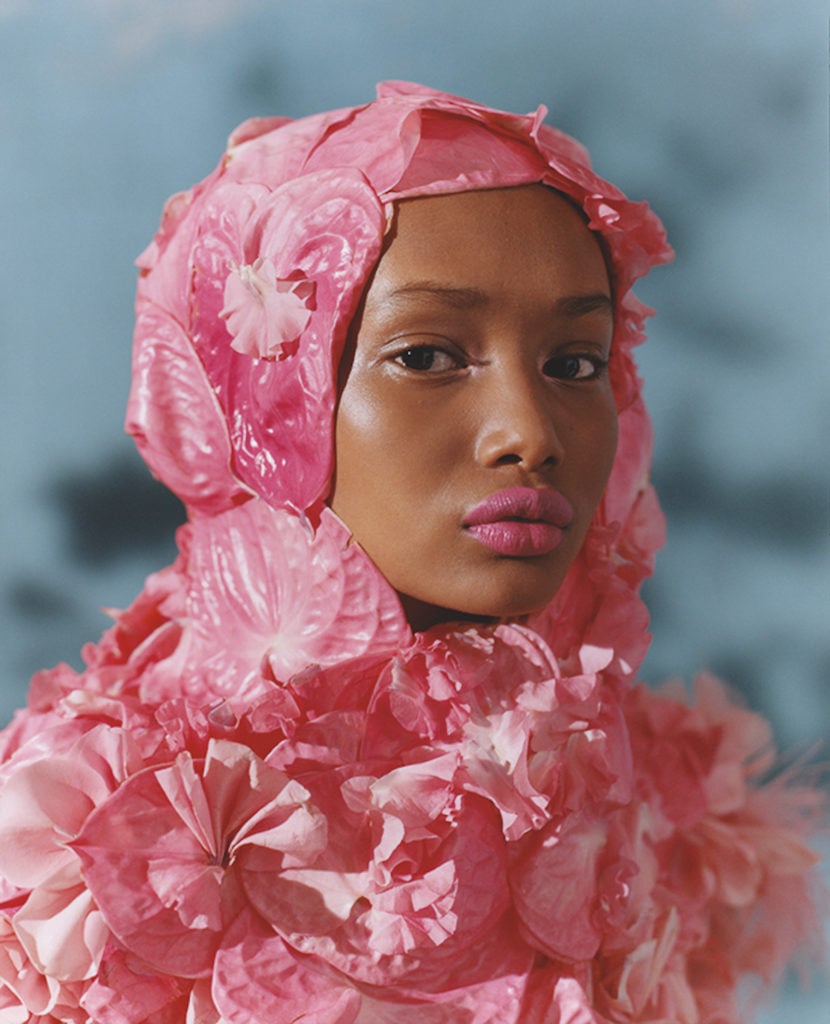
Tyler Mitchell, Untitled (Hijab
Couture), New York (2019). Courtesy of Dr Kenneth Montague/The
Wedge Collection. © The artist.
Where do you buy art most frequently?
From the artists themselves or from galleries, but always after
seeing the work at shows, biennials, or fairs. I have spontaneous
interest, but I do research. I try to get the best work, and that’s
not always the one that’s left on day two of Art Basel Miami
Beach.
Which works or artists are you hoping to add to your
collection this year?
Increasingly, my focus is on
African-Canadian artists. I’d like to get an early work of June
Clark’s for the collection, as well as one of Sandra Brewster’s new
“Blur” pieces. I also want a work by Curtia Wright, a young painter
who is part of the Black Artists Union, a collective started by a
group of recent graduates in Toronto. They’re doing really
interesting work, speaking to a younger generation about growing up
black in Canada.
What work do you have hanging above your
sofa?
Alexander Calder’s Our Unfinished Revolution (1975–76),
a set of 10 color lithographs. It was a gift from my aunt Edith
Tiger. She commissioned it from Calder as a celebration of the 25th
anniversary of her [activist group] the National Emergency Civil
Liberties Committee. She sent it to my dental office [late in her
life] with a note that said, “Here’s something special for you. Now
start collecting art!”
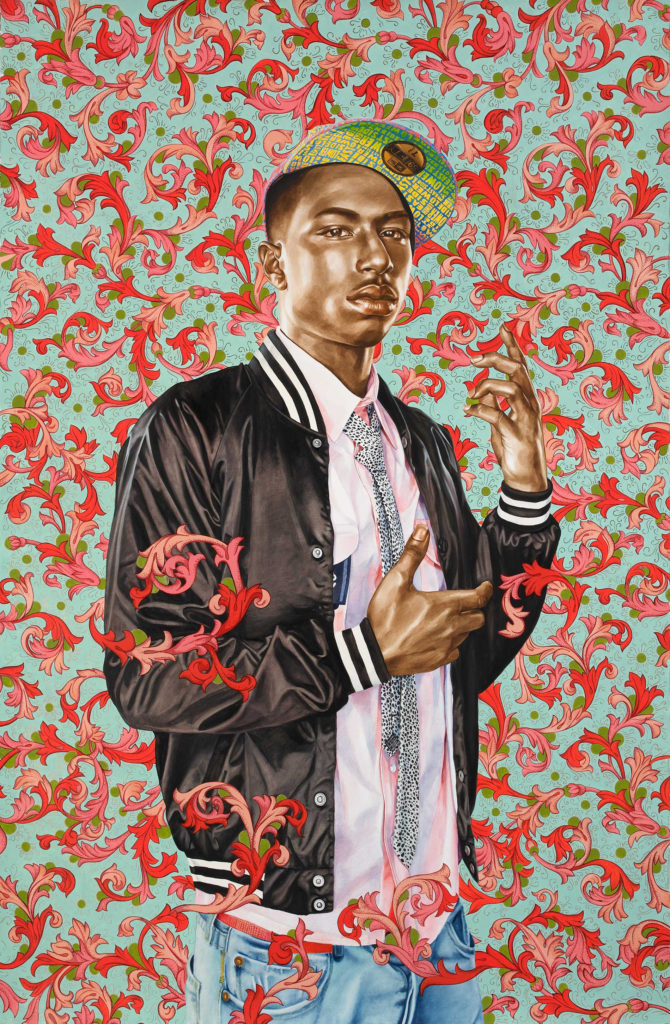
Kehinde Wiley, Portrait of Doctor
Samuel Johnson (2009). Courtesy of Dr Kenneth Montague/The
Wedge Collection. © The artist.
What artworks do you have in your dental
office?
The two most prominently displayed are a Kehinde Wiley and a set
of prints from the 1980s by Jamel Shabazz in the waiting room. No
one asked about the Kehinde for years. Now after the Obama
portrait, not a day goes by that someone doesn’t come in and ask,
“Hey, is that [painting] by the same guy?”
What work do you wish you had bought when you had the
chance?
Of the many [artists] I love and missed before the prices went
wild, Toyin Ojih Odutola is the one that still
stings. Hank Willis Thomas,
who is a friend whose work is in the collection, sent me [images
of] a few of her beautiful drawings in pencil and said she was just
out of art school, she’d been brought on at [Jack] Shainman, and I
should really look at the work. I just didn’t do the research I
typically do, and by the time I came around to it a year later, the
prices had already quadrupled.
We hear a lot about how the middle-class or
professional-class collector is a disappearing presence in the art
market, but you definitely qualify as one. Do you consider yourself
an exception, or is the characterization
overblown?
I’m a bit of an outlier in terms
of how long I’ve been doing it. I’ve been seriously collecting
since about 1997. I came out of dental school very interested in
local artists and art shows in Toronto, so it was a very organic
process in my case. I didn’t really call myself a collector until
the early 2000s, when [Studio Museum in Harlem director] Thelma
Golden, who is a friend, introduced me [at an event] as “a great
collector of black artists in Canada,” and I was like, “Oh, OK, I’m
a collector!”
I had the good fortune of
acquiring early work that very much spoke to me on a personal level
about black identity and representation. I could get an amazing
Malick Sidibé photo for $1,500. Then suddenly the art market jumped
on it, and the prices started jacking up. I’m fortunate to have had
the ability, desire, and courage to buy those works when some
people I knew were asking, “Why are you doing this?” It’s a happy
accident they went up in value.
A version of this story first appeared in the spring
2020 Artnet Intelligence Report. To
download the full report, which has juicy details on how A.I. could
transform the art industry, Inigo Philbrick’s rise and fall as a
wunderkind art dealer, and how titans of the finance industry are
infiltrating the auction houses, click here.
The post What I Buy & Why: Art Collector and Dentist Kenneth
Montague on His Patients’ Reactions to Seeing a Kehinde Wiley in
the Waiting Room appeared first on artnet News.
Read more https://news.artnet.com/art-world/what-i-buy-why-spring-2020-kenneth-montague-1803795
Further reading


Leave a comment