
Melting Ice Has Uncovered Hundreds of Ancient Viking Artifacts and a Previously Unknown Trade Route in Norway
A trove of about 800 Viking artifacts, some frozen in an icy
mountain range in Norway for more than 1,000 years, have come to
light as a result of global warming. The revelations prove that the
mountain pass served as an important part of a trade network with
the rest of the Viking world and that it was likely used to
transport goods such as cheese, butter, reindeer pelts, and
antlers between farms.
“The Viking age is one of small-scale globalization: They’re
sourcing raw materials from all over,” Søren Michael Sindbæk, an
archaeologist at Aarhus University in Denmark, who was not involved
in the study, told Science. “This
is the first site where we have good chronology and the finds to
illustrate that.”
In a melted ice patch on the mountain slopes of
Norway’s Innlandet County, archaeologists found a leather
shoe, a woolen mitten, and a tunic. There were also feathered
arrowheads, horseshoes—and a horse snowshoe—walking sticks, a piece
of a sled, and kitchen utensils.
Along the path they found stone cairns that would have marked
the way, with a stone shelter built near the top of the ice patch.
Collectively, these artifacts suggest that travelers were
commonplace in the mountains, despite their remoteness and the
harsh weather conditions.
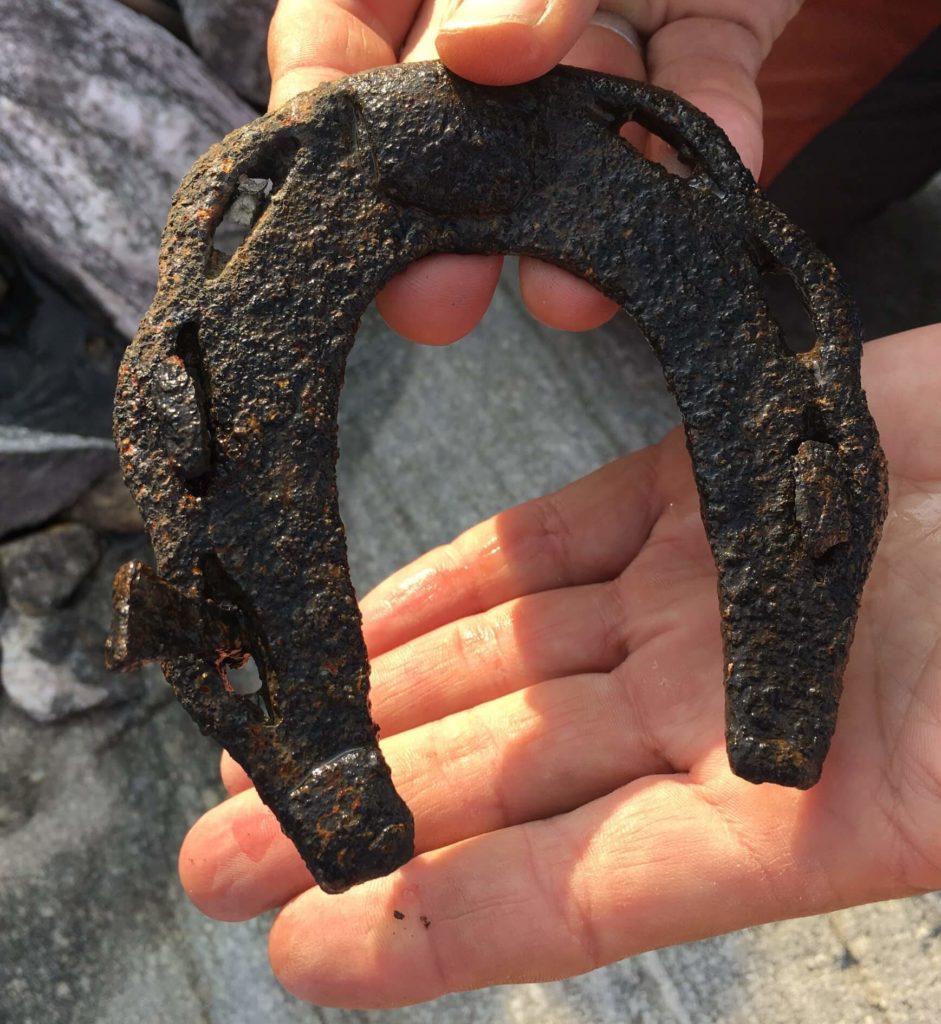
Horseshoe from the 11th to mid-13th
century, found at Lendbreen in 2018. Photo by Espen Finstad,
courtesy of Secrets of the Ice.
“It may seem counterintuitive, but high mountains sometimes did
serve as major communications routes, instead of major barriers,”
study co-author James Barrett told Science. “It’s easy to
travel at high elevations, once you get up there and there’s snow
on the ground.”
The discoveries are part of the burgeoning field of glacial
archaeology, made possible as climate change shrinks ice flows
around the world. Norway’s Glacier Archaeology
Program, led by Innlandet County Council and the Museum of
Cultural History at the University of Oslo, began research in the
area in 2006, joining similar programs in other countries in
researching the field.
The Norwegian “Secrets of the Ice” findings were published last
week in the scientific journal Antiquity. The
paper declared the Lendbreen ice patch on the Lomseggen ridge,
which has been melting rapidly since 2011, to be the “first such
ice site discovered in Northern Europe.” Previous finds of a
similar nature had only been made in the Alps.
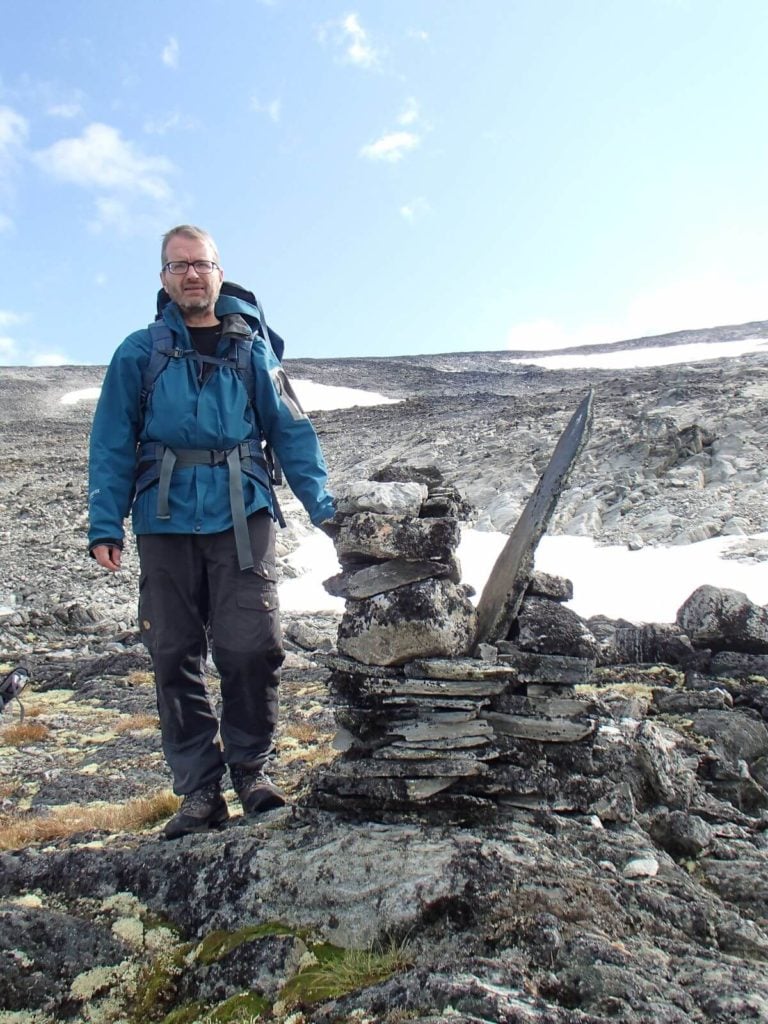
An archaeologist with one of the stone
cairns marking the mountain pass at Lendbreen. The light-colored
rocks in the background were covered with snow and ice until
recently. Photo by James Barrett, University of Cambridge.
“Past travelers left behind lots of artifacts, frozen in time by
the ice,” wrote the lead archaeologist, Lars Pilø, on the project
website. “These
artifacts can tell us when people traveled, when travel was at its
most intense, why people traveled across the mountains and even who
the travelers were.”
“It was clearly a route of special significance,” the journal
noted. The pass was in use between the years 300 and 1500 AD, and
most active around the year 1000. Its use declined with the Little
Ice Age, around 1300, and the Black Death, around 1400.
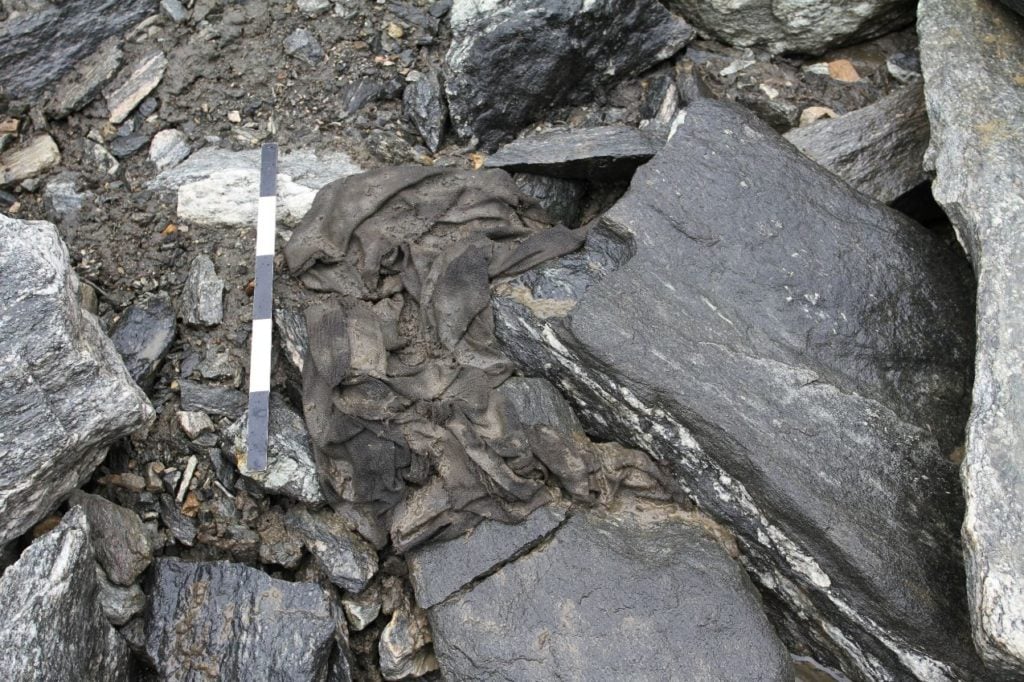
The Lendbreen tunic, which dates to the
year 300, is the oldest piece of clothing ever found in Norway.
Photo courtesy of Secrets of the Ice.
The first major evidence that humans ventured across
inhospitable mountain passes was the discovery of Ötzi the
Tyrolean Iceman in the Italian Alps in 1991. The snow and ice had
preserved the man’s body for 5,300 years, allowing scientists to
study the bacteria in his gut. What they found helped track the
movements of pathogens, and by extension, human migration.
The find “really flipped a switch,” Stephanie Rogers, a
geoscientist at Auburn University, told the New York
Times. “What was that person doing up there?… if we found
something in this place, we are going to find something in other
places.”
The post Melting Ice Has Uncovered Hundreds of Ancient
Viking Artifacts and a Previously Unknown Trade Route in Norway
appeared first on artnet News.
Read more https://news.artnet.com/art-world/melting-ice-reveals-ancient-viking-trade-route-1841139
Further reading


Leave a comment