
‘I’m Frightened, Dismayed, Disgusted’: Jenny Holzer on How Artists Can Use Outrage to Expose the Hypocrisies of Our Time
As the president of the United States contradicts his own
scientists about the global pandemic and conspiracy theorists and
politicians on both sides accuse the media of propagating fake
news, there may be no time more urgently suited for Jenny Holzer
than the present.
The public spread of ideas—both factual and fictional—has been
at the heart of the artist’s four-decade career, which launched in
meteoric fashion with the debut of her “Truisms” in the late 1970s.
The simple phrases, which appeared in public on posters and light
displays, resonated with a kind of poetic truth, but were also
vague and open to interpretation (“ABUSE OF POWER COMES AS NO
SURPRISE” and “PROTECT ME FROM WHAT I WANT” are among the most
famous).
In recent years, Holzer has more pointedly addressed the
government’s role in circulating—and concealing—information. Her
series of “Redaction Paintings,” which she began in 2006, depict
declassified national security documents to reveal just how little
they actually reveal. And her work has grown more explicitly
political in the years since. In the wake of the Parkland school
shooting in 2018, she illuminated trucks with LED-light messages
reading “FISH IN BARREL” and “SHOT DEAD AT SCHOOL.” Soon
thereafter, she rolled out a fleet of impeachment-themed
trucks.
Now, for the 50th anniversary of Earth Day, Holzer is unveiling
her latest project: a limited-edition print that revives one of her
famous Truisms—”ALL THINGS ARE DELICATELY INTERCONNECTED”—in a
cursive script.
Holzer’s gallery, Hauser & Wirth, is selling 100 of the prints
for $1,000 each, with all of the proceeds going to the conservation
group Art for Acres and the World Health
Organization’s COVID-19 Solidarity Response Fund.
We spoke to Holzer about the project, how she interprets Trump
and Andrew Cuomo’s competing coronavirus messaging, and what she
has in store for the 2020 elections.
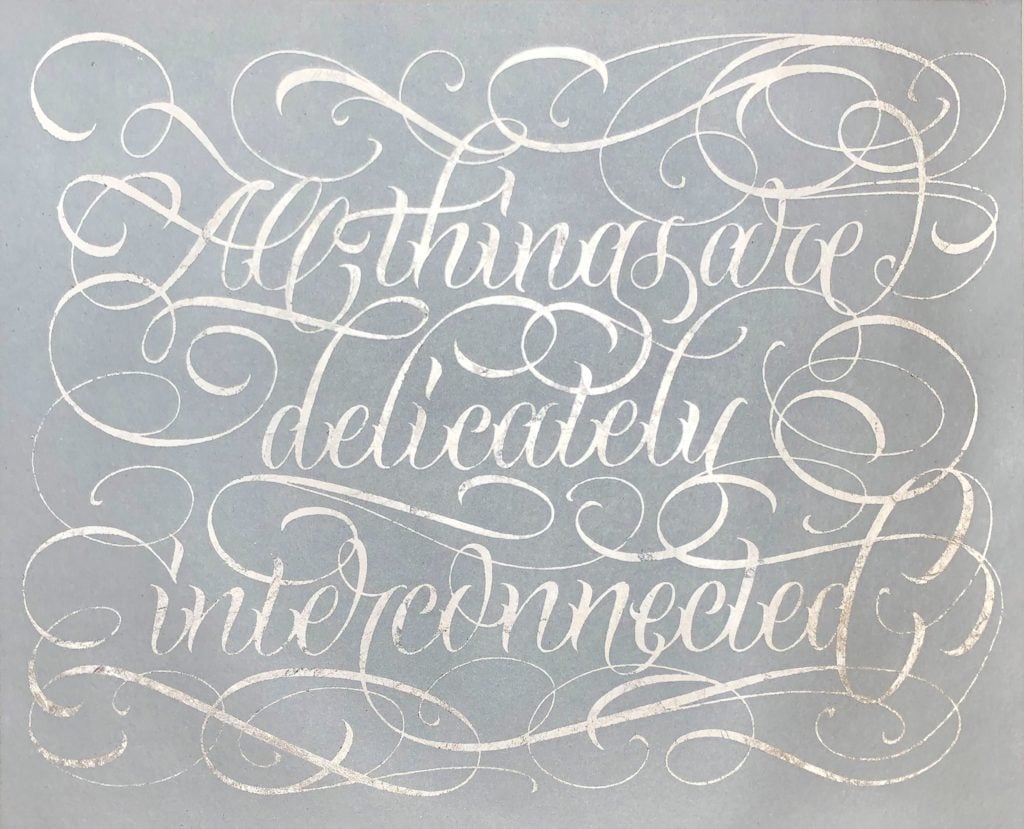
Jenny Holzer, delicately
interconnected (2020). © 2020 Jenny Holzer, member Artists
Rights Society (ARS), NY.
For your new Earth Day project, you’ve made a print of
your Truism “ALL THINGS ARE DELICATELY INTERCONNECTED.” Why did you
choose this particular phrase for this time?
It’s a kind one, so I thought it suitable. It’s a time to be
kind. I’ve been thinking about the pandemic hourly, maybe on the
half hour, and I hope this sentence works for Earth Day as
well. The purpose of this print is to give to charities
dedicated to each cause, so I was glad to find a sentence, however
dusty, that could sincerely address both.
It appears in a font that is itself delicate and
interconnected, which fits the message of course, but is a
departure from the all-caps, sans-serif fonts you’re known
for.
I always loved tattoo scripts. If I weren’t so lazy and cowardly
I would be inked all over with them, but since I never got around
to it, I thought of tattoo scripts, or a riff on scripts, for this
print. I adore sans serif fonts, but not all the time.
A lot of your works, such as the redaction paintings,
deal with information transparency and the way authorities
communicate information to the public. What do you think about the
messaging today from governments regarding
COVID-19?
I have been most impressed by [New York governor] Andrew Cuomo’s
daily briefings. He makes sense and seems thorough, thoughtful, and
questioning. It’s a good time for questioning. I’m astonished by
Trump’s performances; astonished is an inadequate word.
Do you watch them both regularly?
I hesitate to tell the truth: I watch them compulsively.
Do you think that confusion and obfuscation is part of
the point when it comes to Trump’s messaging?
Yes, I do. Trump’s recent linking of the second amendment to
COVID is reprehensible, almost surrealistic. Would that it were
only art.
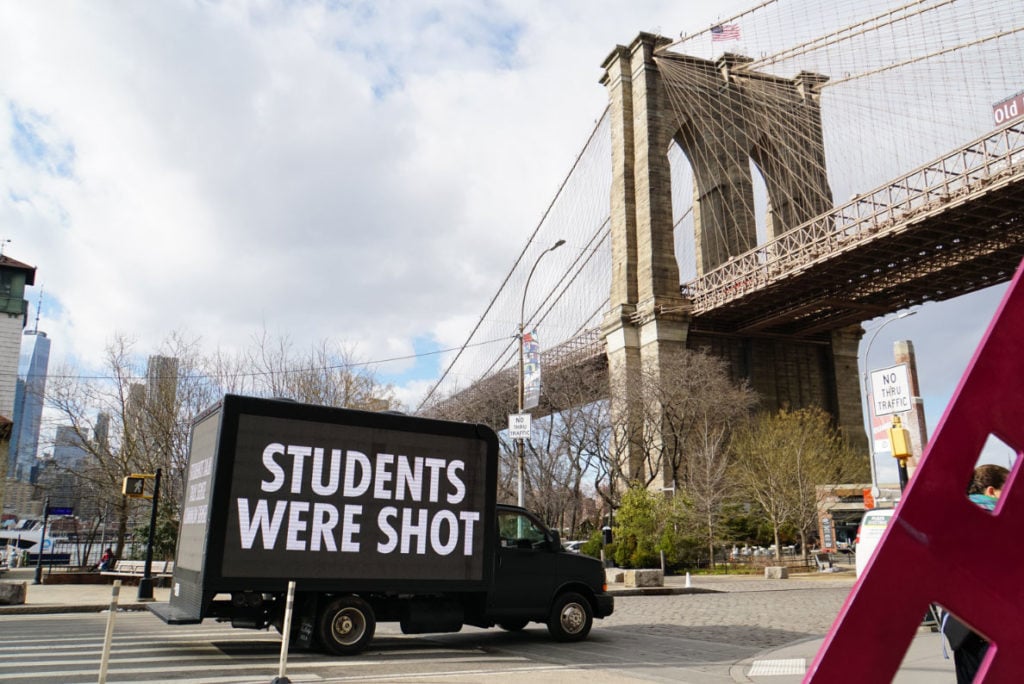
Jenny Holzer, IT IS GUNS (2018).
Courtesy of the artist. Photo: Paul Kamuf.
Are you looking at any media or other material being
produced amid the pandemic as potential fodder for your work?
You turned redacted documents during the War
on Terror into paintings. It seems like there are so many parallels
to the information omissions we’re seeing now.
I want to do something for the election that may or may not be
art. It doesn’t matter if it’s art. We’ve been practicing by
putting messages on LED trucks and sending them around the country,
starting after the Parkland shootings and continuing for World AIDS
Day and also the midterm elections. What’s going on with the
pandemic and what’s going on in the world at large should—must—play
on election day. I appreciated what was mentioned in a
recent New York Times
piece, that election day should be Earth Day and Earth Day should
be election day.
At a time of so much obfuscation, double talk, and fake
news, what role do you think artists can play in highlighting
facts?
Artists are good at reflecting what’s around, and this is a time
for reflection and reflecting if there ever was one. We’ll
have hundreds of thousands of people dying. To your obfuscation
question, lying has become a chronic condition—maybe a preexisting
condition! Isn’t it sad that a germophobe hasn’t given us
protection? Wouldn’t it be good if his feelings about cooties would
yield merciful and effective policy?
Well he would have to experience empathy for that,
no?
Yeah, but it would also be pragmatic to do so. I’ll take
pragmatic, however chilly.
Have you had projects and shows canceled or put on
hiatus during this time? How has the pandemic affected your
career?
All sorts of things have been canceled or postponed. So be it.
The Beyeler in Basel was to have a once-in-a-lifetime Goya show
with a companion group exhibition of contemporary art [of which
Holzer is a part]. It will still happen later, but seeing Goya now
would be… accurate. I’ve been looking at Goyas since I was 20 or
21, making pilgrimages to the Prado to learn what I could, so the
fact that this exhibition has been slowed makes me sad.
I was going to ask if there’s any work from art history
that you think would be apt to consider in this time. Is there
anything that comes to mind besides Goya?
I ran across a Dada quote just this afternoon that’s dandy—I
think we might look at Dada for some dark comic relief, and some
realism. Dadists felt dark things stirring and they were accurate.
It’s from Hugo Ball, 1916: “A Dadaist is convinced of the
interconnection between all beings and things.” I didn’t even know
that quote until this afternoon. That was the little joy toy of
today.
Now that we’re becoming more reliant on new channels of
communication like VR, Zoom, and social media, are you optimistic
that it will create greater opportunities for artists to share
their work, and audiences more access to art? Or do you see
limitations to these technologies?
Well, those are worth trying. It’s something to do meanwhile,
and I’m sure some people for whom it functions will make wonderful
things. For others it will pale in comparison to being
face-to-face, nose-to-nose, imagining, touching gooey, maybe
smelly, regular art.
You’ve embraced new technologies throughout your career.
Have you been experimenting with anything lately?
I wanted to mess around with VR more, but I just can’t deal with
the gear. I don’t like stuff on my head and being blind. I’ve been
more intrigued by, and I’ve started working with AR because you can
see largely unencumbered. I want the ability to make and fake light
projections without getting permits. Everybody is glued to phones,
so that’s where I’d like to be—you know it’s the old street artist
impulse to be where people are, gone to phones.
How do you envision that happening?
In 2017, we had an exhibition at Blenheim Palace in the UK, and
for a couple weeks we had real projections on the palace with texts
from exiled poets and [the aid organization] Save the Children and
from wounded British veterans, for example. The palace was a war
prize so we wanted to show war from the side of soldiers and
civilians, not just “glorious victory.” Those real projections
could only be seen for a limited time and at night, and we wanted
them to last for the whole exhibition. We made it so you could go
with your phone, point it at the palace, and view the content in
projection at any time of day. That experiment encouraged me.
We’d like AR to be a part of the election project that I hope we
cook up. All kinds of people around the country could speak about
what’s important to them, what they love most, what they fear, what
they believe must happen, and we can give them a means to
communicate all that to others.
Through AR?
Yeah, through AR as well as with our little LED trucks and
messages. These trucks usually are employed for advertising, but we
launch them to get out the vote and for driving messages like
“ABJECT SENATE” during the impeachment hearings. I was proud of
“ABJECT SENATE.” That’s succinct.
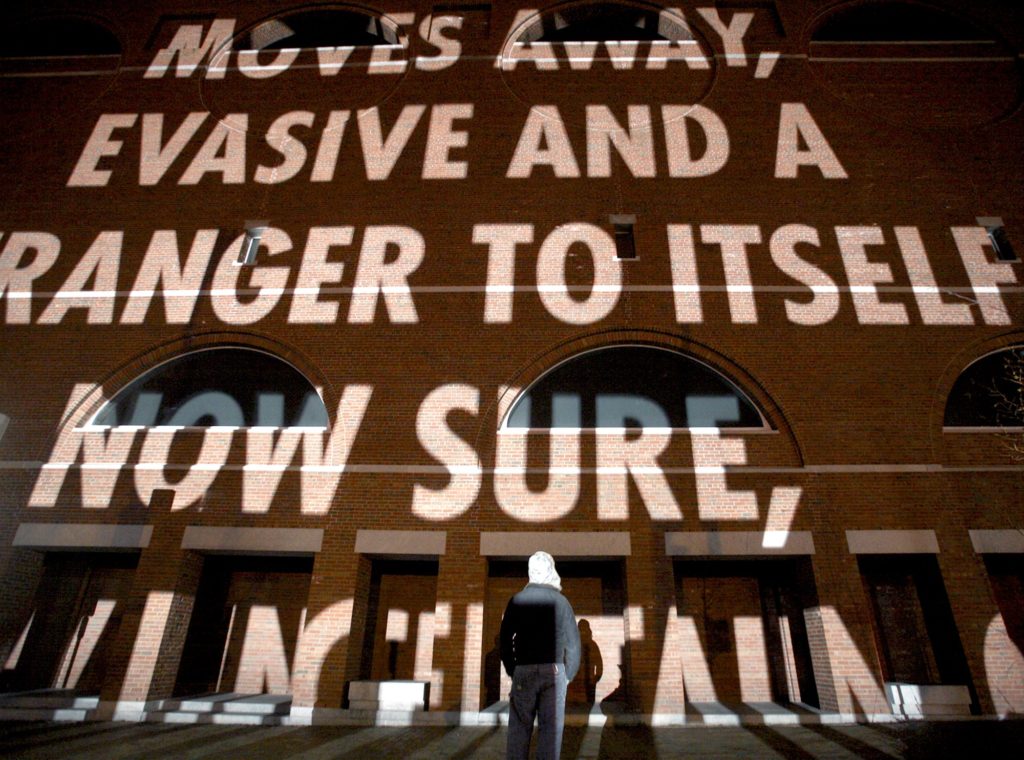
Jenny Holzer from poet Wislawa
Szymborska on the outside of the Portland Museum of Art in
Portland. Photo by Tim Greenway/Portland Press Herald via Getty
Images.
Are you endorsing any candidates?
I find it most effective to present what we the people are
thinking rather than have an endorsement dismissed as simply
partisan. But it’s safe to say I won’t be trucking for Trump.
It seems clear that the world is going to be inevitably
altered when we get to the other side of this pandemic. What
changes do you hope might happen in the art
world?
I’m not so much worried about how the art world will change.
Let’s concentrate on how more people might stay alive and not
suffer unnecessarily. My grandfather was a doctor and my
grandmother was a nurse, so I tend to be more respectful at times
of people who literally help than those of us who meta help‚ though
it takes all sorts.
When your Truisms first came out in the 1970s, many saw
them as bringing a much-needed social and political consciousness
into the navel-gazing art world of that era. But the messages then
were more oblique compared to those you’re using now, which focus
more on identifiable events in the news. Was this an intentional
shift?
I have been shifted and worse by Trump. I didn’t wake up in the
morning and say, ‘Boy, do I hate paintings.’ I’m frightened,
dismayed, disgusted, and many more such words. So recently, at
least, it has made sense to be explicit. That said, in my downtime
I’m making utterly inexplicable watercolors that look like Kusama
on a bad day, on top of the pages of Jeffrey Epstein’s address
book, so go figure. I do have an attachment and claim to the
irrational.
I almost forgot about Epstein with everything else
going on right now, but speaking of obfuscation and
coverups…
But we shouldn’t forget. Were there ever a monster, he would
qualify. And I think there’s more to come, speaking of declassified
or at least secret material. I’d like to know more, sooner, in a
bleak kind of way. It’ll be a while perhaps, given the players, but
it’ll land. Meanwhile, I’m staining the address book. Trump
features—his section of the address book is big, Melania is there,
too. We have the redacted address book and the unredacted one.
How did you get the unredacted one?
Somebody knew somebody who knew somebody.
Is this something you would show?
Yes, if my art part of it ceases to be quite as embarrassing as
it is now! We had a few of the watercolors in a show Switzerland in
the winter—a few of them leaked, so to speak. But I’m going to hold
off on showing more until I become a better artist.
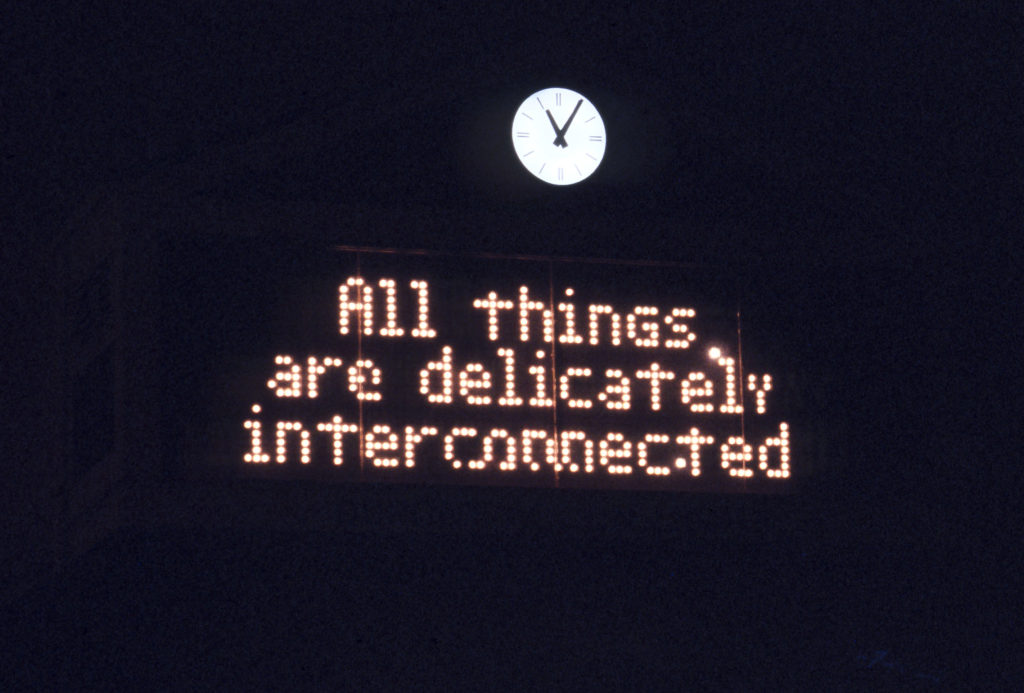
Jenny Holzer, from “Truisms” (1977-79),
1986. Installation: In Other Words, Duopont Circle, Washington DC.
© 1986 Jenny Holzer, member Artists Rights Society (ARS), NY Photo:
Tom Loonan.
A colleague of mine pointed out that two of the Truisms
that seem to be resonating and circulating right now are “RECLUSES
ALWAYS GET WEAK” and “SOLITUDE IS ENRICHING,” which seem somewhat
contradictory. How do you reconcile those?
I don’t reconcile them. The Truisms were written from many
viewpoints as I tried to sort out what I believed and attempted to
portray what other people think, to make a survey of beliefs. There
are all kinds of Truisms that are contradictory. But those two
lines about isolation could be true simultaneously for different
people, or at different moments in time for individuals.
Have you seen other ones making the rounds lately or
resonating?
I don’t look much as searching is inherently embarrassing. I’m
glad the sentences have some reverb though, returning to my guilt
about being not as useful as my medical grandparents.
So you have artist guilt about being a non-essential
worker?
Yeah, I have non-essential wacko guilt.
How do you feel about your Truisms taking on new life as
political slogans today? For example, “ABUSE OF POWER COMES AS NO
SURPRISE” became a hallmark of the art world’s #MeToo
movement.
I’m largely flattered. The only thing that worries me is that
notion that people make their best work in their 20s. That’s a bit
of a worry, but as long as some people remember the series as a
whole, that it was a collection, I’m OK with certain ones having
exciting second lives.
The post ‘I’m Frightened, Dismayed, Disgusted’: Jenny Holzer
on How Artists Can Use Outrage to Expose the Hypocrisies of Our
Time appeared first on artnet News.
Read more https://news.artnet.com/art-world/jenny-holzer-interview-1840491
Further reading


Leave a comment