
The Gray Market: How a Work-From-Home Revolution Will Change Galleries’ Relationships With Their Landlords Forever (and Other Insights)
Every Monday morning, Artnet
News brings you The Gray Market. The column decodes important stories from the
previous week—and offers unparalleled insight into the inner
workings of the art industry in the process.
This week, examining where
galleries would stand after a seismic urban realignment…
REAL ESTATE OF THE UNION
On Tuesday, Matthew Haag of
the New York
Times considered the
consequences a possible work-from-home revolution would have for
the city and state of New York. Although his analysis begins in real estate,
it soon expands to include such foundational elements of
metropolitan life as public safety, transportation, and
sanitation—all of which could be starved for public funding if
enough employers downsize or eliminate their New York office spaces
(and the associated tax bills that come with them). And while these
changes would affect every industry to varying degrees, few
others—and possibly none—would be affected in quite the same way as
the gallery system.
Zooming out from New York for a
moment, Big Tech has been leading the charge toward long-term
remote work in the broader US since the start of the shutdown.
Facebook and Google recently announced they will permit employees
to work from home for the remainder of 2020. Twitter
did them one better, as CEO Jack
Dorsey informed staffers on Tuesday that, with the exception of
those responsible for maintaining data servers or other physical
assets, employees can telecommute permanently. (Note: It is not
especially clear to me where the boundary lies between “can” and
“must” here.)
Although each of those tech
Goliaths has had a New York office for years, the majority of their
staff was siloed at their respective Bay Area compounds prior to
the crisis. Haag instead focused on a group of executives at
several major employers headquartered in Manhattan, most notably
from within the finance industry.
JP Morgan Chase already notified
its approximately 180,000 employees that it was, in Haag’s words,
“reviewing how many people would be allowed to return” to its
offices even after the shutdown lifts. Barclays and Morgan Stanley
have not gone that far yet, but Barclays CEO Jes Staley went on the
record to say that “the notion of putting 7,000 people in a
building”—which the bank has been doing near Times Square for
years—“may be a thing of the past.”
Even if this potential
work-from-home reckoning were to stay confined to high finance, its
effect on New York real estate would still be colossal. JP Morgan
Chase, Barclays, and Morgan Stanley together lease
more than 10 million square feet of
office space in Manhattan.
That sum equals “roughly all the office space in downtown
Nashville,” according to Haag.
But since finance and tech have
become the entrepreneurial paradigms for an increasing number of
industries worldwide over the last four decades (including the arts), you’d better believe that if Wall Street and
Silicon Valley start riding the wave of large-scale remote work for
the long term, others will join them ASAP. And that would put
galleries in a unique position in New York and around the
world.
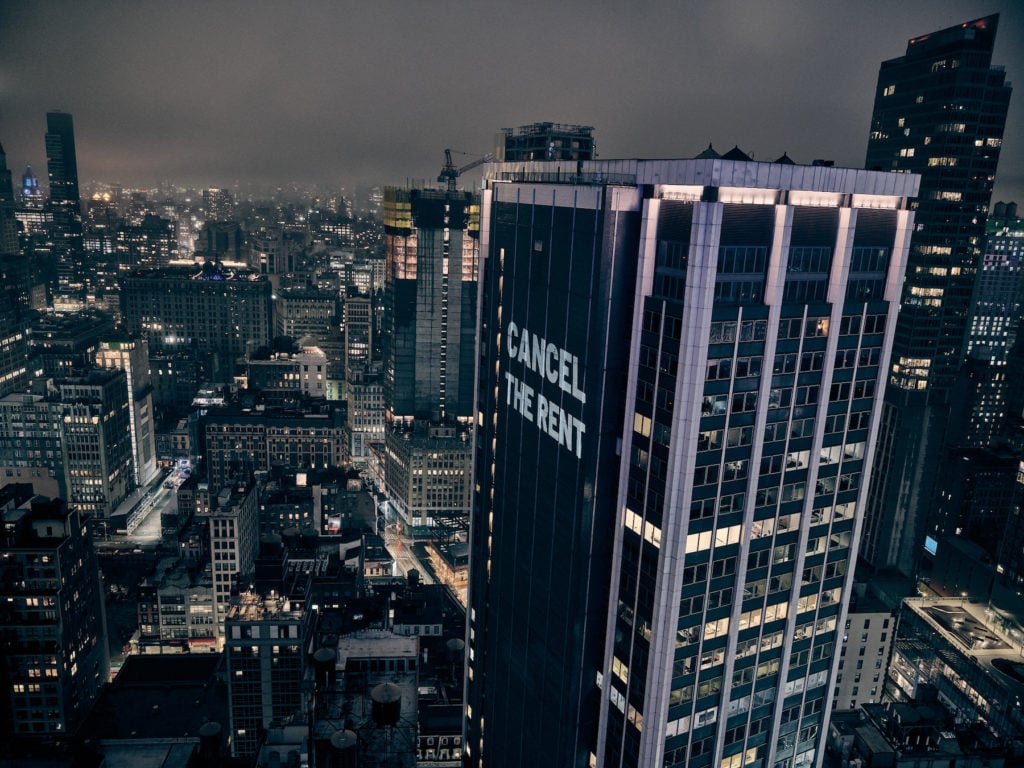
The Illuminator projects the “Cancel the
Rent” message on Saturday, March 28, in Manhattan. Image courtesy
the Illuminator.
TAKE IT OR LEAVE IT?
Since the world’s developed
nations transitioned from being primarily manufacturing economies
to primarily service-and-information economies starting in the
1990s, crises have forced decision-makers at almost every company
to ask the same cost-conscious question: How much of my business
genuinely demands gathering staff and/or clients into a communal
physical space?
In more and more cases in every
year since, the answer has landed somewhere between “not very much”
and “basically none.” This answer has also taken on even greater
importance in light of the distressing
spike in real-estate
prices, which have doubled in the US since 2000 (and made rent relief a central
issue in the current crisis). No wonder we’re now at a point where
some of the biggest firms in some of the world’s biggest cities are
weighing dramatically reducing their real-estate footprint, if not
erasing it almost entirely.
Assuming they do—and as I
wrote
a few weeks ago, I rarely bet
against companies doing whatever benefits their bottom line
(especially once their execs start openly discussing it with the
press)—their choice unquestionably strengthens galleries’
negotiating positions on rent once the crisis starts to fade.
Millions of square feet of real estate would become tenant-less not
just in Manhattan, but in major art hubs across the globe. Prices
would plummet as a result of the broader commercial exodus,
granting dealers more leverage on their leases than they’ve had in
years.
Of course, plenty of galleries
won’t manage to survive the crisis at all. But those who do should
be able to either favorably renegotiate with their landlords on
their existing spaces, or upgrade to a new home base for the same
amount (or possibly less) than before. Similarly, new galleries
should be able to set up shop at rates that many of their forebears
would have agreed to wire-walk between office towers for the
opportunity to lock in.
None of this is revolutionary
thinking on my part. However, it’s worth highlighting that this
seemingly obvious benefit carries with it an asterisk the size of
an asteroid.
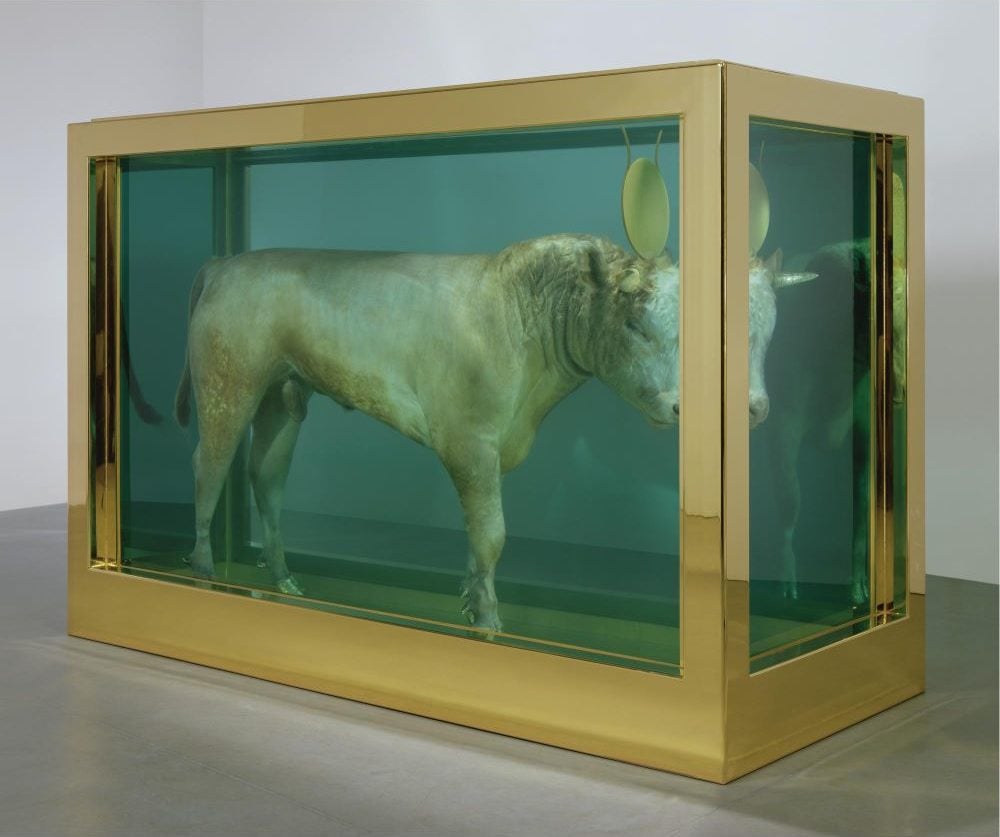
Damien Hirst, The Golden Calf
(2008). Image courtesy of the artist and Sotheby’s.
PRISONERS OF WEALTH
Although galleries and auction
houses in Europe and Asia are beginning to open again, it remains
unclear when their counterparts here in the US will be allowed to
stir their physical spaces out of state-mandated shutdown. In the
interim, their forced march into exhibiting exclusively online has
reinforced the enduring vitality, if not the near necessity, of the
IRL art experience.
Yes, online sales are
increasingly
common and
increasingly
lucrative for dealers.
But most artists still want to show their work in a physical space,
and most enthusiasts still want to see it there at least some of
the time. These preferences
plunge galleries into the shrinking pool of businesses who stand to
lose something major by opting out of brick-and-mortar locations.
And unlike for so many white-collar firms, it’s important that
those locations still occupy relatively desirable neighborhoods in
premier cities.
When it comes to metropolitan
real estate, then, galleries remain a somewhat captive
client.
Sure, there will always be a
handful of dealers who can draw collectors, curators, and other
power players to more remote neighborhoods within art capitals, or
even to locations outside them. I always remember Jeffrey
Deitch, all the way back
in 2015, talking about how he was “more stimulated by the
experience of going into this alley behind the liquor store [on the
Lower East Side] to get to Ramiken Crucible” than by almost
anything else on the art scene, including the gleaming blue-chip
galleries in the poshest neighborhoods. Art fairs (remember those?)
like NADA Miami and Liste also regularly include respected dealers
based in non-art hubs like Athens, Georgia and Cluj-Napoca,
Romania.
But the number of successful
galleries situated off the beaten path is small, and their
prospects for both visibility and long-term sustainability remain
questionable. Accessibility and density matter in the gallery
sector. You can entice die-hards like Deitch to go on an urban
scavenger hunt for one special space, but otherwise, galleries
cluster together into the most attractive districts they can afford
for a good reason: they want to be as close as possible to where
buyers want to spend the rest of their time.
Even if millions of square feet
of office space change hands or go vacant, the average
high-net-worth individual is still going to want to live in premier
cities like New York, London, and Los Angeles rather than moving to
the suburbs. This is partly why it was laughable that
Amazon’s infamous
nationwide contest for HQ2 would end anywhere other than where Jeff Bezos,
newly single and newly crowned the world’s wealthiest man,
would want to be based
himself.
Remember, most New York
collectors blanched at crossing into Brooklyn or Queens even before
anyone outside of the healthcare industry had ever heard the ‘c’
word. The challenge will be even starker now that the very act of
leaving your home feels like the climactic sequence in a zombie
apocalypse flick.
All of the above means that
you’re unlikely to see a slew of Lower East Side galleries move to
the outer boroughs, let alone New Jersey or Connecticut after the
crisis fades. The same is true in every other art capital around
the world. Landlords know this as well as I do, which puts a
distinct handicap on dealers’ negotiating power even if Manhattan
becomes a corporate wasteland.
It’s impossible for me to say
how much leverage galleries would ultimately gain from a mass
corporate migration away from cities. At a certain point, their
priority to stay metropolitan will counteract the strength provided
by all those empty office towers. But wherever equilibrium would be
in this new vision of real estate, the process of getting there
would once again prove that, in the 21st century, the art market
remains an industry unlike any other.
That’s all for this week. ‘Til
next time, remember: the only constant is change.
The post The Gray Market: How a Work-From-Home Revolution
Will Change Galleries’ Relationships With Their Landlords Forever
(and Other Insights) appeared first on artnet News.
Read more https://news.artnet.com/opinion/work-from-home-real-estate-1863447
Further reading


Leave a comment