
How Art History Can Help Explain the Renaissance of Conspiracy Theory That Is Defining Our Time
This is the second part of a two-part essay on conspiracy
theories. The first part is here.
Earlier, I looked at how “conspiracy thinking” could be made
sense of in relation to a broader spectrum of thought. In this
part, I want to look more narrowly at what recent art trends can
tell us, by analogy, about the appeal of conspiracy theory.
Magical Thinking
This is really the most elementary point, but it must be said
anyway: From the sinking of the Battleship Maine to the Tuskegee
Syphilis Experiment to the Jeffrey Epstein sex ring, history
provides unrelenting testimony to the fact that whatever dark
thoughts you have about what goes on behind the scenes with the
wealthy and the powerful, the truth is likely worse, much worse.
Real conspiracies are the soil in which “conspiracy theory”
grows.

February 17, 1898 headlines in the
William Randolph Hearst-owned New York Journal. Image
courtesy Wikimedia Commons.
The latter term, though, is conventionally used dismissively to
reference what other people believe. Yet it turns out that
no community really has a lock on conspiracy thinking.
Reams have been written on the circulation of conspiracy
material in hip hop. Travis L. Gosa argues that all
the New World Order, 9/11 Truther, and Illuminati references (among
many others) in hip hop respond to the real experience of racist
oppression, flow from the scene’s emphasis on ground-level
experience over “experts” associated with a hostile system, and,
most intriguingly, that dabbling in the “cultic milieu” is actually
part of how the music maintains countercultural cachet in the face
of commodification.
In a very different register, it is quite clear that enlightened
MSNBC liberals are not immune to the allure of a good conspiracy.
Last year, I wrote an essay on an astonishingly improbable
theory that was then gaining traction that
Leonardo’s Salvator Mundi was sold as part of a plot
by the Russians to aid Donald Trump.
I want, however, to focus on a different example, specifically
because it points to some of contemporary art’s best capacities for
grasping unfamiliar ways of thinking.
In an essay I wrote and
on a podcast I spoke on
for this site, I have spent a lot of time picking over a virulent
online conspiracy theory that performance artist Marina Abramović
is at the center of a vast cabal of Satanists who control the
entertainment industry. These theories seem to me horrifying (not
to mention, if you scratch the surface at all, steeped in dangerous
misogyny).
There is, however, just one inconvenient factor that I’d have to
reckon with, were I to try to make this case to a public beyond the
art audience. And that is the fact that the art world quite
clearly is in the grips of a romance with the occult—not a
Satanic, baby-eating orgy behind the scenes, but a flirtation with
New Age revelation, right out in the open.
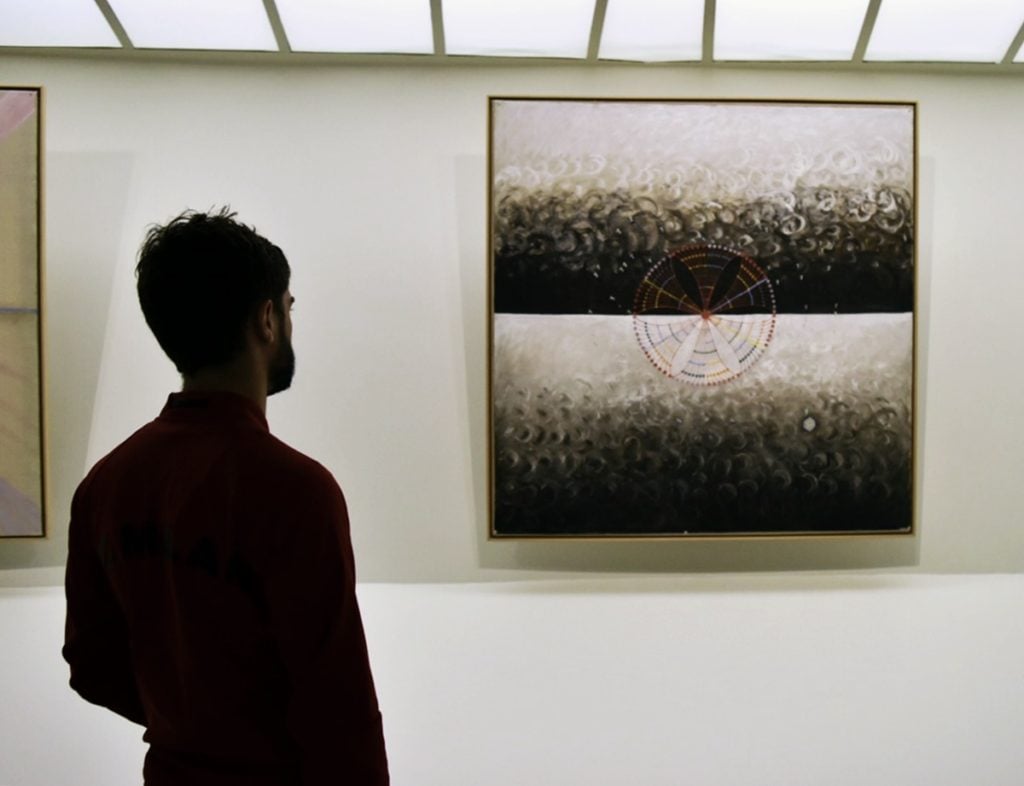
Installation view of Hilma af Klint at
the Guggenheim. Image courtesy Ben Davis.
The Occult Truth
This vogue has been one of the defining trends of recent years,
with immense museum crowds turning out for shows of Victorian
spiritualist Georgiana Houghton in London and Swedish mystic Hilma
af Klint in New York. It was quite literally the last thing I wrote
about before lockdown began, via the subject of the Whitney’s
spotlight on Agnes Pelton, the “desert transcendentalist” who
believed she communicated with spirits through her airy, odd,
semi-abstract paintings.
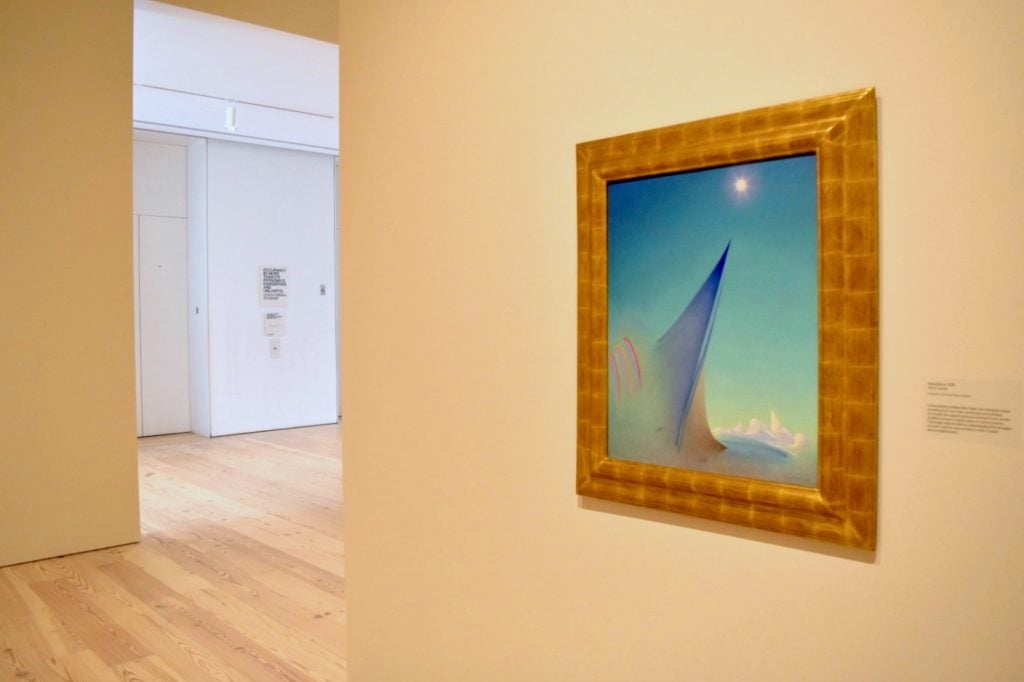
Agnes Pelton, Resurgence
(1938). Image: Ben Davis.
Pelton was, among other things, inspired by the Agni Yoga
doctrine of Helena and Nikolai Roerich. A burning-eyed portrait of
Nikolai was an unsettling note in the otherwise ethereal Whitney
show, and another painting may have been of Helena, who claimed to
channel otherworldly wisdom directly from the spirits. Nikolai was
a fascinating figure, a painter and set designer (he did the
scenography for Stravinsky’s “Rite of Spring”), who was also an
adventurer and mystic.
His association with Henry
Wallace, FDR’s 1940 VP pick and the ultimate New Deal true
believer, touched off a minor political scandal when foes
threatened to leak his adoring correspondence with the guru to the
public—a distant echo of the #SpiritCooking scandal
that snared Abramović and John Podesta in 2016.
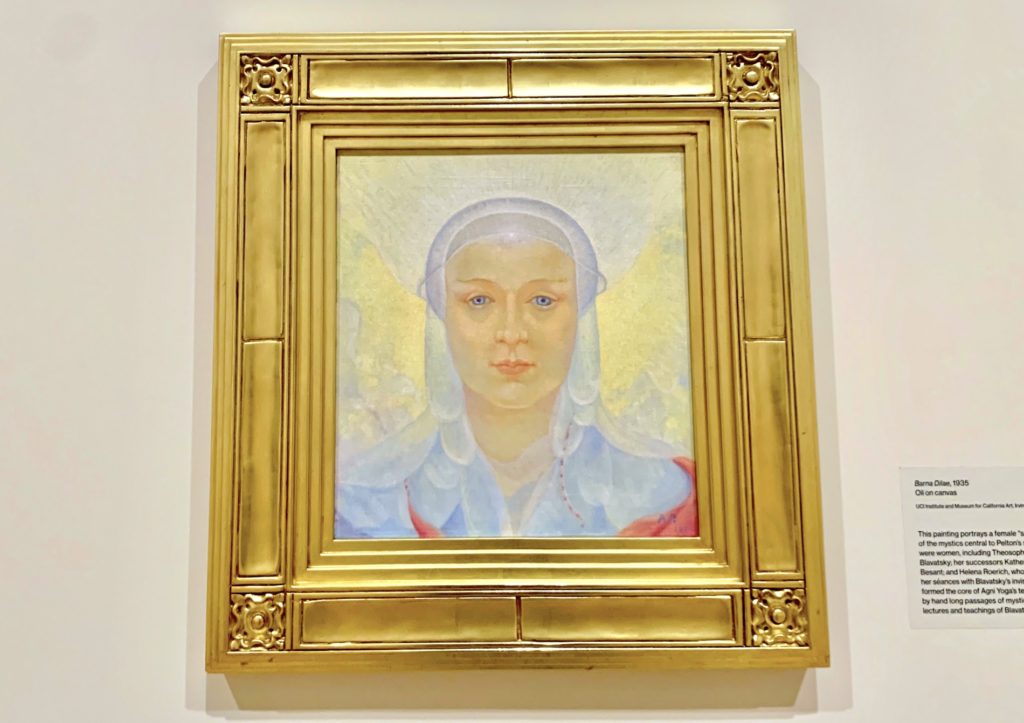
Agnes Pelton, Barna Dilae
(1935). Image: Ben Davis.
The press on such museum shows tends to water down what these
various artists actually believed into some vague,
Instagram-friendly “spirituality” for popular consumption, rather
than getting too into the weeds of what they believed. But in
general, one has to think that the popularity of this rediscovered
mystical art is very much on account of, not in spite of, its
promise of esoteric meaning. The Occult Turn in art is just one
expression of a much larger recent popular turn towards alternative
spiritualities and witchcraft, with sales on “mystical services”
reaching $2.2 billion
in 2018.
When critic and art historian Eleanor Heartney recently
explained the surging appeal of magical art, her
explanations were pretty much the same as the explanation I gave
for the appeal of conspiracy theory in part one of this essay:
a generalized sense of hopelessness about the social order that
leads to a hunt for new narratives of empowerment; a feeling of
encroaching chaos that amplifies the appeal of alternative codes of
meaning to give an order to it all; a disenchantment with soulless
commercial culture that leaves people looking to attach themselves
to the romance of secret knowledges.
Astrology functions, if you think about it, very much like the
revelation of a cosmic conspiracy. It is replete with esoteric
graphs and charts, a sense of meaning both universe-spanning and
intimately concerned with your personal affairs, and the revelation
that behind the fluctuations of history there are just a few
immutably repeating archetypes.

R. H. Naylor’s horoscope for Princess
Margaret from the Sunday Express. Image via Wikimedia
Commons.
The first newspaper astrology column, “What the Stars Foretell
for Princess Margaret” by R. H. Naylor,
appeared in 1930 in Britain’s Sunday Express—a time
when the traumatizing global fallout of Wall Street’s sudden
collapse gave the ability to foresee the future a particular
appeal. As one account puts it: “The early horoscopes
read more like Nostradamus than Dear Abby. Astrologers worried
about political events, about war, famine and pestilence.”
Last year, writing in the New
Yorker, Christine Smallwood quoted an astrologer on the
surge of interest in star science following the 2008 crash: “All of
those structures that people had relied upon, 401(k)s and
everything, started to fall apart. That’s how a lot of people get
into it. They’re like, ‘What’s going on in my life? Nothing makes
sense.’”
The 2016 election intensified these energies. “In the Obama
years people liked astrology. In the Trump years, people need it,”
another astrologer told Smallwood. That energy is likely to swell
further now, at a time when we are suffering a “global narrative collapse,”
and the sudden plunge into the darkness leaves massive numbers of
people looking for any light to guide them to safety.
Master Narratives
Two years ago, the Metropolitan Museum Art’s “Everything Is Connected: Art and Conspiracy,”
curated by Douglas Eklund and Ian Alteveer, stands out as an
attempt to look at recent art history through the theme of
conspiracy theory. It was received in relationship to the shock
electoral triumph of birther enthusiast Donald Trump and talk of
the “post-truth” condition. But the show was
inspired by a challenge from the late LA artist Mike Kelley, bard
of all things traumatic and cast-off.

Kelley, Educational Complex
(1995), seen in “Everything Is Connected.” Collection of Whitney
Museum of American Art, New York.
“I don’t think that there’s anybody in the academic world who
will even go near conspiracy theory at this point,”
Kelley remarked in the 1992 interview. “Once
it starts to become obvious how it is a motivating factor in real
life, then people will start to write about it as a mythology or an
ideology.”
The early ’90s was a telling moment to open a conversation on
the subject. The Cold War had just ended. Very serious people were
talking very seriously about the “end of history“: there
were no more big ideologies to motivate people; left and right
could converge in a “Third Way” era of technocratic government;
globalization and neoliberalism would continue unfolding forever
with a logic so ironclad that it didn’t even really have to explain
itself. In art and in the academy, this was the high water mark of
“postmodernism,” which arrived as a philosophical admission of the
“Death of Master Narratives.”
Kelley had a wonderful antenna for all that was repressed by a
middle-class culture of consumption and respectability and
disembodied intellect, and how it tended to return in displaced
form with an eerie, intensified power (his reflection on conspiracy
theory actually appears, somewhat out of the blue, between
reflections on how the term “folk art” conceals conservative
ideology and how dolls are monstrous if you really look at them).
He correctly predicted a flourishing of interest in conspiracy
theories, which would be emblematized by the pop-culture sensation
of the X-Files, which launched
the next year.

Gillian Anderson and David Duchovny in
promo image for The X-Files.
Well, conspiracy theories are, exactly, “master narratives.”
They imagine the broken pieces of the world as a puzzle that
promises revelation, if you just piece it together. And the
increasing sway they have had on public life up to the present can
be seen as the return of the repressed when it comes to ideology—if
the technocratic centrists don’t offer a story, or the story they
do offer doesn’t reflect emotional reality for a large
number of people, then a story that makes sense of that
reality will be invented.
Conspiracy Criticism vs. Conspiracy
Critique
The Atlantic has just put out an entire “Conspiracy
Theory” issue. Adrienne LaFrance’s cover story argues
that the QAnon-inspired belief that Donald Trump is locked in a
secret war with a deep state cabal of child molesters is on its way
to becoming something like a religion.
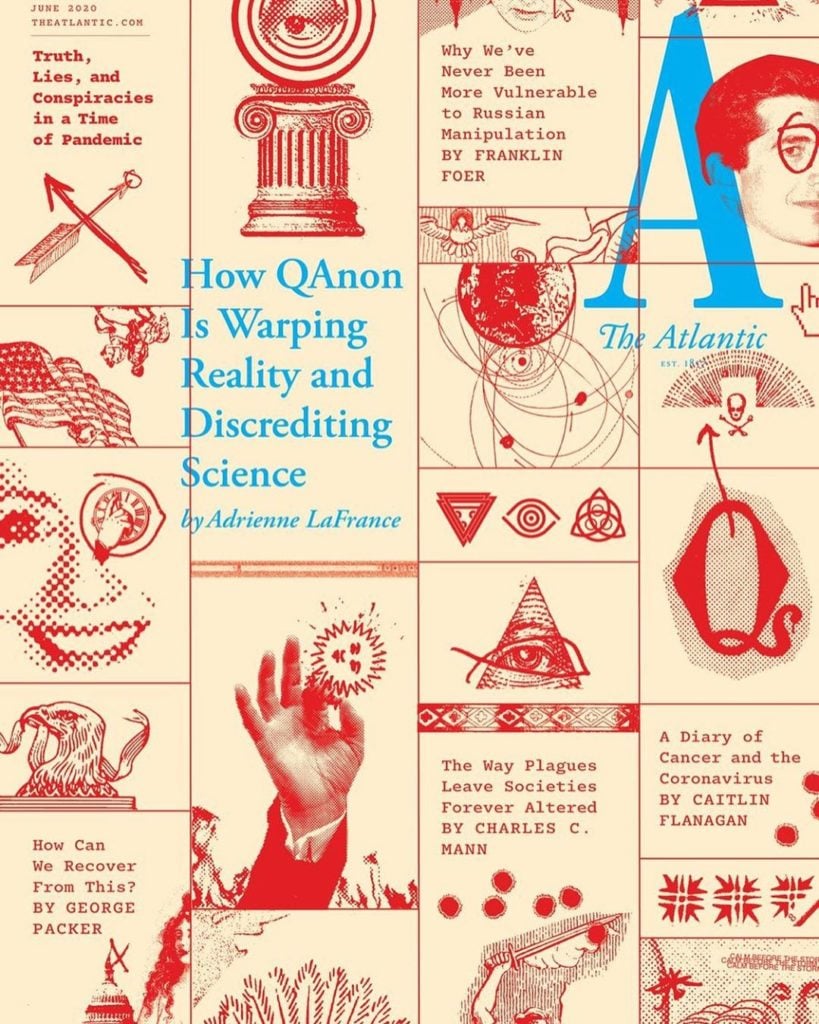
The Atlantic‘s June 2020 issue
on conspiracies.
It’s a colorful account—but the line that stands out to me is
this: QAnon, LaFrance writes, “is a movement united in mass
rejection of reason, objectivity, and other Enlightenment values.”
Even given QAnon’s strong evangelical component, I don’t think this
is what LaFrance’s article actually shows.
Almost everyone thinks of their own beliefs as reasonable, in
one way or another, and no community recognizes itself as being
held together by irrationality. The people LaFrance talks to often
say they are motivated by “research” and “thinking for themselves”
rather than accepting what the media tells them.
The Atlantic‘s own editor, Jeffrey Goldberg,
infamously helped promote the narratives
that let the Bush administration conspire us into the Iraq War,
scarring the lives of a generation of Americans—so it’s actually
irrational, when you think about it, to stigmatize distrust of the
“objective media” as irrational.
The article’s toss-off reference to “Enlightenment values” only
makes sense as an appeal to the presumed readership’s
self-conception as enlightened, rational, immune to conspiracy
themselves.
In his book Ideology:
An Introduction (published, it so happens, in 1991,
the same end-of-history era when Kelley made his remark), Terry
Eagleton distinguished “criticism,” which put its faith in the raw
power of facts, with what he called “ideology critique”:
“’Criticism,’ in its Enlightenment sense, consists in recounting to
someone what is awry with their situation, from an external,
perhaps ‘transcendental’ vantage-point. ‘Critique’ is that form of
discourse which seeks to inhabit the experience of the subject from
inside, in order to elicit those ‘valid’ features of that
experience which point beyond the subject’s present condition.”
Why does this perspective-shift matter? Because elsewhere, the
experts that the
Atlantic‘s own writers talk to say that the most basic
operation, if you are trying to stop the spread of dangerous
disinfo, is, first of all, to distinguish between “true believers”
and the broader, looser class of the “curious” and “uncertain.” You
probably can’t win the true believers—but if you want to starve
them of converts, the last thing you want to do is lecture, shame,
or ridicule the merely curious about how they are stupid. You want
to try to find some point of identification. The anathemizing
perspective that imagines “conspiracy” as blind cult thinking that
only other, irrational people engage in makes both these tricky
tasks harder.
New Age vs. New World Order
Something like QAnon is of an entirely more apocalyptic caste
than the kind of arty occultism that has fired the imagination of
museum-goers in recent years. The former is essentially a pro-Trump
mythology whereas the latter’s underlying politics are
a spiritualized feminism.
Another way to put that is that the people who are drawn to the
latter are more familiar, in their starting values. The point of
reading the two together, for me, is to say that you may already
understand how a seemingly unintelligible phenomenon moves through
the world better that you think you do.
When LaFrance describes the appeal of QAnon as being “a very
welcoming belief system, warm in its tolerance for contradiction,”
that’s actually how scholars have also
described the particular appeal of New Age philosophy for
the American temperament, as a kind of a la carte meaning-making
activity.
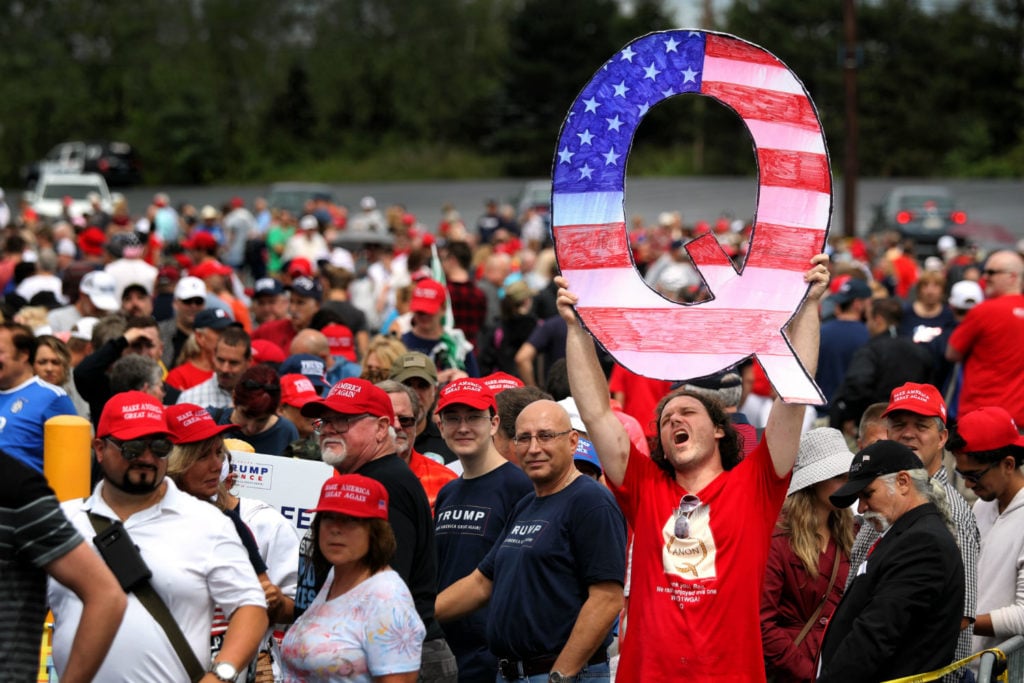
A man holds a large “Q” sign while
waiting in line on August 2, 2018 at the Mohegan Sun Arena at Casey
Plaza in Wilkes Barre, Pennsylvania to see President Donald J.
Trump at his rally. Photo by Rick Loomis/Getty Images.
And when LaFrance describes Q followers as looking to interpret
cryptic online prognostications to help decipher and predict
current events, it really sounds like it scratches the same itch as
astrology. QAnon’s prophecies about the news are often wrong, but
that fact is unlikely to make it fall apart—any more than the fact
that R. H. Naylor’s astrological predictions spectacularly
missed World War II stopped newspaper astrology from taking
root (“Hitler’s horoscope is not a war-horoscope,” he wrote mid-1939).
For the average person in ordinary times, speculation about
various conspiracies is probably more like trading wisdom gleaned
from horoscopes: something that people dabble in for amusement,
that connects them to other people in their circles, that gives a
sense of agency or fate, that serves as a coping mechanism, that
they draw from in dribs and drabs overlapping with a lot of other
beliefs.
Bizarro World
I’m not a huge fan of Crooked Media’s Hysteria podcast, which
has a kind of faux hip Beltway tone that I can’t take. I’m glad I
tuned in to the April 22 episode, though, because it offered such a
perfect example of what I am talking about (last week, the hosts
were on to talking about how COVID-19 is good news for the Dems
because the death of the cities will turn the suburbs blue).
There, former Obama deputy chief of staff Alyssa Mastromonaco
had this to say about April’s wave of “Liberate America” protests,
whose adherents she called “COVID Deniers”:
I have a very good friend who is a Democrat but is very
conservative. She sends me a text that is like, “The fucking
Democrats. They are making fun of these protests and these people
are just concerned with their jobs and scared about their future.”
And I’m like, “What the fuck is she talking about?” And so I did
some research and I had to send her some new articles, and I was
like, “You know this shit is backed by the Koch Brothers and the
Trump campaign and this is just fucked up—this has nothing to do
with people and their jobs.” This is just some bizarro liberty
argument that is really just Donald Trump wanting to get the
economy back so that he can have a reasonable argument for running
for president.
Well, the Liberate protests are definitely astroturfed.
And definitely dangerous: the premature reopening they have sped
along will lead to thousands upon
thousands of deaths.
But the people stoking this fire aren’t totally stupid either.
They see an opening. Their campaign wouldn’t actually attract
people if it didn’t potentially touch a nerve that was raw.

Protestors pray near Governor Charlie
Baker’s residence during a Reopen Massachusetts Rally on May 16,
2020 in Boston, Massachusetts. Photo by Maddie Meyer/Getty
Images.
What strikes me about the Mastromonaco rant is that, by her own
account, she is presented with human proof that pundits “making
fun” of the protests is backfiring. The images of the
demonstrations are alarming, the forces behind them
sinister—but in her unnamed friend, she has actual evidence that
not everyone potentially picking up its message, at least, is
either a hardcore reactionary or a grifter.
And her response is to continue to make fun of the
protests (the name of the episode was “We ALL Want Haircuts,
Karen,” boldly addressing an audience that is clearly not the
show’s audience, while being sure to piss off anyone like her
friend).
Instead of the moral of the anecdote being “these protests seem
to be more attractive to people we want to win than we thought;
recalibrate,” the moral seems to be that if you just
rationally prove that the #LiberateAmerica
message should only appeal to people utterly unlike
you, then the problem is solved.
Conspiracy of Silence
The kernel of rationality in the Liberate protests is plainly
that society is wounded and there has seemed to be no credible plan
besides “stay home, listen to the experts” to get us through months
and months of pain with no promise of anything better on the other
side. “It is irrational to reopen now” is not a narrative that
people can connect to a vision of a future for themselves if they
see only hardship looming.

A nurse wears personal protective
equipment as she performs range of motion exercises on a COVID-19
patient in the Intensive Care Unit (ICU) at Sharp Grossmont
Hospital amidst the coronavirus pandemic on May 5, 2020 in La Mesa,
California. Photo by Mario Tama/Getty Images.
The fact that fantasies of a secret Bill Gates/Anthony Fauci
cabal conspiring to keep America idle for nefarious ends is gaining
wider and wider traction has to be seen as an indictment not merely
of Trumpian brain rot. It is also a symptom of the fact that the
political mainstream—what Tariq Ali calls the “extreme center”—has no
narrative that might feel like a credible step towards salvation.
In the resulting void of despair, all kinds of diabolical thoughts
gain traction, as people look for any kind of incantation to cast
to part the clouds and are drawn to the people who are chanting the
loudest.
Not so far beneath the surface of the mockery of the Liberate
protests, you sensed a cynical hope that these misguided crowds, at
least, will spread the virus among themselves and die. “You can’t
gaslight a pandemic,” the saying goes. Or I think people not so
secretly hope that the experience of the coronavirus’s lethal,
non-negotiable reality will turn people against Trumpian
fabulation, and that will snap discourse back away from the detour
of conspiracy and onto the rails of reality.
But in the absence of any strong counter-narrative or plan to
rally the common human passion for survival around, you don’t have
a strategy. You have a weird mix of contempt and your very own
brand of magical thinking.
And, most importantly, if the function of conspiracy theories in
the first place was to provide a graspable narrative to navigate a
painful reality that doesn’t seem to make sense, then the encounter
with still more pain and more senselessness is likely to deepen the
fever rather than to cool it.
That’s a prophecy, by the way: the myths we see moving people
now are as nothing compared to those we will have to take seriously
in the times to come.
The post How Art History Can Help Explain the Renaissance of
Conspiracy Theory That Is Defining Our Time appeared first on
artnet News.
Read more https://news.artnet.com/opinion/conspiracy-theory-art-history-1855647
Further reading


Leave a comment