
Can I Put a Paparazzi Photo in My Artwork? + Other Thorny Artists’-Rights Questions, Answered
Have you ever wondered what
your rights are as an artist? There’s no clear-cut textbook to
consult—but we’re here to help. Katarina Feder, a vice president
at Artists Rights
Society, is
answering questions of all sorts about what kind of control artists
have—and don’t have—over their work.
Do you have a query of your
own? Email knowyourrights@artnet.com and it may get answered in an upcoming
article.
I’m making t-shirts to raise funds for COVID-19 relief, and
I’d like to use an image from a painting I created and subsequently
sold. Do I have to consult the person who now owns the painting
before I do that?
Reader, you are wholeheartedly
encouraged to make that t-shirt, and you do not need permission
from the person who owns the work. Once a work of art is sold, the
physical object no longer belongs to you, but the underlying
copyright still does, and always will.
Copyright is a form of
protection provided by law to the creators of “original works of
authorship,” which of course includes your creation. Copyright
protection exists as soon as the work is created in fixed, tangible
form. Word to the wise and even the not-so-wise: should you ever be
asked by an entity to sign over your copyright (which you
technically can do), just say no.
Of course, the letter of the law
is different from questions of etiquette, and the person who
purchased your painting may be a little surprised to see someone
wearing the t-shirt in Bushwick. It wouldn’t hurt to drop them an
email about your plan. If they’re a fan of your work, they’ll most
likely be supportive, even flattered. And, heck, they just might
buy a t-shirt.
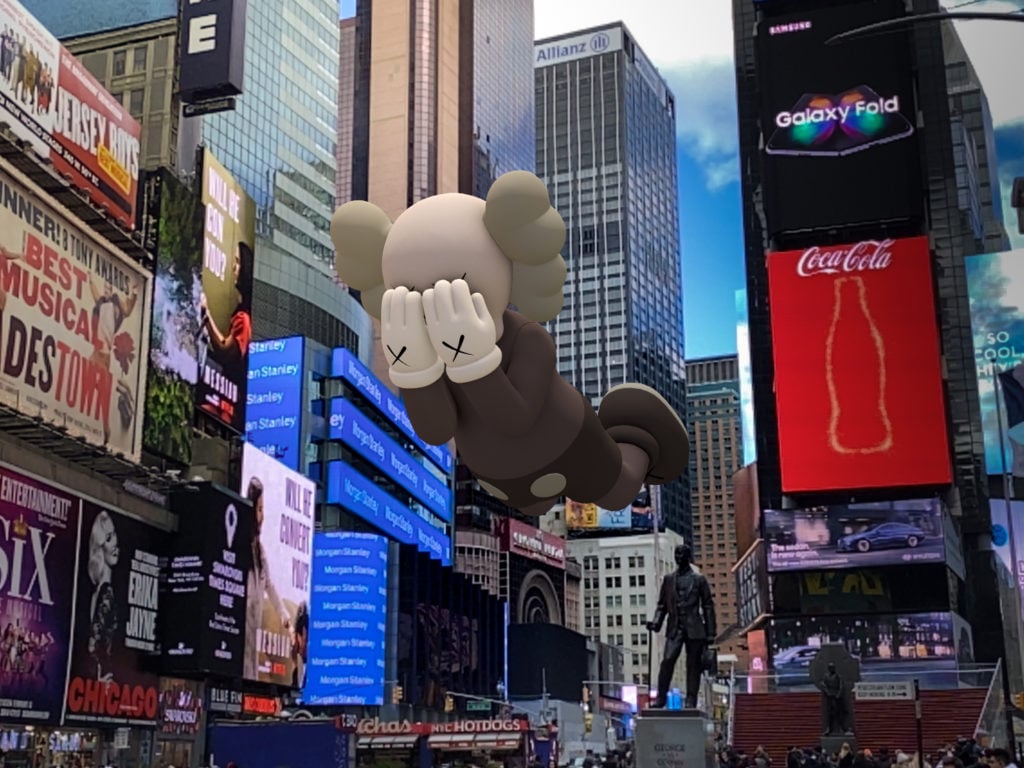
KAWS, COMPANION (EXPANDED) in
Times Square, New York, 2020, augmented reality. Courtesy: KAWS and
Acute Art.
I work in fashion and for the past couple of weeks, I’ve been
licensing filters made by augmented reality (AR) artists
for use in a forthcoming advertisement for a brand. Are the
rights involved with AR different?
There is no shame in the
licensing game. You would be surprised by how open artists are when
it comes to licensing their work for commercial purposes. It can be
an exciting way to collaborate with other creatives and see one’s
work re-contextualized for a new audience. Our data shows that
artist/fashion collaborations have ballooned in the last
half-decade or so.
To answer your question:
Standard copyright law is highly applicable here. Not only is
original computer code automatically copyrighted—as a literary
work, funnily enough—but work within a computer program is also
copyrightable.
Allow me to draw your attention
to the 2013 New York Southern District case of
FireSabre Consulting
vs. Cindy
Sheehy.
Sheehy, a teacher at Ramapo Middle
School, contracted FireSabre, a digital design consulting
agency, to build virtual
classrooms for her students in SecondLife. (SecondLife, you may
recall, is a video game that is kind of like the Sims mixed with
Fortnite, only way less interesting than either.)
SecondLife sells parcels of
digital real estate called “islands,” which are essentially blank
slates that could be customized by users, a process called
“terraforming.” Sheehy hired FireSabre to build a variety of things
on her islands for her students: a train station, a cafe, music
shops, and, of course, a volcano. But after FireSabre and the
school had a falling out, Sheehy argued that her students still had
a right to use FireSabre’s designs. It wasn’t like FireSabre owned
SecondLife, she said, and besides, the islands were fluid entities
that could be un-terraformed and re-terraformed as she or her
students saw fit. What’s the point of even having a volcano if
you’re not going to use it, right?
The court ruled against her all
the same, noting that just because “someone else could come along
and, with or without permission, alter the original piece of art
does not mean the art was too transitory to be copyrighted in the
first place.” So, yes, art made in video games, virtual
reality, and augmented reality is just as protected as art made in
paint or clay—so be sure to pay those AR artists, too.
I’ve been working on a series of photo collages that involve
using paparazzi shots. Hypothetically speaking of course (wink
wink), would I need to pay the paparazzi who took the photo of
these two beefcakes if I were to, say, cut
them out and place them into a beautiful landscape photo that I
took? It’s transformative, right? Hypothetically speaking of
course…
Cakey though those beefs may be,
you’re entering less friendly waters than the ones depicted in that
photograph. Many experts have differing views on this issue, but as
a general rule, unless you fundamentally change or alter the work,
your version will not qualify as a “transformative use.”
A transformative use, or a
transformative work, is not derivative. It does not offer a new
spin or a riff on the original. It transforms it
entirely,
so that the resulting work is
something new, and thus cannot conceivably serve as a market
substitution for the work that it borrows from. (Not to get too
lawyerly on you, but it’s helpful to know there is a four-factor
test for fair use, which weighs the purpose of the new work, the
type of work being copied, the amount of the source material being
used, and the impact the new work might have on the market for the
original.)
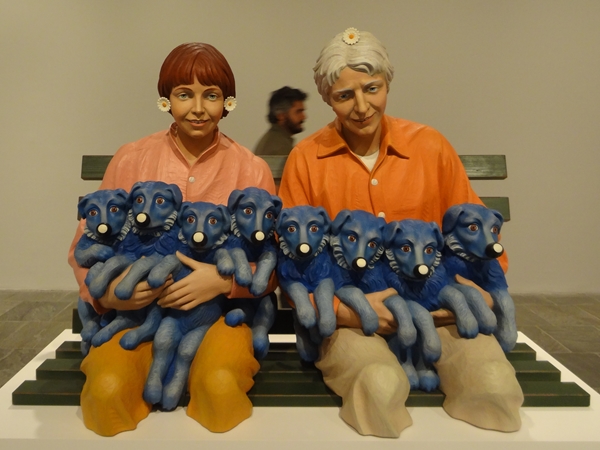
Jeff Koons, String of Puppies
(1988). Photo: Benjamin Sutton.
Consider the 1992 case
Rogers v.
Koons. The professional
photographer Art Rogers took an innocent photo of a man and a woman
with their arms full of puppies; Jeff Koons found the picture on a
postcard and gave it to his assistants with instructions on how to
create a sculpture based on it. Koons actually went so far as
to remove
the copyright label from the
postcard before giving it to his assistant—and requested that as
much detail be copied as possible. Then, when he was sued by
Rogers, he had the cojones to call the piece
“transformative.”
The court disagreed, finding
“substantial similarity” between his original photograph and the
sculpture, concluding that the average person would recognize it as
a copy. The court also determined that, just like a brown-and-gold
“GUCCE” bag you can buy on Canal Street could hamper demand for the
real thing, the Koons work could hurt the market for the original
photograph and authorized derivative works.
If you’re asking yourself how a
blue-chip sculpture could affect the market for a postcard, it all
depends on weighting those aforementioned four factors of fair use.
Another landmark case involving the artist from 2006,
Blanch v.
Koons, saw Koons
appropriate a picture from a feature in Allure magazine: a pair of female feet clad in,
appropriately enough, Gucci sandals. Market-wise, you might
consider editorial magazine photography closer to fine art than the
puppy photo—but the
judge in this case did not, calling the Allure photo “banal rather than creative.” Savage. He
ruled for Koons.
What you propose to do is in
fact not that dissimilar from Koons’s work in the latter case. And
collage as a form is fairly protected. Richard Prince has won many
copyright cases because even though his collage works constitute
blatant, gleeful theft, they transport images from one market
(advertisements, girlie mags, ethnographic photography) to his own
(that of the blue-chip art market). And your piece would,
presumably, transport the image from the celebrity tabloid world to
the fine-art world.
Then again, even if Prince wins,
he is frequently sued. Legend has it that “paparazzi” was a term
coined by the famed Italian director Federico Fellini, who took the
name from an Italian dialect word that roughly translates to “the
buzzing noise made by a mosquito.” You might find the paps no less
annoying if you pursue this piece.
Are memes considered fair use?
One could make a solid case that
memes—widely shared photos captioned with text that parodies a
cultural symbol or idea—find their lineage within the canon of art
history. Both Rene Magritte and Marcel Duchamp both had a strong
early meme game. (You may recall that the father of Dada himself
took a postcard of Leonardo da Vinci’s Mona Lisa and added the letters “L.H.O.O.Q.” to the
bottom. Say it three times fast and you start to hear, “Elle est
chaud au cul,” or,
“She has a hot ass.”)
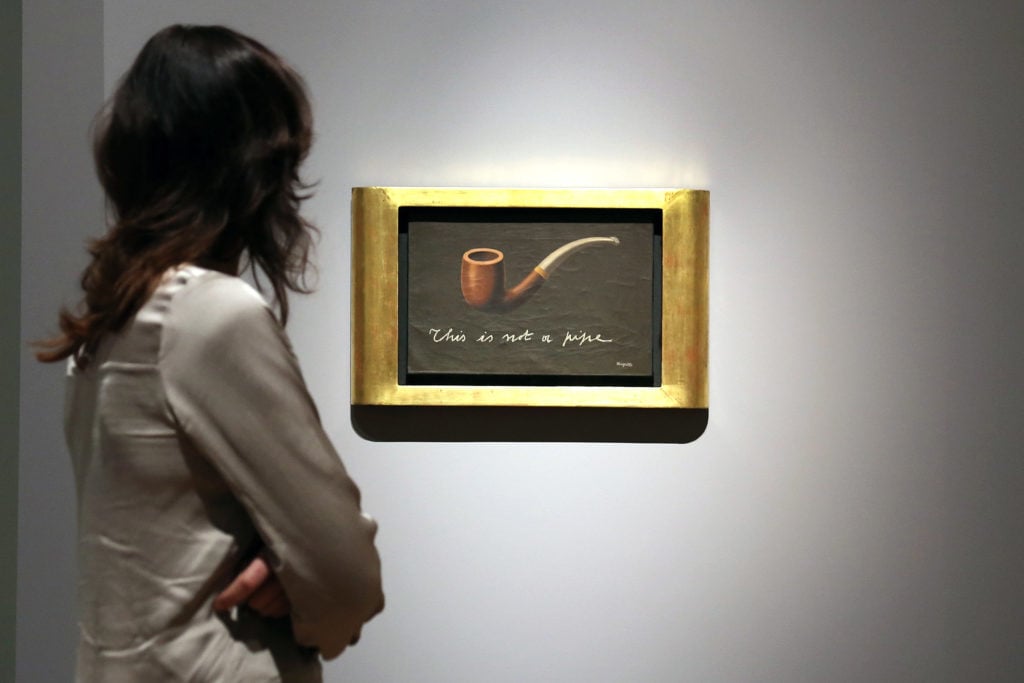
Rene Magritte’s The Treachery of
Images on view in Germany. (Photo by Hannelore Foerster/Getty
Images)
Parody is among the best
examples of fair use. It clearly transforms the object of its
ridicule, and no one in the market for Airplane! is going to accidentally rent
Airport 1975
or any of the other films it was
parodying.
But I’m assuming this question
emerged from a desire to repurpose Frances Bacon’s
Portrait of Pope Innocent
X and frame it around
some text that begins “TFW,” so I’m here to tell you that you can
definitely do that, even if said text doesn’t end with an explicit
send-up of existential angst.
When it comes to contemporary
art, modern-day meme masters like Jerry Gogosian and Brad Troemel tend not even
to post images of the works they’re skewering, but their galaxy
brain-level irony would probably allow them to post a picture of a
piece by someone else, add text stating “this is an artwork by me,”
and get away with it. God bless the First Amendment.
The post Can I Put a Paparazzi Photo in My Artwork? + Other Thorny
Artists’-Rights Questions, Answered appeared first on artnet
News.
Read more https://news.artnet.com/opinion/know-rights-may-1865850
Further reading


Leave a comment