
A 1,000-Year-Old Viking Ship Has Been Unearthed by High-Tech Archaeologists in a Norwegian Farmer’s Field
The Norwegian village of
Avaldsnes is a former Viking stronghold. According to the town’s
historical society, the Norwegian defense fleet was able to
mobilize approximately 310 ships in times of war. Not only that,
there were probably several thousand privately owned ships of
notable size. When leaders died, they would be buried in their
ships in large burial mounds.
But finding them is rare; only 15
or so Viking ships have been excavated thus far. So archaeologists
with the Norwegian Institute for Cultural Heritage Research (NIKU)
were very excited last month when they found what appears to be
either a Merovingian or Viking period burial site in Edøy, a tiny
island in the archipelago to the west of Trondheim. They made the
discovery thanks to georadar technology.
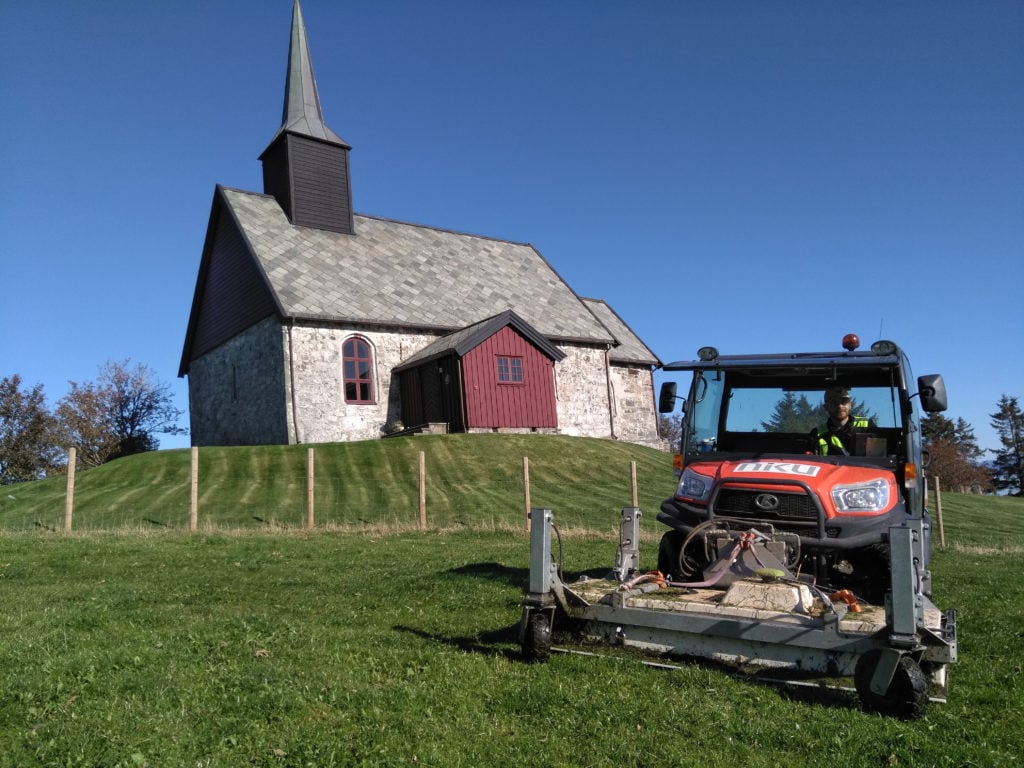
The georadar used in the discovery of
the Viking ship is seen in front of Edøy Church, where
archaeologists originally looked before finding evidence of the
Viking ship in a farmer’s field.
“We only know of three
well-preserved Viking ship burials in Norway, and these were
excavated a long time ago. This new ship will certainly be of great
historical significance and it will add to our knowledge as it can
be investigated with modern means of archaeology,” says Dr. Knut
Paasche, Head of the Department of Digital Archaeology at NIKU, and
an expert on Viking ships.
The ship in Edøy was found using the same
techniques—ground-penetrating georadar developed by LBI Arch Pro
research institute and its partners (including NIKU), using
technology from Guideline Geo, which
canvases the earth like an artifact-hunting Zamboni—that
have previously been used to detect landmines in former
warzones.
The ship was found by NIKO archaeologists Manuel Gabler and
Dag-Øyvind Engtrø Solem, who were surveying an area near Edøy
Church in September of 2019. They had finished surveying the area
and had a little extra time, so they decided to use the georadar on
a nearby farm. That’s where they unexpectedly detected the ship,
buried in a mound in a farmer’s field.
“As the technology is making leaps forward,” Dr. Paasche says,
“we are learning more and more about our past.”
Though the finds are still considered rare, the new technology
has helped archaeologists make two such major discoveries in the
past two years. In 2018, a perfectly intact Viking ship was found
in Gjellestad just below the topsoil, where evidence suggests there
was previously a large burial mound that had been flattened by farm
equipment. The Edøy case is nearly identical.
The georadar data shows that the
ship in Edøy has an over 42-foot-long keel (a long piece of wood
that serves as the ship’s backbone). The ship’s front and back look
to have been damaged by agricultural plows, but the hull appears
intact.
“The length of the keel indicates that the ship may have
been a total of 16–17 meters
[52–55 feet] long. It is too early to say
anything certain about the age for the ship, but the ship must be
from the Merovingian or Viking Period. Which means the ship is more
than 1,000 years old,” says Paasche.
According to Ars Technica’s Kiona N. Smith, who first reported
on the story, the farmer whose land the ship was found on is named
Per Hassle. Despite his name, the
archaeologist Solem told Smith, Hassle has been very
cooperative. “The burial is
indeed located on a working farm, but we couldn’t have wished for a
more agreeable landowner. He is very interested in history,
especially local history, and is very enthusiastic about the
project,” Solem said.
NIKU plans to go ahead with an excavation in the near future, as
well as exploring larger parts of Edøy area in hopes of finding
other Viking artifacts.
The post A 1,000-Year-Old Viking Ship Has Been Unearthed by
High-Tech Archaeologists in a Norwegian Farmer’s Field appeared
first on artnet News.
Read more https://news.artnet.com/art-world/viking-ship-found-georadar-norway-1722768
Further reading


Leave a comment