
A Dishy New Novel Imagines the Backstage Battles at the Met’s Annual Temple of Dendur Dinner. Read an Excerpt Here
They were known as Mezz Girls. Everyone swore that the young
women of Development’s mezzanine offices were indistinguishable,
one from the next.
That night, before the party, they were being trained.
It was still the Age of Socialites, a post–Bonfire of the
Vanities, pre-celebrity era. A pageant of rich women with hard
hair and important jewelry. Black-tie meant gowns that rustled as
they swept across the Great Hall. It was the sound of expense.
The guests were due to arrive in thirty minutes, so the Mezz
Girls listened carefully as Winny Watson’s instructions hummed and
rolled like those of a ballet teacher.
“Arms parallel, palms to the sky, and turn,” she said.
“Aaand again. Arms parallel, palms to the sky, and
turn.”
Winny, a museum volunteer and former Mezz Girl herself, insisted
on this awkward movement as a graceful way of directing people
without pointing. The maneuver began with elbows clamped to the
waist, forearms positioned as if preparing to receive a heavy box.
The “turn” signaled a swing of the upper body, torso twisting in
the desired direction.
The Mezz Girls followed along, exchanging skeptical
glances.
“What the fuck?” one snorted. The Mezz Girls liked to swear, but
only amongst themselves.
Winny continued to issue instructions in her Park Avenue caw,
wearing a one-shouldered gown that revealed ripples of loose flesh
over her fit tennis arms. While her authority over matters like
pointing had questionable origins, her Mayflower pedigree did not.
She descended from Eatons on her mother’s side and Fullers on her
father’s, creating a gene pool as shallow as a serving of consommé
at the Colony Club—with a worldview to match.
The Mezz Girls were all pleased when the first tottering guest
appeared in the Met’s doorway, abruptly halting the lesson.
“Thank fucking God,” they sang in unison.
When the partygoers entered the museum that evening, a miniature
graveyard greeted them: a long table spread with hundreds of
perfectly spaced envelopes the size of business cards,
alphabetically arranged—one for each guest—and set atop a dark
linen tablecloth. The pristine white rectangles rested on their
half-opened flaps, a name carefully calligraphed on the front and a
table number tucked within. It looked like Arlington National
Cemetery for mice.
The curious sight of this tabletop graveyard was coupled with a
ritual. The well-dressed Mezz Girls snapped up the correct card for
each person entering the museum, efficiently—though not hurriedly—
presenting it to them: “Good evening, Mrs. Astor. May I give you
your seating card?”
As the rush of arrivals quickened, the swinging rhythm of card
retrieval and distribution accelerated, growing almost competitive
among the jostling Mezz Girls, with the ultimate goal of clearing
the table. When an unknown guest had to retrieve their own card,
the shortfall crushed the young women. Success meant the
obliteration of the entire cemetery—a resurrection of sorts—as
each guest thwarted the fate of the miniature tombstone. But some
cards inevitably remained until the end of the evening. Sullen
memento mori to those who never arrived.
’m bored. This is boring. Are you bored?” They
all heard Mrs. Leonard Havering address this question to no one in
particular. Her defining impatience had amplified with old age, a
slow lacquering built with fine layers of loneliness. She had just
entered the Great Hall and was anxiously scanning the room as if
searching for a missing cat.
“Oh dear, you know these evenings take a bit of time to pick up
steam,” the wise Mrs. Wilmington counseled after catching the
remark. She delivered her comments as if waving away a slow,
buzzing fly. “I hear the auction is unrivaled this year, so sip
some champagne and get your bidding arm ready.”
All this came from Mrs. Wilmington’s mouth while she continued
to move right past Mrs. Havering to avoid the risk of an actual
conversation. Had Mrs. Wilmington simply flown away, it would have
had equal effect.
The preppy wife of one of the museum’s Trustees charged toward
Mrs. Havering like an overgrown Girl Scout. Mrs. Towey never
appeared quite right in a gown; even at the age of sixty-seven she
looked like a star field hockey player on awards night, hair
clipped with a single barrette at her temple, constantly adjusting
the long strap of her evening bag like it was a backpack filled
with books.
She cartoonishly kissed her own palm and then pushed her hand on
Mrs. Havering’s cheek with an exaggerated shove. The slap-kiss. It
was her trademark. Mrs. Havering bristled, but the Mezz Girls
enjoyed Mrs. Towey’s unfiltered energy.
“Great to see you!” Mrs. Towey barked. “Another show here at the
rodeo! Ha! Great! Bye!” She tackled her next victim before Mrs.
Havering could even respond.
Everyone seemed to be moving but Mrs. Havering. She had somehow
stranded herself on a rock as the social stream whirled around her.
Her eyes skipped around the room, and she absentmindedly touched
her hand to her chest and felt for the lavish sapphire necklace
that spread across her gown. It reminded her of her wealth, quietly
clarifying that she belonged in this crowd so clearly repelled by
her presence.
In these moments, the Mezz Girls could tell that Mrs. Havering
missed her late husband. They missed him, too. Leonard was the fun
one, the gregarious foil to her hard edge. Over the years, his
cupcake optimism grew into a glittery persona, drawing everyone
into his jolly parade of banter and delight. “I’m just glad you’re
playing for our team!” he would cheer to the Mezz Girls as they
took his coat or gave him his seating. “You’ll be running this
place soon!” They loved his attention, his bold trespass across the
usual silence, if only for its recognition that they actually
mattered in some small way.
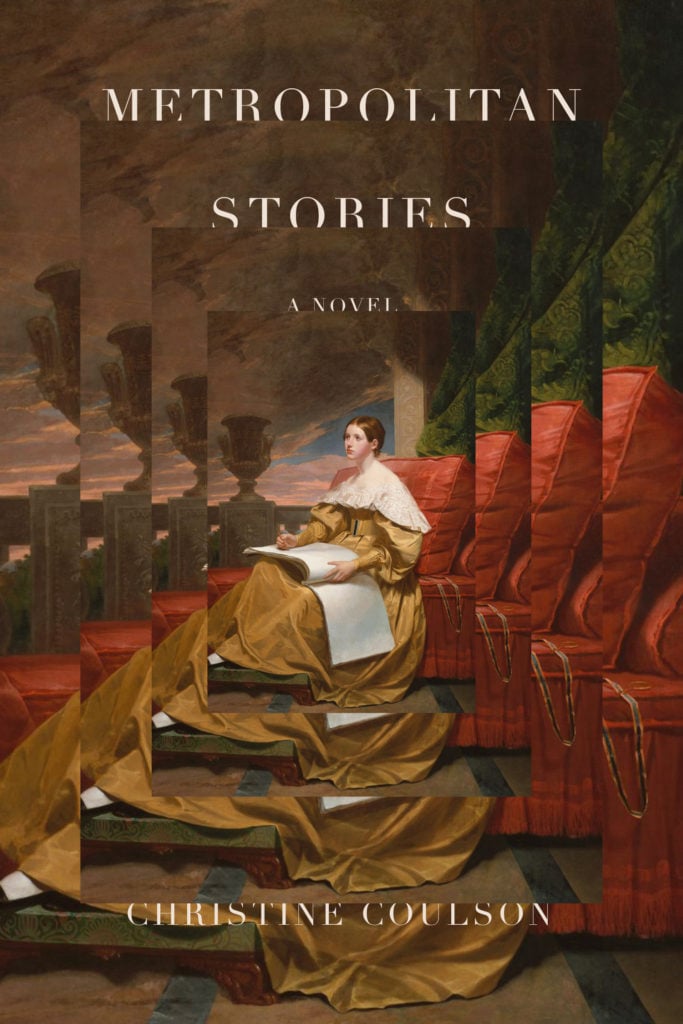
The cover of Christine Coulson’s
Metropolitan Stories (2019). Courtesy of Other Press.
“Mrs. Havering!” Lindie Garrison approached the small, smirking
woman with a waving enthusiasm that betrayed her ambition.
The Mezz Girls knew that Lindie’s infamy sprouted last year when
she held a dinner party for thirty people and the waiters left
midway through the meal. In her careful instructions to the
caterer, she had neglected to sign the overtime clause. When the
chef took too long preparing the halibut au gratin, the staff
simply walked out at the hour they had been told.
The dinner party ended with a wine-soaked Mr. Garrison earnestly
singing “Blowin’ in the Wind” to their guests as he sat on the edge
of the couple’s bed with his acoustic guitar.
It would be a limping return for young Lindie. “Lindie,” Mrs.
Havering replied with a neutrality that Lindie read as progress.
“I would love
to catch up, but I see someone from the Greek and Roman
Department whom I must speak to about a sarcophagus.”
At that very moment, a rose fell from one of the oversized
floral arrangements in the four niches of the Great Hall; Lindie
saw it and pouted, perhaps recognizing the possibility of a
similar fate for herself.
One of the Mezz Girls also noticed the fallen flower and
retrieved it with a swift, boomerang movement, scooping up the
wayward rose and returning to her post like a ball girl on a tennis
court. The Development Office trained its own like ninja. A Mezz
Girl could sail across a room, airborne, to retrieve a dropped fork
before it hit the ground. Legend had it that one of their ranks
supported a broken elevator from below—a high-heeled Atlas to the
elevator’s sky—when the Emperor of Japan was briefly trapped
inside.
Met style—a cocktail of European elegance and Protestant
restraint—had rules, imperatives that defined every element of an
evening, from the personalized seating distribution to the silent
commandeering of a chair for an elderly Trustee, complete with a
museum curator to keep her company. A stray, dead flower would not
do.
Cocktails continued in the Great Hall, as furred and feathered
couples gathered around the Information Desk, now transformed into
a circular bar with waiters serving from within its perimeter. The
lights were dimmed, and hundreds of votive candles spread across
the steps of the grand staircase, conjuring a private night sky
for the great and the good who now populated the Hall’s cavernous
space: men and women, middle-aged and older, puffed with the sort
of lucky birth or financial achievement that inevitably led to big
rooms filled with small chairs fashioned from gilded bamboo. The
Met had convened its club, and this benefit to raise money for
building the collection felt like its annual dance.
When Mrs. Wrightsman passed through the entrance, it was as if
the Mezz Girls heard a dog whistle. They reflexively locked their
eyes on her and smoothed their dresses. The collector of all
collectors, donor of all donors, queen of all queens. Like royalty,
Mrs.
Wrightsman didn’t need attention, rather, she was to be
protected from it.
The Mezz Girls watched with the restraint of a silent army as
Met Director Michel Larousse bounded to the door for the museum’s
most important Trustee. She spoke in a porcelain voice that matched
her fragile silhouette and went straight to business.
“Michel, I walked in with Danny Swillbinger and encouraged him
about giving his collection,” she said confidentially about the
well-known collector of Fragonard drawings.
She then paused and added with a sly humor, “Just so you know
I’m still pushing the firm.”
“Indeed, you’re our own prized pit bull,” Michel smiled as he
lightly took hold of her arm. He swam in her attention, relieved by
her presence. It meant he could neglect everyone else.
A gong rang through the Great Hall. Again, the Mezz Girls
snapped into action, springing from one troupe to the next to ask
politely that they move in to dinner. Daphne, a Development
veteran, approached a group near the Roman Galleries with a mild
but deliberate force.
“Excuse me. If you could proceed to the Temple of Dendur for
dinner now…” She tried Winny’s patented upper-body shift to point
in the direction of the Egyptian Wing, but felt like a Barbie with
back problems.
Mrs. Randolph ignored Daphne’s instructions, turned to her, and
asked in her syrupy drawl, “Well what do you think, young
lady? Who’s the better artist, Picasso or Braque? Jim here thinks
ol’ Pablo was just a better salesman.”
Daphne hesitated, rattled by the interaction, but then responded
earnestly, “Isn’t the most interesting period for both artists the
moment when you can’t tell their work apart? When they are side by
side developing Cubism, and the work is indistinguishable?”
Mrs. Randolph raised an eyebrow and paused as Daphne panicked
that she had overstepped. “I like you!” Mrs. Randolph replied
brightly. “You’re smart, and you’re decorative.” She
appraised Daphne in her blue dress, then picked at it approvingly
as if she were removing lint.
The ancient Temple of Dendur sat like a nightclub on the Nile,
dazzling and radiant in the slippery reflections of the water that
surrounded it. On the platform around the Temple, thirty-two
tables ached under piles of flowers, porcelain, glass, and
silverware. A piano sent an endless song into the air.
One of the Mezz Girls, who had trained as an archaeologist,
wondered what anyone would make of a society represented by such
mass-produced excess, a society with ritual public sacrifices in
the form of fundraising auctions. She looked down at the pamphlet
that sat at each place. She had heard about this year’s special
packages, designed to encourage the men to bid.
Many of the Mezz Girls were in the meeting when Mrs. Barnley,
the evening’s formidable Chairwoman, declared that “men are the
new women” for any successful charity auction. The evening’s
offerings seemed to represent her best guess at what that
meant.
THE METROPOLITAN MUSEUM OF ART
ACQUISITIONS BENEFIT AUCTION
October 4, 1999
The Lance-a-Lot Package
Grab a weapon and suit up in full armor for a Central Park joust
that everyone will enjoy. All equipment courtesy of the Arms &
Armor Department. Commemorative video included.
Guns!
Horses not your thing? There are other Arms to explore. How
about a few rounds in the Museum’s basement shooting range? You can
keep the paper targets and brag about your blow holes.
Die Like an Egyptian
Jar up Uncle Miltie’s favorite snacks and send him smiling into
the afterlife. The Egyptian Department technicians know all the
ancient secrets of preservation. Let them deliver what no modern
funeral can with the ultimate in personal care.
Row, Row, Row Your Boat
Whip by those other boats in the Central Park lake with a canoe
from the African Galleries. It’s all the adventure of world travel,
right here in our backyard.
The Mezz Girls watched Mrs. Havering approach her table,
scowling. They also noticed the strange man with elaborate facial
hair who stood next to her seat as if waiting for her. He had a
thick gray beard along the sides of his face and a walrus-like
mustache, with what appeared to be a two-inch wide landing strip
shaved up his neck to his lower lip. It made his chin look like a
tiny, naked ass bending over to expose itself beneath a hairy
dress.
“Look who’s here, ladies,” one of the Mezz Girls said,
“Everyone’s favorite asshole.” They were used to the ghost of Jacob
Rogers showing up at these events to taunt and tease the
guests.
“Old Havering’s gonna meet her match tonight,” Daphne responded,
her eyes fixed on Rogers.
All the Mezz Girls knew Rogers. The locomotive magnate had been
kicking around the Met since he died in 1901. Back then, he shocked
the museum by leaving it his entire fortune. The six-milliondollar
gift was a lottery boon, and the museum went shopping. Van Goghs
and Bruegels and Greek vases, masterpieces by the thousand. The Met
was still spending it.
But Rogers was also a legendary jerk, called “a pure animal man”
in his own obituary. He often showed up at the museum’s black-tie
dinners like an embarrassing uncle at Thanksgiving. And as with any
family, all the Mezz Girls could do was try to limit the
damage.
“I don’t like anyone I don’t know,” Mrs. Havering cracked by way
of introduction as she sat down. “Indeed,” Rogers replied with
admirable gentility and a hint of agreement, as he instinctively
pulled out her chair.
“I’ve lived too long and done too much to have to spend an
evening with some stranger,” she continued, now shouting upward as
he remained standing.
Rogers’s thick wool dinner jacket looked like a dusty theater
costume, and she inspected it with a questioning glare. She also
noticed the shifting quality of his presence, at once overwhelming
and not quite there, and attributed its elusive character to the
dramatic lighting that had been designed for the evening.
Spotlights shot asymmetrically across the room, striping the
Temple in their path and pooling in bright circles upon the gallery
floor.
“I could not agree more, madam.” Rogers’s curt accommodation
merely fueled her rage.
“I tell you, a single woman in this town gets treated like the
help. I get shoved with any nobody they can find.”
Rogers was unflinching; Mrs. Havering had indeed met her match.
“No more than an unattached gentleman, I assure you. We have
solidarity in that.”
Mrs. Havering smirked and started her cat search again, rolling
her eyes around the room with skittish speed.
“Why do I even bother coming to these things,” she grumbled. The
list of auction items lay on her plate, and she reviewed it with
her lips tightened in tense disapproval.
“This place has lost all its dignity,” she muttered— again, with
no intended audience.
The Mezz Girls wondered if Mrs. Havering couldn’t benefit from a
joust or a few rounds in that firing range. Wealth could be a
burden in New York if you joined the wrong game: So many rituals
were required to distribute your money and stay relevant. But
jumping on a horse and poking the innards out of someone at full
speed, or shredding a target with a violent spray of well-shot
ammo….Ah, the release that might deliver for her pent-up anger and
resentment.
Mrs. Havering didn’t seem to notice that the rest of the guests
at her table had arrived. Two fortunate no-shows bracketed her and
Rogers, isolating them from the six guests on the other side of the
table. The Mezz Girls wondered if they should find fillers, but
knew it was a boulder of an assignment for even the most genteel
diplomat.
“Fuck it,” they decided. Mrs. Havering’s table would be closely
monitored instead.
Rogers and Mrs. Havering spent the first course of the meal in
an epic silence, as she continued to sway back and forth, bobbing
and weaving in her seat, sizing up the other tables to identify
everyone else’s more favorable placement. Even Lindie Garrison had
been placed next to a curator from the Asian Department.
Sliced cucumbers held the first course’s salmon mousse topped
with caviar. Rogers scraped off the mousse to eat it, then lifted
the cucumber pieces to his mouth, scooping them up awkwardly with
his knife and fork. His knife slipped while conducting this odd
operation and a large cucumber disk careened through the air. A
Mezz Girl intercepted it with the stealth flash of an outstretched
arm, just as it was about to peck at the back of an expansive
helmet of hair. One small seed escaped, stuck in the net of
hairsprayed tendrils, hanging tenuously like a spider from its
web.
After the first course, the auction got underway, helmed by a
Christie’s auctioneer who knew almost everyone there. Rumor had it
that he had drawings of every Upper East Side residence that might
one day have property to sell—inventories and scribbled notes
sketched on cocktail napkins in cramped powder rooms during dinner
parties and receptions, tracking each home’s future potential as a
source of revenue.
He dove quickly into the first item, the Lance-a-Lot Package,
which drew bids at a steady clip, easily reaching $750,000. The
momentum slacked as the price neared $1 million. Unfazed, the
auctioneer shifted gears and began to promote the package’s
commemorative video. He pointed to the flickering projections
playing behind him on the wall: old black-and white films of museum
staff dressed in armor from the collection as they jousted in
Central Park.
“In the early years of the twentieth century, Trustee Edward
Harkness used his Hollywood connections to get a movie camera for
the Met’s Egyptian Expedition,” the auctioneer explained, “In the
off-season, the camera returned to New York, and, as you can see,
the staff got a little creative.
“This is once-in-a-lifetime stuff, people. Do I hear $1
million?” he added.
“One hundred and twelve million!” Rogers called out
impatiently, with an old-fashioned stiffness that just narrowly
veered from a British accent. With his formal intonation, he
sounded like an overeager amateur on stage.
The Mezz Girls rolled their eyes.
“Now he’s fucking with the auction,” one of them hissed.
“I bet that amount is what his original gift would be worth
now,” another one added, shaking her head and folding her arms
across her chest.
Mrs. Havering pivoted dramatically toward her neighbor. Her eyes
widened with shock, as if she had finally found the cat she had
been hunting for all night, only to discover that it had a hundred
and twelve million dollars. Leaning back in his chair, Rogers
moved into one of the streams of light and now seemed like a
reflection in a cloudy mirror. She could have pushed her hand right
through him.
Murmurs rippled through the stunned party, and the bewildered
auctioneer dropped the hammer without so much as a countdown,
anxious to lock in the bid.
“Sold for one hundred and twelve million dollars to the very
generous gentlemen at table twenty-three!” he shouted.
Hesitant, confused applause broke out, and immediately a fuming
Mezz Girl appeared at Rogers’s shoulder, knowing that she had to
keep up the charade of his antics.
“Your name, sir?” she asked politely, her pen poised above her
clipboard.
The crowd hushed with a prying quiet—the leaning curiosity of
the rich—interrupted only by the scrape of chairs turning toward
the man’s table, waiting for his response.
“Jacob S. Rogers,” he proclaimed, then paused for effect, “of
Rose Lawn, Paterson, New Jersey.”
“Paterson, New Jersey??” Mrs. Havering exclaimed into
the silence, now doubly slighted by being seated next to someone
from New Jersey. “No one is from Paterson, New
Jersey! ”
Confusion gripped the room. Some had heard of Jacob Rogers and
began to whisper questions in a real-time gossip chain. The chatter
swelled and grew louder.
Enjoying the disorder, and the fury he had inspired among the
Mezz Girls, Rogers stood up from his chair, stroked both sides of
his substantial beard, and crossed the room. The guests quieted as
they watched him move through the tables.
After descending the few stairs from the Temple platform, he
walked straight through the gallery wall, dissolving into a cloud
of shimmering dust. The Mezz Girls heard him snicker as he
left.
“Bastard,” they muttered.
The crowd exploded again with more questions.
“Typical!” Mrs. Havering howled from her perch, now fully
exasperated. She craned her neck and scanned her table
incredulously; the cat was lost again.
Then she twitched, and her face suddenly softened. She
registered the strangeness of Rogers’s appearance and
disappearance: If Rogers was a ghost, then maybe her husband,
Leonard, could be in the room, too?
Her eyebrows curved into gentle arches framing a new depth in
her eyes. Her stern, pursed lips relaxed into an expression of
hope and expectation. She brightened, sitting upright like a young
woman in her gilded chair, as if waiting for someone to ask her to
dance. She gazed around the room again, but this time breathless,
her heart quickening with the idea that Leonard could be near.
When Leonard Havering rested his hand on his wife’s shoulder,
all of her indignation and anger fell away. She gasped and floated
upward to him, relieved, renewed.
The Haverings swayed together within the commotion of the
rustling crowd, a waltz of memory and comfort. A tent of light
formed a cone of glittering dust just for them, as they moved
within a bright circle upon the floor. Leonard glowed as Rogers
had, ethereal and indefinably vague, while Mrs. Havering clutched
the back of his dinner jacket with childlike fists, a desperate
attempt to keep him.
“I don’t like anyone I don’t know,” Mrs. Havering whispered,
this time a confession rather than a complaint. She buried her head
in Leonard’s chest and finally spoke the truth, “I think you’re the
only person I’ve ever really known.”
He smiled—that blooming, optimistic beam that always sliced
through her despair—and pulled her closer. “I know,” he soothed,
his voice as clear as water, her face lifted to the past, “I
know.”
Over at Michel’s table, Mrs. Wrightsman sat serenely, enchanted
by the Haverings and the gentle chaos Rogers had stirred. In the
raking light, she looked just like the Met’s marble head of Athena,
goddess of wisdom, from the late second century BC— bought with
the Rogers Fund in 1912.
Christine Coulson, recently published by Other Press.
The post A Dishy New Novel Imagines the Backstage Battles at
the Met’s Annual Temple of Dendur Dinner. Read an Excerpt Here
appeared first on artnet News.
Read more https://news.artnet.com/art-world/metropolitan-stories-exceprt-1674619
Further reading


Leave a comment