
A Haitian Artist’s Glittering Vodou Flags Steal the Show at Miami’s Faena Festival
“I woke up this morning and I thanked God, and I tell all the
spirits ‘thank you’ for giving me the strength to make flags,”
Myrlande Constant said, looking up at her colorful beaded Vodou
flags suspended from the lobby ceiling of Miami’s Faena hotel. She
was donning a jacket decorated with the same circular felt pieces
she had used for one of the works at the unveiling of
the second-annual Faena Festival, titled “The Last Supper,” an immersive
exhibition that includes work by 23 artists, including Martha
Rosler, Ana Mendieta, Camille Henrot, and Janine Antoni, in
addition to Constant.
The 51-year-old Haitian artist’s eight large-scale flags, which
are embellished in glittering beads depicting alternative versions
of the Haitian religion’s myths surrounding food, unity, and
solidarity, are her largest to date.
Faena Art curator Zoe Lukov first encountered Constant’s Vodou
flags two years ago at the Miami gallery Central Fine and was
struck by the artist’s interpretation of functional sacred objects
with dense visual and narrative layers. Contacting the artist, who
lives on top of a mountain overlooking Port-au-Prince, was a
challenge, but Faena ultimately managed to commission Constant to
make one flag, which later turned into two, and six other flags
came from institutional loans. “While we spoke through a
translator, I felt that we actually communicated organically—a
really beautiful mutual trust developed almost immediately given a
shared understanding for the goals of the project,” Lukov said.
The 10-by-7-foot flag, Rasanbleman soupe tout eskòt
yo, took four months to complete and required assistance from
the artist’s five children. Constant, too, took needle in her hand
at an early age, watching her seamstress mother embroider and sew
beads onto wedding gowns. “I would skip school and make embroidery
on dresses my mother left unfinished,” Constant told Artnet News
about her early fascination with textiles.
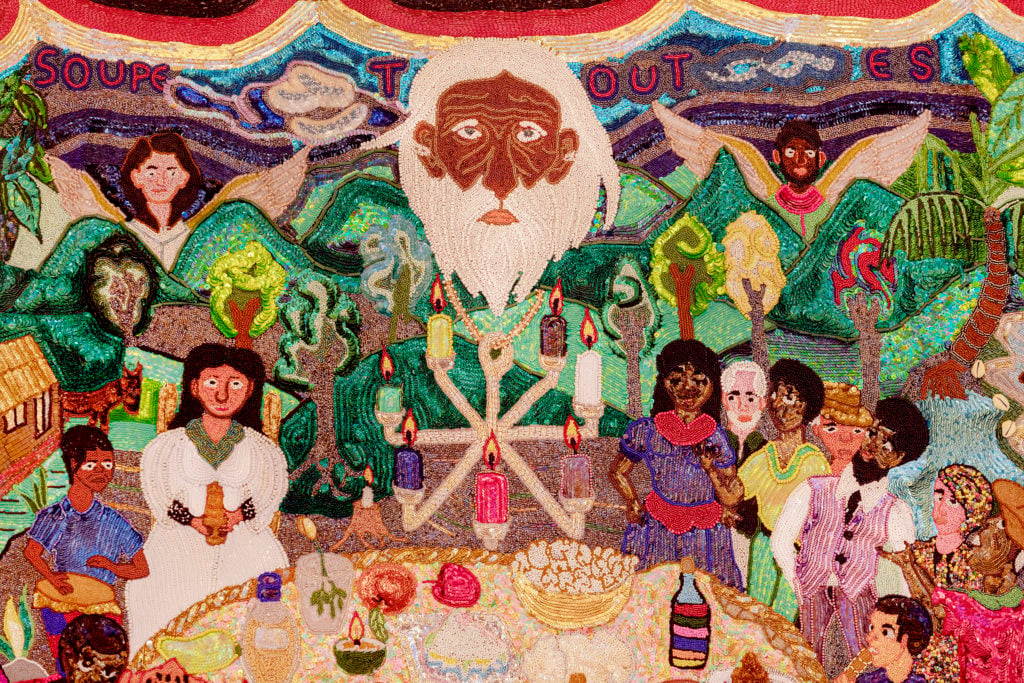
Myrlande Constant, Rasanbleman soupe
tout eskòt yo (2019). Courtesy of Faena Art, photo: Oriol
Tarridas.
Her art stems from a deep belief in God—a Supreme Creator, and
her narratives evolve around humans’ relationships
to loas, who are representatives of God in physical
world in Vodou, each with human-like characteristics and
attributes. Evident in her flags on view at Faena is her balancing
of the spiritual with a contemporary world view, in which figures
in different colors, religions, and nationalities intersect and
coexist over a scene of feast or death.
After the factory she worked for closed following the bloody
anti-government demonstrations of 1986, which would eventually lead
to the overthrew of Haitian president Jean-Claude Duvalier,
Constant found herself making decorative embroideries of flowers to
sell at street markets.
Watching a Vodou practitioner friend make paintings inspired
Constant to push the limits of her own visual language. “Beads were
the medium that I knew and I realized I could try and make
paintings,” she said. Eventually she abandoned the flowers and
started to embellish textiles with references to history,
spirituality, and life cycle. It was around the mid-1990s when a
woman who saw one of her flags told her to never let anyone call
her work craft.
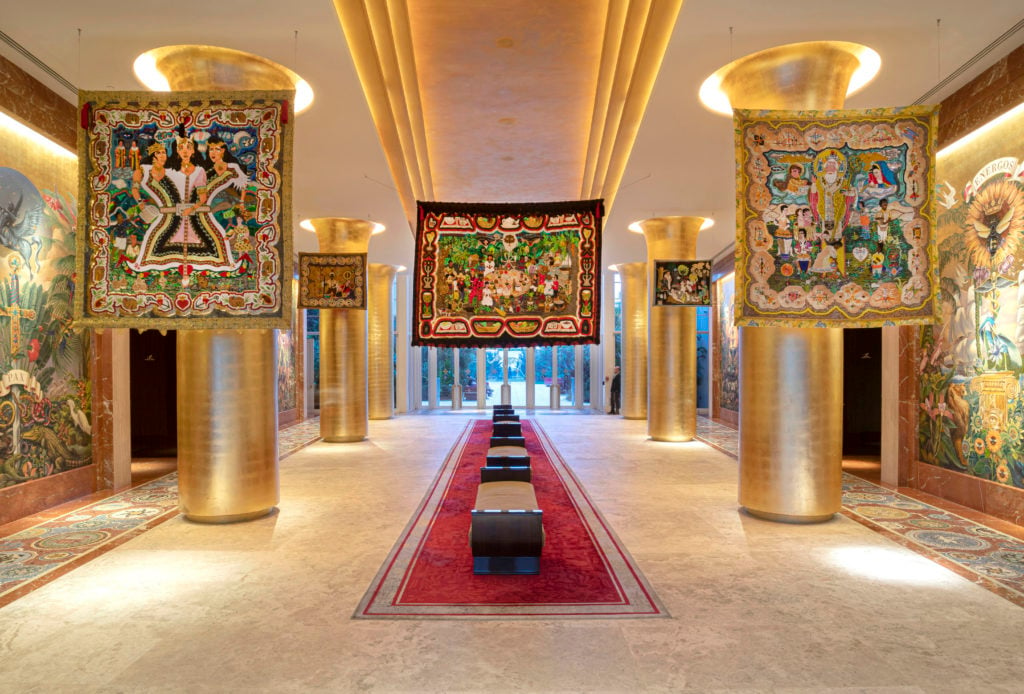
Installation view of Myrlande Constant
works at the Faena Festival, 2019. From left: Marassa Trois,
Rasanbleman soupe tout eskòt yo, Exorcism all 2019.
Courtesy of Faena Art, photo: Oriol Tarridas.
Today, Constant works with a large wooden structure that anchors
her meticulous process of applying beads onto fabric in various
scales. She draws directly onto white fabric with a pencil before
stretching it onto the structure from four angles. She repeatedly
embroiders onto the drawing from the back of the flag, which she
considers an instinctive process as much as a meditative one. Her
blind view of the fabric during production is nowhere to be traced:
Constant’s mesmerizing beaded flags boost bright colors and
intricate figures engaging with mundane rituals such as dancing or
eating, shrouding the artist’s religious references with the joy of
everyday life and charm of sparkling colors.
She is a pioneer in a male-dominated practice, as well as a
revolutionizer who brought buoyant colors and contemporary subjects
onto flags and exhibited them at Pioneer Works’s 2018
exhibition Pòtoprens: The Urban Artists of
Port-au-Prince and The Waterloo Center for the
Arts in Iowa in 2017. She will have a solo exhibition at
the Fowler Museum at UCLA in 2021. The current interest in her work
isn’t surprising given the growing fascination in spirituality
in art more broadly, particularly among women artists whose
practices bridge introspection and immateriality with the physical
world. Earlier this year, the Guggenheim’s massive survey of
Swedish abstract painter Hilma Af Klint drew 600,000 visitors
into the late artist’s contemplative and mysterious renditions of
the metaphysical, becoming the museum’s most-visited exhibition in
its history. Meanwhile, the 2017 Venice Biennale engaged with
shamanism and primitivism in art that looked “inside” to reason the
surrounding world and its cracking dynamics.
In a social landscape ridden by unpredictabilities and political
complexities, it comes as no surprise that art which seeks comfort
and answer in the sweeter side of the unknown gains visibility and
access, and artists who have been religiously committed to a single
practice but kept outside the mainstream, such as Constant, find
space on gallery and museum walls.
The post A Haitian Artist’s Glittering Vodou Flags Steal the
Show at Miami’s Faena Festival appeared first on artnet
News.
Read more https://news.artnet.com/market/myrlande-constant-faena-festival-1723518
Further reading


Leave a comment