
A Sharp-Eyed Dealer Bought a Mislabeled Guercino Painting for $74,500. It Could Be Worth $1 Million
A newly rediscovered painting by the Italian Baroque painter
Giovanni Francesco Barbieri, better known as il Guercino, is on view this week at New
York’s Christopher Bishop Fine Arts
as part of Master Drawings New York.
Remarkably, for the first time in some 300 years, the dealer has
also managed to reunite the painting, Aurora (1662), with
its preparatory drawing, which was in fact instrumental in
definitively identifying the lost canvas.
The dealer purchased the painting, previously unknown to
scholars, at Doyle New York in 2012. It was listed for sale
as a 17th-century work from
the Dutch School with a pre-sale estimate of just
$2,000–4,000.
“It was obvious to me that it was misidentified,” Bishop told
Artnet News. “I knew first of all that it couldn’t be Dutch, and I
had an inkling that it might be Guercino.”
On the basis of that hunch, Bishop went to see the work in
person. “I knew pretty much immediately what it was—there’s a
certain masterful and unfinished aspect to the late work of
Guercino that is unmistakable when you really know it,” he
said.
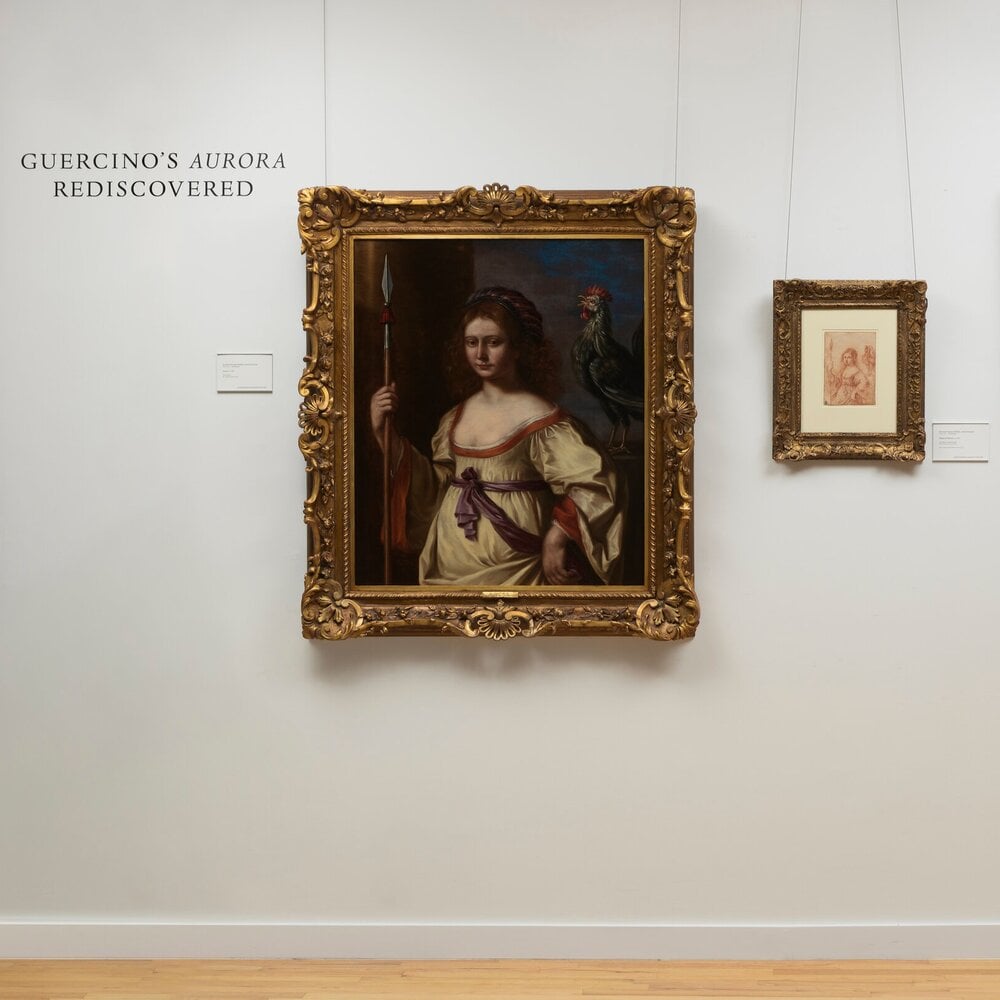
Installation view of Guercino’s
Aurora and its preparatory drawing at Christopher Bishop
Fine Art. Photo courtesy of Christopher Bishop Fine Art, New
York.
Other bidders seemed to have had a similar idea. The final
selling price was $74,500—an astonishing 1,862 percent more than
the high estimate. “A couple of other people must have figured out
what I figured out!” said Bishop.
As an authenticated Guercino, the canvas is worth much more even
still. According to the Artnet Price Database, the artist’s record
at auction is £5.19 million ($7.86 million), achieved at
Christie’s London in 2010 for the oil painting King
David.
“The Guercinos that bring millions and millions are generally
large-format multi-figure works,” said Bishop. “These single-figure
works tend to bring from the mid six figures up $1.2, 1.4, 1.6
million, and that’s in line with what I’m asking for the
piece.”
Bishop is hopeful that he can find an institutional buyer,
preferably one who will take both the drawing and the painting.
“The two pieces together are worth four times as much!” Bishop
said. “You rarely see studies and paintings side by side. The
survival rates for works on paper of this period are not fantastic,
so there are lots of paintings for which we simply don’t have the
preparatory drawings.”
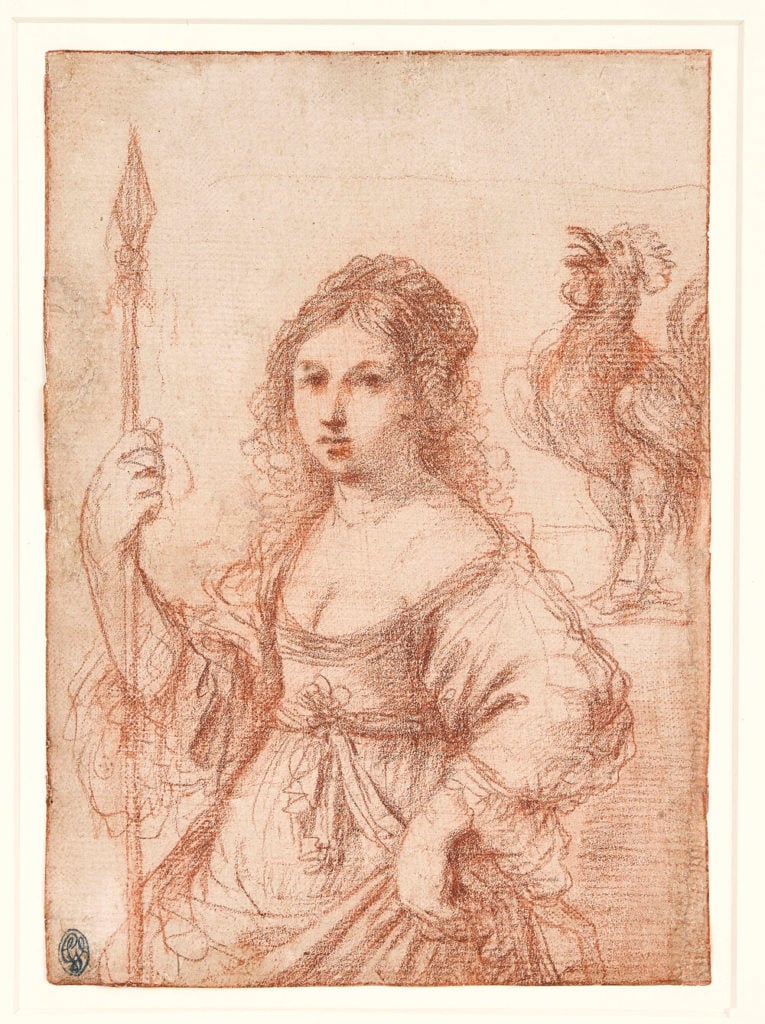
Giovanni Francesco Barbieri, known as il
Guercino, An Allegory of Vigilane. Photo courtesy of
Christopher Bishop Fine Art, New York.
It was the drawing that helped Bishop really nail down the
authentication question. The Aurora drawing sold
last January at Sotheby’s New York under the
title An Allegory of
Vigilance, fetching $25,000. That work had remained with
the artist’s family after his death, and its existence offered
convincing proof of what Bishop had long suspected: the painting
was by Guercino too.
“It’s really a story of scholarly patience,” said
Bishop. “You need to have the instinct and the gut to understand
what you’re looking at, but you also need a couple more pieces of
the puzzle!”
After acquiring the drawing, Bishop revisited the research he
had done after acquiring the painting in 2012. “Artists’
records weren’t typically this well kept, but the business
part of the enterprise was given over to the artist’s brother so
that Guercino could focus on the painting aspect,” said Bishop.
“The account book was preserved by the family and ended up in the
state archive of Bologna.”
Although the painting’s artist had been misidentified, the frame
still bore a 19th-century name plate with the
title Aurora—the correct title, it so happened. The
account book revealed that Aurora was commissioned by
Capitano Raffaello Gabrielli, a Bolognese solider who collected
several works by Guercino.
“The pieces of the puzzle started to fit,” said Bishop. “You
don’t always get that deus ex machina moment where
the drawing shows up and you know that you were right all
along!”
For final confirmation, Bishop arranged a meeting with art
historian Nicholas Turner, a Guercino expert and former curator of
drawings at the J. Paul Getty Museum. Turner authenticated the
painting as being by the hand of Guercino. (The timing was also
fortuitous, with an exhibition of the artist’s work on view through
February 2 at the Morgan Library & Museum.)
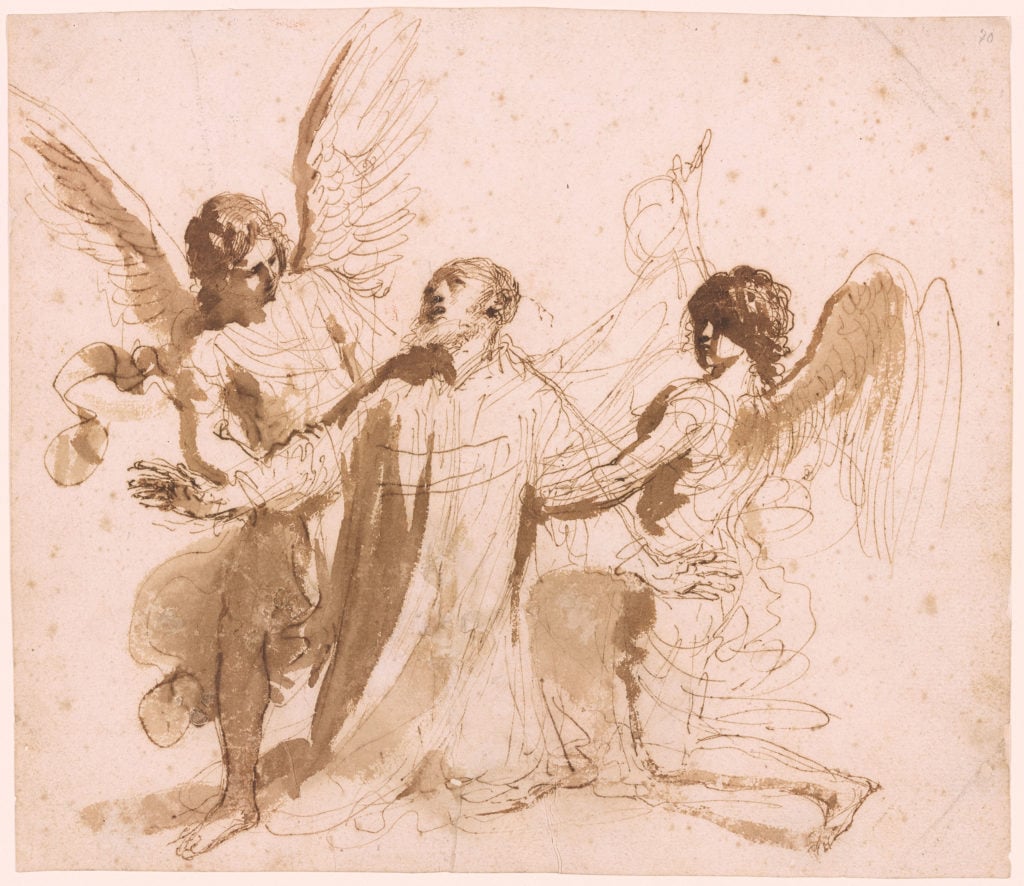
Giovanni Francesco Barbieri, called Il
Guercino, Vision of St. Philip Neri (1646–47). Courtesy of
the Morgan Library & Museum, gift of János Scholz.
The newly discovered composition depicts the goddess of dawn as
a solider watching over the city of Bologna through the night
(hence Sotheby’s alternate title An Allegory of
Vigilance). For the original
owner, Aurora would have had a special personal
meaning.
“The virtues this women incarnates are the values of the
Christian soldier and those would have been his values,” said
Bishop. “Aurora represents the fierceness and the spirit of freedom
of the Bolognese people, who were very proud not to be subjugated
by Rome or Florence or Venice or Milan or any of the more powerful
neighbors that surrounded them.”
So where was Aurora all these years? In a
private American collection for some 60 years, according to Bishop.
“The sellers knew very little about where it was acquired,” he
said. “What’s remarkable is that Aurora retained the
correct title. Sometimes there’s an inventory of the collection
dictated by a parent to a child, and two labels get switched, or
someone misremembers which one grandpa was talking about when he
was talking about a Dutch painting—it’s kind of like a game of
telephone.”
“Guercino’s Aurora Rediscovered” is on view at Christopher
Bishop Fine Art, 1046 Madison Avenue, New York, January 24–February
15, 2020.
“Guercino: Virtuoso
Draftsman” is on view at the Morgan Library, 225 Madison
Avenue, New York, October 4–February 2, 2020.
The post A Sharp-Eyed Dealer Bought a Mislabeled Guercino
Painting for $74,500. It Could Be Worth $1 Million appeared
first on artnet News.
Further reading


Leave a comment