
Akris Creative Director Albert Kriemler on How His Fashion Design Begins With Art That ‘Sparks a Desire’
Two weeks ago, Akris—the Swiss
fashion house founded in 1922 by Alice Kriemler-Scoch—presented its
Fall 2020 ready-to-wear collection at Paris’s Museum of Modern Art.
Vogue called it the “elegant, high-fashion version of
comfort food” for its luxe cashmere fabrics transformed into cozy
cowl-neck sweaters, body-hugging capes, and high-collared coats
designed to take shelter in.
Beautiful clothing doesn’t have
to be loud, at least not in creative director Albert Kriemler’s
books. “I think a woman of purpose doesn’t want to wear complicated
clothes,” he said.
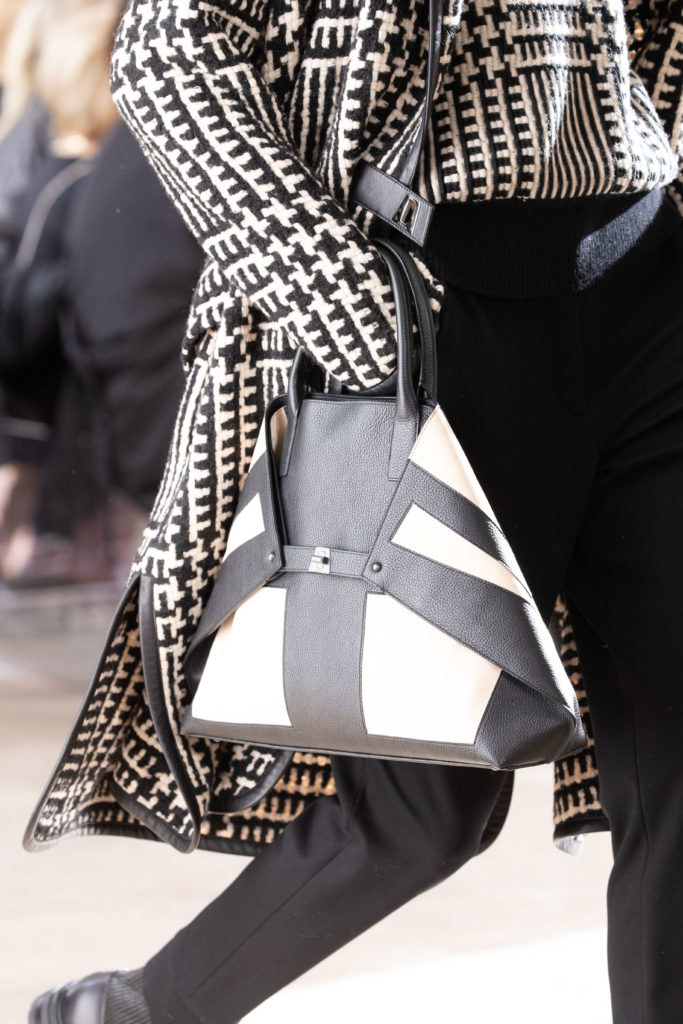
A detail of Akris Fall 2020. Photo
courtesy of Akris.
But, upon closer inspection,
there’s more to Kriemler’s method than first meets the eye,
starting with the fact that the show was the designer’s first to
ever take place in a museum. That’s surprising given his history of
referencing and working with a score of different artists since
Akris began presenting its clothes in 2004.
A cursory glance at the house’s
collaborations will illustrate the range of Kriemler’s artistic
tastes, which range from German photographer Thomas Ruff, who
co-created garments made to mimic his photographs of celestial New
York skyscrapers, to the Cuban-born artist Carmen Herrera, who
exhibited her work for the first time in the US at age 101.
Kriemler approached her about collaborating on a few pieces for his
Spring 2017 show, which riffed on her graphic, minimalist
works.
At least on a surface level,
Kriemler’s selection process is more about introducing his audience
to the varied sources of his inspirations rather than nabbing an
attention-grabby collaboration with an art-market-star du jour.
Kriemler’s penultimate collection, for Spring 2020, for example,
was inspired by the Italian Modernist painter Antonio Calderara, a
student of Lucio Fontana who was a bit of a dark horse. Among his
small, but dedicated following, Calderara was known for
experimenting with the bounds of duplication via his beautiful
small-scale works, which earned him the title “master of the little
painting.”
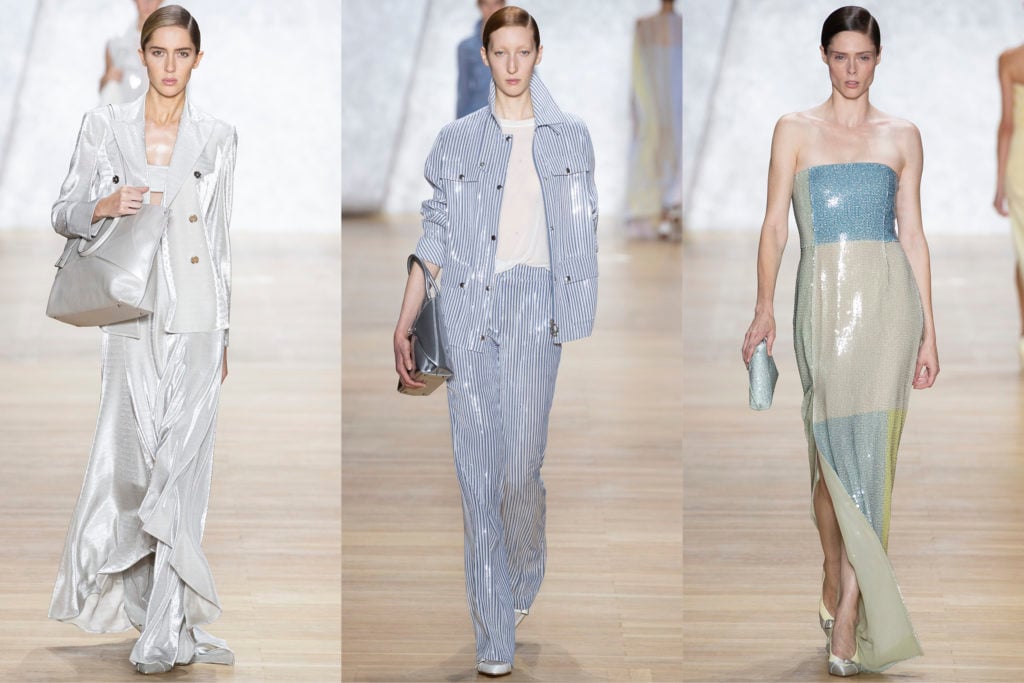
The Spring 2020 collection, featuring
clothes inspired by artist Antonio Calderara. Photo courtesy of
Getty Images.
It comes as little surprise,
then, to learn that Kriemler’s latest collection was also inspired
by artists—in particular a 1925 sculpture titled Arbe
Cubiste (or Cubist Tree) by the French duo Jan and
Joel Martel, twin brothers who were founding members of the Union
des Artistes Modernes, and whose sculptures of animals and the
world around them emphasized the sensuousness of nature’s forms.
After discovering their work, Kriemler set out to conceive a set
design for the runway show that channeled their shared
ethos.
“I came across the stunning
sculptures of the Martel brothers while reading about the architect
Robert Mallet-Stevens,” Kriemler tells Artnet News. “They designed
four concrete trees for his garden at the Exposition Internationale
des Arts Decoratifs et Industriels Modernes in 1925. The geometric
shape of their leaves immediately reminded me of our iconic
trapezoid [print]. I was fascinated by how the Martels, with a
touch of humor and provocation, reduced a tree to a simple
geometric abstraction.”
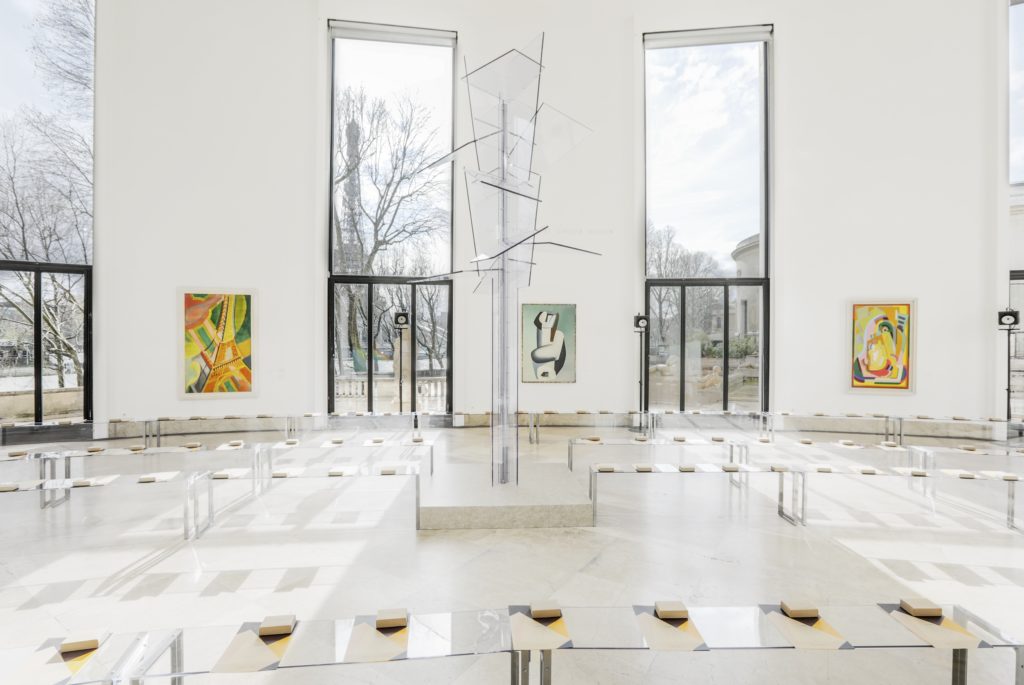
Kriemler’s runway show staging, inspired
by the Martel brothers’ sculpture. Photo courtesy Akris.
Inspired, Kriemler decided to
reduce the form even more by translating the Martels’ geometric
tree form into transparent, plexiglass works, which he placed in
the gallery where the show would take place. With the trapezoid
shape harkening back to Akris’s design roots—subtly playing on the
‘A’ of house’s name, and connecting to its past collections’
geometric underpinnings—it felt like fate. “They were the perfect
pieces for our discreet set in the museum, and they didn’t
overshadow the masterpieces of Sonia and Robert Delaunay [hung
around the gallery], but still referred to my
inspiration.”
As for the collection itself,
Kriemler began learning more about the French architect and
designer Robert Mallet-Stevens, eventually watching the 1924
drama L’Inhumaine, for which he designed the bold cubist film
sets. Their black-and-white architecture and drama served as
inspiration for several of the clothes, including a tunic featuring
a Cubist-inspired pattern, a techno-grid cube skirt, and a long
printed coat featuring a trapezoid-style closure.
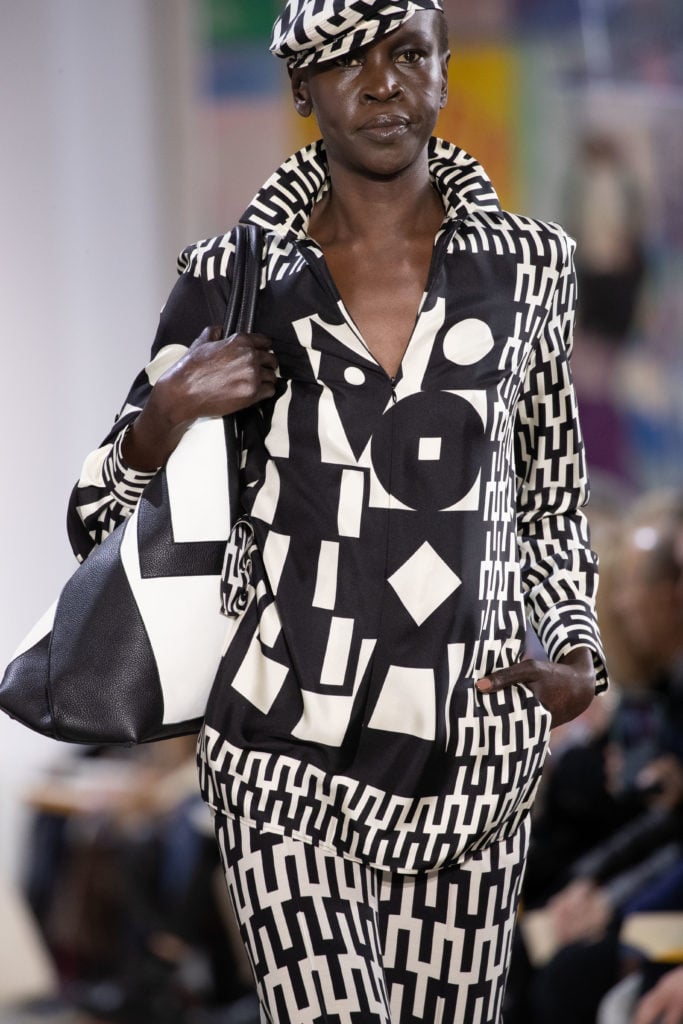
Bold prints inspired by the Cubist set
designs of Robert Mallet-Stevens. Photo courtesy of Akris.
Additionally, Kriemler fell in
love with Mallet-Stevens for his own history of collaborating with
fine artists, many of which began through his involvement with
the Union des Artistes
Modernes, through which the architect helped establish Paris as a
new center for groundbreaking art and design. Mallet-Stevens’s
spirit of collaboration reminded Kriemler of his own work, and his
mission to break new ground and inspire novel art forms through the
cross-pollination of art and design.
“I go to exhibitions, I read and
talk to artists, architects, or other creative minds and then it
sparks a desire to create a dedicated collection to the work,” says
Kriemler, of how the seeds for all of his collections have begun.
“Sometimes it’s a specific piece or art that inspires workmanship,
or sometimes it’s a pattern. It’s not a set principle, and often
the project starts without a plan, but with a subjective selection
of oeuvres. I always challenge myself to translate a work on fabric
with respect, but then also to add another dimension to it—to bring
a sense of ease and movement to it by transforming it into a new
medium that lives well on womens’ clothes. I want it to be
something that enhances their lives.”
The post Akris Creative Director Albert Kriemler on How His
Fashion Design Begins With Art That ‘Sparks a Desire’ appeared
first on artnet News.
Read more https://news.artnet.com/art-world/akris-fall-2020-albert-kriemler-1808022
Further reading


Leave a comment