
American Arts Organizations Stand to Lose a Staggering $6.8 Billion This Year as a Result of the Shutdown, a New Study Says
When arts organizations across the United States closed their
doors indefinitely two months ago, revenue from ticket sales fell
to zero overnight—and, for some, their very survival was thrown
into question. Now, a new study estimates that cultural
institutions stand to lose a total of $6.8 billion year over year,
equivalent to a loss of 26 percent of operating expenses on
average.
The report, titled “In It for the Long Haul,” from SMU DataArts and TRG Arts, draws on an analysis of
historical and projected data from 35,000 nonprofit organizations
across the US. Rather than just doom and gloom, however, the report
also aims to give cultural organizations tools to face the
challenges ahead.
“There will be a new normal,” Zannie Voss, director of SMU
DataArts, who authored the paper with Jill Robinson, CEO of TRG
Arts, told Artnet News. “Too much has changed to say that we could
go back to doing things the way we’ve always done them.”
Some institutions won’t make it. As early as March, the American
Alliance of Museums was predicting the closure of as many as 30
percent of the nation’s museums if the shutdown extended longer
than a couple months.
Aside from a few outliers, the median arts organization can only
afford to pay its regular expenses for two months without
additional revenue coming in. With all programming on hold during
an extended closure, an institution can stretch its working capital
a bit further, especially if it furloughs employees. But the
obstacles remain considerable.
“It depends on what their situation was in terms of liquidity
going into the crisis,” Voss noted. “If they don’t have reserves or
access to credit lines or working capital, it’s going to be very
difficult for them to be able to make up that kind of a loss.”
The report’s $6.8 billion top line figure was based on surveys
conducted across the arts sector, with the Andrew W. Mellon
Foundation providing member data from national service
organizations such as the Association of Art Museum Directors, the
Association of Performing Arts Professionals, and the League of
American Orchestras.
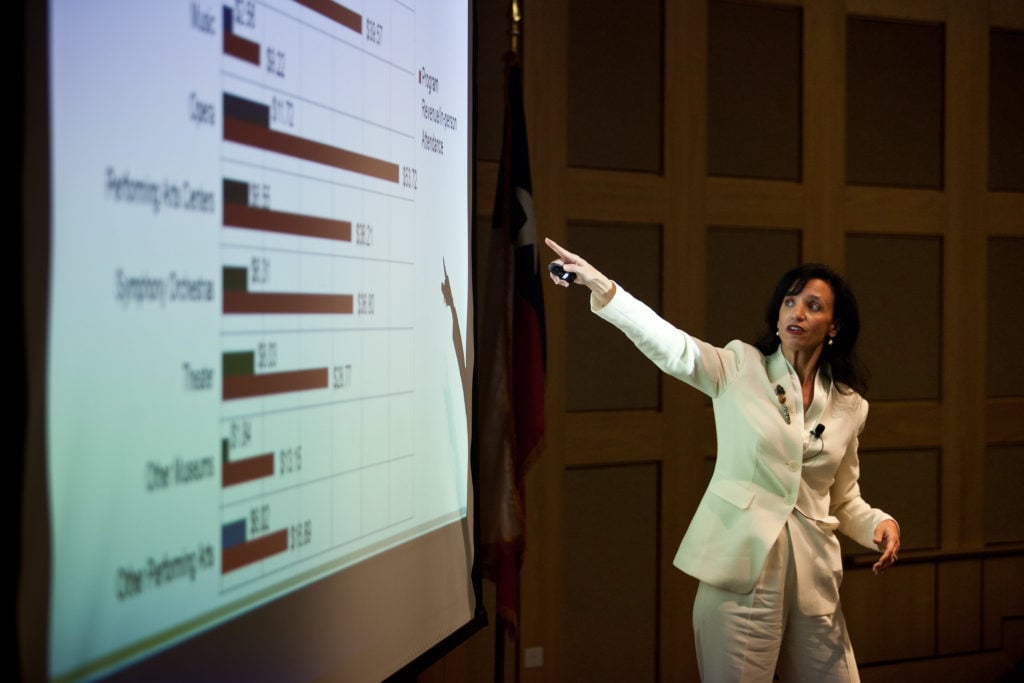
Zannie Voss, Director, SMU DataArts.
Photo by Kim Leeson.
The losses may be compounded by a reduction in public arts
funding down the line as local governments adopt new austerity
measures. “We haven’t even begun to see the ramifications on city
or state budgets and the hard decisions that are going to have to
be made as a result of that,” Voss said.
Reopening will look different for each individual organization
as they attempt to devise a timeline and a level of activity that
respects the health and safety of both employees and audiences. And
although some people will be eager to come together again,
especially for communal arts and culture experiences, there will
also be varying degrees of social scarring.
“When you think about how this crisis has impacted the lives of
those who have fallen of ill or have lost loved ones, there’s a
sense of fear and hesitancy, a discomfort with being in confined
spaces,” Voss said. “In a part of the country that has had
relatively little instance of people falling ill, perceptions are
going to be quite different than they would in a community that has
been hard hit.”
If cultural organizations close en masse, it will be a blow to
the nation’s GDP—the sector accounts of 4.5 percent of the nation’s
economy, according to the National Endowment for the Arts. But the
effects aren’t limited to jobs lost and tourism dollars
unspent.
“What I think is even more profound is the social loss. Arts and
cultural organizations have historically played a role as places
where people gather,” Voss said. “What you do now, how you treat
patrons and employees, that’s what everyone will remember after the
crisis recedes. Enough people have to care that you don’t go away
because of the value you provide to your community.”
But beyond the unprecedented challenges cultural institutions
face in the short term, the extended closures also offer a unique
opportunity to access their overall mission and core values.
“For the field as a whole, there is a good potential for
reimagining and understanding how to continue to be relevant, to
adapt,” said Voss. “There’s a lot of resiliency and there’s a lot
of imagination.”
The post American Arts Organizations Stand to Lose a
Staggering $6.8 Billion This Year as a Result of the Shutdown, a
New Study Says appeared first on artnet News.
Read more https://news.artnet.com/art-world/how-can-museums-adapt-to-long-term-closures-1863123
Further reading


Leave a comment