
An Archaeologist Who ‘Discovered’ One of the Earliest Crucifixion Scenes Is Going to Jail for Faking His Unbelievable Finds
A Spanish archaeologist who was celebrated in 2006 for
discovering one of the earliest representations of the
crucifixion has been found guilty of faking the find—and several
others.
Eliseo Gil has been sentenced to two years and three months in
prison for falsifying records and artifacts, including one that
incorrectly suggested that the written Basque language was six
centuries older than previously known.
The scam was “one of the greatest falsifications or
manipulations relating to archaeological materials from the Roman
world,” the lead police officer on the case told the court, as
reported by the Guardian.
Gil made headlines when he unveiled the results of excavations
in Veleia, a Roman town near the Basque city of Vitoria, claiming
his discoveries would “rewrite the history books,” but the
authenticity of the artifacts was soon called into question.
By 2008, experts had pointed out
several red flags. Some of the objects contained traces of
modern glue and references to nonexistent gods. The much-lauded
crucifixion scene read “RIP,” which contradicts Christian belief in
the divinity of Jesus.
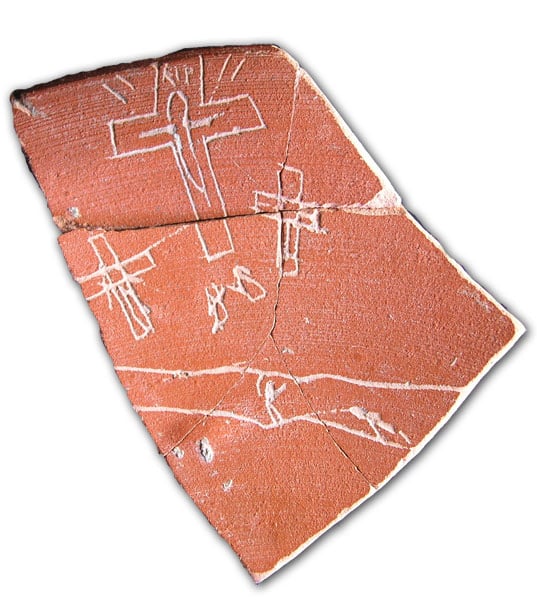
Spanish archaeologist Eliseo Gil claimed
this pottery shard was an early depiction of the crucifixion, but
the carving it has since proved to be a modern addition. Photo
courtesy of the Álava Provincial Government.
Also suspicious were markings on pottery shards that were
perfectly contained, as if they had been inscribed after being
broken. And the spelling, punctuation, and grammar in some of the
inscriptions was oddly anachronistic and riddled with errors
(Jupiter was written with a “J” instead of an “I,” even though
there is no “J” in the Latin alphabet, for instance.) Most
damningly, the field archaeologists on the dig could not recall
seeing these inscriptions, which turned up after lab analysis.
The court ruling against Gil determined that the 36
artifacts had been altered “with contemporary incisions that were
intended to suggest they contained inscriptions or markings of the
same age as the objects themselves, and that they possessed a
historical and cultural value of which they were devoid.”
To make matters worse, these actions irreversibly damaged the
authentic Roman artifacts.
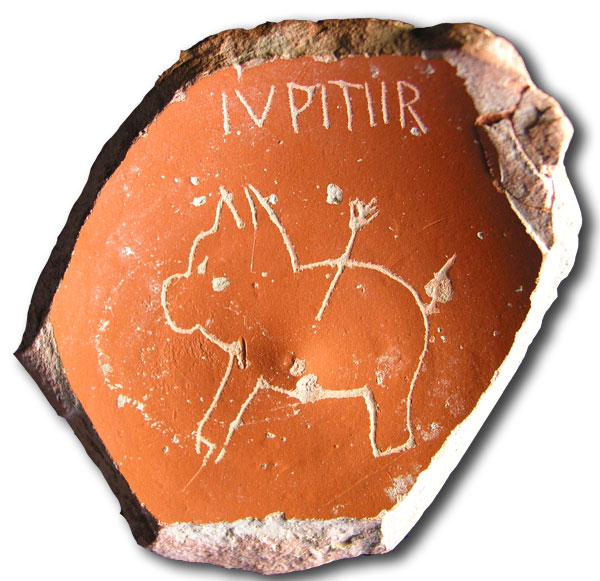
The placement of this artwork seem to
conveniently avoid the pottery’s broken edges. Photo courtesy of
the Álava Provincial Government.
Gil and his collaborator, physicist Rubén Cerdán, who
drafted false reports proclaiming the artifacts’ authenticity, were
found guilty of fraud and keeping false records, with a 15-month
sentence for Cerdán. The court ordered the men to pay the local
government which funded the archaeological dig €12,500
($14,000).
A third defendant, geologist Óscar Escribano, was sentenced to a
year in jail after pleading guilty earlier this year. He claimed
the incident was “nothing more than a joke,” according to El Diario.
Gil’s lawyer, Javier Martínez, said he would appeal the verdict,
telling the EITB radio station that
“it has not been proven that the pieces are false, nor, in the
event that some of them are false, who falsified them.”
The post An Archaeologist Who ‘Discovered’ One of the
Earliest Crucifixion Scenes Is Going to Jail for Faking His
Unbelievable Finds appeared first on artnet News.
Read more https://news.artnet.com/art-world/spanish-archaeologists-fake-discoveries-1885953
Further reading


Leave a comment