
Archaeologists Have Discovered the World’s Oldest Illustrated Book in an Ancient Egyptian Burial Site
Egyptologists have discovered the oldest copy of what is being
called the world’s first illustrated book, a 4,000-year-old edition
of the “Book of Two Ways,” an ancient Egyptian guide to the
afterlife considered to be a forerunner to the “Book of the Dead.”
The text predates previously known versions by some 40 years.
The find was first published in the Journal of Egyptian
Archaeology in September by Harco Willems, a
professor at the University of Leuven in Belgium.
Unlike modern books, these historic writings weren’t inscribed
on bound pages, but on the walls of sarcophagi. They were
meant to aid the deceased through the perilous journey to the
underworld, during which they might be beset by demons or raging
fires. If one were to cast the correct spells, he or she might
achieve immortality.
Though the plank’s inscriptions reference a governor named
Djehutynakht, Willems’s research has revealed that the coffin
originally held the remains of a woman named Ankh, referred to
throughout the text as “he.” That is in keeping with Egyptian
mythology, where rebirth was the purview of male deities, and dead
women adopted male pronouns to be more like Osiris, god of
death.
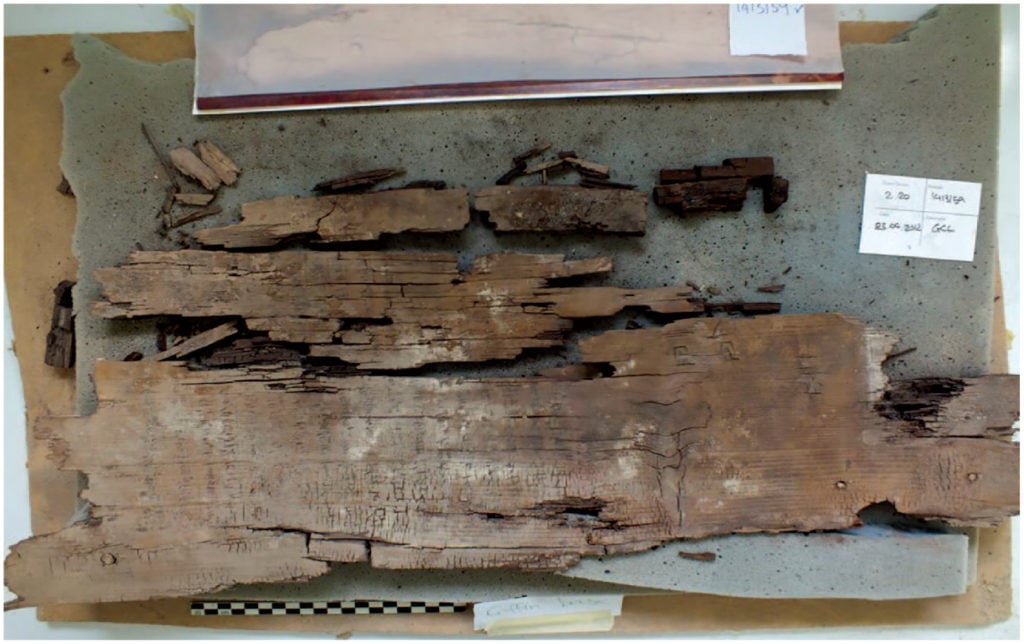
Coffin fragments bearing the earliest
known version of the “Book of Two Ways,” an ancient Egyptian text
considered the world’s first illustrated book. Photo courtesy of
Harco Willems.
“To me, what’s funny is the idea that how you survive in the
netherworld is expressed in male terms,” Willems told the New York
Times.
The Egyptologist has overseen digs at the Coptic necropolis
of Dayr al-Barshā, used as a cemetery during the Middle
Kingdom period, from about 2055 to 1650 B.C, since 2001. He
excavated the ancient coffin fragments from a burial shaft at the
complex of an ancient Egyptian provincial governor,
or nomarch, named Ahanakhtin, in 2012.
The fragile state of the artifacts, repeatedly ransacked by
looters long ago, prevented them from being studied until now.
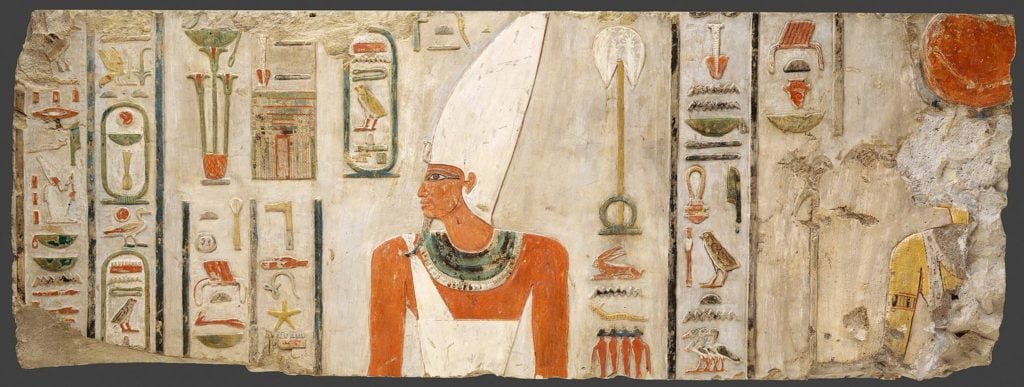
This image of Pharoah Mentuhotep II was
found at the site of Deir el-Bahri in Egypt. Photo courtesy of the
Metropolitan Museum of Art, New York.
The planks of wood bear carved ink inscriptions and painted
illustrations meant to ensure successful passage through the
netherworld to Rostau, the realm of Osiris. (The text is called the
“Book of Two Ways” because it offers instructions on how to travel
either by land or by water.)
The pigments, however, have faded with time, and the faint
markings are visible largely thanks to high resolution
imagery processed with DStretch software.
Based on inscriptions on other tomb artifacts referencing
Pharaoh Mentuhotep II, who reigned until 2010 B.C., Willems
believes this newly identified “Book of Two Ways” is at least four
decades older than any of the two dozen previously known versions
of the text.
The post Archaeologists Have Discovered the World’s Oldest
Illustrated Book in an Ancient Egyptian Burial Site appeared
first on artnet News.
Read more https://news.artnet.com/art-world/ancient-egyptian-oldest-book-1744110
Further reading


Leave a comment