
Art Dealers at Frieze Masters Are Hustling to Make Sales Despite a Low Supply of High-Quality Works
“What brings you here?” a well-dressed man asked Ari Emanuel,
the CEO of entertainment behemoth Endeavor, in the aisles of Frieze
Masters in London on Wednesday morning. “You know, we own this,”
Emanuel replied, arm extended for a handshake.
One might have forgiven the Hollywood executive for skipping the
VIP opening this year. Less than a week ago, Endeavor—which owns a
70 percent stake in Frieze’s parent company—abruptly postponed
its highly anticipated
initial public offering for the second time this year.
But nevertheless, Emanuel was in attendance alongside
well-heeled collectors and art-industry veterans
including Princess Eugenie of York, actress Kiera Knightley,
artist Tracey Emin, and curator Tom Eccles.
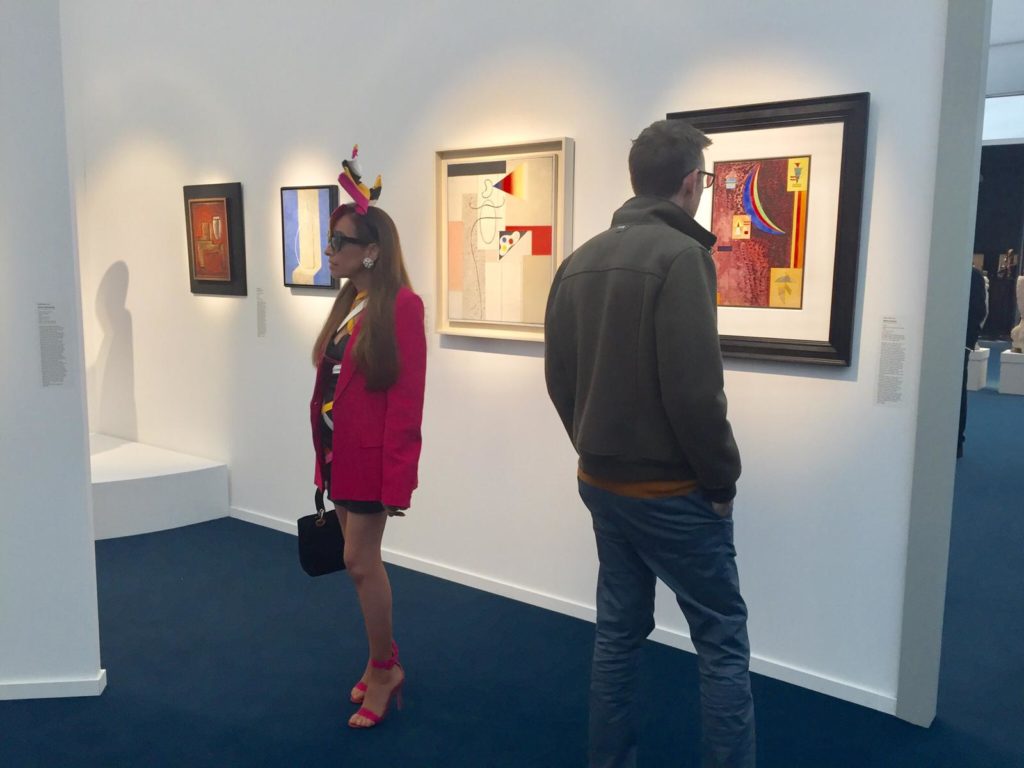
The scene at Frieze Masters. Photo:
Noami Rea.
Aisles were bustling in the first few hours of the fair, but
collectors were generally loathe to pull the trigger in a moment
characterized by uncertainty and caution thanks to Brexit jitters,
political tumult in the United States, and unrest in Hong Kong.
Another major challenge is supply: both in the London auctions this
week and on the private market, there is simply “not that much good
material right now,” notes one dealer.
Soon after the doors opened on Wednesday morning, Hauser & Wirth
announced the sale of a Cy Twombly oil-and-chalk work on paper from
1968, priced at $6.5 million. Meanwhile, Annely Juda Fine Art sold
a petite 1966 bronze by Naum Gabo for £50,000 from its booth
dedicated to Russian Constructivists; Galleria Continua sold a 1947
work by the Italian graphic designer Armando Testa
for £90,000; and Hazlitt Holland-Hibbert sold works by Peter
Phillips, Allen Jones, and Peter Blake for around £100,000
each. Gisèle Croës Gallery sold a pair of large cast-iron
basins, Japanese screens, and several other works for prices
ranging from €60,000 to €400,000.
At a time of circumspection, “people are looking for work that’s
rare, high quality, and correctly priced,” says Nick Olney of
Kasmin. The gallery brought one of the more expensive works on
offer at Frieze Masters: a lyrical abstract painting by Lee
Krasner, Moontide (1961), priced at $10 million.
It is one of the few paintings by the American artist that remains
in the collection of the Pollock-Krasner Foundation, which
consigned it.
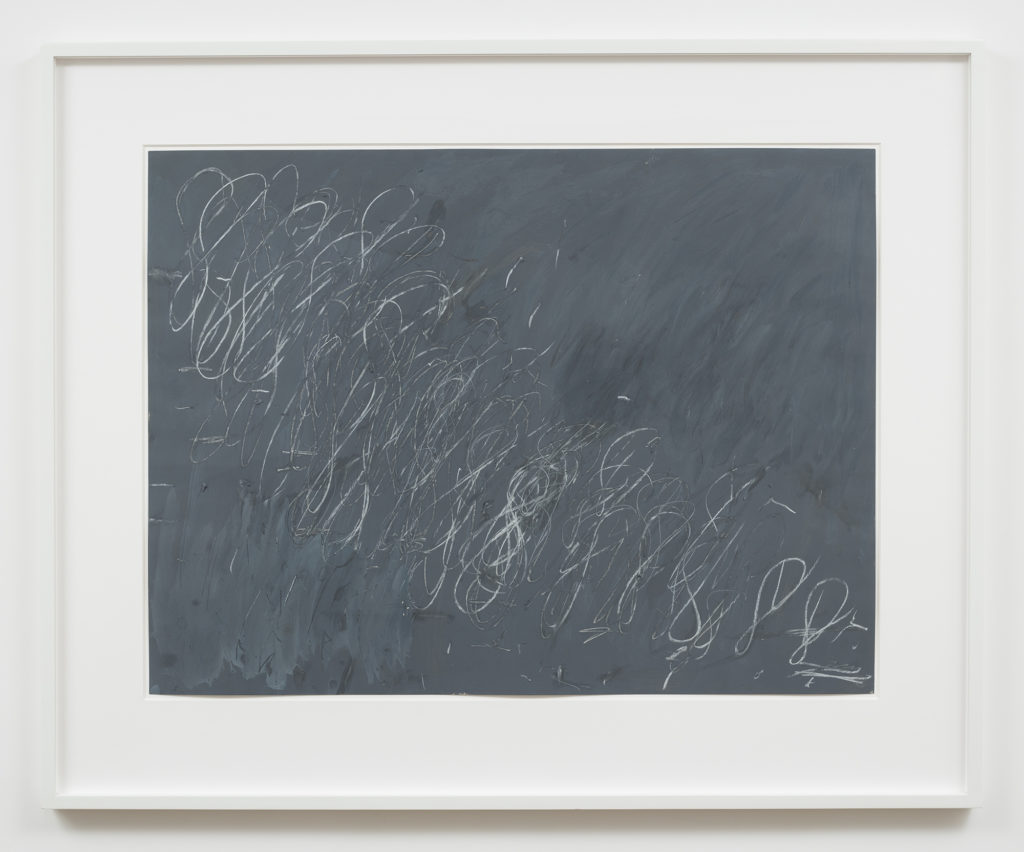
Cy Twombly’s Untitled [New York
City] (1968). © Cy Twombly Foundation. Courtesy the foundation
and Hauser & Wirth. Photo: Timothy Doyon.
London across Regent’s Park, where competition for highly
sought-after contemporary work can be stiffer. Most of the sales
finalized within the early hours of Frieze Masters had been lined
up in advance—and unlike in headier times, it seems that galleries
are having to hustle hard for every single deal they make.
Plus, because fewer major estates on the order of Rockefeller or
the travel magnate Barney Ebsworth are coming to market, dealers
and auction-house executives alike are scouting for works
piecemeal, often competing with one another for inventory.
“All this museum giving is taking a toll on the quality level”
of art available on the private market, says Franklin Parrasch, who
sold a sculpture by the late West Coast minimalist Tony DeLap for
$85,000 as well as a work by Dennis Hopper, whose paintings the
gallery now exclusively represents, for $45,000.
The impact is being felt most acutely at the top end: Total
auction sales of works over $10 million dropped by 35 percent in
the first six months of this year compared to the first half of
2018, according to the fall 2019 artnet Intelligence
Report.
Six- and seven-figure works on offer at Frieze Masters included
a Botticelli portrait, said to be the last in
private hands, at Trinity Fine Art, priced at $32 million;
an embroidered map by Alberto Burri that is reproduced on the cover
of the artist’s catalogue raisonné for €2.5 million
at Tornabuoni Art; and five of the 27 existing works
from Joan Miró’s masonite series, priced at $2.5 million each
at Nahmad Contemporary.
But perhaps as a result of the supply squeeze, many of the most
memorable presentations at the fair are of works that have long
been underestimated or overlooked by the mainstream art world,
rather than B material by familiar blue-chip names. This segment of
the market is a specialty of the fair’s Spotlight section, which
has been organized this year by Laura Hoptman, the director of New
York’s Drawing Center.
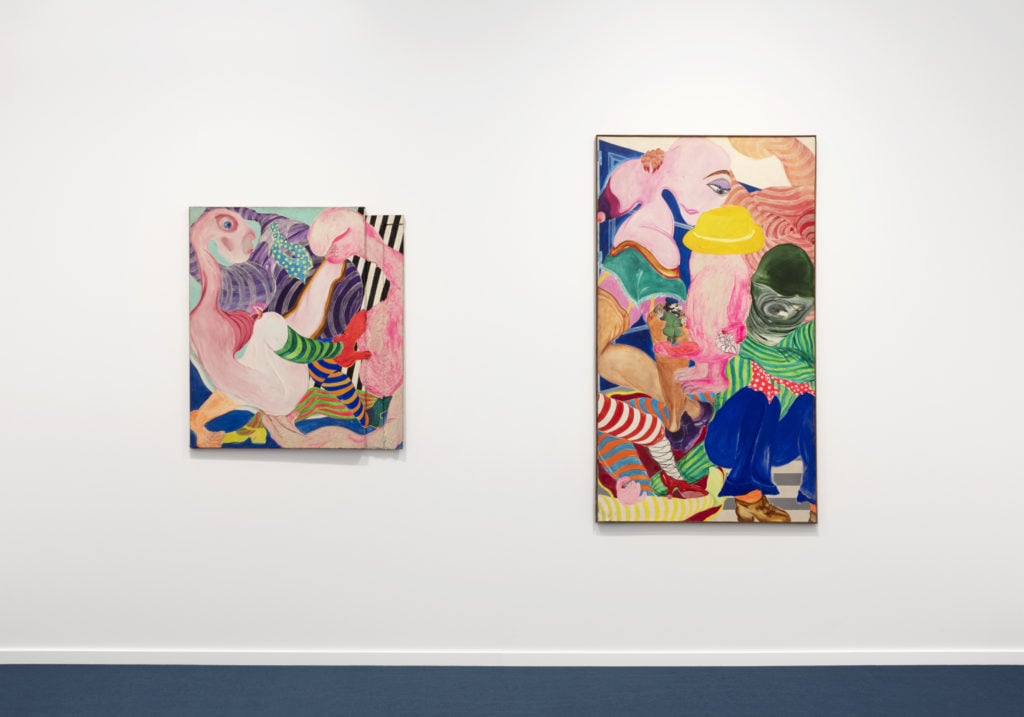
Works by Jacqueline De Jong at Frieze
Masters. Photo courtesy of Pippy Houldsworth Gallery.
A solo booth of exceedingly atmospheric black-and-white
photographs by the American artist Ming Smith is a particular
highlight. Although the artist was the first black female
photographer to have a work acquired by the Museum of Modern Art in
New York in 1975, she was largely ignored by the art establishment
in the ensuing decades, and does not currently have formal gallery
representation. (The Frieze Masters stand is presented by Jenkins
Johnson gallery of San Francisco.)
Another high point is the work of Jacqueline De Jong, an
80-year-old Dutch painter and activist whose irreverent paintings
of tangles of stockinged legs and lumpy faces look as if they could
have been made last year, rather than in the ’70s. Next month, the
artist’s solo exhibition organized by the Stedelijk Museum opens at
MoMA PS1 in New York, as does her first UK solo exhibition at Pippy
Houldsworth Gallery in London. Her paintings are on offer at the
gallery’s Frieze Masters stand for prices ranging from €24,000
to €45,000.
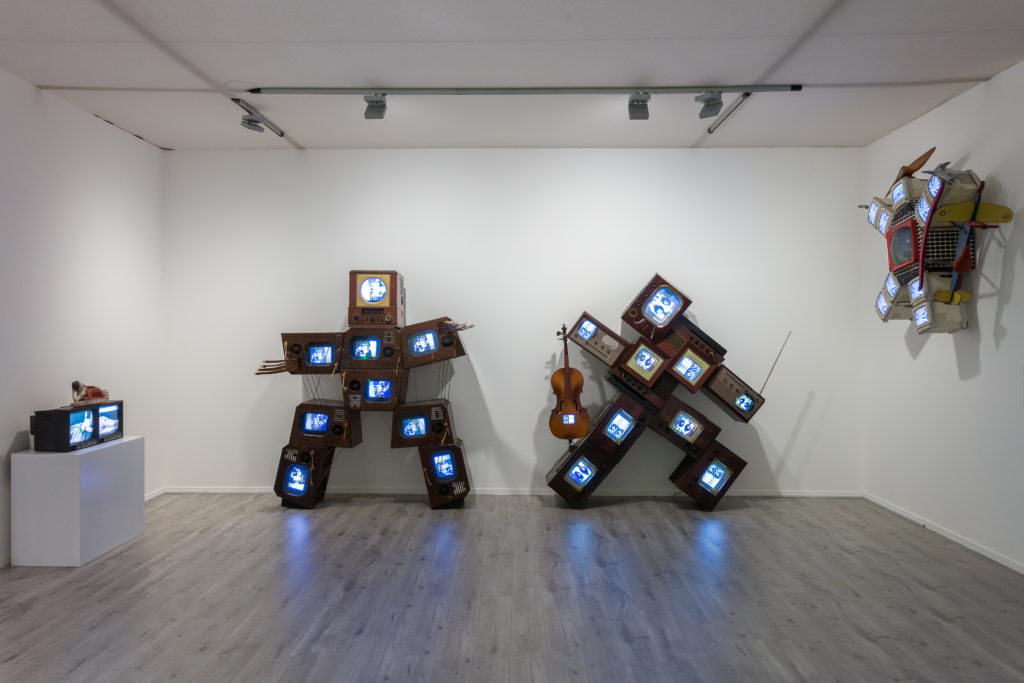
Nam June Paik at Gallery Hyundai at
Frieze Masters. Photo by Mark Blower, courtesy Gallery Hyundai.
And although his work is hardly unknown, the late video-art
pioneer Nam June Paik offers one of the most heart-pumping
presentations in the fair. A solo booth organized by Gallery
Hyundai serves as an appetizer for a full retrospective of the
Korean-American artist’s work opening at Tate Modern later this
month.
Buzzing, towering sculptures assembled from television sets,
musical instruments, and other cast-off materials are available for
as much as $1.5 million—but Patrick Lee, the gallery’s director,
insists the artist’s market has plenty of room to grow. In what
could be considered Frieze Masters’ unofficial slogan, he said
people may be somewhat familiar with the work—but “he’s
under-appreciated still.”
Additional reporting by Naomi Rea.
The post Art Dealers at Frieze Masters Are Hustling to Make
Sales Despite a Low Supply of High-Quality Works appeared first
on artnet News.
Read more https://news.artnet.com/market/frieze-masters-2019-1667377
Further reading


Leave a comment