
Art Schools of the Future Need to Teach Students to Understand Technology. How Will That Change the Future of Art?
Are you a sculptor? A painter?
An illustrator? For decades, art students starting out have asked
themselves these questions. But these categories could look very
different in the near future, as art schools belatedly attempt to
incorporate new technology into their curricula.
Earlier this year, one of the
world’s most prestigious art schools, The Royal College of Art in
London, announced plans to expand its
curriculum to include
science and technology. It was a watershed moment that suggested
some art educators are finally understanding that these subjects
need to be part of the academy in order to for it to survive the
digital age.
But how can art schools adapt to
this new paradigm, and how will the changes inform the kind of art
that will be made in the future?
A Culture Gap
There has been much discourse
about how education needs to expand from STEM to STEAM,
incorporating art and creative thinking into more right-brained
areas of innovation. But so far, the science sector has been more
open to welcoming art than the reverse.
According to the 2019 State of Art
Education Survey, 52.2
percent of art teachers want to learn more about teaching digital
art effectively, but only 21.9 percent of art teachers feel
comfortable actually teaching a digital arts curriculum.
Schools like the Massachusetts
Institute of Technology and New York University, meanwhile, have already incorporated arts
education into their historically science- and technology-led
curricula.
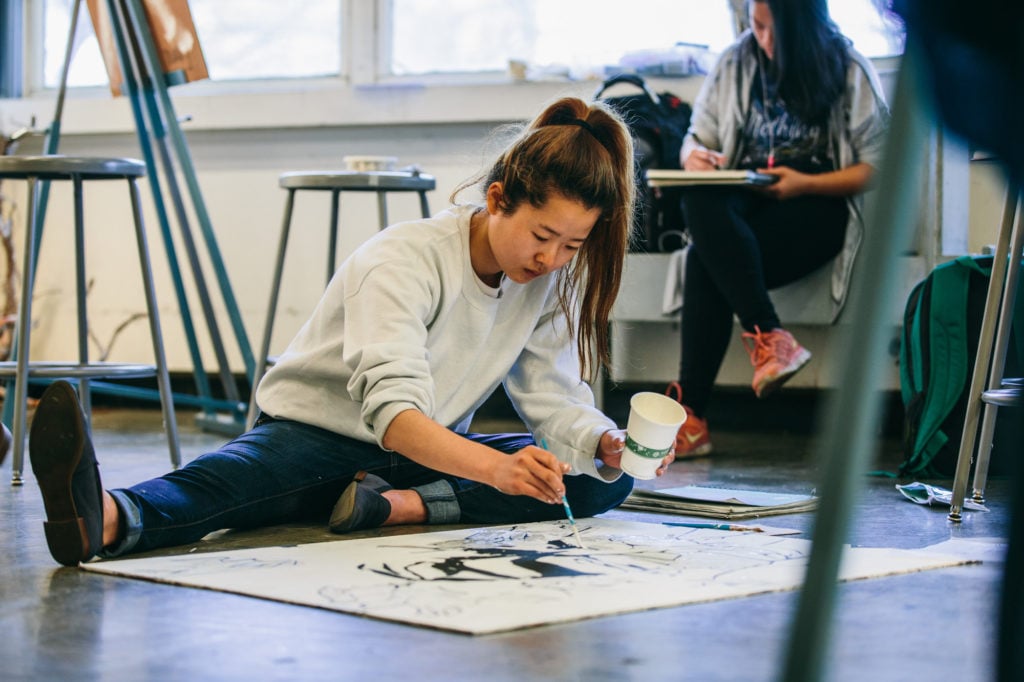
The University of Arkansas art school.
Courtesy of the University of Arkansas.
“Many art schools have been cautious to adopt anything that
feels too vocational or applied,” says Luke Dubois, an
associate professor of integrated digital media at NYU. “Art
schools need to focus on career training that stays within the
values of the arts.”
Professor Mick
Grierson, a research
leader at the newly opened Creative Computing
Institute at the
University of the Arts London, attributes the gap to ideological
friction between arts and technology. Some traditional creatives
are not only unsure how to integrate technology into their lessons,
but also hesitant to see coding and other tech stills as artistic
practices in and of themselves.
“There are plenty of people who, for decades,
have been in the art and design community but haven’t really been
able to find a home for their technology-led creations and
practice,” he says. “So of course, they naturally migrated to a
STEM environment because it’s easier for them to talk about the
materials they use and the approaches they take.”
As a result of this culture
clash, digital artist and educator Vicki Fong believes arts schools have missed a huge
opportunity—and art is suffering as a result. “People are using
digital skills to speed up the process, so more art is being made
at a much quicker rate, which doesn’t necessarily increase the
quality,” she says. “Digital art so far has been about production,
about churning things out. I think that mentality is shifting
now.”
How Can It Change?
One thing is clear: many artists
won’t just naturally begin incorporating technology into their work
without schools teaching them how. In a 2016 report,
“Discovering the
Post-Digital Art School,” arts educators Charlotte Webb and Fred Deakin note that “the notion of a current generation
of young digital natives who inherently understand the internet
with all its culture, grammar, and protocols, and who can
effortlessly create innovative digital content and projects in ways
that their teachers could never understand, is now acknowledged as
simply a paranoid myth,” they write.
There are schools that do
digital arts education well, like UCLA’s
Design Media Arts curriculum, which uses technology-powered art
processes without putting too much of an effort on
commercialization. As curator and cultural strategist Julia Kaganskiy
notes, schools that excel in this sector integrate both
technological thinking and practice. The field cannot simply be
viewed as an add-on—it’s critical for any artist who wants to be
able to respond to the state of the world.
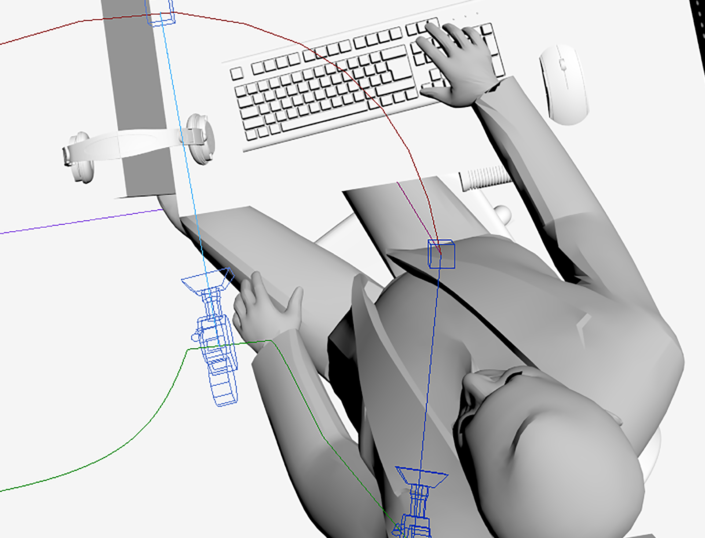
A counter investigation into the murder
of Halit Yozgat. Courtesy Forensic Architecture.
“As software, algorithms,
non-conscious cognitive agents and cybernetic thinking increasingly
shape the world around us, artists need to have a strong grasp of
the practical and philosophical implications of this
transformation,” Kaganskiy says. “I’m not saying that every artist
needs to learn to code, but they should probably read some media
theory and software studies texts, maybe even some posthumanist
philosophy.”
Brilliant technological arts
education needn’t only happen in formal learning environments. The
artist-run School for Poetic
Computation, founded in
2013, has students and faculty work together on projects to explore
the intersections of code, design, hardware, and theory. The idea
is that true digital arts education needs to be
collaborative—something that commercial technology spaces idolize
above all else—which is perhaps why some of the most successful
digital art is coming from groups like teamLab or
Forensic
Architecture, rather than
individual practitioners.
What Comes Next
In order for digital art to be
treated as seriously as analog art, however, experts say that
universities will need to adopt an even broader shift in
thinking.
“The biggest problem that digital art forms have
faced is that scarcity equals value, and being readily available
means these works essentially are worthless,” says Mick Grierson.
While some services now offer digital art as limited editions and
authenticate it using blockchain, the sector will inevitably require the art
world to broaden its understanding of value and access, at least to
some degree.
Vicki Fong thinks that the
future of digital art will be exhibited in online, virtual
spaces. “There is already
emerging this market where individuals that are interested in
buying digital assets,” she says. “If we think about Millennials
and Gen Z who may not own physical spaces but who have more of a
digital online existence—they will want these assets to dress their
virtual spaces.”
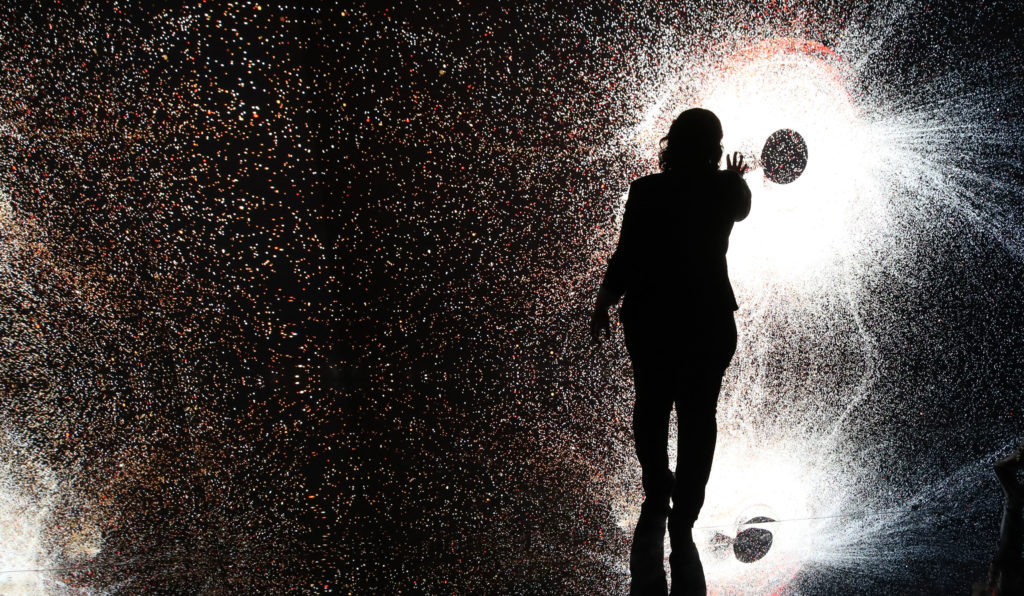
An immersive artwork replicating the
experience of stepping into the gravitational waves of a black hole
by audio-visual pioneers Marshmallow Laser Feast, installed in the
1830 warehouse at Manchester’s Science and Industry Museum, as part
of Manchester Science Festival. (Photo by Peter Byrne/PA Images via
Getty Images)
The technification of the art
school curriculum still has a long way to go, and art educators
need to do more than just prep students with Adobe suite skills.
Considering that art school will cost students an average of
$64,068 in the US and between £35,000 in
the UK, potential art
students need to be reassured that the education can be tailored to
the contemporary art landscape.
The appetite is there: Earlier
this year, the VR art collective Marshmallow Laser
Feast was the subject of an exhibition at the Saatchi
Gallery, which was not
only a sold-out hit, but was also extended for an additional five
months, showing that audiences have a strong appetite for digital
art that is both thoughtful and critical.
Despite the fact that
the first computer art
exhibition took place in 1965, art schools are still slow to put
computerized art into the hands of artists instead of commercial
tech mavericks. “It’s like the art school has handed the baton of
creativity over to the computer scientists and programmers, who
often make terrible art,” says digital artist Alan
Warburton.
And indeed, whether a work of
art is made with acrylic paint or code, some say the qualities that
make it meaningful are the same—and that is something only art
schools can teach. “Too often artists (and curators, and audiences)
get caught up in the novelty of the tool itself and sacrifice
substance in the process,” Kaganskiy says. “It’s fine to explore a
tool’s formal and aesthetic possibilities, but art needs something
to say. Technology will continue to change, but that desire for
connection or transcendence is constant.”
The post Art Schools of the Future Need to Teach Students to
Understand Technology. How Will That Change the Future of Art?
appeared first on artnet News.
Read more https://news.artnet.com/art-world/art-school-tech-adapt-1742802
Further reading


Leave a comment