
Artists Gathered at the Fotofocus Biennial to Debate How Tech Is Changing Photography. The Conversation Got Truly Terrifying
The latest effort of
Cincinnati-based photography biennial Fotofocus was all about how
the very premises of photography are coming apart.
With the rise of artificial
intelligence and increasingly sophisticated deepfake technology
making news, the day-long symposium, “AutoUpdate: Photography in the Electronic
Age,” brought together some of the sharpest
artists and thinkers in the field working on the photographic
image. The message was loud and clear: Things are grim.
Talks and presentations by
Trevor Paglen, Lynn Hershman Leeson, Josh Kline, and Michelle Kuo set out to catalogue and
address how digital technologies impact image-making—and
seeing—today. The
impact is likely much more fundamentally significant than you
realize.
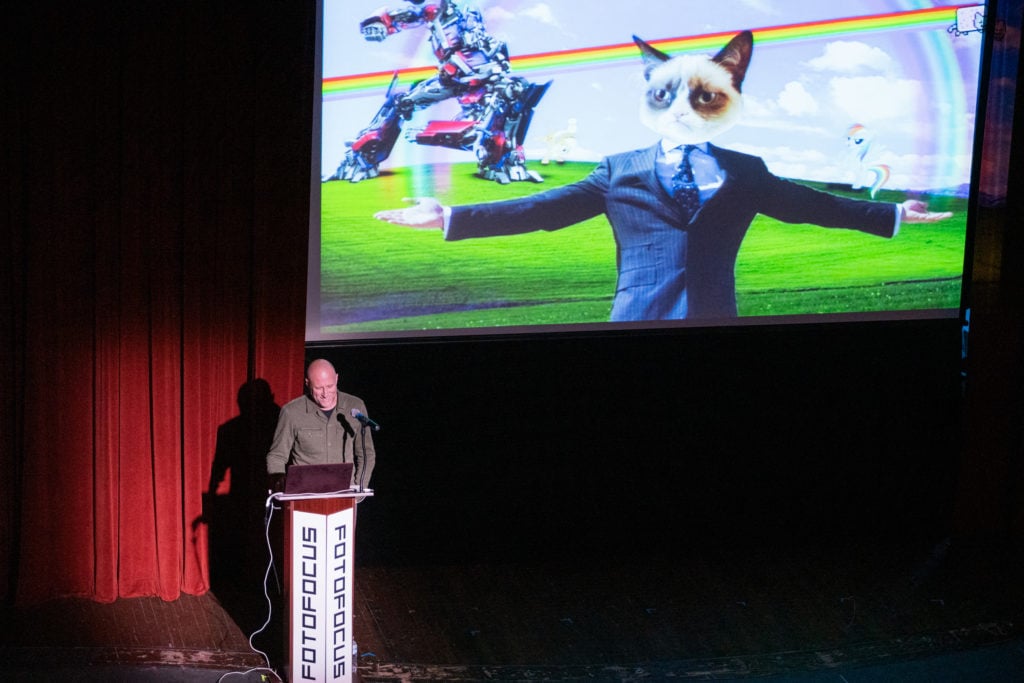
Trevor Paglen speaking at Fotofocus.
Photo: Jacob Drabik.
For much of its history, a
photograph needed a human viewer to exist or have
meaning. Today, the
paradigm has shifted dramatically.
“We’ve probably reached a moment
in history when most of the images in the world are by machines,
for other machines,” said Paglen in his keynote lecture. “Machines
themselves are doing most of the image looking in the world…. We
have autonomous systems that are doing the looking and the
interpreting for us, and doing it at vast scales that are almost
incomprehensible to us.”
Indeed, machine eyes are
omnipresent. They scan social media profiles and security
databases. They monitor our
movements in airports and parking garages and register our license
plates as we pass a traffic light. They watch us watch tv and
follow us around shopping malls, trying to glean information about
what products we might be interested in buying. And they do all
this at a far greater rate than we do.
But worse still, they don’t just
watch; they judge.
Paglen discussed his recent
project ImageNet Roulette, an app he created with AI researcher
Kate Crawford that reveals the biases embedded into
image-recognition systems. The program, which went viral
last month, allows users
to upload a photo of themselves, then spits out an AI-generated
label based on the features of their person. More often than not,
the designations are deeply problematic: “criminal,” “loser,”
“Jihadist.” This highlights how choices are already being made for
citizens by technological forces that have taken on an independent
life of their own.
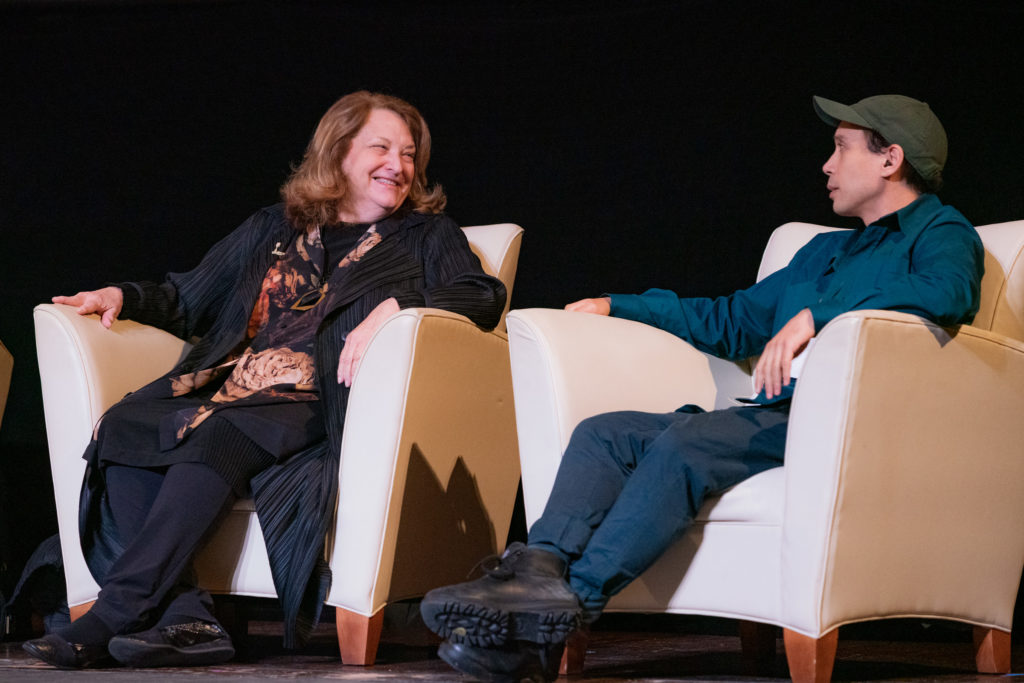
Lynn Hershman Leeson with Josh Kline.
Photo: Jacob Drabik.
Other panelists, too, described
a distrust of systems and institutions, especially those of the
state.
Hershman Leeson discussed her
current research into predictive policing—an analytical technique
used by authorities to identify locations of potential crime that
has been widely criticized by social justice organizations for its
reaffirmation of racial profiling. On the same panel, Kline discussed his work
investigating the surveillance state.
The accumulated implications
were alarming. Summing things up, Michelle Kuo, a curator at the
MoMA and the moderator of the talk with Kline and Hershman Leeson,
quipped, “Well, good luck to us!”
“To me, that comment encapsulated the whole
program,” Kevin Moore, a curator who serves
as artistic director of Fotofocus, told me later.
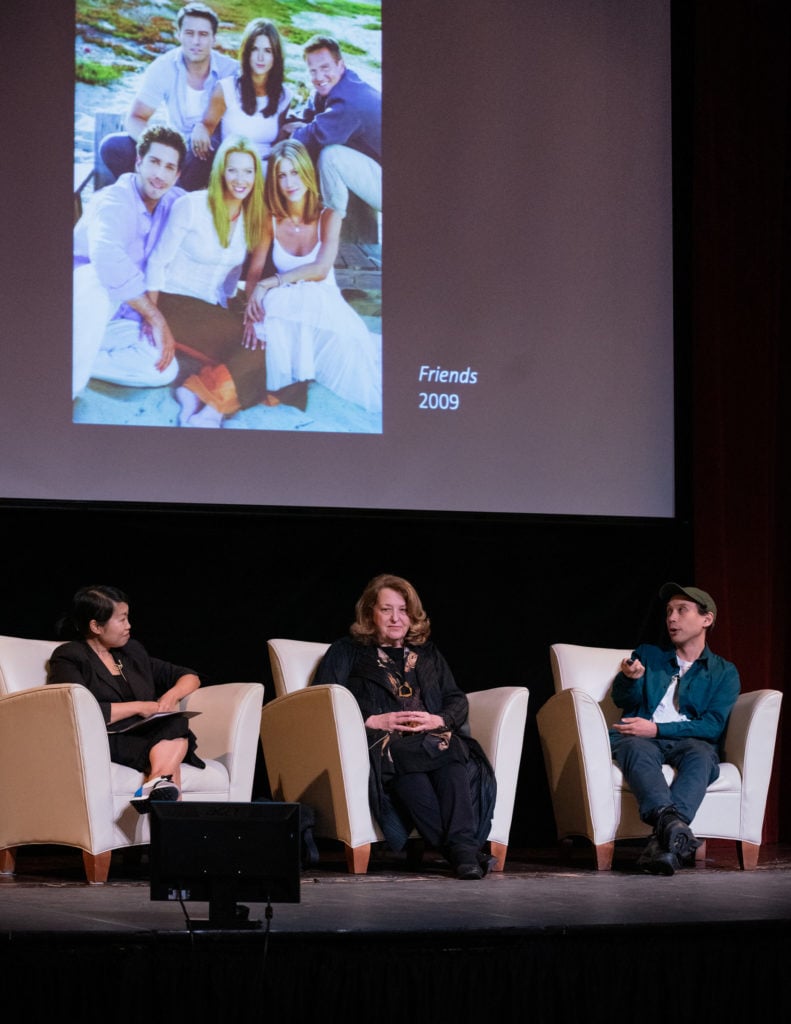
Michelle Kuo with Lynn Hershman Leeson
and Josh Kline. Photo: Jacob Drabik.
Still, he says that he was inspired to see people debating the
problems of the day with some depth. As a historian of photography,
he also notes that thinkers have long known that photos don’t
reflect objective truth, and that how we look is coded by various
forms of ideology.
“I’ve always thought that
photography’s not really about objectivity. It’s about different
competing forms of realism,” Moore explained. “We have to look at
discussions of photography in this moment as being colored by a
politics of absolute competing realities. We have a president who
insists on whatever reality suits him, even in the face of contrary
evidence, in the face of science. And that’s not just him—we live
in a world where that’s become a technique for selling things or
evading retribution for our actions.”
That gives conversations like this
one stakes that go well beyond art. “There are real consequences to
which of those realisms dominate, which realisms
win,” Moore explains. “And photography has become a tool
in that war.”
The post Artists Gathered at the Fotofocus Biennial to
Debate How Tech Is Changing Photography. The Conversation Got Truly
Terrifying appeared first on artnet News.
Read more https://news.artnet.com/art-world/fotofocus-autoupdate-1675759
Further reading


Leave a comment