
As Health Concerns Put a Stop to Public Gatherings, New York Auction Houses Face a Reckoning—But Still Refuse to Cancel Major Sales
On Friday, as galleries and museums around New York started closing en
masse to prevent the spread of coronavirus, the major auction
houses in the city were silent. Then, at around 8 p.m., Christie’s
sent out a notice that most of its offices around the world would
close and that sales would be called off through April—but, at
least for now, its bellwether Modern and contemporary art sales in
New York would continue in May.
Phillips was more precautionary, closing offices in the US and
Europe and delaying its 20th-century and contemporary art evening
sale, which typically runs as part of New York’s May auction
week.
Sotheby’s, meanwhile, took the most lenient approach of all. No
sales would be cancelled, including the design and photography
sales set to be held in New York—live from the York Avenue sales
room, with the rostrum packed with specialists—in less than three
weeks. None of its galleries would be closed to the public.
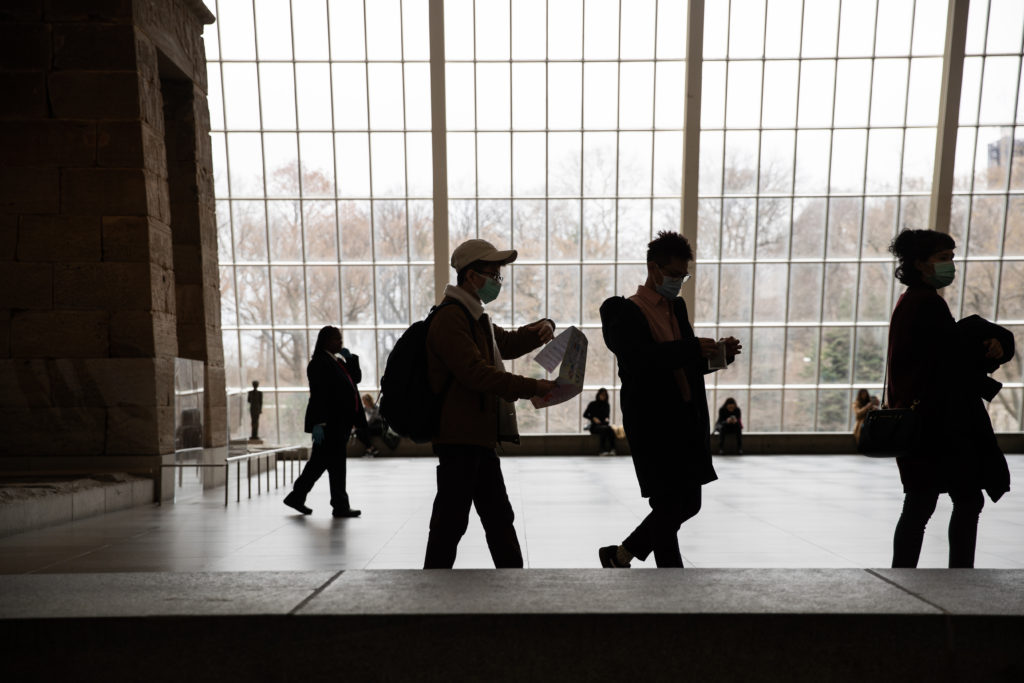
Tourists wearing protective masks at the
Metropolitan Museum of Art on March 10, 2020 in New York City. The
museum announced it would close Friday because of the COVID-19
pandemic. (Photo by Jeenah Moon/Getty Images)
Rather than urge art-lovers to self-isolate to prevent the
spread of the disease to the more vulnerable, Charles F. Stewart,
the CEO of Sotheby’s, encouraged the public to see exhibits at
Sotheby’s in New York and London (“a particularly inventive
exhibition that shouldn’t be missed!” he said of a show in London,
exclamation point Stewart’s). “Over those nearly three centuries,
we have successfully managed through all manner of
circumstances—from world conflicts to market downturns—and we will
manage in this instance as well,” he said.
Keeping Course in the Storm
That sentiment now seems like it’s a world away—a testament to
how quickly both official regulations and social mores are
changing. On Monday, New York Governor Andrew Cuomo banned all
gatherings of more than 50 people, following the Center for Disease
Control’s earlier message that such limits on crowds be in place
for at least eight weeks. With the virus expected to not peak for
months, it’s become impossible to image a scenario in which an
auctioneer presides over a packed salesroom, flanked by specialists
spewing phlegm into their phones.
And yet, the two members of the global auction house duopoly
insisted that, by hook or by crook, their blockbuster sales would
go on. As of now, the springtime spree of conspicuous consumption
that’s often dubbed a “gigaweek”—in the past, the houses have
grossed billions of dollars between them in a matter of days—would
proceed.
By Monday night, Christie’s issued the same statement it put out
on Saturday, noting that “we continue to assess the situation daily
and make appropriate arrangements to help ensure the health and
safety of employees and visitors to our salerooms and galleries
worldwide.”
“Christie’s is currently working through a restructuring of its
forthcoming auctions, including significant changes to the sales
calendar in the Americas and Europe. In the meantime, the following
sales scheduled for March and April are postponed, with the
announcement of new dates to come shortly,” the statement
continued.
And late Monday, Sotheby’s sent out a notice indicating that it
would take the auctions that it had previously moved from a
coronavirus-panicked Hong Kong to a then-safe New York—and move
them back to Hong Kong, now in July. (Other changes
include indefinite postponements of a number of Paris auctions.)
But the bellwether May sales would stay on the schedule, expected
to be held as if we lived in normal time. Any changes to that plan
will be made 30 days before the event, Sotheby’s announced.
“Sotheby’s is technologically equipped to operate in a variety
of scenarios and, based on conversations with both consignors and
bidders, we are considering a number of formats to provide for
sales to proceed in the most effective manner,” the house said in a
statement.
Postpone to Summer?
Even if the sales have not been officially cancelled, given the
restrictions in place—and the real chance that they get much, much
worse—several advisors said that at the very least, the sales would
have to be postponed.
One suggested that the May evening auctions be pushed to June, a
month which will almost definitely have a big hole left by an
expected-to-be-pushed Art
Basel in Switzerland. In the past, the auctions had come right
after Frieze New York, but given that fair’s rumored postponement
or cancellation, Christie’s and Sotheby’s wouldn’t lose anything by
moving to another, more auction-centric month.
“June is already a sale season due to the fact that London has
their sales in June,” said one advisor when reached on the phone—or
rather, via FaceTime audio, due to the poor cell signal in remote
locations members of the art community have escaped to. (Like other
advisors quoted in the story, this one requested anonymity; the
world might be ending, but there’s no reason to anger the world’s
biggest auction houses before it does.)
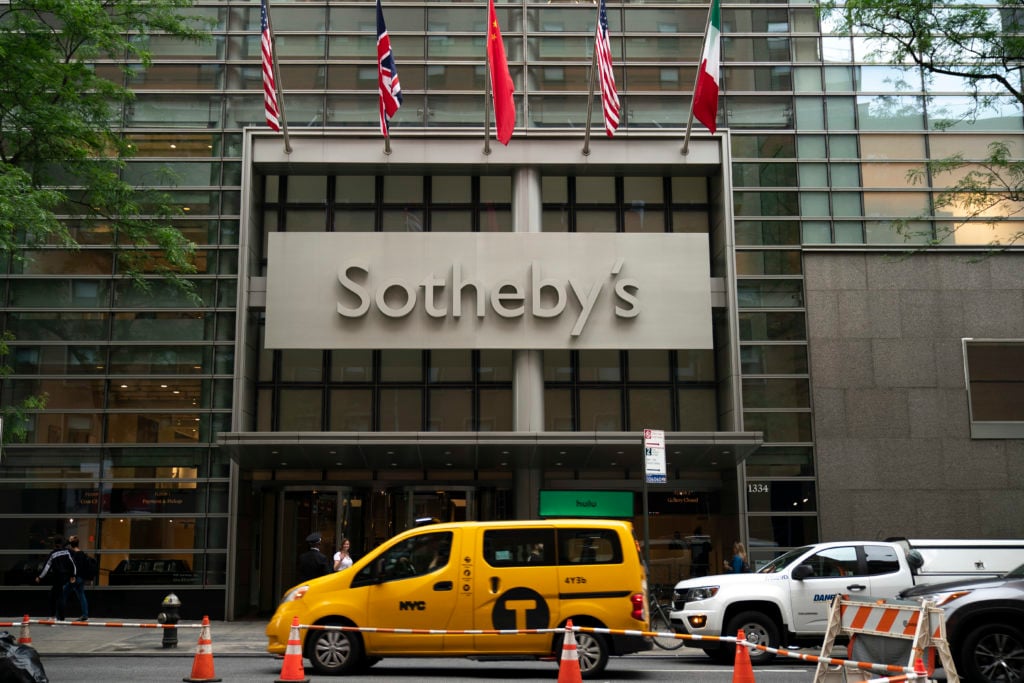
Sotheby’s headquarters on the Upper East
Side in Manhattan. (Photo by Drew Angerer/Getty Images)
Social-Distance Auctions?
Postponement is a natural response, though perhaps an optimistic
one. Who knows if gatherings of more than 50 people will be allowed
by June, especially if the president has said that our previous way
of life will not return in full until July or August? One option
floated was to have the auctions live-streamed with just an
auctioneer but no audience, presidential debate style, and a few
specialists the mandated six feet away from them (perhaps in some
Saville Row-designed hazmat suits). Collectors could watch from the
Hamptons and bid through their favorite specialist. Don’t the real
buyers opt not to show up anyway, and have their surrogates do the
dirty work?
Art Basel’s online viewing room, which opens this week,
could offer a model for high-priced virtual art purchasing. But
several advisors pointed out that the scheme might not work for
sales that were expected to feature eight-figure lots from
collections as high-profile as Linda
and Harry Macklowe’s. Such pictures would almost certainly be
pulled.
“What consignor would want their property sold under such
circumstances?” one advisor said.
No Sale, No Overhead
There’s also the problem of condition reports. One source
explained that, while a good chunk of collectors pre-buy work from
dealers prior to the VIP openings of fairs solely based on seeing
JPEGs on an iPad, that is almost always primary work straight from
an artist’s studio, where condition is rarely an issue. Most
collectors would want to see a work that has passed through many
hands up close before spending millions.
While it would be bad for optics momentarily, the more
logical—and overwhelmingly safer—choice would be to cancel the
sales entirely. There could even be a silver lining in that, while
the prices will be lower than they were last November, deal-seeking
collectors would be able and willing to buy works privately. (The
fate of the Marron
collection has already proven that to be a fruitful
direction.)
That way, houses can avoid having to come up with estimates for
every lot as well as the entire business of compiling and printing
auction catalogues. Even a live-streamed sale could be a little
pricey—not to mention poor optics if a number of works are bought
in. “A better use of their skill set and human capital is
getting their best people targeting work and brokering private
sales,” said another advisor.
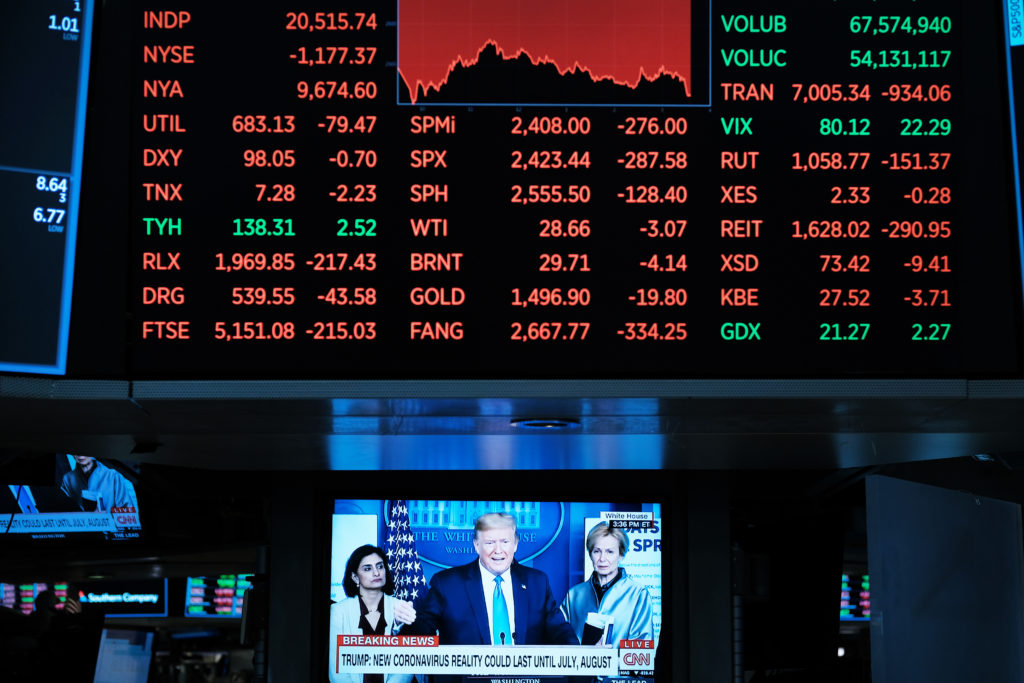
President Trump is displayed on a
television on the floor of the New York Stock Exchange (NYSE) on
March 16, 2020 in New York City. Stocks again fell sharply on Wall
Street despite a drop in interest rates. (Photo by Spencer
Platt/Getty Images)
“Radio Silence”
More than mere speculation, sources expressed an overwhelming
sense of dread about where the art economy is headed. Several
compared what is happening now to the 2008 recession, while others
mentioned 9/11. There is a feeling that the economy won’t bottom
out until there’s a realistic idea of how many people are going to
be affected by the disease, and how hard cities will be hit.
There’s a fear that Monday’s 3,000-point drop in the stock market
might not be the worst of it. I asked one dealer how business has
been in the last week. “Radio silence,” they said.
For that reason, another dealer said that any attempt to hold a
major auction—whether it in a new location or streamed live
online—is likely to be a major loss. “They can hold the things in
space,” the dealer said, “but if no one feels in the mood to buy
art, does it even matter the format?”
The post As Health Concerns Put a Stop to Public Gatherings,
New York Auction Houses Face a Reckoning—But Still Refuse to Cancel
Major Sales appeared first on artnet News.
Read more https://news.artnet.com/market/auction-coronavirus-cancelled-1806282
Further reading


Leave a comment