
As Hong Kong’s Economy Wavers, Singapore Wants to Become a Destination for Southeast Asian Art. Can a Tiny Art Fair Help the Cause?
Laughter, chatter, and the pop
of champagne corks offered a swanky soundtrack to the VIP preview
of S.E.A. Focus, the upstart art fair in Singapore that concluded
its second edition on Sunday. The fair, held inside the pristine,
air-conditioned central hall of Singapore’s dedicated art district
Gillman Barracks, attracted visitors from across Southeast Asia and
served as a clear articulation of the city state’s ambition to
become a regional art hub.
Indeed, just like Singapore’s
perfectly manicured tree canopies, the intimate, smart-looking art
fair—or platform, the term preferred by its organizers—was no happy
accident. It was, instead, the product of a carefully coordinated
effort on the part of the government to drive arts development. The
commercial platform, which focuses on Southeast Asian contemporary
art, has taken on an increasingly important role following the abrupt cancellation
last year of Art Stage Singapore, formerly the region’s most
prominent art fair.
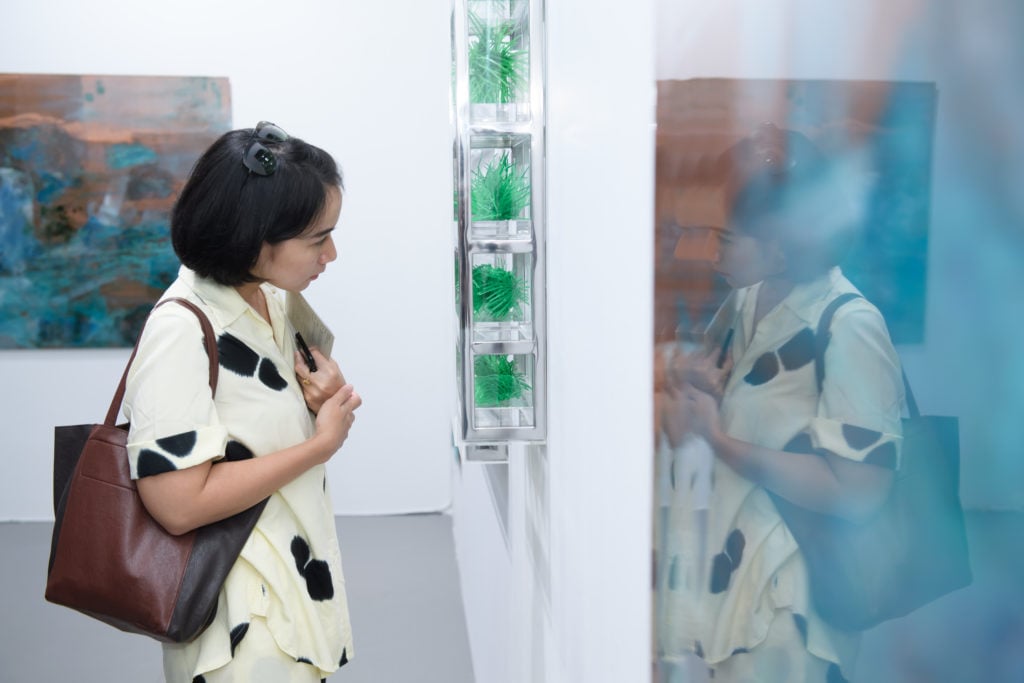
A visitor inside the FOST Gallery booth
at SEA Focus 2020. Image courtesy of STPI—Creative Workshop &
Gallery.
“People from our region trust
auction houses more when it comes to buying art, even antiquities,”
said Emi Eu, the director of STPI–Creative Workshop & Gallery, which
organizes S.E.A. Focus.
“Sotheby’s and Christie’s play such a huge role in our market. For
years, we have been trying to recalibrate that. But now that Art
Stage is no longer with us, we hope that we can contribute on a
small scale.”
Compared with other art markets
in the region, like Indonesia and Hong Kong, the market in
Singapore is relatively small. The city state has not managed to
attract or retain international galleries the way Hong Kong has,
despite national investment. But Eu hopes S.E.A. Focus can grow
into a hub for the wider region—particularly at a moment when Hong
Kong is suffering from both
political upheaval and a recession.
“We hope to not just bring
Southeast Asian art to the forefront, but also to bring everyone
together through a platform that can send a message to the outside
world,” she said.
A Top-Down Effort
Compared with Art Stage, which
hosted around 100 dealers in
2018, S.E.A. Focus is small, with just 20 exhibitors in 2020. But
thanks to its dedicated backers, it is likely to outlast other
regional fairs that have struggled to stay
afloat in recent years.
The National Arts Council
Singapore, which plays a key role in driving Singapore’s cultural
development, helps fund the fair. Organizer STPI Gallery is also
backed by the government, with its Gillman Barracks venue and
around 25 to 30 percent of its annual budget covered by public
funds. Along with the ongoing Singapore Biennale, the fair is a
centerpiece of Singapore Art Week 2020, also a government-backed
initiative.
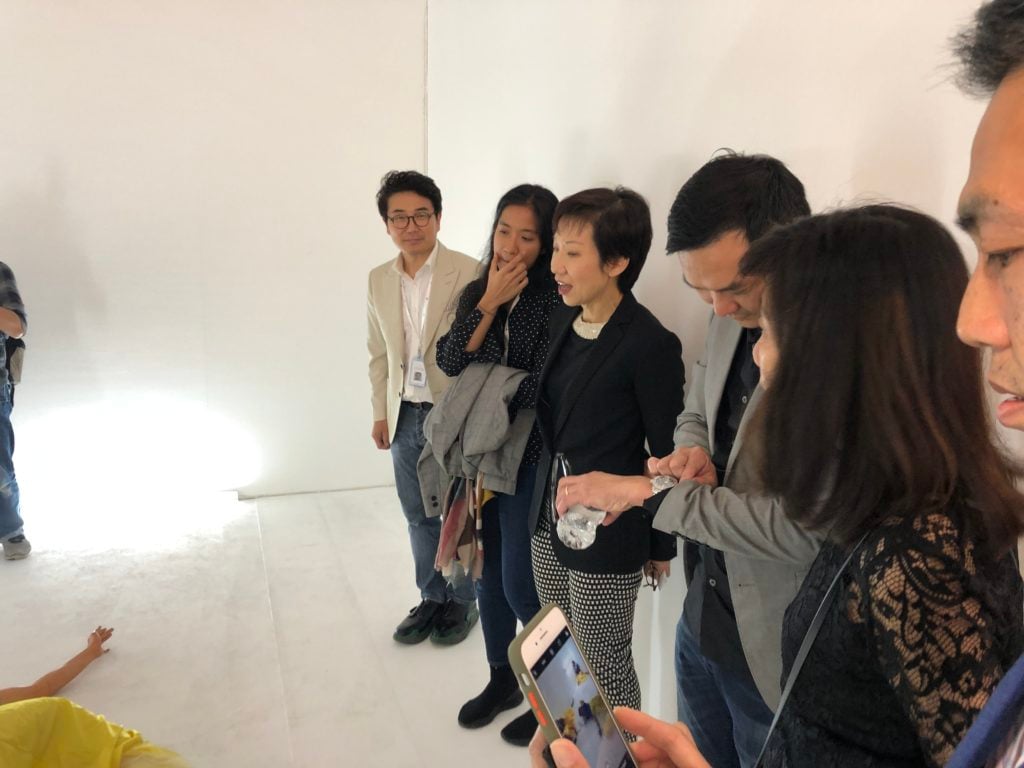
Grace Fu, Minister for Culture,
Community and Youth (center), was engaged in a conversation with
artist Eisa Jocson (second from left) discussing her work at the
booth of The Columns Gallery booth at S.E.A. Focus. Photo: Vivienne
Chow.
Indeed, Singapore—a former
British colony and then a part of Malaysia that didn’t become
independent until 1965—takes
art seriously. As Grace Fu,
Singapore’s minister for culture, community, and youth, pointed out
in a speech at the fair’s vernissage, the arts help define the
nation’s identity. The fair’s mission “to discover, appreciate, and
understand Southeast Asian art and artists better” is in line with
the government’s official four-year arts plan, which aims to
position Singapore as a global destination for art viewing, making,
and buying.
And while the direction is
top-down, its execution comes down to individuals. “We are a really
good example of public-private partnership,” said Eu, who first
visited Singapore in 1996 and relocated to the Lion City from the
US in 2001. “Speaking as an outsider, it’s quite extraordinary. It
is feasible because it’s a small city state.”
It also helps that Singapore’s
economy and political leadership is stable, fueled largely by the
banking, biotech, and energy sectors. “In light of what’s happening
around the world these days, the Singaporean government gives us
stability and assurance that we can continue to move forward,” Eu
said. “We have to be discerning, take the good and run with
that.”
Southeast Asia in Focus
The intimate second edition of
S.E.A. Focus drew galleries
from cities ranging from New York and Berlin to Beijing and
Seoul. The only common ground was their choice of art—they all
presented work by artists who come from or have strong ties to
Southeast Asia.
The result was an
easy-on-the-eyes, if not challenging, fair characterized mainly by
solo or duo presentations of regional contemporary art. Yavuz
Gallery mounted a solo presentation of Singapore-based Luke Heng;
STPI presented the Thai artist Pinaree Sanpitak and Indonesian-born
Melati Suryodarmo; Vitamin Creative Space, which has spaces in
Guangzhou and Beijing, presented work by the Vietnam-born Danish
artist Danh Vō.
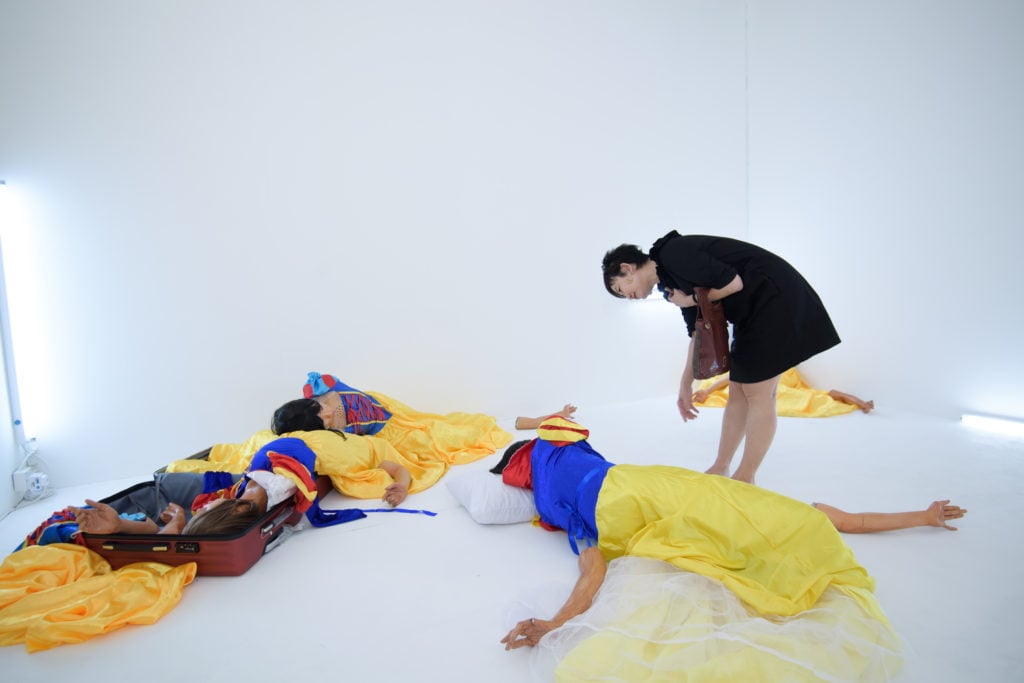
Installation view of the Columns Gallery
booth at SEA Focus 2020. Image courtesy of STPI—Creative Workshop &
Gallery.
Participating dealers were in
good spirits by the end of the first day. Sullivan+Strumpf, which
has spaces in Singapore and Sydney, sold many of the fossilized
sculptures it brought by Singaporean artist Dawn Ng for undisclosed
prices. “The fair is small
but the quality is high,” said the gallery’s owner Ursula Sullivan.
“It brings together a proactive group of Southeast Asian galleries
and collectors.”
The Columns from Seoul held a
solo presentation of Eisa Jocson from the Philippines, who won the
2019 Hugo Boss Asia Art Award. Jocson’s eerie sculptural
installation Becoming White, which consists of figurines of broken limbs
dressed up as Disney’s Snow White, was a key attraction at the
fair. Dong Jo Chang, the gallery’s president, said a number of
works were on reserve on opening night.
An Alternative View
While S.E.A. Focus was having a
successful run at the immaculate Gillman Barracks, a grungy pop-up
art space on the other side of the city offered an alternative view
of the Singapore scene and its potential future. A former ship
repair workshop and warehouse at 2 Cavan Road became an exhibition
space for Twenty
Twenty, a project
spearheaded by the Singapore Arts Club, founded by art entrepreneur
Audrey Yeo.
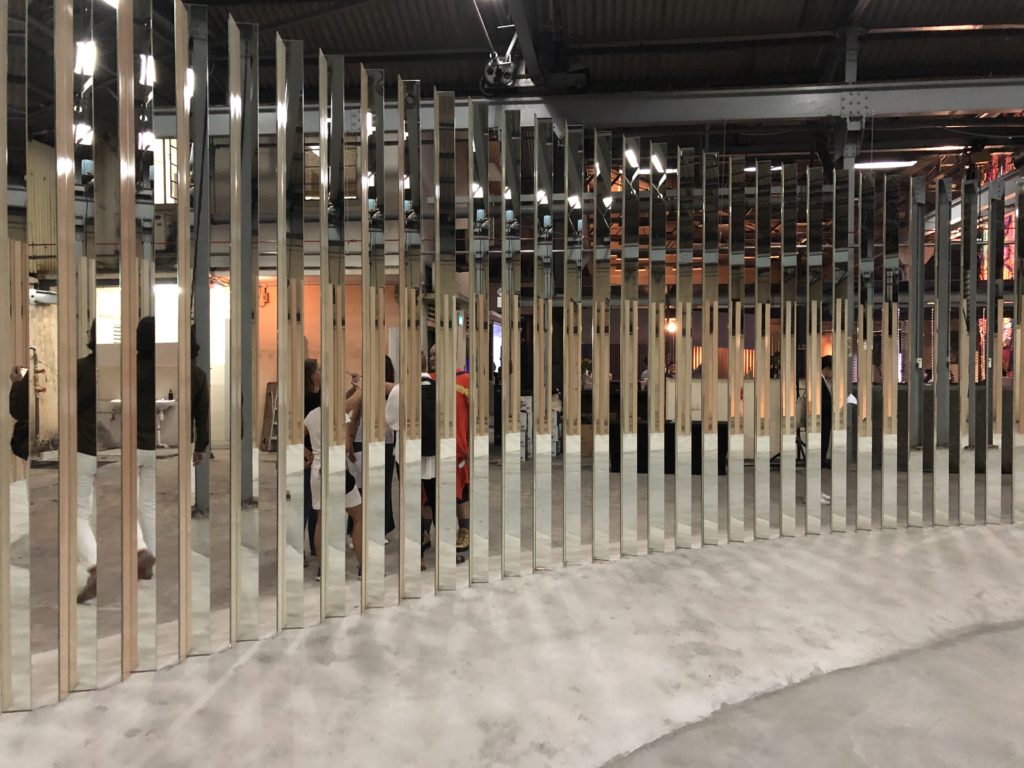
Merry Go Round by Singaporean artist
Dawn Ng is a headlining piece on show at Twenty Twenty, a pop-up
exhibition by Singapore Arts Club. Photo: Vivienne Chow,
The group exhibition featuring
six artists is an unusual statement in Singapore. Unlike many of
the neatly restored heritage sites in the city state, the
exhibition space was raw. The pop-up art show was also privately
organized by Yeo without public funds.
“While the Singapore government
has done a lot to grow the art scene here in the past decade or so,
it’s vital that there is self-driven growth as well,” Yeo said.
“The ecosystem not only needs expansion, but also sustainability.
And long-term sustainability is best achieved through a confluence
of institutional leadership and the energy of independent players
and market forces.”
She added: “An art scene is like
a gene pool: diversity is health. A vibrant, dynamic arts ecology
would encompass a plurality of voices, opinions, expressions,
forms.”
The post As Hong Kong’s Economy Wavers, Singapore Wants to
Become a Destination for Southeast Asian Art. Can a Tiny Art Fair
Help the Cause? appeared first on artnet News.
Read more https://news.artnet.com/market/singapore-southeast-asian-art-fair-1759077
Further reading


Leave a comment