
As Trump Guts the NEA, We Need More People to Engage in Activist Philanthropy. Here’s What That Means
Lost in the flood of dispiriting headlines this
month—which included political interference by the Justice
Department, the coronavirus outbreak, and Democratic infighting—was
the news that President Trump’s proposed federal budget for
2021 would eliminate the
National Endowment for the Arts. While it is unlikely that the
budget will be confirmed in its entirety (this is not the first year that
Trump has proposed cutting the NEA), it nonetheless gave me déjà vu
to 25 years ago, when conservative forces in Congress slashed the
NEA’s budget by 40 percent and eliminated grants to individual
artists as part of the mid-’90s “culture wars.”
These cuts curtailed a long history of federal
investment in the arts that stretched back to the WPA murals in the
1930s, helped to form the American Film Institute, funded hundreds
of museums, dance companies, and theaters, and supported thousands
of individual artists’ work.
In 1996, in reaction to the NEA cuts, I quietly
started Anonymous Was A Woman, an
organization that awards no-strings-attached grants of $25,000 each
year to 10 women artists over the age of 40. I had recently
inherited a foundation and, as a working artist in the middle of my
own career, I was intimately familiar with the challenges that
women artists face.
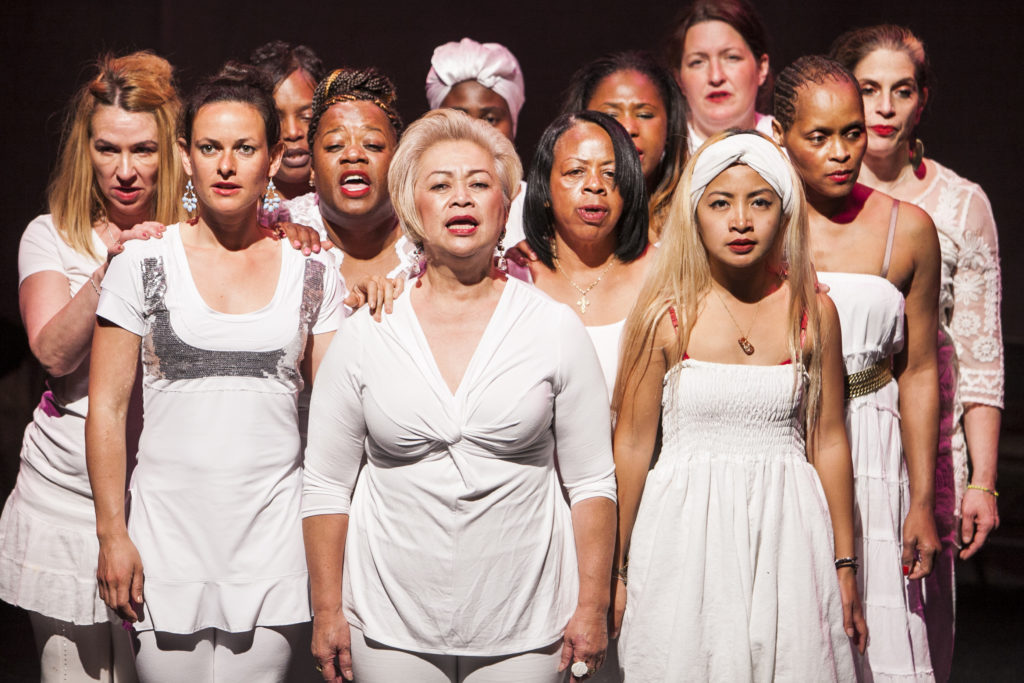
Anonymous Was A Woman grantee Rhodessa
Jones’s The Medea Project in BIRTHRIGHT? a performance in
collaboration with Planned Parenthood of Northern California.
Photograph by David Wilson, courtesy the artist.
The mid-career period can be a desert for women
artists: they are no longer hot, young commodities ripe for
discovery, nor are they sufficiently old to be “rediscovered.” And,
of course, galleries already have significantly fewer women artists
on their rosters to begin with. Women over 40 often must balance
the demands of family life—child care, parental care, and, in some
cases, single motherhood—with their work. Plus, studies have
revealed that women are underpaid relative to men both in the art
world and in other professions, which is notable since many women
artists must hold multiple jobs to make ends meet. It all adds up
to a precariousness felt uniquely by mid-career women artists, a
precariousness amplified by a lack of resources that can make
pursuing new projects, exploring fresh directions in one’s
practice, or even persevering as an artist at all feel
unsustainable.
To date, we have awarded more than $6 million to 240
artists. The impact has been significant, with artists who received
the award going on to exhibit at major museums and biennials,
pursue ambitious new projects, or simply take a well-deserved
break. But a recent data study
released by Artnet News and
In Other Words sharply challenged the illusion of progress for
women in the arts: between 2008 and 2018, only 11 percent of art
acquired by the country’s top museums for their permanent
collections was by women; only 14 percent of museum exhibitions
featured women artists; and the sale of women’s artwork in the
global auction market comprised only 2 percent of the total market
share. Needless to say, we have a long way to go.
In 2018, I made the choice to reveal my identity as
the founder and sole
patron of Anonymous Was A Woman. In a political climate where
women were coming out to tell their stories in greater numbers than
ever before, I felt that it was important to join the conversation
as a vocal supporter of women artists, to proudly express my
solidarity, and to draw attention to the ongoing need for support
of this demographic. Anonymous no longer, I also hoped to use my
platform to expand the reach of our grant and to offer a model to
other philanthropists. During the recent Frieze art fair in Los
Angeles, I was joined by artists Andrea Fraser, Liza Lou, and
Shinique Smith (all past award winners) for a conversation at
Creative Artists Agency about the reality of making art as a
woman, moderated by the curator Helen Molesworth. We shared our
experiences—some discouraging, others hopeful—with an at-capacity
audience.
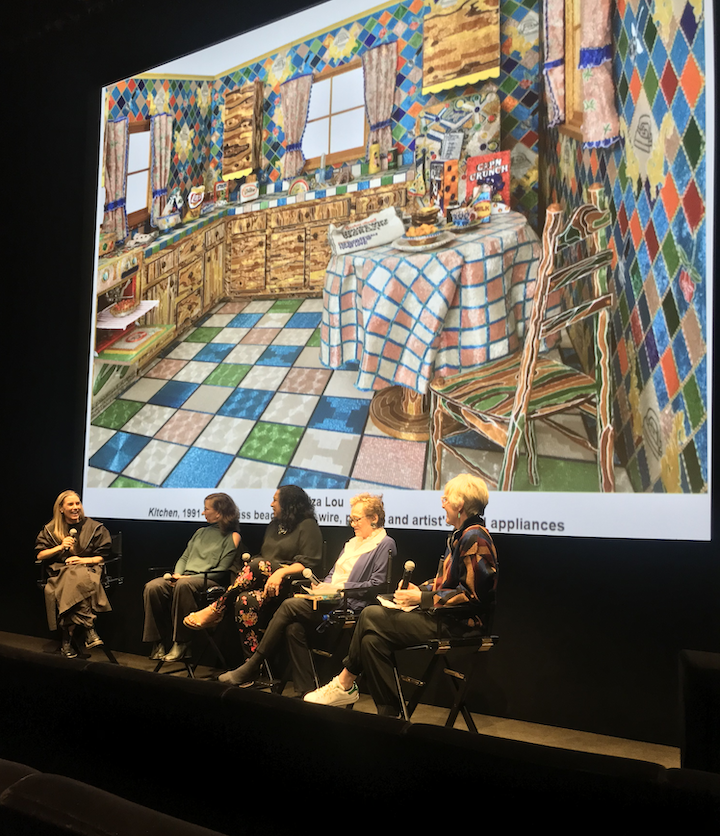
Liza Lou, Andrea Fraser, Shinique Smith,
Susan Unterberg, and Helen Molesworth in conversation at Creative
Artists Agency (CAA), Los Angeles. Photo courtesy CAA.
Fraser characterized Anonymous Was A Woman’s mission
as feminist philanthropy. She is right: it is philanthropy that
begins from a place of advocacy and activism. This type of
philanthropy—directed to a very specific need; awarded with no
strings attached; and immune to the bureaucracy and entrenched
structures of already-powerful institutions—ensures that grants
have the maximum possible impact. Funds are awarded irrespective of
some of the factors that influence decision-making within an
institution (including placating donors, considering revenue or
attendance implications, or prioritizing projects that may bring
with them the support of well-resourced galleries).
Most importantly, it allows for complete freedom
regarding how the funds are used (all that Anonymous Was A Woman
requires from recipients is a letter, one year later, explaining
what the grant meant to the artist and how she used it). This kind
of philanthropy also brings with it the non-judgmental
understanding that paying for childcare may be as valuable as
investing in new materials or traveling for a project. Such
advocacy is crucial at a moment when there is a total vacuum of
government support for the arts. While I am uncomfortable with the
label of “philanthropist,” the truth is that it is what I am. And
so I urge other philanthropists to take seriously the crisis of the
current moment and consider activist philanthropy in arts and
culture by directly funding the work of artists and creators.
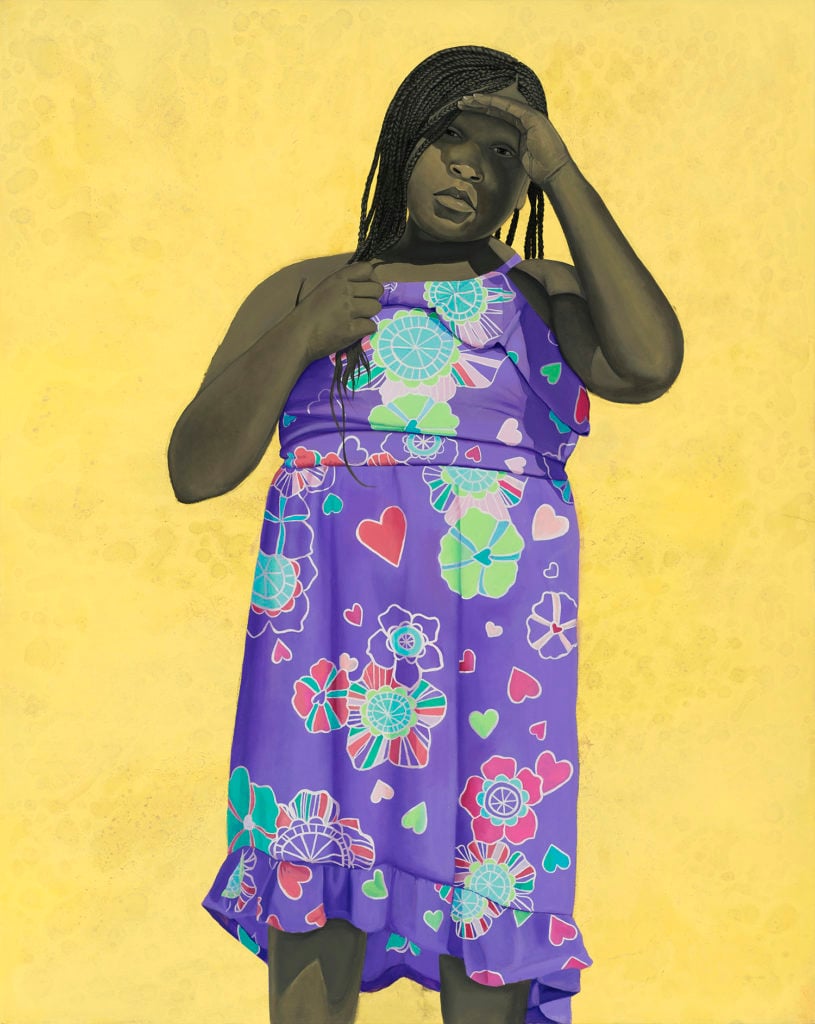
Anonymous Was A Woman grantee Amy
Sherald’s All Things Bright and Beautiful (2016). Courtesy
of the artist and Hauser & Wirth, ©Amy Sherald.
The idea is to create a philanthropist class that, in
the absence of an NEA, does the work that the NEA was intended to
do. (That is, “to fund, promote, and strengthen the creative
capacity of our communities by providing all Americans with diverse
opportunities for arts participation,” according to its mission
statement.) Art enriches our lives and makes the world a more
bearable place. It’s important that the work of today’s artists not
go unfunded simply due to the whims of a single administration.
By funding artists directly, the support that we
provide is unadulterated. In meeting some of the hundreds of
artists who received our grant over the past two decades, I have
heard how much the award meant to them—and, in many cases, that the
money was appreciated, but what they really valued was the
encouragement and the support to keep making, to keep pushing, to
continue to work in spite of all of life’s pressures. Furthermore,
it is vital that the funding reflect a wider and more inclusive
“art world.” The NEA is unique in the world of cultural funding in
that it reaches all 50 states, while we know that much of the
funding for major arts institutions is clustered on the coasts and
in major cities; so by funding individuals all over the country,
philanthropists have the opportunity to reflect the NEA’s mission,
even if the NEA isn’t.
Just as certain wealthy individuals are building
organizations and contributing resources to address issues such as
climate change, gun control, and women’s reproductive rights—issues
that a different government might address sufficiently on its
own—so, too, can individuals more directly intervene to support the
creation of culture. Rather than solely funding museums and other
established institutions that, in some cases, perpetuate inequality
and make the bleak statistics above all but inevitable, activist
philanthropists can fund the work of the artists themselves. This
is not just a way of supporting the arts in general, but of
creating more sustainable and less hierarchical networks of
support.
Until we have a government that values the role of art
and artists in society—and is willing to fund their
work—individuals with means must embrace their own version of
activist cultural philanthropy.
Susan Unterberg is an artist and the founder of
Anonymous Was A Woman, a non-profit organization that has awarded
$6 million in grants to 240 women artists over the age of
40.
The post As Trump Guts the NEA, We Need More People to
Engage in Activist Philanthropy. Here’s What That Means
appeared first on artnet News.
Read more https://news.artnet.com/opinion/nea-op-ed-activist-philanthropy-1785825
Further reading


Leave a comment